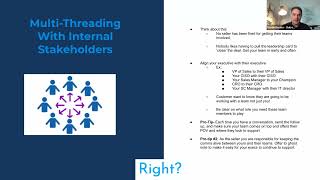
Jeff Rosset explains how to build multi-threaded deals by bringing your whole team into customer conversations instead of selling alone. One deal involved roughly 120 people across the buyer's organization. Use a spreadsheet to map every stakeholder and have executives reach out to their counterparts to avoid getting blocked by a single contact.
Chapters
If we're asking them to bring their squad, we need to be bringing our team to the conversations as well. It is multi threading as a single person is not really truly multi threading. So if you're expecting them to not operate in a silo, we shouldn't be either or vice versa. As a seller, you're not going to get fired if you deal. If there's other people involved, it just never happens. So bring in people. So get your team involved early and often as the conductor, again, it's going to be on you to ensure that when you follow up with them, include your team that was on that call and that follow up and then ask that team members to also respond so that company knows that they're working with the team, not an individual. As awesome as we are, as salespeople, companies want to work with a team, not just a single salesperson. They know your job, they understand your role. That's not to minimize how awesome you are or the relationship you have. It's just a fact. Especially as we talk enterprise and larger deals, it's your responsibility to keep those comms going. Just because I introduced my CEO to their CEO or my VP to their vp, I need to be constantly thinking of ways to keep that connection there so that when I do need to go ask for that extra push, how easy would it be just to have your CMO reach out to their CMO and say, hey, can you put your finger on the scale here and get this thing done very easily, very quickly? Most likely, right? So you have to be the ones responsible for this. And one of the things that you know, here's an email that I use to continue to get their executives involved and try to get other team members involved. But I want to come onto this. This is one of the things that I do and has been extremely helpful. And not only my career, but my time here at Outreach is again, I'm the conductor. I have to know all of the players on the customer side and all the players on my side and who needs to connect to who. Me having this in my head is not going to happen. Documenting this and writing this out is going to be critical. What you're seeing here is that multinational business there is a corporate and then they have individual business units. So these are the people that we worked with on a daily basis from the customer's perspective. This doesn't include all of the revolving door contacts and people that we need to explain what we're doing, to educate, to bring up the speed for them to make a decision for them to understand the challenges. So I had to start documenting. I have a document with that. And ultimately, once we've won the deal, I counted it up. It was close to 120 people that we had talked to that needed to be involved in a purchase. But as you see here, in each of these business units, these were simultaneously single deals while converging into one large deal. I'm not working with one person, nor are they working with just one person. These are all the people that were involved. And there were times where I had to have Sean reach out to Kipper, I had to have Anna reach out to John Waldo, I had to have Nate Broom reach out to Vimy Caper and Andrew Capper, right. I had to run all of these plays, and I had to make sure that we were constantly multi threading, constantly being in communications with one another. When we all started with one person who said that they, they knew what to go do, they did not know what to do. And as you can see, it was a tip of the iceberg of all of these, I'm gonna say hundreds of people that we ended up having, having to work with. So one of the things that, you know, I would love to impart on everyone is document this, build this out, use a spreadsheet to help guide you in managing your sales cycles and getting more effective and efficient at multi threading. You're gonna have people that like it. That's okay. That's not your job. Your job is to get and win revenue and win business and help the company. If this one person is blocking you from that, you as a seller have to figure out how to overcome that objection, that challenge, knowing that's not true.