Coaching in Chaos w/ Sam McKenna, Todd Caponi, Jen Allen-Knuth, and Matt Green
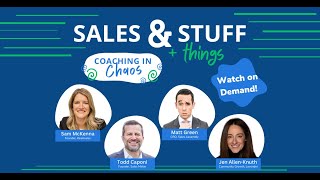
In this month‑long "Sales and Stuff and Things" panel, host Mason Cosby brings together sales leaders Matt Green (CRO, Sales Assembly), Sam McKenna (CEO, SamSales), Jen Allen‑Knuth (Lavender/Lavender Community), and Todd Caponi (author of Transparent Sales Leader) to discuss how to coach sales teams in the current chaotic, remote‑first environment. The conversation covers: (1) the importance of constant, transparent communication—illustrated with a Japanese death‑row analogy—to reduce uncertainty and keep reps focused; (2) setting collaborative KPIs and expectations, and using the "Five Fs" (Focus, Field organization, Fundamentals, Forecast, Fun) as a one‑on‑one agenda; (3) reward structures beyond money (mission, recognition, predictability, independence, security, equitability) and the PRAISE model; (4) practical pipeline‑generation tactics such as self‑sourcing, mining past deals, job‑changer outreach, inbox analysis, and buyer‑research via LinkedIn and industry events; (5) handling stalled deals with honesty, feedback loops, and re‑engagement surveys; (6) mentorship and visibility for early‑career reps in remote settings; (7) balancing manager‑rep ratios and meeting overload; and (8) the role of cold outbound versus social selling. Throughout, the panel shares concrete frameworks, anecdotes, and actionable tips for new managers thrust into leadership, aiming to improve motivation, pipeline health, and team culture in uncertain times.
Chapters
Hello and welcome to Sales and Stuff and Things. This is your monthly session to chat through Sales and Stuff and Things. Today we're going to be chatting through specifically Coaching in Chaos. We actually hosted our remix event, and if you asked a number of sales leaders who's hitting their revenue goals, which we did, literally 150 of them, one person raised their hand out of 150 sales and marketing leaders. Right now, I think we are all experiencing a little bit of chaos. So what we want to do today is actually dive into specifically some strategies around how you can coach in a remote environment, ways that new managers can start to figure out how to manage their teams. I can't tell you the number of people that I've talked to that have gotten a battlefield promotion where their leader was laid off and now they're expected to lead. That's a difficult place to be. So how do we start to effectively manage in those environments? The other things are just everybody is really concerned around pipeline. It's like, how do we actually motivate our teams to continue to develop some pipeline? And then lastly, and I think also most importantly, how do we help our buyers recognize the cost of an action? I know that budgets are tight. I know that budgets have been frozen, but the reality is you're actually losing more money because you're not acting. So how do we start to recognize that? And with us for this session and every session with no end in sight, forever and ever, I have contractually obligated them. We have an incredible group of people. So I'm going to pass it off to my most favoritest person because he signs my checks. Matt Green.
Oh, thank you, Mason. Yeah, no, I'm excited for this. Matt Green, CRO of Sales assembly, pumped to keep this going. I will pass it over to the illustrious Sam McKenna.
Thanks for that. Hi, everyone. I'm Sam McKenna. I'm the CEO of SamSales. We are a sales training company and you've probably seen my loud voice on LinkedIn, so. And hanging out with us on. On our first podcast. And I'll pass it over to Jen.
Thank you, Ms. Sam. I'm Jen Allen Knuth, aka Demand Gem. I'm really trying to make that stick. I am over at Lavender heading up community growth. For those of you that are not familiar with lavender, it is a tool that is installed in your email or your sales engagement platform that helps you write sales emails that do not suck. So with that, let me pass it over to the amazing Todd Capone.
Oh, thank you. So hello, everybody. I'm Todd Capone. I'm like, my nerdery knows no bounds. I've written a couple of books, Transparency for individual contributors. And then what I'm really excited to be digging into today is how do we use all of those concepts to help all of you that are kind of struggling through leadership challenges right now? And that was kind of the basis for the newest book, the Transparent Sales Leader. But I also, like, I joke about when cool people are doing cool things on the weekends. I'm digging in the late 1800s, early 1900s Books on sales and sales leadership. So ask away and look forward to digging into this.
I love it. So with that, I didn't introduce myself. My name is Mason Cosby. I serve as director of Demand Gen over here at Sales assembly, which means my job is to really just drive awareness that we exist and can help you close your skill gaps. And that's what we're hoping to help you do today. So with that, let's go ahead and dive right into strategies for coaching in a remote environment. Matt, you've actually got a fair bit of experience on this front as you've led a number of teams that are all remote. There's a number of people that submitted questions in advance of, I just don't have to keep my reps engaged. I don't know how to actually help them grow. I'm not actively seeing them. We're not on the floor anymore. How do we actually coach these people when they're all sitting in their basketball shorts on their couches doing their sales calls?
Thanks for the question, Mason. There's a big one that we hear a lot. Obviously. First of all, we should probably set expectations. It's like everything else in life. It's not black and white. There are shades of gray. Right. And that does extend to how remote are our remote teams. Right. You know, it's not just in office or fully distributed. You know, a lot of companies right now release intentionally. After Covid hit, they did, you know, try to build for these hub and spoke models. We have, like, little pockets of folks that are based around the country, if that's the case. One thing that you mentioned, Mason, as far as not seeing people nearly as much as you used to, I think a lot of leaders underestimate the power of just being visible in person. There is a benefit to seeing how tall people are, but there is also an additional benefit just from a leadership and a motivational perspective about you as a leader, especially if you're a level above, maybe their frontline leader, actually spending time in person with these folks. But you know, taking a step back, just talking about managing and motivating remote teams in general. Cardinal rule is that there's never such thing as too much communication.
Right.
And I'd love to get Todd's thoughts on this in a few moments because I know that he's big into not only communication in general, but also, I mean, transparency within communications as far as like how and when you're communicating with your teams. Another thing that then I know a lot of leaders have rolled out that's worked really well is, you know, leadership when it comes to things like KPIs and metrics and obviously the higher level goals, it's instinctive for us to make assignments. There is a whole lot of value, and especially when you really are drilling deep into the KPIs of making that sort of a collaborative process. Right. So that the reps that might be operating in his or her basketball shorts on their couch, you know, they feel some level of ownership because to an extent that kind of help come up with the KPIs. Right. You know, if these are the goals that we're going for on a monthly or quarterly basis, you know, let's kind of work backwards. And what do you think are going to be an appropriate set of KPIs that we're going to be able to manage you towards? And then last but not least, you know, once you have those settled, it really does come down into drilling deep as far as expectations setting. Right. So these are the goals that we've kind of agreed on these KPIs on a daily basis. We need to make sure that we're setting clear expectations of. Okay, here's how we're going to achieve these KPIs that we again collaborated on together. But Todd, I know that you have a lot of experience doing this and to your point, just about nerdery in general. I've heard you talk before just around the power of communication and transparency within communication. Would love to hear your thoughts on this as well.
Yeah, I mean there's so much like we could spend a full hour on it. But so can I just. I'm going to give one specific tip that for all the leaders on the phone thinking about the macroeconomic situation, why wouldn't we talk about this? But let's talk a little bit about Japanese death row for a minute. All right. You guys good with that?
As expected. As expected.
That's why I came here. Yeah, I was hoping for this today, so please.
Yeah, I mean, because it's, it's so appropriate. But, you know, like, if. If you ever got sentenced to death row in Japan, that sucks, right? Like, I don't know if any of, like, raise your hand if that's ever been you, but, you know, you're on death row, like, what a nightmare. However, there was something very specific about Japanese death row that they literally didn't tell the inmates what day it was going to happen. So every day when they went to bed at night, they were wondering, is tomorrow morning when I wake up, like, is this going to be the day? And so in 2021, so two years ago, the Japanese death row inmates, they got together with their lawyers and filed a class action lawsuit against the Japanese government. Not about death row, but about that specific piece of it. That there was this uncertainty around when the actual death row is going to happen. And I believe they may have won that. But the reason I bring up that story is for all of you leaders right now. Are you being communicative to your teams around what's going on from a macro perspective? Own it, right? Like your reps. If you're not saying anything about, hey, here's where we are, here's what we know, here's what we don't know. Your reps are essentially going to bed like Japanese death row inmates, where, if there hasn't been any talk about this, they go to bed at night going, hey, I just saw on Twitter and LinkedIn another layoff, another rift going on. Is that going to be me? Because no one's saying anything. They don't sleep as well. When they don't sleep as well, they don't perform as well. When they don't perform as well, they're not as creative. They get desperate. They spend half of their time polishing up their resume. And so for all of you, just like the one tip that I can give you right now on this is schedule a meeting where you embrace what you know, but also embrace what you don't know, because there's no way to predict how deep and how long this is going to go. But then schedule certainty around the uncertainty, meaning, hey, on a monthly basis, the second Tuesday of every month, we're all going to get on the phone and we're going to give you updates so they know when to expect it and they'll sleep better. And that transparency will bring people together, especially during times of uncertainty. So that's just like kind of a side tip. I could go on about all this other stuff all day long, but embrace it right now.
I think that actually directly touches on Something that a lot of managers are experiencing right now because that's, that's from the manager perspective of how do you help your reps, but it's also reps helping their managers. What we're seeing is constant happy ears. So there's just a lack of realism and actual understanding of what is happening in the pipeline. So Sam, I'm going to pass it over to you. And I mean as, as reps are not actually necessarily reporting up, I'm not going to say that's untrue, but it's not the full truth. How can managers actually help encourage the reps and foster their reps to be honest so that those managers can then actually effectively coach?
Well, I'll say just one thing on the heels of what Todd was saying with that transparency. I think also for a lot of first time managers and second and fourth time managers, we think that transparency isn't something that we should offer the people below us because there's a line, right? Especially if we're a frontline manager. There's a line between leadership and I'm a leader now and I get to know all these things that you don't know. But you've got to really think about that transparency. That's also how you build the culture on your own team. No matter what the culture of the organization is, you can build that culture by offering that transparency, by saying, here's what I know, here's what I can share, right? Maybe I'm going to share just a little bit more. I'm keeping it within the privacy of our team, which we know never really happens, but think about that. That's how you build your bridges with your team so that they do know and they don't think they are going to get murdered the next day. I will say something too, just like, and I know not everybody is in the same position, but to think about how you can communicate the stability of your organization to the rest of your team. We talk at Sam Sales like we haven't grown probably in the same way that we could if we invested a ton of money in people and technology, all sorts of things. But what we did invest in in the early stages of company is making sure that we had salary Runway for a full year. So that's something that we talk about all the time. Like we have enough money. If we don't close anything else for another year, we have salary to carry us forward. And I think there's a unbelievable sense of relief and reassurance that comes with that. I think the thing that I Was going to say for your question, Mason and Jen would love your input as well. But I think what you do to kind of motivate those reps, right, it's really dependent on what you reward. So if you are a leader who rewards pipeline and like having a healthy pipeline, something I always yelled at when I was a rep was the lack of pipeline that I had compared to everybody else on my team. And I was like, well I'm also like a top performer, always number one at the top of the leaderboard and yes my pipeline is lower but it's also real. And so just think about the things that you do reward. Are you also rewarding for the little things that we want to keep reps doing? Right? Are we rewarding for social selling? Are we rewarding for multi threading, Rewarding for speed of deal and things like that? Rewarding for smaller discounts? Whatever you measure and whatever you reward is exactly what your reps will do.
Can I add something there? So when we think about rewards though for everybody, the idea that you know, hey, my sales team, they're coin operated. If you believe that you're probably right and it also means you're doing it wrong, right? So like when we think about rewards, it's not monetary, right? Like we as human beings, we're prediction machines. So help them predict. We're also recognition machines. Like we love to be recognized, right? To give status, to be validated for our efforts. Like some of those rewards coming just in the form of on a weekly meeting just going Jen, look what Jen did this week, right? And just like so when you think about those rewards it's not just monetary, it's the status and the recognition that you're giving everybody.
So yeah, just really quickly then we'll let a lack of demand gen talk. A leader said to me and I internalized this as first said to me I think like maybe 10, 12 years ago and it's always stuck with me. People are motivated by and large by three things, money, mission and recognition. Right. And it's not again zero sum. It's not like an either or thing. It's usually a combination thereof, right? And a big part of your responsibility as a leader is to really find out like okay, what is that sort of pie chart balance within an individual and sort of coach them and motivate them and lead them, you know, in a general sense just based on that balance that you kind of discovered. But Jen, over to you, I think
my perspective is a little bit different, right? I've never led a sales organization the way that these three amazing people have. But I've been on the receiving end of it, right? And the point Sam, you just raised, I don't think is considered enough. I worked for a manager who celebrated forecast accuracy, and that was something you can do every single month. So we had those people that would put million dollar deals in the pipeline and they'd push and they'd push and they'd push. That was worse and considered and widely accepted as worse than the people who had smaller pipelines who are at 90, 95% accuracy every month. So I couldn't agree more. Especially as a salesperson, there's nothing more frustrating than sitting on a pipeline call and seeing someone who is just over forecasting get celebrated while you're actually bringing a real opportunity to the table. So from a seller's perspective, I can't tell you how much celebrating accuracy matters. But the second thing is just consistency, right? As someone who's worked remotely from 2014 on, I think this was not a major shift for me, but I watched others where it was. And I think one of the best things I had a sales leader do was just consistently ask the same sets of questions every single time we were looking at a deal. If I walked into a deal review with him and I didn't know what that company sold, who they sold it to and how they sold it, I knew I wasn't allowed to even discuss that deal. And so by virtue of not asking me 700 different things, which is even harder, I think, in a remote environment where we're all scrambling and information is coming at us from all angles, just knowing exactly what my manager expects from me made it so that I could show up better for them, which meant they could show up better for their leader.
Can I touch on just the. I think the expectation word is so important and I think just one thing to highlight in a little bit of a different vein, I think, one, we have tremendous expectations of our reps and our employees, right? But I think there are a lot of things that's tied to our expectations that aren't well defined. So if you look back here and you see urgent bird gets the worm. What is urgency? My urgency is very different than what Mason's gens, et cetera, can be. So I think really defining what those expectations are is important, right? Not give great client service, make sure your proposals go out on time, like, what does that actually mean? But I think the other thing from a leader perspective that we often don't do is what can you expect of me? And this was something that I did when I took over my, my team at LinkedIn was to say here are my expectations, here's what, you know, great client service and urgency and etc. I mean, but here's what you can also expect of me. And if you're not getting that for me, this is an open door for you to be able to say, you said you were going to coach me, you said you were going to do this. I'm not getting it or I'm not getting enough of it. Can we talk about that? So, so even kind of that vulnerability on my side of like here's the line you should hold me to really goes a long way.
I love all of these thoughts. And there's one thing that came out of the, of the chat that I want to pull out from Matt Fuller. Just it's kind of piggyback off of what Matt had said earlier just around like leaders need to understand what motivates their teams. And especially as we have a younger generation in the salesforce, they need to understand what motivates them in life and how they can support those life purposes. And I'll just give a quick personal example. I joined sales simply three months ago and a large part of that job transition is I found out that I was expecting my first child. So what motivated me changed. I was seeking more work life balance more so than a higher paycheck. Now granted we can get both, but I want to just help leaders to understand I'm not a leader, I'm an employee. I am the person that you're trying to help. So understanding what's actually happening in their lives helps you to then understand what motivates them. And I think that perfectly transitions into for a lot of these new managers, many of them are doing one on ones for the first time and a lot of managers are struggling to understand kind of that difference between. To your point, Jen, a deal review versus a one on one. So I am curious and Todd, I'd love to pass this over to you specifically as we're looking at one on ones and deal reviews and just the different kinds of meetings that new managers should be having with their teams. Like how should a new manager structure that one on one so that they're actually hearing what their reps are need?
Yeah, I mean first of all, for all the new managers out there, I had made this joke at Remix that it's kind of like you become a new parent where like one day you're not a parent, the next day you are a parent, you've seen other parents before, but that's essentially the extent of the training you've ever got on parenting. And suddenly it's just like, holy crap, this is kind of an important job. And that's literally what happened to me as a sales leader. Like back in 2008, I went from B, B minus rep to running sales operations to hey, Todd, you're VP of sales now. Yes. And then like two days later, I'm waking up feeling like a dog chasing a car down the street where I'm just completely out of control. Whatever direction the car is going is where I'm going. And like every so often I'm about to catch up to the car, then it takes off and it's like, deal issue, personnel issue, board meeting, whatever. And so for everybody, I'm going to share something here that hopefully you guys can take notes on real quick. I call it the five Fs of building revenue capacity. But essentially it's the five things that encompass your responsibility as a revenue leader. If you've got these five, you internalize these five. It becomes the agenda for your one on ones. So to address that issue. But it also is like you've got a 30, 60 day to 90 day plan in your pocket at all times and when the bullets start flying, you've always got this to fall back on. So for anybody who's watching, I'm pulling out the whiteboard, but I've already written this out for you. But here they five are. And again, internalize these and you'll be 98 ahead of the rest of the revenue leadership world.
Right.
All of your responsibilities as a revenue leader fall into these five categories. Number one is focus. Meaning your responsibility as a leader is when your reps wake up in the morning, their most valuable asset that they can convert to revenue is their time. Are they spending their time on the right opportunities with the right people and the right prerequisites? That's number one. Number two is to the field organization. So building the team with the right tools and the right resources. Do you have that? Number three is to the fundamentals. Meaning are they getting the right things right consistently? They're messaging, positioning, buyer journey, negotiating, presenting, demoing, all that stuff. Number four is to the forecast, meaning, yeah, as a revenue leader, you've got a responsibility to predict the future. So not only the forecast, but the, the KPIs, the things that you have to measure. And then number five, arguably the cheesiest, but without question the most important, it's fun. And when I say fun, I'm not talking about cotton candy and lollipops. I'm talking about culture. Building an environment where your team shows up, stays, does their best and becomes advocates for you. So to go back to the one on one question, I mean for. I know there's a couple of power reviews peeps on here like Jim I see out there. And you remember that our one on ones were all structured around the 5s because so often we think our one on ones are about the forecast and the deals, but we've got to be talking about all of these things. And if you know me, we always have a shared Google Doc that we would establish the week before following our last one on one. Put the five F's in there during the week. If your reps or the individuals you're doing the one on ones with have important but not urgent things, pop them in the dock, all right? Important but not urgent meaning don't go interrupt, don't go slack them during the day because that's such a productivity killer. Throw it in. You do it, your rep does it. When you show up for the one on ones, this becomes your agenda. And we always started with fun culture, you know, like Mason was talking about. What motivates you? Start there and then we go through each one of these and we make sure we touch on them. Where are we spending our time? No science projects. How are we doing in terms of like, are you getting the resources? Are you using the tools the right way? How's the structure? How's the team that's supporting you? Let's talk through some of the fundamentals. Are there things that you need help with? Like where do you like? Here's the things. I think you're doing great, but here's one opportunity I think you've got to really help yourself. And then yes, let's talk about the forecast and the metrics and the KPIs. We take notes in the one on one doc. When it's done, push it down, put a new 5S on the top and start collecting for the week. You get control, you see the holes before, before they form and you stop getting into that trap of only talking deals and forecast during your one on ones. So that is my rant for today. Thank you very much. I will pass it off to you for thoughts.
Well, Todd, I mean just on that last one, when you said pass it off to you, I thought you were looking at me, so I jumped in.
Always looking at you.
Yes, I appreciate that. Talk about fun at scale, right? Because you just talked about funder and One on ones. And we know that the big struggle right now is again that employee engagement. And that obviously ties into motivation and just their attachment to the company outside of monetary rewards and job stability, so on and so forth. But if you do have a fully distributed team and obviously open up to anyone else on the line as well, how do you build and foster a culture of fun at scale in a fully distributed environment?
Yeah, I mean that's like we kind of talked about earlier. But I've got again, I'm a nerd. My nerdery knows no bounds. I have a model for this. I call it the praise model. But the praise model is the six things that contribute to us intrinsically. So and that's something that I think so many leaders just haven't mastered is like we're taught like you know, the structures and processes, but are we really taught what builds us intrinsically to show up, stay, do our best and advocate? But the praise model is basically, and I'll rattle it off really fast, there's six things that contribute to us intrinsically. The P is predictability. We do our best when we can predict. We are forecast machines. The R is recognition. We do our best work when we're recognized for our efforts, given status, validated and feedback. The A is aim, meaning if we come to work every day thinking the aim of our work is to hit our number, we're doing it wrong. Like how does our work matter to our company, our customers and their customers. The I is independence, meaning we do our best work when we're trusted, when we're given the tools and resources to do it without being micromanaged. The S security. We do our best work when we feel safe, when we're part of a pack, when we're part of a family, when we feel related to others. And then the E is equitability, meaning we do our best work when there's fairness, when the juice is worth the squeeze, when we're getting paid what we should versus others who are doing similar jobs. Right. Nothing crushes intrinsic inspiration like politics or somebody else being treated differently than you. So that's the way like if you grasp onto praise and I used to use it, I had a little sticky on my my laptop to guide my conversations, guide the thoughts, guide the things that I was thinking about, guide even my all hands meetings, you can actually start to establish that kind of motivation at scale pretty easily, I think.
There's one thing I'd say like thinking about this framework. One is probably so great for so many managers on here who just haven't thought through how to do this or like awesome framework on both the five Fs and the prai. I will say keep in mind, right, how often do we get promoted into roles or we are frontline manager, we have absolutely no idea what we're supposed to be doing. We don't get any of that training. So this is just a great way for you as a leader to train your reps to do that. I think on the fun piece what I would say is like we also talk about active listening and how important that is. When you do get into these one on one calls and you're asking how was your weekend, how was this, how was the celebration that you were doing? Whatever, make sure that you're actively listening. You ask that question, you hear what they say and you ask another question. On top of that, don't fast forward to the stop. Even if you leave it for the end, at some point it has to be in there. But I would get this on my one on ones with one of my old bosses all the time. How was your weekend? It was great. What's your forecast? And I'm like, we are in our one on one. I'm like, I don't want to tell you my forecast. Like let's, let's talk about all this other stuff. On the other piece I would say of how to keep that exciting from a fully distributed organization. But also for some of you who do get together in person. One, we're talking on Slack all day long and it is a productivity killer. But it's also just a great way for us to connect and, and I would say make sure there are different mediums and different interests, places that people can connect on things. So we talk about little wins all the time at Sam Sales. Like just things to keep motivation going. We have a very maturely called Slack channel that is called Oopsie Poopsie where we share our failures both professionally and personally. We talk about binge watching, we talk about pet spam, right? Just a place for people to connect in different places. But I think on the same when you get together in person, our minds always go to drinking and eating. And that's exactly what we do. Now I love both of those things a lot. However, right. There are also people who would love to get together, right, and build rapport like at a soul cycle class or going hiking somewhere or doing something like that. So think about that too because I think that that can box a lot of people in and make them uncomfortable. That the only place to build Rapport in connection with their peers is sharing cocktails and food. So think about different ways that you can, you can scale that fun and connect with them first.
Again, I think everybody on this call loves frameworks and then very practical application around how do we effectively manage and coach our teams. And then it's all critical. The other thing though is at the end of the day, people right now are really, really struggling with pipeline. So like honestly, when we were asking questions in advance, the vast majority of questions were around how do we keep reps motivated around pipeline? I mean literally I asked what are the biggest problems we had? Prospecting, numbers, money, meetings. So Sam, as you're looking at the current environment, how are you able to help not just your own team, but as you're working with others, like how are you able to help foster and keep people motivated to keep generating pipeline, to keep doing the right activities, to keep making sure that things are going to come in.
So I think a couple things here. One, one thing that really surprised me, sorry for any LinkedInners on the phone, but something that really surprised me when I got to LinkedIn was there was absolutely no metric around self sourcing pipeline, which I think is bananas. One of the ways that I've always been so significant, so consistently successful as a rep is I've thought never about what's going to be inbound for me with my BDRs, my marketing leads, etc, but really thinking about, okay, I owe a million dollars in quota. What's our, what you know, what's the average of conversions? What's our average contract value? Doing the quota math and then working my way backwards from there to make myself completely responsible for my own qu quota. I think one thing that is interesting is that I didn't instill that. So my expectation of my reps, right, which were enterprise grade reps was I want you to have self source three meetings a week, which is really, really hard by the way. Three meetings a week, Existing clients land and expand moles inside your company. It doesn't matter. Three meetings a week that hopefully turn to two demos, that turn to one opportunity. And it's a tough metric to hit. We're not going to hit it, right? But if we're striving for excellence, right. And if we can come close to that, more often than not, we're really going to keep our foot on the gas. The other thing that I would just say in terms of motivation, one more thing to consider from a metric, companies always look at what their average win rate is and then expect that in terms of the amount of pipeline they have. So if a win rate is 33%, all you need to have is that 3x of your pipeline. What I've always thought about is always having that assumption that I'm going to hit 20% of the pipeline that I've got and that's going to close. So I'm looking at that industry average and I'm keeping 5x as my metric, which again is really, really hard. But if you do that, not only can you build better relationships with your clients because you're not going to hustle somebody into having to be the only deal that's going to get you over the line, but it also means that if some of those deals do come in all at the same time, like you're going to get into accelerators pretty quickly. Keeping motivation on pipeline to me is just frankly, how much money do you want to make? It is completely in your control. That is the beauty of being in sales. Highest highs, lowest lows. But you, your effort, you really get to control the amount of money that you make. Final thing that I would just say like, you know, if one, if it's not measured, like I said, if it's not measured, it's not going to be done. So making sure that you as a leader are really keeping a hold on that metric, are we bringing in those deals? Are they moving forward? Have we had activity in 30 days, etc. But then to making sure that we're looking in smart places for our pipeline. I think that we, most organizations do this all wrong, right? They're just going after their network, they're spraying and praying they're doing all this stuff. When instead we can look in our graveyard of closed loss deals from the last 18 months. We can look at people who have changed jobs, we can look at people who used to work for our employers that now work in our territory. We can look at people that are connected to our executives that are now in our territory. There are so many smart ways to look at this. When we're remix in Chicago, which sales assembly Mason and Matt were so nice to host us for and got to see Jen Speak and Todd for two seconds. That's lackluster. But when we got to do that, Kevin Chu, who's the co founder of Catalyst, was on stage and one of the things that he talked about was asking best customers for introductions to their last two employers. And I about fell out of my chair. I was like, what the hell did I think of that, right? Like, what a great hack. There are so Many smart places for you guys to look for a pipeline. It doesn't have to be that hard.
That was incredible. And I want to pass it to general quick, just as we think around specifically pipeline generation. I mean, Sam just shared a number of quick, simple, not easy, but simple tactics that people can run. I'm curious, from your perspective, as you are really the demand gen, how are you able to generate pipeline quickly and effectively and what are your quick, simple tips?
Yeah, I think when, when we as salespeople here go generate pipeline, the thing that hits registered stress is go book a bunch of meetings and we confuse being busy with being productive. And often I actually blame the leader far more than I blame the rep because we celebrate how many meetings we got booked versus I actually have a series of great conversations. So I think it was 2021 when I was like many sellers getting frustrated with marketing saying, you know, where are my leads and why don't we have more leads? And I, my manager at the time said, look, you're not wrong, but you cannot put your W2 in the hands of somebody else. You're always going to be disappointed. Right. And so that was what really changed for me. That's when I started getting more involved in LinkedIn and I started realizing there are conversations happening before buyers have figured out what they want. And I was not having the same conversation with my buyers were when I was looking at my emails and the things that I was sending. And so the best tip that I can give you, the one that worked and truly changed the game for me, is go show up where your buyers are hanging out and watch and observe what they're talking about. You can do something as simple as like Google the stakeholder that you sell to, let's say you sell to a cio, Google CIO conferences, and then go look at what are the agenda topics. And that's going to give you a cue as to what your people actually care about and then figure out am I having conversations about those things and if I'm not, stop for a second. Go get smart on those and get smart on connecting the dots back to the problem that you solve. I think the largely the biggest reason we have an issue with building pipeline is just because we're not relevant and we're trying to force a solution conversation. When people are out there looking to
learn, even pointing back to exactly what you said on stage at Remix, John, where do your buyers go to learn? Right? Like, I really hope everyone took that away because we know, we know where they're going to learn. Right. They're going into our communities, they're going on LinkedIn. They're going in group texts. Right. They're going to the fastest path of that education. Right. And solving their challenges possible. There is. We talk about this all the time. LinkedIn is a 24. 7 networking event. Your buyers are there, they're listening, they're learning, they're engaging. So go figure out what conversations they're having. Such a good point.
And one other piece there. You know, think about who you're selling to, like what the Persona is. I was on the exact target revenue leadership team for a few years, and we were selling to marketers. You know, right down the hallway, there was a whole marketing team, there was a cmo. And what we would do is every couple weeks, we'd like cmo, we'd bring him in and we'd ask him those questions, like, what's top of mind? So we had four sets of questions. What's top of mind for you right now? Like, what are you focused on? What's the Number two is how are you measured? All right, Number three is to Jen and Sam's point, like, where do you go to get smarter about your role in your business? So what do you read? The Twitters, magazines? What is it then? Number four question we would ask is, hey, would you mind showing us your inbox?
Right?
Like, show us your inbox. What. What's like white noise? What stands out like a beacon? What messages made you laugh? Which ones did you actually open? Which ones didn't you? And then the next week we'd bring in somebody who was doing demand gen, or we'd bring in somebody who's doing digital marketing. You, if you're selling to finance, I bet you have finance people, right? If you're selling the operations, probably have
a couple of those.
Are you leveraging what's in your own organization, too? And so many companies are like, it's right there. You don't even have to ask your customers. So just a thought there that you probably have a resource sitting right down the hall that you can leverage the crap out of that you probably aren't.
In an effort to keep Matt from talking more, I'll just go ahead and weigh in on that thought. I think this is. So this is one of the keys that was. That made us so successful during my time at on 24. Exactly what you said, Todd. Right? Our value prop, our emails, everything. Literally took this down the hall. Joe Hyland was our CMO at the time. And I'm like, would you open this. Would you respond to this? You care about this. And your point, how are you measured? That person cares about getting promoted, getting a raise, being successful? How is that person measured? How is this team measured? What will success look like for them in a year? To Jen's point, also, we're not relevant to our buyers, right? Like, this is the missing link of what so many organizations are going through in their sales emails and their sequences and their demos. It's not relevant to what the buyer actually cares about. So understanding what those things are and being able to tie value is so important. But instead, we just send emails that say, this is what we do. They're marketing emails. Do you want to buy? No, I already have something for that.
Yeah.
So nothing opens your eyes faster than seeing somebody's inbox, too, right? Like, I know, Jen, you've shown yours. And like, I know in my book, I showed my old one for that. Like, once all of your team looks at an inbox and goes, is that what my message looks like in this? Holy crap, that's horrible. It'll change your life.
So we've talked, I think, with some great practical application around pipeline generation. But again, there's been a fair bit of data at the beginning of the year that said in 2023, deals are going to take four to six months longer to close than they did in 2022. So now the question becomes, we've generated the pipeline. Fantastic. We've gone to job changers. We've gotten great intros. Now what? So, Jan, I'm curious, from your perspective, I know that you love to talk about this cost of an action and how to actually help people change their minds. So I would love to just hear from. From your perspective, you've got to deal in the pipeline, and it's just completely stalled. What are. What are you doing?
Yeah, every time I have a deal that stalled, which, let me tell you, was by and large the number one reason I lost, it was never competitors. It was never. Not never. It was rarely competitive, rarely price. It was just like, sure, we could train our people to be better or we could just. Just not.
Right?
Like, that's a perfectly viable option. And people don't always choose better in our regular lives and elsewhere. When I had a deal that was stuck, I would always go back to my initial conversation and one of two things would happen. I would either see, hey, I got happy years. Like, someone came in when I was selling Challenger and said, like, I read the Challenger sale.
I loved it.
I want to train our team. And I went Right to. Well, let me tell you exactly how we can. And that was a misstep on my part. Or two, there was an actual true deep conversation where I understood the trigger event and the problem that was behind it, but something along the way fell off. So the first step is to isolate, like, how did I start the conversation? Did I drop the ball or did it happen elsewhere? If I drop the ball early, I always am in favor of just having a honest conversation with buyers. If I think about the people I'm closest to in my life, it's the people I feel like I can candidly talk to and not worry about being judged. I think sometimes we get so fearful of hearing bad news, we just make our jobs harder by just kicking it down the line until they finally tell us. So what I would do in those instances is I would say I would send an email that said, maybe like, remember our first convers conversation on X, whatever their problem was, and then the email I would take ownership of the problem and I would just say in reviewing our first conversation, I think what happened is I got happy ears because I heard you saying a lot of great things about Challenger and I neglected to do the right work to understand what else might get in the way of this might make it hard for you to socialize this with other people. And essentially what I'm saying is I think it might be worth going back to the drawing board to figure out if there's another way in. And I think when we lead with honesty and vulnerability and authenticity, it becomes much harder for our buyers to not reciprocate that. That when I am trying to convince someone to do something, it is really easy for them to be put off because no one likes to be convinced. So that's what I would do if I dropped the ball early, if I got mid stage and realized something changed. What I'm trying to do here is I'm trying to make it easy for them to give me the honest truth. I'm then going to go and say like, hey, I have a hypothesis. I might be totally off base. My assumption is maybe something else became more urgent or maybe you got stuck trying to figure out how do I get everybody else on board the bus If I'm anywhere in the neighborhood of this, I've got a couple ideas or maybe it's something else. Hoping you can shed some light. And yes, like transparency, right? Like that is transparency. And when we open the door for bad news, we can have an honest conversation. I think the deals that I lost were places where I just Wasn't making it easy for the buyer to give me the truth because I was too busy trying to convince them so I could hit my own target.
It. You know one thing that you mentioned there Jen, which ties into a question that the Dean had in the comments, I think that a lot of reps, they conflate stalled opportunities or ghosted opportunities with things that are closed loss, right? Legitimately closed loss. And you know, an eye opening exercise for us, we did this twice over the past couple quarters is any deals that were stalled. Second, why the hell aren't these people getting back to us or that were legitimately closed loss. We sent them a survey and you know, ask them a series of questions, you know, that they could fill out Async where you know, they didn't have to deal with some level of uncomfort right of maybe emailing me back directly or hopping on a call. And what we found there was a surprising amount of opportunity where people, if they're filling out a brief Google form, they're telling you it's like oh no, no, no, it's not that I'm not interested and oh my God, sorry, I've been ghosting you for the past six months. It just wasn't the right time. Or to Jen's point, we were trying to do this internally but if you hit us up four weeks from now, it's going to be a much better time to have this conversation, right? So just be sure to lesson there is just be sure to number one, understand that a ghosted prospect doesn't necessarily mean a closed loss opportunity. But even if it is one, even if it is both ghosted and or closed loss, there is a whole lot of power and just sending out again to Jen's point, some form of transparent type of communication, asking them to communicate with you Async if that's going to be more comfortable for them and just gathering a whole lot of data about either A where you went wrong or B if you legitimately did not go anywhere wrong and there still is an opportunity, might find a whole lot of insight as to when you're going to be able to pick that opportunity back up.
I think there's something that Jen said too that probably kind of went overlooked but I think is so important right when she's thinking about her stagnated deals, she went back a few steps. So we, we do these strategic deal reviews all the time in SAM sales and people are like how do we create urgency? You know, how do we do this? How do we move this along? And it's not really thinking about what should we be doing today to move that. Right. We'll figure that out. But it's really looking back at three and four and five steps before what we missed to be able to create that urgency or to multi thread or to build this into our larger deal. So I think even as you look at those deals that anything that you have that's forecasted, you know, for the end of the year for seven figures or whatever, you know, is a monster deal for you start to think today, right, what, what are we doing? What are the next steps? What are the things that we're potentially missing? And I think even if you just take. Take time to do deal reviews like that and say, why won't this deal happen? And start to ask those uncomfortable questions that we don't want the answers to, and we're just hoping we can sit in our hole and that it'll just happen anyway, you'll really set yourself up for success. I think to Jen and Matt's, both of their points, right? Also on asking for that feedback or being transparent and vulnerable and hoping that the client does the same thing back for you. I think this even applies for when we apply for jobs and we don't get it right. Giving a little bit of logic, right. Of why you're asking for that feedback go a long way. I really want to learn, I want to grow. You know, this isn't an opportunity for us to convince you otherwise. It'd be great, you know, to understand, was it something we did? Did we not pay attention to you in the same way that our client did? Is it product offering? Is it integration? Is it something about my skill set maybe that didn't make me qualified for this role yet. What can I work on? Would love to just learn from this if possible. Not everybody is going to give you that, but the people that do, what a valuable learning opportunity for you as a rep, as a company is product development and certainly as an interviewer as well.
You know the piece on this that I just want to remind everybody of, and this is empathy, right? This is like we're all leaders on the phone here. But just keep in mind all of your leaders that you're selling to, like anybody, they got 100 priorities at any time. But if everything's a priority, nothing's a priority. So they only get to choose like four or five. And so what triggers the decision? Well, first it's predictability. That's why we all read the negative reviews when we're buying something online. We read the negative reviews first. Right? Because we're trying to predict and we know inherently that perfection does not exist. And until we're able to get to the prediction, we can't trigger a decision. And then number two is once we have that prediction, like, hey, this is what it's going to be like going with your solution. We then compare it to the other things and go, is the juice worth the squeeze? And it's not always the best reward that we go. Like, we actually bias our perception of a reward by the journey to get to it. But it's all right, I've got limited time, resources and dollars. Am I going to allocate it towards this or something else? So sometimes stall deals are. The buying brain can't predict. Right? That's where it starts. Like, I'm not getting to a good prediction. So help them predict. And then number two is I got a thousand things I could work on, but these are the five I'm going to focus on. And then how do you use what Jen talks about to really make sure that you're elevated into that top 5? 5?
Incredible insight on specifically how to accelerate pipeline. And we've actually got four questions. We're going to dive deeper on a variety of topics that we talked about today. If you have questions, we do have about 13 minutes to go ahead and drop those in the Q and A while we get a couple other questions in. Two things just to share with you. One, if you've gotten value out of this, we are doing this every single month on the third Thursday you will get the link to register so that it will be be on your calendar every single third Thursday of the month. That's the first thing. Second thing, we will also be sharing this audio recording through our new podcast channel called Revenue Jam. So if you got value out of this and you want to send this maybe to your manager and say, hey, I listen to this great piece of content, think it would be super valuable for our team, then you can actually deliver it directly to them through Spotify or Apple podcasts wherever they listen to their podcast. I said two. I lied.
There's three.
My bad. Not fully transparent. I want you to go follow all of these leaders. So if you're not following Sam, Jen, Todd or Matt on LinkedIn, go do that. Because they are providing great, highly valuable, highly tactical sales leadership and sales content on a daily basis that's going to help you up your sales gain. Favorite recent testimonial from a sales assembly member that was actioning Sam sales advice was that they went From a pip to near 200% quota attainment within a single quarter. To be very clear, this is not lofty bull crap thought leadership. That's not from practitioners. This is real world practical application. That's what we want to deliver for you every single day, every single month. With that, we've got some clear questions. So if you want to ask your question live, go ahead and raise your hand. If not, then I'll just go ahead and start reading some of them off. So Matt asked Gartner continues to report on seller drag, too much non selling junk. And they are asked that they are asked to do so. Sales managers that are also feeling this drag with abundance of internal tasks versus the external being with the team activities. Matt, I'm curious for you. What advice do you have that sales managers and sales leaders can start to break the chains of just so many tasks so that they can effectively actually be with the team to foster those relationships and foster those coaching opportunities?
Yeah, so we, we've referenced our remix event the other day a couple times and I apologize, I'm going to do it again. Ryan Beretta, the president of Sprout Social, who is a super busy guy, obviously runs an extremely large organization. He said something that to me was just like big light bulb moment, right? He's like, you know, as leaders, you know, our calendars and regardless of the level of leadership, whether you're president, frontline manager, our calendars are consumed by other people's priorities, right? And I think just number one, you know, at a very high level, recognizing that that's a problem, right? If you're a leader right now and you look at your calendar, presumably a whole lot of your week is going to be stacked with other people's priorities, not yours, right? So number one, recognizing it, number two, now that you recognize it, see what you could do to change that, right? You know, if you're identifying internally like, okay, well my priority should be this, that or the other thing regarding engaging the team, motivating the team, you know, coaching to whatever KPIs that again, you and your team members have sort of come up with collaboratively, then you just have to go through the exercise of actually restructuring your calendar, right? Doing all those things that we all probably know in the back of our minds, like, hey, I should get better about declining internal meetings that aren't really that relevant to me or you know, blocking off time for this or that. So as long as you're able to recognize that that is the reality and then once you do actually start taking Action on it. You're probably going to start seeing a big lift in that area straight away.
I couldn't agree more on the just declining of meetings. I think that there's a constant just we got to make sure that everybody's here so we can make the decision. And the reality is it's humble but also a recognition that I'm not actually needed to make this decision and I have other more important priorities that will actually drive the business forward. So couldn't agree more. Just say, hey, looks like you've got all the right people. I'm probably not needed for this meeting. You guys have a great time with that. There's another question that's just around kind of this conversation of remote versus hybrid workforce specifically for those in early career. So again, Matt, you mentioned a fair bit on this of just it's good to see people but for somebody that's early in their career, if they're remote, they're not getting seen as much. So what are some of the best ways to mentor and support growth for these individuals specifically early in their career and any best practices around that mentorship and growth. And I'm going to pass it over to anybody that wants to take that.
I hear this a lot. I don't get seen at work, right. Because we are remote. I've been remote much like Jen forever and I also love the aspect of remote because we can go where the town is versus just where our headquarters office is. So big a big proponent of that. I will say how you are seen is also dependent on you, right? So don't expect everybody to see you. You've got to show up. And a way that you can show up is by one just contributing in team meetings the amount of times, right. We get on calls and a leader's like, I want to talk about this. What is, you know, what thoughts you have and everyone's like, or they're off camera. Being on camera, you know, is tough all day long. But make an effort especially for the important things where you get higher visibility. Specifically if there's a skip level leader on the call, call super, super important. Participate. Help bring a topic forward, right? Talk about something that you've been working on. Help break the ice even if it's really uncomfortable for you. I think also visibility on slack channels goes a long way. Giving accolades to other people, strategically positioning the way that you talk about going above and beyond. I might say something, let's say in a slack channel with us of like, hey, Jen and I were just working on a better way to connect with our buyers in this specific niche. Here's something we came up with. Hope it's helpful to you. It's not bragging, it's helping. But it's also saying, hey, we're working together to try and make our organization better so you can be seen that way. The one thing I will say just about mentorship, right? For anyone that is going to seek that mentor, make sure one, please don't ask to be them, to be your mentor right out of the gate. Just say you're really successful, you've done so much awesome stuff here in your career, et cetera. I'd love to learn from you. I have a couple of quick questions. I'd love to learn about your career, your process, et cetera. Would you ever be up for getting together for 20 minutes? Make it clear that you are prepared and then do your homework. If you're meeting in person, by the way, just a quick little hack. If you're, if you're in the same building or for coffee, ask them for their drink order or whatever they want to eat in advance. Show up early, get the drink order, have it ready for them when they arrive. That way you're not awkwardly standing in line for 20 minutes and burning that really valuable time together. But the key is, after that meeting, make sure you execute. People want to know that the time that they spent with you was well spent and they were actually doing something with it. So take four, three, four weeks, right? Go back and say, hey, I took your, your process, I did this, etc. Etc. Do that again a couple weeks later and then ask for more time. You've got to earn that time the second time around. The best way to do it is just by showing that you actually listened and you did it.
Yeah, I love that, Sam. And you know, the common thread that connected all of those different ideas was the sense of ownership, Right. You know, if you're a rep, I mean, you have to own your own destiny. And a big part of that is going out and actively seeking out mentors, you know, seeking out that type of advice. And if you're a leader, I know that many times, you know, leaders, and we talk to a hell of a lot of them throughout the week, they tend to get a little bit paranoid about their reps, seeking out leadership because they look as like, oh, well, you know, a leader might come in and poach them, right? You have to become comfortable with your rep. You have to understand that the value of a rep on your team, having access to mentorship outside the four walls of your organization is going to far equip, you know, the value or any sort of level of risk that might exist, you know, from losing that level of talent. And candidly, let's be honest, you know, if you're a leader and you're losing talent to other organizations, there's probably some other things you need to improve on internally.
So the other thing I think from a leader's perspective, I encountered this when I was doing a coverage for a team of AES and SDRs is we often celebrate deal wins, but find the smaller wins to celebrate. Like, hey, this rep was able to get attention from someone on social and then create those opportunities in team meetings. Give people the opportunity to feel good about celebrating things other than just a win.
I love it. So, two final questions and I'm going to pass this one to Todd. What do you think? It's a sweet spot on the manager rep ratio, specifically as you're looking at that one on one and those the five Fs a lot of managers aren't able to get to all of it because they've got to hop to another meeting. So what's the manager rep ratio?
Yeah, there's, there's so many schools of thought on this. I mean there's a difference between if they're remote versus their in person, right? There's a difference between if they're enterprise versus their SDRs. I mean just, there's a certain commonsensical element of this too. But like one of my clients, their ratio is 12 to 1 right now. I, that's I think nuts, right? Like, I mean that's probably way too much if you're having to spend 12 hours a week just doing one on ones. There's a ton to be invested in that. But again, there is no magic bullet to that answer. I don't know if the other three of you have a better answer for that, but for me, each one of my line leaders could handle a different ratio. Like my corporate leader had a different ratio than my enterprise leader. The people that had remote versus in house had a different ratio.
We do have only three minutes left. And I'm not gonna lie, this last question honestly could and probably should be a whole topic in and of itself. So I'll go ahead and tease it out. If you want to get follow ups, go message these people directly on LinkedIn. They're happy to answer. But the question is, is cold outbound dead? Has social selling replaced it? And what percent of AE's time should be focused here? Now I'm going to pass it for a quick answer to Sam. But again, I think we're going to probably pick up on this topic next month. So Sam, go ahead and give us a quick Is Cold Outbound dead? Your hot take on Cold Outbound No,
I think Cold Outbound should maybe be a last resort. Like I talked about earlier. You have so many avenues to all these little tinders that you can create with the data that you've got in your system. So start there, then move on to Cold Outbound. I don't think it's done. Not everybody is on Social. Not everybody's on Social as often as we need them to be, right? But Cold Outbound, to me it isn't truly Cold Outbound if we warm it up a little with good old show. Me and Omi doing our research on what we can about the company and then doing that, yes, it's still cold. Will we stand out? Heck yeah. But use those 16 other methods that I talked about first, right? And make your life a whole hell a lot easier for sales.
Love it. Well, if you've enjoyed this, we've got some other topics that we'd love to discuss with you in the future and come back next month when we do this exact same thing on a different topic of your choosing. So again, thank you. Hope you enjoyed the first edition of Sales and stuff and things. We will be doing this until who knows. Awesome. Thank you everyone.










