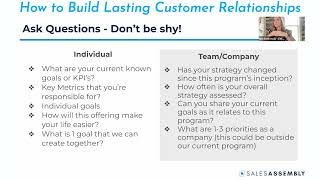
In this training presentation, the speaker outlines a straightforward, three‑bucket approach to building long‑lasting customer relationships for account managers and customer success professionals. The first bucket focuses on asking discovery questions that uncover both individual and company‑level goals, key performance indicators, communication preferences, strategy changes, and blockers. Sample questions are provided to surface what matters to the customer, how the partnership can make their life easier, and what joint goals can be set. The second bucket emphasizes active listening, describing core techniques such as signal encouragement, avoiding interruption, and probing to truly understand the customer's feelings and challenges. The speaker stresses that active listening not only builds trust but can reveal expansion opportunities beyond renewal. Throughout, live chat participants contribute additional question ideas, illustrating how the framework can be applied in real conversations. The overall message is that by consistently asking the right questions and listening attentively, account managers can align their solutions with customer priorities, anticipate strategic shifts, and unlock additional value.
Chapters
So the foundation of, you know, kind of to start that built, start building a strong, long lasting relationship in my mind. And my team sometimes makes fun of me for this, but I like to keep it simple. I don't like to overcomplicate relationships either. I like to keep a very straightforward leader too with my team. And these are kind of the three main buckets that we stick to in terms of customer relationships and making sure that we, we bring our, you know, wholehearted self to the table. We're asking questions, we're being active listeners and we're putting ourselves in the customer's shoes. So number one, asking questions. There are plenty of questions that we're asking our customers. But I wanted to narrow it down to two main buckets here for the focus of asking discovery questions. It's really about like, what does that look like with our main like day to day contact? What are their current goals and KPIs? Do we know? Do we actually know? And this could be related to our program or not. But what, what matters to them? What key metrics are they responsible for understanding that could actually give us insight into how our program fits into their overarching goals. And then what are their individual goals? What do they care about within, you know, their structure, their team? And how could we, our partnership actually weave into those goals? Now I understand that that's not always easy to pull out in like a regular cadence or a regular conversation, but we'll talk about that as we kind of continue on here. Again, how will this offering make your life easier? We want to make our customers lives easier within our relationships. We don't want to bog them down with information that's not going to provide value. So asking the question of like, how can our solution make your life easier, I think that's totally okay. And what is one goal that we can create together? This could take time, but opening the floor to actually jointly and I think Elvis mentioned that like you can coexist with your customers as well. Hey, what, what's one goal that we can actually put together together based on our partnership that we can start to track towards any others in the chat that on an individual level that that have worked for you all in terms of discovery and asking new questions as you're building relationships? I think Bren, I see. What goal can we create? Love that. Yes. It's like you are in my brain. What will help elevate you with your leadership? That is snaps on that. That's an amazing question. Definitely jot that one down. Where are you struggling that I can help you with. Perfect. How do you prefer to I love this question. How do you prefer to communicate and how often that is leading with empathy. That is a true like you are trying to put yourself in their shoes and understand what is going to work best for them them. Keep on populating those questions in the chat. These are amazing. I'm going to switch switch gears to the team and the company individuals. Great. But also they've got probably big picture goals as a company and an organization that are tied either to that individual or program specifically. So has your strategy changed since the program's inception? Like what's changed in your org? You might be in a three year contract, right. But there's probably moves and shifts that have happened along the way. You all as newer account managers too you might come in mid contract and have to figure out where we are within the relationship and how we actually fit into that bigger picture strategy. Asking about the company driven goals and initiatives is key in discovery. How often this is one of my favorites and one one of the things that I think my team actually does really well is how often is your strategy assessed. Now this could be with leadership change. This could be a combination of things. But this is also something that we're seeing more and more often. Especially in the space that I'm in currently is csr. The strategy is constantly evolving, dependent on a lot of different factors. So understanding how often maybe it's quarterly, maybe it's biannually but really understanding how often that's happening is key and on the company level. And then can you share your current goals? This is also from what I found a little bit tricky. They don't want to necessarily divulge or be overly transparent about some company goals. But you can narrow this down to maybe the partnership that you have so that at least you can try to understand how to weave your partnership into those goals or objectives. And then kind of similar to the individual approach, what are one to three priorities as a company that are important to them? Just so that again you can note you can keep on your radar and making sure that when you're bringing additional value, you're tracking back to these key priorities that have that have already been shared. Amanda, I like that. What are you worried about not doing? That's a very interesting question actually. What? Yeah. What if we don't accomplish our goal? What. What happens if our metrics are not met? Right. You kind of want to understand what's on the other side of that. That's a great question. Tiffany. What does your current process look like? And what blockers do you see going back to our. How we kick this off? Right. What are the goals and challenges? That's blockers is. Is a key understanding of understanding what are what challenges or what blockers they may have individually or as a company. So the next bucket here is active listening. And I did put it in all caps because it is very, very important. So not only is asking questions important, but actually listening to the responses and trying to pull out this visual some of you all have probably seen. I actually tried to look for something different. But many of us account management leaders love this picture because one, this is also kind of how our brains work. We're absorbing, we're trying to ask questions, but then absorb and write them all down and remember. But what's at the core is remembering what active listening is actually all about. So signal encouragement. We're listening for feelings. We're avoiding interruption and disruption. We're probing. Right. We're trying to figure out what's actually being shared based on some of the questions that we might be asking. So again, just trying to remember to really be an active listener in your customer relationships so that you're not just showing up with an agenda, you're not just checking the box and moving on. I think this is really, really important and could uncover, since we're, you know, most of us are quota, carrying this key could also unlock a potential expansion opportunity on top of a renewal. So being an active listener and listening to what they have to say could be a key to unlocking new dollars.