Fridays Are For Closers Season 2, Episode 2 - How To Be A Great Storyteller
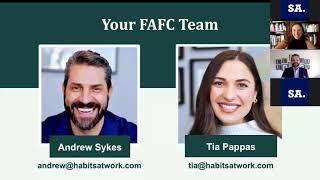
Andrew Sykes and Tia Pappas teach how to deliver a story that moves people. Mehrabian's rule shows vocal tone and facial expression matter far more than words. They cover pacing, pauses, present-tense reliving, and techniques like the Power Open and rule of three.
Chapters
Record and we'll get rolling. Thank you everyone for joining us in our second session of our Friday Czar Foreclosure series. For context, of course, this is a five part series that we here at Sales assembly are doing in partnership with Andrew Sykes and Tia Pappas, our friends from habits at work all around the general concept of storytelling. And for those of you who were able to attend our first session two weeks ago, you're probably extremely excited for our session today just around the concept of how to be a great storyteller. For those of you who've seen Andrew in action before, you know that there's probably no better person on the face of the earth to teach each of us how to become better storytellers. Andrew is indeed the master at it. Before we turn it over and dive into the meat and potatoes of today's program, I just wanted to take a quick opportunity and thank our partners that made this possible. The that all actually have in some way shape or form some tie to us as salespeople and as sales leaders and becoming better storytellers. You have lessonly, if you're a sales leader, making sure that your reps are adequately trained and upskilled on the components of how to become a better storyteller Showpad, making sure that they have the content and the materials available to help deliver that story. And then of course our final partner, Vidyard, which which provides salespeople and sales leaders much more compelling way outside of email and voicemail direct messages on LinkedIn to actually deliver that story. So I want to say thank you to all three of them for making this series possible. And with that said, I'm going to turn it over to Andrew and Tia. Take it away Andrew.
Thank you Matt. Good afternoon, good evening or good morning depending where you are and welcome to our session on how to be a great storyteller. Episode two in our five part series. And my name is Andrew Sykes and I'm joined by my friend and colleague and co founder and habits at work, Tia Pappas, who will have a cameo appearance in our session today. So to give you some indication of where we are in the series, if you joined us, last week we looked at how to create a moving story and what we meant by that was how to write one. By looking at the four elements that make a story a story rather than mere dialogue. The context that draws people right into a story and puts them in that scene. The conflict that makes people want to learn more and lean in to hear what will happen next. The climax where the Resolution is revealed, inside of which we hide our facts and figures. We illustrate for a particular customer, perhaps what another customer did or did not do to achieve an outcome or to fail at achieving an outcome. And finally, the closure where we wrap up our story, we make the point again, we summarize point of the story, and we include a call to action so that stories do the job that they're intended to do for us as fellows, which is to help us change a human being's mind from how they were planning to go about solving their problem to perhaps now solving their problem with your service or solution. And that is the key and safest way to change another human being's mind is to wrap your value proposition, your proposal, your motivation for buying from you inside of this Trojan horse of a story. And today we're going to look at how we take a written story, which may be interesting to read. And of course, some authors create stories that just suck you in and you feel like you're really part of it. But in sales, stories are meant to be told, meant to be spoken. And so we're going to be looking at what it takes to be a phenomenal storyteller that has people just on the edges of their seats wanting to hear how the story ends. Next week or next time we meet, we'll be talking about how to choose the right story at the right time for the right reason. And I will have a special guest appearing with me and Tia on that session. Look out on social media for us announcing who that is and what they'll be doing in that. But I guarantee you it'll be fun to come and listen to my friend who will be joining us. And later on we'll get to part four and five. But for today, let's get into the reason that we're here. The purpose of our time together today is to look at some of the expert moves that make a story a story and that allow you to tell a story that has people just be entertained and at the same time, educated. And we'll have an opportunity for you to think about how to plan your practice after today's session, such that you can take perhaps the story you crafted last week when you joined us, or any business story that you have, and not only polish the words, but practice how you deliver those words, the devices that you use to make it sound like music to the ears of your listener, to include a drumbeat through the story. So that is memorable and effective. And so what I'm hoping you'll gain from today is the insights into and some learning around how to be a great storyteller. And we'll leave you with some tools and some skills that allow you to maximize what you what we call the emotional arc in every story you deliver every time. And one of the themes that I want you to look out for throughout our session today is that the emotion that you feel inside usually gets dampened by the time it reaches your face. And one of the things I'm going to challenge you to do is bring a lot more emotion from what's inside to outside so that people can feel it, feel with you, and therefore be moved and inspired to take actions as a result of your stories. So we always have two layers of communication in our masterclasses here on Fridays after closes. One is us talking to you through this medium, and the second is what's going on in the chat. My colleague Tia is very active in the chat, answering questions that come up. We're looking for your comments. So if you joined us last time, please open your chat. In fact, whether you did or you didn't, open the chat, and just so we know that you know where it is, if you joined us last time, put a yes in. And if you didn't join us last time, put a no in. So we have a sense of how many people were here last time. All right, more yeses than no's. For those of you who are nos, we'll do a quick recap. Thank you for finding the chat. So last time we looked at how to write a story, and I'll very quickly remind you of that as we go through today's session. But today we're looking at this idea that great storytellers use two things to make the story feel entertaining and emotional. The way they deliver the story and the devices they use in the way that they tell the story. Both intended to evoke a specific emotion or a reaction from someone. Here's why. Research in decision making says that all human beings make decisions emotionally. And then we rationalize to ourselves why we made the decision by looking back on the decision and saying, well, here were the pros and cons. And this is why, of course, I used a logical approach. But in the moment, it's our gut or rather our emotions that are driving all key decisions. Therefore, if stories are intended to change a human mind, they must first change a human heart or change how somebody feels. So what is this idea of delivery and devices? Delivery is the act of taking something, of course, and delivering it or giving it to another person, maybe providing them with something that was promised to them or expected by them, or in some cases, in some stories, even an unexpected outcome. And when we look at the partner of that devices, that's particular words or phrases or figures of speech, maybe things like quotes or the way that you combine words, the sounds you use, and the way you use this beautiful instrument you have, your voice and the box in which it comes, your face and your body. It's a set of techniques that have been proven to make stories more memorable, more musical, so more lively and engaging for people to listen to and even find themselves sucked into. Last time we talked about this idea of how we've got so much noise in our heads, but if you imagine going to watch a movie in a movie theater in the days when we could, within about two or three minutes, that noise in your head seems to stop and you're sucked right into the story. And it's because of the way that story is delivered and the devices that are used inside of those stories that. That evoke specific emotions inside of you so that you feel what the characters feel and you're part of that story as if you were along for the ride with the hero, or in the best case, even the actual hero of the story. So let's first look at delivery, and then we'll look at devices. And in between that, we're going to have a fun opportunity to see some of the delivery of a great story in action, and then we'll break it apart so you can see just how that was done. Now, for those of you who didn't join us last time we spoke about this idea of a story arc that has both a business arc, what you want the story to do, and an emotional arc. And we think a simple way of building stories is into these four parts. The context, which need not be more than just a simple sentence, that pulls people right in the conflict, which is what makes a story a story rather than mere dialogue or text. Because the conflict is the point at which we're asking ourselves, I wonder what's going to happen next? How will this end? And it's that that has us really pay attention, release dopamine in our brain, that has us feel engaged with a story, more likely to remember stories as a result, and even helps us release oxytocin, the trust hormone that leads us to be more likely to collaborate with people who share stories with us. The climax is the point at which sellers like us reveal to a customer we're speaking to how another customer went about using a certain technique, product, or solution, perhaps one that we have to offer and produced an amazing outcome. The outcome is usually explained in the climax of the story. And that's the part of the story that really connects back to why someone cares about why they should perhaps consider taking a new action that they hadn't considered taking before. Remember, the problem statement that we're solving is that as sellers, we have to change somebody's mind. Yet facts and figures merely serve to have people dig in and resist information because they, for us as threatening stories, are a beautifully wrapped vehicle that safely carries facts and figures from one brain to another in a way people find entertaining and wonderful. And so is perhaps the single most essential element in the seller's arsenal when it comes to having an exerting influence over the people to whom we speak. Now, when we're delivering it, we don't only design the story into these four parts. We want to think about the emotions that we want to evoke at each part of the story. Why? Again, because emotions precede decisions. Emotions precede actions. Therefore, if we want customers to decide to buy from us and then act on that decision, we have to be really deliberate about the emotions we want them to feel, when and why. So how do we do that? We might say, well, in the context part, we want people to feel, say, intrigued, so they kind of have their interest piqued. And then in the conflict part, particularly if we're telling a story about a customer who was really struggling with a problem, we may want them to feel compassion, to feel something for the hero that was really struggling with a business problem or confronted with something that they couldn't quite see how to overcome. And if it's a success type story, we want the climax to leave our customers feeling excited about what's available, not only for the person in the story, but for them, if they were to take similar actions and then as we put a bow on it and call them into action, we want them to be inspired rather than impressed with us. Inspired means to breathe life into something. So we literally want to have a story, breathe new life into someone so. So that they feel the energy to get up and go and buy a product from us or a service from us, or to continue working with us. So the first thing to do is, once you've written your story, is to annotate that story with words that indicate the kind of emotion that you're trying to evoke in your customer when you deliver the story. Now, it's one thing to say, I would like my customer to feel compassionate. The question is, how do you actually get them to have that feeling. And the insight comes from research from Albert Mehrabian that he did in 1974 when he looked at the three vectors of communication. What we say, the verbal, our words, what we say with our faces, the visual, and what we say with our voice, the way we modulate our voice, the vocal. And what he found is when these three vectors of communication are in conflict, meaning carried 55% by how our faces communicate what we want to say, 38% by how our voices communicate what we want to say, and only 7% by the words we actually say, which is a tiny, tiny percentage. Just think about the implications of that for a moment. When you send an email, all you have is the words, the verbal. And this explains why so many people have these experiences where you send an email quite innocently and you get a reaction from someone who read in tone or intention or emotion that just wasn't there, and they're angry with you or upset with you. That's why email is never the first choice tool for sellers. It's a utility tool, not a communication tool. That's why we always push sellers to pick up the phone, so at least you can add in the vocal. And thanks to companies like Zoom and Google Meet and others, we now have the opportunity in these times of lockdown, to at least add in our visual so you can see someone's face. So if there's one big insight I'd like you to take away from this one slide, it is that you rob yourself of the greatest opportunity to be an effective communicator and a wonderful storyteller, and therefore an effective seller, by focusing on the words rather than how you deliver those words, how you express yourself. I often play with the concept when I visit countries where I can't speak a word of the language by challenging myself to see if I can make myself understood. Interacting with a local person, I'm sure they find it more than irritating, but I engage with them in an attempt to either find somewhere or ask for directions, knowing that the words I have will be absolutely useless. And what I've learned by practicing that experience or by practicing that fun thing, is that people will understand your intention based on your hands and the things that you do with your hands, like pointing to a map or doing this, indicating that you're looking for somewhere to eat, or if you're in a famous place and you can model with your hands the picture of some amazing piece of art that you're looking to find, you can get a lot done without actually speaking a Single word. Now, the words do matter, of course, but what matters so much more than that is how we deliver those words. And what I've just done is deliver a bunch of words to you with some animation. But that's very different from demonstrating that point. So let's see if we can do a little better than just telling you this, since facts and figures hardly ever change your mind. And to do that, a very simple exercise that I would like to do with you. I'm going to demonstrate the first part of it. And then, since we're on a webinar and we can't easily have everyone doing this together, the effect is slightly diminished. But I'm going to challenge you to do this at home. I presume you are surrounded by friends or family, and maybe you're at liberty to do this if you're at work. This might be a little bit more awkward, but what the hell. This is a simple sentence, and if you've read it already, as I'm sure you have, you would find no difficulty at all in understanding what it means. But watch how the meaning changes when I just do one simple thing in the way I deliver it. And I'm going to deliver this sentence a couple of times and then challenge you to do it a few times yourself. The first time I'm going to do it, I will emphasize the first word only, and then the rest will be delivered normally. The second time I do it, I'll emphasize the second word and so on. So I'll do it four or five times, and then I'll take a break and allow you to do it at home or wherever you are and experiment with it, just to hear it in your own voice or head. So let's go. I never said I thought it was a bad idea. I never said I thought it was a bad idea. I never said I thought it was a bad idea. I never said I thought it was a bad idea. And one more for me. I never said I thought it was a bad idea. So I'm going to take a quick pause and give you a moment to do it three or four more times, emphasizing the next time the it, then the was, then the a. Go do that now in the comfort of your own homes.
Okay.
And we're back.
I saw some of you doing it. Thank you for playing along. That was a lot of fun. I hope you get the point that one sentence has, in this case, 2, 4, 6, 8. So 10, 11 different meanings depending on just one tiny change in the way you deliver. You may have noticed I Did two things. I emphasized the word, but I also used a hand gesture to communicate that emphasis. And it completely changed the meaning. So one tiny delivery technique can have such a big impact on meaning. And that is a living, breathing example of Arabian's research into this idea that how we say what we say more important than what you say. There's a corollary to that, which is who says what matters? There are things that I can say, as, you know, an old white guy, that simply other people could not get away with and vice versa. So it's important when you're telling stories to consider who is speaking and therefore how you should deliver things. Whether you need to add more empathy because you're not in a position to understand the struggles of a particular customer who may be from a different background or have different life experiences or be of a different age. Because the last thing you want someone thinking when you're delivering your story is that may apply to you or that may apply to your customer, but that doesn't apply to me. Because the whole point of these stories is allowing people the opportunity to see themselves in the story, to see themselves as the hero of the story. I know that my favorite genre of music is James Bond movies. And when I go to see them, I'm embarrassed to tell you that I imagine myself walking into the casino in a tuxedo, maybe not a purple one, laying down a bet and, you know, making a million dollars and then doing some grand escape because I'm sucked into that story. And I can see myself in those stories. Why? Not because I'm anywhere near that character, but because it's told so well as a gift to me that invites me in to be part of or even the hero of a story, even though it's about someone else. Now, that may well be fine, that how we say what we say is more important than what we say. But it's also true that today we are delivering stories over a virtual medium. And that requires something a little extra. Because when we're talking like this, some things are lost. For one thing, the body language that I have, the way I'm using my hands, might be a little out of sync because there's a lag in the video. Or maybe you can't even see the rest of my body. And that presents a challenge. So how do we overcome that? Well, there's a couple of things that we have to do. And the first is that we have to double down on how much we evoke emotion in people by almost exaggerating the way that we Tell stories. And it's going to feel to you when you do that like it's fake or it's too much. I've been coaching people in speaking and selling now for 25 to 30 years. And there is a golden rule in this area which is however excited and emotional you think you are, the other person experiencing how you speak is probably seeing you at two or three or four or five levels less excited than that because we have a much richer imagination than we do have an outer expression. So how do we use emotion rather than simply being emotional on the inside? And there's a couple of techniques that are really the critical difference between good storytellers and. And phenomenal storytellers. The first of which is how we use this beautiful instrument you call your voice. We describe it as vocal shading. That's your tone of voice, whether you're speaking deeply or you're speaking high pitched in a way that makes people think you're super excited about something or you change your volume. We tend to think as kids as and my 7 year old Lex is more guilty than anyone that to be heard we need to shout. But as it turns out, those people who are softly spoken, who draw attention to them through their quietness and stillness are the ones who have everyone else lean in because they're interesting. There's clearly something going on there that we're curious about. That old saying that still waters run deep. So there are many ways to modulate your voice. The speed with which you speak so that when you speak quickly it evokes this idea of urgency and excitement. But when we slow down, you can feel a difference in the emotion. It doesn't necessarily become sad or melancholy, but it's very difficult to express sadness when you're speaking very quickly. So I encourage you to play with this instrument to record yourself. And as difficult as it is to watch yourself in response, we all hate hearing our own voices, or worse, seeing ourselves on video. Just see what it looks like to be told a story by you. Second thing is, and it's probably the hardest thing to get right, is the use of pause. In our speaking coaching. It is the number one thing that we push people to use. Here's why. When you're reading, you tend to use two types of pauses. Very short pauses that last for about 0.15 of a second and medium pauses that last for about half a second. If you were writing the punctuation to match that, that would be a comma and a period respectively. But there's a long pause of about A second and a half. And when people are speaking rather than reading something, they tend to use medium and long pauses versus the short and medium pauses we use when we're reading. That's why when someone is reading text, you can hear there's something different about their voice, and you think it is that maybe it's a little unnatural or it's flowing too fast. It's not that. It's the pauses that give away reading versus speaking. Now, that may be interesting, but here's the killer. Research for Sellers comes out of Columbia University, and it says that when people are lying, they tend to use short and medium pauses. When people are telling the truth, it correlates with using natural language pauses or pauses, the medium and the long ones. And people will pick this up when you're speaking to them. So I trust that as great sellers committed to helping people make progress in their lives, you won't be lying or making up things. But in case you're excited and as a result, not pausing long enough, you may come off as if you're doing that. So allow yourself the space to put in these pauses. And when you're telling a story, it's more important to exaggerate it even further. Why? Because there are key points in a story which you need to allow people the chance to absorb what you've said. Comedians would talk about this as not stepping on your own joke. When you land a line, wait a while for people to laugh or to understand it. If it's your mic drop moment in a story, there's a reason people mock the drop the mic. It takes some time until it hits the ground, and that's the time during which people will absorb the takeaway. There's no point telling a wonderful story if people don't remember it and do something with it. So pause is perhaps my favorite technique for telling a story. And then the third one, of course, is how you speak. And what I mean by that is the tenses in which you speak. And we're talking here about living or reliving the story so that people can be in it rather than retelling it. You know, using what I call the Cartman from South park approach, which is one time. And you tell us about a story that happened in the past as if it's removed from you versus using present tense language. Present tense language, so that people are right in that story with you. Just like we saw in the I never thought it was a bad idea exercise, we can now combine present tense language with emotion. And to do that, I would Love to give a couple of people a chance to play this game with me and Tia. I think we had a few people volunteer in advance. Is that right?
We do. We have some volunteers on standby. Alex Zine, Anna Garrett Flowers, and Wanda Dunaway. We will work on getting you guys off of mute. Please prepare yourself.
Okay, so Tia, you'll remind me who those are. I know the first two. So, Alexine, you'll be off mute in a moment. And Alexine, here's what I'd like you to do is simply read this sentence to us. However, the emotion that I want your face, your body and your voice to evoke for everyone is anger.
Okay, Are you ready? I don't think you can see me, but you can hear me, right? Okay. Anger. The situation is impossible.
Got it. And Alexine, I'm gonna give you a go to with a little bit of feedback. On a scale of 1 to 10, 10 being the angriest you've ever been in your life, we're at about a three and I know you can do better. So have another go. Okay.
The situation is impossible.
All right. Way to nail it. Alexine, I know that you are very brave and we call on you often, but may I say something about this?
Yes.
This situation is impossible. Wonderful. Okay, Enna, you're up. You're gonna say I couldn't hear.
Can you hear me?
We can. Your sentence, Anna, is I couldn't believe it. But here you've just won a 500 million dollar lottery. Ready?
I couldn't believe it.
Awesome. Three out of ten. Go for a six out of ten.
I couldn't believe it.
Fantastic. Alright, Sia, who's our fourth volunteer?
Okay, I have Garrett Flowers ready to roll.
Garrett, how's it going? Terrible. This is the saddest day of your life. You just got some really bad news. Tell us the sentence in the saddest voice you have. The news was devastating.
Awesome.
Garrett, do you want to have a second go? I'll try again.
Yeah,
the news was devastating. Well, that sounded a little bit like you went from set and started to be excited about it. Great job. Okay, let's bring it home with the fourth person. Tia, who do we have?
Okay, we have Wanda on deck.
Wonder. Now we're going for just blissful joy.
Okay, we'll try this. Can you hear me? Yep. He was filled with joy. Yay.
Yay. Give it one more try.
Okay. He was filled with joy.
Wonderful. Okay, guys, firstly, thank you for playing this game. You had no warning what was coming. I know it's a Very difficult exercise, and you nailed it. But what I would like everyone else to take from this exercise is just how different things are inside versus outside. And to have people experience you as being in the moment with that emotion that you want to evoke. You have to amplify it so that there's no mistaking what's on your face, what's in your mind, what's in your heart. And that will feel a little fake. It'll feel like you're over performing, almost hamming the performance. But if you're authentic about it and allow yourself to feel how the person in the story felt, it makes it a little bit easier to evoke that emotion in other people. Actors call that the New York method acting approach, which is to be in the character so much that you feel what they feel and therefore it comes out. And that's how you deliver a story that evokes emotions. So I promised you earlier that we would have now the chance to do two interesting things. The first thing is to give you an exercise that you can do at home to bring excitement to your stories. And it's called the 10 times more excited Exercise. Here's how it works, and I warn you, it's very difficult. So if you accept this challenge before knowing what it is, say yes in the chat. Hell yes. Yes times 10. Yes. Wonderful. Here's the exercise to get yourself in the practice of being more emotional on the outside than other people experience you. To normally be such that what's on the inside matches, what comes out is transferred to the other people. We call it the 10 times more excited Exercise. And it sounds very simple, but it's not. It starts by standing in front of your mirror at home and for just four seconds, being more excited than you have ever been in your entire life. You can scream and shout, or you can do it soundlessly. What you're trying to evoke is that excitement that, as you saw earlier, is a match for just having won a $500 million lottery. So far, so simple. But to turn this from something you can do for a little while into something that you can sustain for a story. Here's how the exercise goes over the coming weeks. Go from 4 seconds, then to 8 seconds, then to 12 seconds. And each time you do it, try and increase how long you can sustain the most excited you've ever been until you reach right up to two minutes. Two minutes of being more excited than you've ever been takes an extraordinary amount of energy. So just for fun, if you are prepared to do this now with Me, I'm going to put myself on mute so that I don't burst my speakers. And for just four seconds, we're all going to do this exercise together. I'll go on mute. I'll count us down, 3, 2, 1. And then you'll just jump around as excitedly as you can be for four seconds. Ready? If you are, say yes in the chat. Okay, team, I'm going on mute. All right. Welcome back. I hope you did it. I hope you had lots of fun. My hair is all over the place. I'm sweating a little, I'm dishevelled. But, boy, was that 10 times more excited. And it should be exhausting. Almost out of breath. Now imagine doing that for two minutes. Now, being ten times more excited may not be required to deliver a story wonderfully, but we've seen now a couple of techniques to deliver a story. And I promised you early the opportunity to hear someone deliver a wonderful story. And as she does this, I'd like you to start to notice and maybe even write down what you notice and what you see as some of her delivery methods, where she's excited, where she's using pauses and some of the devices we will unpack after she's finished that story. And of course, my partner and friend Tia Pappas will do exactly that. Tia, you on mute. But I would love you to share a story with us. Now.
My sister's wedding was the best day of my life. My sister, her name is Angelique. She's my favorite person in the whole entire world. So naturally, she asked me to be her maid of honor when she got engaged and therefore give the maid of honor speech at the wedding. In addition to this, she and my now brother in law asked me if I would be willing to emcee the reception, which is a really high pressure gig at a 250 person, big fat Greek wedding. And I wanted to deliver for her because she's just my very best friend. And it just so happens around the same time, I had declared to myself and to Andrew and my team that I wanted to be part of the Habits at work facilitation team. And I did absolutely nothing about it. So when Ange asked me to emcee the event, I thought, this is perfect. I'll get my butt in gear. I'll have some goals and some dates, and I'll really have an opportunity to focus on my speaking and kick off this thing endeavor. And for the next six months, I did absolutely nothing about it until one morning while running hills in downtown San Francisco before a Big training. I heard a voice from very, very far behind me. And the voice was out of breath. And it was Andrew. And he said, are you prepared for Angelique's wedding? I said, oh my God, no, I'm not. And finally he caught up to me and he said, are you prepared to look like a total idiot in front of 250 of your closest friends and family? And I said, oh my God, no, I'm not. So that night I go home and I immediately start writing my speech. And I put 30 minutes into the calendar in our calendar every, every single workday from that day up until the wedding. And for the next six months, I practiced that speech every single day. And I got coaching from Andrew every single day. And when the big day finally arrived, I introduced my sister and her new husband, Michael, for the first time as man and wife. And they walked down this beautiful staircase at the Natural history museum in Sar Lake City. I welcomed our 250 guests by sharing a story about a radiant white and gold butterfly, my sister, and the thoughtful, deliberate, slow tortoise that captured her heart. And it was such a hit. I mean, it went better than I could have ever expected. My sister and Michael were great, grinning ear to ear. The guests were laughing and crying and cheering. And when I finished the story, I headed directly to the place that I had been eyeing the entire day, the bar. And on my way, a woman stopped me and she said, I loved that story. It was unique and memorable. And we got to talking and shortly thereafter, her husband joined the conversation. And he too was really complimentary. He said, I was so impressed by that story you told. What do you do? And as a seller, I love that question. So I said, well, I help leaders and salespeople master conversation skills and activate high impact habits like storytelling. And he said, well, I run a company and if you help salespeople do what you just did, I'd love to talk to you. And I was like, yeah. Yes, amazing. I said, let me get your contact info. I'll reach out to you after the wedding. And he puts out his hand and he says, my name is Ted Mathis and I'm the CEO of New York Life. And it looks about like that. And for those of you who don't know, New York Life is a Fortune 500 company. It is the largest mutual life insurer in the US And Andrew has been trying to get a meeting with ted Mathis for 20 years. And you might say that it was luck, and you would be right. It was lucky that Ted was even in the audience that day. But as the famous South African golfer once said, the more I practice, the luckier I get.
Thank you, Tia. So let's decode tia's story. And by doing that, bring to life a couple of the devices we use in telling stories. Tone it from text, music. And the first is the Power Open. Now, this is as applicable in virtual meetings like this on Zoom, as it is in live meetings and even on stage. And a Power Open is a great way to think about W to the power of four. There's four things you should think about, particularly if you're on a stage is number one, walk to the center before you open your mouth. The worst possible thing you can see a speaker do or someone presenting is in a formal setting is as they're walking on, they're already saying, hi, thanks for having me. You want to own the room, and the only way to do that is to walk to the center. Number two W is to wait. And you saw TIA do that because it has the room or your audience quiet down and wait for you to speak. The third W is so that you are centered, is to put your weight on the balls of your feet. It doesn't matter really, in a virtual setting, although we encourage you to stand for meetings. Stand on the balls of your feet. Why? It stops you from doing this, which is really annoying on a virtual setting or in a live setting. And the fourth W is for wow. I learned this from my speaking coach, Mickey Williams, and she has taught me the power of a wow. Because in the first three to five seconds, or maybe a minute at the most, is your opportunity to grab your audience when you tell a story. How might you do that? Well, in the chat, I'd like you to indicate what technique you think TIA used. Here are a couple of examples. You can start with a question. You can start with a date, 6th of June, 1944. Or a name. I tell a story about Kempton Hotels, and I often started with Steve Panetti because the story is about him. You can start with a challenge to your audience. How many of you have learned a new skill over the last month at which you are now five times better than you were a month ago? Or a statistic 1 in 3 people or 1 in 5 sellers chicken out of telling a story. Or you can start with a contrast, which is different from how life usually goes in the chat. Which of those techniques do you think TIA used to. Just looking to see your answers. Got it done. Contrast. You're right. For those of you who guessed contrast, you're exactly right. This is exactly the word she used. She said, my sister's wedding was the best day of my life. Why? Because normally we would say my sister's wedding was the best day of her life. The contrast is it was Tia's best day. And that has you say, hang on, something is interesting here. And you pay attention as a result. So that's some techniques, some devices for opening with power. A second technique is to use what's called the rule of three. Many of you will have heard it. It is a great way to have people remember things. Why? Because somewhere, somehow, humans remember things in threes. They come in threes. We remember them in threes. We talk about them in threes. And you saw an example of that when Tia was talking about New York Life. New York Life, she said, for those of you don't know, number one. And she was even annotating it. New York Life is one of the largest mutual life insurers in the world. Number two, they're a Fortune 500 company. And number three, her punchline. I'd been trying to get a meeting with Ted for the last 20 years. When you watch comedians deliver jokes, they often do exactly the same thing. There's a laugh line, a pause, a second one, and then a third one. The next one is a callback, which is during the story, calling back to something you said earlier. Again, you'll see this technique in Stand Up Comedians. So well done. Something becomes funnier because it's repeated rather than less fun. And so you can call back to either a line or a phrase or a chord during the story. And it provides a kind of drumbeat through the story that gives it this rhythm and that people get attuned to. In Tia's story, she had a callback to this line. I did absolutely nothing about it. And she called back to it later on. Six months later, she had still not been in action. I did absolutely nothing about it. And it emphasizes this fact that she just wasn't in action time and time again. So use some of those inside of your stories to make them come alive. And then, of course, the close. Perhaps the most important part, of course, the close should be the climax followed by the closure itself. But how do you close a story effectively? What devices might you use? Of course, you want to end with a punch, but so many people end with a fizzle such that you don't even know that the story's done. And you want to be visually thinking about the mic drop moment and have your entire body and voice come to a strong Ending, stopping the story, being silent before you move off the stage or before you say another word so that the big takeaway can land and be absorbed by people. The second thing you want to do when you are ending a story that makes it really tangible for people is to deliver your biggest and best outcome at the end. Why? We know from research in behavioral psychology and the difference between experiencing and remembering things that what we remember is the average of the peak and the end of a story. So if you can take the most important or the most impressive part of a story and put it at the end, that's what people will remember. And that's of course what you want them to remember. The big takeaway. And as I've already said, a pause is such an important part of how you tell a story. But at the end of the story, you do want to pause before you land your call to action such that the point of the story has been absorbed and then people are ready to hear the so what? So what should I do? What is my call to action? And pause again. And last but not least is don't step on your own story. That's just like not stepping on your own joke. If you're a comedian, you tell someone a story, you need to give it time to land rather than immediately rushing onto the so want to buy or whatever. The thing is that you are about to say next. And when you were listening to Tia do that, she ended with this great line. You might say that Ted seeing my speech that day was lucky. And you'd be right, because that's probably what people are thinking in that story. But as the famous South African golfer pause Gary Player Pause said, and if you notice, she put a long pause in there so that we're all leaning in thinking, what did he say? The more I practice, the luckier I get. And if there is one line that captures that entire story which was fun and interesting, it's that practice generates perfection. Or at least we accrue mastery through practice. Or set it another way, we become lucky. A light hearted way for a lighthearted story and then a pause at the end. That's how to close the story. So we are coming to a close ourselves. We've got about eight or nine minutes to go. I wanted to take a pause myself and check for a couple of questions before we challenge you with some homework between now and the next time. Tia, what questions came up that you'd like to hear?
Will you review the W's in the Power Open?
Yes. So the first W really applies to when you're on stage, which is
you
walk to the center before you start to speak. The second one is not only do you walk there, but you wait. So you compose yourself. You put a big smile on your face. You let the audience, if they are applauding for you, if you've been introduced, let that subside so they can hear your opening line. And the third W is also wait, but spelled differently. The first one, W, A, I, T, wait in time. The second one, W, E, I, G, H, T. Put the weight on the balls of your feet so that you don't rock or do anything other. Any of these other body tics that make it a little bit annoying to watch you. And the final W is for wow. Your first line, your first word has to be something that captures people. That's often the context of an opening story. So that's some of techniques for professional speaking. But they applied just as importantly to when you're on a zoom call, which is make sure people are paying attention by waiting, ground yourself, and then wow them with your open.
Thank you. May I throw out a few more?
Sure.
Okay. See?
Oh.
Can you please give an example of relive, not retell.
Yes. It's mostly about the tents. So I could say I was standing right by the side of the boat, wondering whether or not I could reach my son as he put his hand out. Because I'm there in the moment. It's happening in present tense versus a couple of weeks ago. I was standing by the side of the boat when Lex reached out his hand. And then I. And you notice I'm talking in the past tense. It doesn't feel as immediate and urgent. But also, being in the story is about allowing yourself to experience and exhibit and therefore evoke the emotions you were feeling in that time. I see a question there also from Rodrigo. What do you do if you are feeling nerves at the beginning? Did I capture that it seemed to disappear? I will tell you this. I don't have any great techniques for this other than to reframe nerves. I've been doing this for a couple decades and I'm still nervous. I was nervous before. Today I'm sweating profusely from my 10 times more excited exercise. What I've done is I now tell myself, this is my body preparing to perform so it no longer lands for me as, oh, boy, something's going to go wrong. I get excited because my body knows this is it. This is my moment. Sometimes I listen to Eminem's song Chocolate Music just to get myself in that Mood for getting out there and punching the story, if you like. Okay, time for one more. Tia?
Yes, Alexine has a question. How do you recapture attention in a demo, for example, when you feel prospects are starting to zone out?
Love that question. Thank you, Alexine. And I think the answer is as simple as stop the demo, tell a story. Because if you think about it, from age 3 to 103, people are captured by stories. We pay money for stories. We spend our life watching stories. Americans spend something like five hours a day watching tv.
Why?
Everyone loves the story. The corollary to that is almost everyone hates a damn demo. So if you have to do a demo, show one feature, tell a story, start telling another story, and inside the story in the climax part, say, and then they use this feature and show them a little piece of it and then get back in the story. So wrap your demos in a story and if your demos are dying, bring them alive with a story. Okay, time for one more if we have one tier. Otherwise, we will issue the challenge for the best.
Oh, so we have a question about length of story. Fred asked, how long was Tia's story? Are there any guidelines around that? My story, I think this was probably around four, maybe four and a half minutes, which is actually a little long. I can cut that story down today. The purpose of sharing that story today was to really emphasize, like, have high energy, emphasize the pauses, and emphasize delivery. So it ended up being a little longer. I would say average customer stories in a meeting are around three minutes. Would you agree, Andrew?
Yes. I think three to four, three to five is about as long as you can go. Of course, the more entertaining and animated you are, the longer you buy yourself. But my view is tell the story in the least possible time to get the job done. So if it can be told in two minutes, do it in two minutes. If it takes half an hour, you're probably spending 28 minutes in the context. Get to the point. I've never met a story that couldn't be told well enough in four or five minutes. A business story anyway. So, team, we're coming to the end. Time for me to issue a challenge. Until we meet again. Here it is. I would like you to think about and maybe put in the chat as you're thinking about this. What will you do differently as a result of what you've learned today? And if you are so inclined, I encourage you to reach out to us on email and let us know. What are you actually going to do from what you learned today? How, when, and with whom will you practice what you've learned today. I said this last time. What's predictable is you'll leave today, hopefully had a good time. Be grateful to Matt and the team for putting this on and then do nothing. Don't be predictable. Be extraordinary. Being extraordinary requires planning and then executing on your practice. So how might you then take what you've learned and give it to someone else as a gift? How might you share what you've learned with your team today, take it back and share with them this idea of delivery and 10 times more excited and devices on your next team call. Challenge your peers to see who can be 10 times more excited or the most excited. So here is what I would like you to do specifically with a peer over the next couple of weeks until we meet again. Practice telling your story using both these devices and the delivery methods to amplify or bring the emotion to life, that emotional arc. And do that three times in the next two weeks. Why three? The first time you do it, you'll actually get worse. The second time, probably worse as well. By the third time you start to get better than you were. If you're just try to lay out the story without any practice at all. You go through that chasm of drop performance before you come out the other side and use the 2x2 formula. Coach someone to coach you on how to improve your story. Video your final story and share it with your team or your manager. For those of you who weren't here Last time, the 2x2 formula looks as follows. It's when you tell a story, your coach will ask you what's one thing you did well? You'll self reflect and respond and they'll say yes. Then they'll share one thing you did well. And because feedback is a gift, you'll say thank you. And by doing so they'll help you build your confidence and then they will move to how you can improve by asking you to reflect on one thing you could do differently next time. So reflect on that and share your response. They'll say yes and then share with you one thing they think you could do differently, not necessarily better. It might have been something that was missing. And last but not least, you should say thank you because that second gift is how you build your competence and mastery in storytelling is the product of confidence and competence. Thank you for joining us today, Matt.
I mean what can I say about this session that hasn't already been said many times over in the chat box? A lot of fire emojis. A lot of en fuego. This was fantastic. A lot of big takeaways. I think the biggest one for me that I'm gonna work on after this session is after hearing Tia's story. We might wanna replace Andrew as the main speaker of this series and put Tia in his place. And Andrew can act as, you know, as sort of the second in command going forward. But that being said, thank you, Andrew. Thank you, Tia. This was fantastic. Thank you to all the attendees that participated with us today. Everyone's going to receive a follow up email from me this afternoon which is going to have a recording of this session included in there along with a link to RSVP for the next session, which is going to be two weeks from today, August 21st. Andrew is going to be diving into, obviously, the continuation of the series, the story, the right time and the right reason, taking what we've learned over the previous two sessions and really diving into much more tactical ways of how and when to deliver specific types of stories. So I'd encourage everyone to join us for that. And again, thank you everyone. Thank you Tia and Andrew and thank you to our partners that made today possible and have a good rest of your day and a fantastic weekend.
Goodbye everyone. Have a great weekend, everybody.
Have a great weekend. See you in a few weeks.










