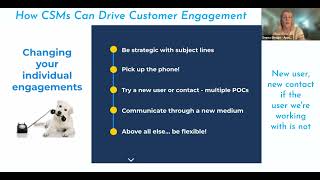
Jeff Rosset shows CSMs how to re-engage silent customers through value-focused emails, unscheduled calls, and multi-threading across new contacts. He recommends meeting customers on their preferred channels like WhatsApp and LinkedIn, and stresses the importance of pivoting tactics when your first approach doesn't work.
Chapters
First and foremost, strategic subject lines. This sounds very basic, but I cannot tell you the number of emails that I see that are just check in. That is not an engaging subject line. And if you are trying to talk to somebody who will not talk to you, that is not going to do it, right? So start being strategic. Start calling out things, really giving value there. Picking up the phone. This one seems. You know what, I don't even want to say that this one seems obvious because I think in csm, since that's the majority of who we have on the call today, CSMs don't love this concept of picking up the phone when we don't have a scheduled call. It's. It's something ingrained in us that is tricky for us to do. And it can be the best way to catch a customer, right? If you have been talking or sending emails over and over and over and you get nothing, if you're going to keep doing it, you're probably going to get nothing. Think about that customer that we were talking about in the beginning when I asked you guys to think about a customer that is one that's ghosting you. This is a big one. We don't like to do it because it's a little bit out of our control, right? We feel like we don't have a lot of control on what could happen there. If you have those and you really come in with a plan, it can be incredibly valuable. So this is one that people don't love, especially our systems, but I think it's incredibly valuable. New user, new contact. If the user we're working with is not engaging with us, let's try somebody new. This is also important just from our perspective of having multiple relationships with a customer. A lot of you have probably heard of this concept of multi threading, right? Where you, you want to have as many relationships in the organization as possible. Because you are not just a company that is supporting your individual point of contact, right? Your ultimate goal is to be supporting that company. So if your relationship is just with one person at that company, you're not quite there. You need to have broader relationships across multiple people. And, and if you have that, that gives you a much better opportunity to avoid issues if someone leaves. Right. Or if someone moves into a new role. So having lots of different contexts is valuable and it's also incredibly valuable when you can't actually engage communicating through other mediums. This is a big one. And I'll use an example for us. At my company, we have a lot of customers who use WhatsApp and that's how they communicate. So we will send tech or we won't send texts, we will send emails, we will try phone calls. We will reach out through different mediums. Get nothing. It's radio silent. You set up a WhatsApp account, you contact them on WhatsApp. I have a response in five minutes. Is that necessarily my preferred medium of communication? No, but my goal is to engage with my customer. So if that means I get a WhatsApp account and I WhatsApp my customer to get a meeting scheduled, then that's what I do. Right, because that's this better method for me to engage with, and that's going to get me in front of the customer in the right way. So start thinking about potentially new mediums. Another great example of that is LinkedIn. So if you see that a customer is constantly posting on LinkedIn, but they will not follow up with you on your emails, LinkedIn message them, send them a message or comment on one of their posts. Get in front of them in the way that you know that they're active. And last but not least, when we think about this, and as we move into these other examples as well, I want all of you here to remember to be flexible. This is one of the things that I really try to share with a lot of my CSMs and account managers, as well as onboarding managers. Flexibility is really important. I think we like to have a particular plan in place, and this is what I do and this is how I do it. But. But when that doesn't work, you have to be ready to pivot and to change and to try something new. So that flexibility, while it can be a little bit scary, I know we mentioned that with the phone calls, it's really valuable for being able to engage a bit more.