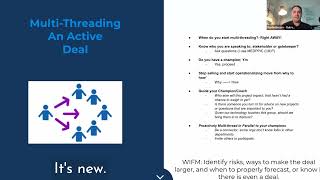
Jeff Rosset explains how to build multiple stakeholder relationships from the start of a deal. He distinguishes champions from coaches and gatekeepers, and shows how one seller uncovered a seven-figure opportunity by reaching beyond a single contact in a 200,000-person organization. Parallel outreach to finance, security, and other functions prevents bottlenecks and expands deal size.
Chapters
People often ask me, when should we start multi threading? Now. If you haven't do it now, do it at the start. Don't wait. Waiting only causes more problems in the end. Now, is it a guarantee? No. Obviously there is those anomalies that you're able to skip through some of this stuff and get a deal done. But more often than not, my luck is starting to run out that these things are having to happen in all deals right now. We got to know who we're talking to, right? First of all, if we're going to start asking and needing to go do this, figure out you're talking to your champion is probably a gatekeeper. They're probably not a champion because if they're not going to be introducing you to people, they're a gatekeeper. That's just wild to me that nobody's going to introduce you now. It feels good to us because somebody's talking to us and they're making us feel like there's money at the end of this. But if they're not introducing to people, there's probably not a deal or they're not really authorized to do anything anyways. So win fast, lose fast is my thought on this. Are you talking to your champion? Are you talking to a coach? A coach and a champion are going to tell you who else to engage. And a champion is going to bring in those other people. So use this as a way to test your champion. Just because somebody's talking to you and they're telling you all the right things doesn't mean anything. Ask them, make them do something for you, not just tell you good things. If you have a champion here, then you're definitely going to be able to multi thread. They're definitely going to tell you who to go after. Same with a coach. So if you don't have a champion, if you don't have a coach and you're dealing with a gatekeeper, start over, go prospect more, Go after an executive. Just get away from that person that you're talking to. Be bold. I don't think any of us would spend time with people who can't, you know, make our lives better. So why are we spending precious work time with people who aren't going to help us get a deal done? But once you have a coach and a champion, start guiding them. Part of this is helping them. Some of the technologies and some of the products that we all sell have been bought and there's a process. There's a lot of stuff that people haven't bought before. It's a new line item, it's new. They don't have a process or they're a dysfunctional organization. Either way, that's okay. Become that Sherpa for your customer. Show them that you're of value, that you're not just trying to be an order taker. Guide them, talk to them. Hey, Mr. And Mrs. Customer. Typically at this stage, because the technology does X, Y and Z, we at this stage are going to need to be talking to this person or hey, at what point do we start talking to security and making sure that all of this works? Or who do we need to be validating this business case with? Like, if I can't get past you, then there's just no deal. It's not worth the aggravation. Go around it. But guide your buyer. If there's a buyer and there's a deal, they want to buy and they're going to help you, they want you to help them and they're going to help you as well. But also continue to multi thread. Go after different stakeholders, different organizations, yourself. Once you realize you're working with a gatekeeper, go, go contact marketing. Go contact Revops, Go contact finance. So you're in this conversation. I can't tell you how many times I say, hey, I'm talking to this person. And they all come back and say, well, they're kind of a nobody. I don't have time for this. This isn't a priority. Cool. I now can go reprioritize my time with a real deal. One of the things I've worked really hard at doing and I encourage others, is to make people work for your time as well. You can say no to things because it's still not a deal. If it's not a deal, it's not a deal. It doesn't matter how many times you talk to the person, gotta let go. Your time is valuable, you're important. You've got more things to do. So quit messing around with people who really aren't gonna buy. Nobody can buy a loan. So I'm giving you permission to tell the person that is willing to talk to you that hey, if you're not going to do this and there's no deal, move on and reprioritize your time. And if it's a real thing and there's real interest and you've done a real good job, they'll come back, leave it, move on. It's bold. I know it's uncomfortable, I know. But that's the only way you're going to actually win more deals is by getting uncomfortable and walking away from a lot of stuff. It's not real. So again, identify all of these risks in your deal early, figure this stuff out, don't wait until last minute. This is how you're going to make the deal larger. Like, hey, I now have other stakeholders who have other initiatives and we actually find out that there's a bigger initiative up top. So at this large multinational company, we were working with one person out of a company of 200,000. The seller's like probably 10,000 people. One person was telling us all these amazing things, all these good things. We couldn't get past go. So then I went to a different business and started having conversations. Lo and behold, we got to corporate and there was a whole massive sales effectiveness evaluation going on. And we were talking to the wrong person, the wrong team who had no visibility into that because it felt good. We were stuck there forever until we started to pivot off. And then we went up and found this massive seven figure opportunity that was perfectly made for us to win. But luckily we had all these conversations down here and with that one person. So then take it up to the organization. But if we had just kept trying to sell, trying to chip away, chip away, chip away, we would have lost that, that chip away for this probably six figure deal. We would have lost this almost close to eight figure opportunity. So go around, go parallel, go find the real deals within an organization. Because again, nobody can make these decisions by themselves.