Revenue Jam LIVE: Rolling Out a Quota to CS
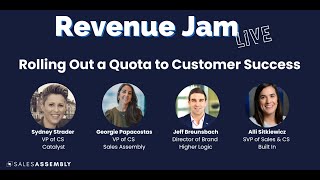
In this hour‑long live panel hosted by Georgie Papacostas of Sales Assembly, four seasoned customer‑success leaders—Ali Sikowitz (Built In), Jeff Spru (Higher Logic / Gain Grow Retain), Sydney Strader (Catalyst) and moderator Georgie—explore whether and how to introduce revenue quotas for Customer Success (CS) teams. The discussion opens with market pressures: longer sales cycles, tighter profitability goals, and the need for CS to shoulder more revenue‑generation responsibility. Participants examine the prerequisites for a quota‑ready CS organization, emphasizing team tenure, skill‑set, and product complexity. They then debate the appropriate North‑Star metric (net‑revenue‑retention vs gross‑retention) and the concrete activity‑based KPIs (health scores, product adoption, NPS/CSAT, account health, usage metrics) that should drive those outcomes. Cross‑functional collaboration is highlighted as essential—marketing, sales, product, and engineering must align around “moments of impact” and at‑risk account processes. The panel shares change‑management tactics for rolling out quotas: leader‑first buy‑in, transparent communication of the why, role‑playing, documenting context, and providing enablement. Compensation design is discussed, stressing measurable targets, avoiding un‑measurable goals, using spiffs, double‑comp periods, and ensuring quotas are within individual control. Practical rollout models are offered, including phased implementation, aligning incentives between CS and sales, and iterating based on feedback. The session concludes with audience Q&A on ownership of NRR in a B2B SaaS home‑care context, reinforcing the need for shared metrics and flexible compensation structures. Throughout, the panel stresses a balanced, data‑driven, and empathetic approach to integrating quotas into CS teams.
Chapters
Hello and welcome to Revenue Jam Live. Today we have assembled an incredible panel of speakers that we're really, really excited to have joined us here at Sales assembly to discuss the topic of rolling out a quota to customer success teams. So before we dive in and introduce our panelists today, we did want to kind of set the intention and take a moment around why we chose this topic. And while it might be super trite for me to say this, I start a lot of meetings like this, unfortunately. But we're living through a challenging time in our industry and for CS teams specifically, that means we're coming up against a lot of challenging things when it comes to retention and renewals. In the same vein, we know that our partners in sales are struggling to hit their quotas. We know that sales cycles are taking longer and many organizations are starting to look at CS and account management to make up that revenue. Right. And as a result, some CS teams are getting a quota for the first time. For some it's going well, others maybe not as well. Right. They may see team members leaving people feeling burnt out and, you know, that decrease in retention that we mentioned earlier. So that's why we're talking about this topic today. And by the end of this conversation, we hope that you have maybe clearer understanding of how to effectively roll out a quota to your CS team so. So that you can retain and expand your existing customer base. Before we get started, we are going to do some quick intros and then we will dive in. We've got some polls like Mason mentioned, for those of you who are just hopping on now. We really intend for this to be a conversational event for those of you that are Sales assembly members especially, you know that we do a lot meetings like this where, you know, we really encourage participation from the group. So we'll be looking out for your chats, we'll be looking out for your hand raises. But with that, I'm Georgie Papacostas and I look after the Customer Success team here at Sales Assembly. We're a development platform that helps B2B tech companies close the skill gaps for the entire GTM team. And so I'm going to turn it over to the panelists. Let's start with Ali. Can you please introduce yourself?
Sure. Thanks, Georgie. Hi, everyone. I was happy to see a couple familiar faces. My name is Ali Sikowitz. I'm the SVP of Sales and Customer Success at Built in, which is headquartered in Chicago. We are a recruitment platform specifically for tech companies nationwide. My role at Built In, I've been here about eight years. I oversee customer success, support, implementation and pre sales as well as our sales FDR AE am side of things. And then just really quick context because I know everyone here is different size companies. I built out our CS team from zero in 2018 to what the org is now of about 40. We taken some steps forward back throughout the process. So definitely can talk through, you know, building standardization, things of that nature. So looking forward to today's conversation.
Thank you so much, Ali, Jeff, we'll turn it over to you next.
Awesome. Excited to be here. I'm currently coming to you from a phone booth in the Boston airport. So I had some travel changes and we're rolling with this on the fly. But I'm excited to be here. I'm a co founder in a community called Gain Grow Retain. We have about 12,000 customer success leaders of that community and something that we started in 2020, so that's been fun. And then for my day job, I am a marketing leader over at Higher Logic and Higher Logic is a company that is helping you connect to your customers. So we build communities for B2B SaaS companies to better connect and engage with customers and really try to shake up success at scale. So we've been working on that and have some exciting stories to tell, just similar to Allie. Just to give you some context, early in my career I spent running a consulting firm for BB SaaS companies. We would go help with customer success. So I've seen 60 or 70 companies throughout that time and then I've been at B2B tech companies in CS and marketing and account management roles. So bring a little bit of perspective from that too. So that's me.
Thank you both. And Sydney, could you please round us out?
Yeah, for sure. Hey, Sydney Strader and I'm the VP of Customer Success at Catalyst. Super excited to have everyone join us today. Catalyst is a customer growth platform. So as Georgie was kicking us off and talking about the importance of CS teams, revenue teams, driving retention and revenue growth and doing that as efficiently as possible to keep cash burned down for organizations. That is where Catalyst is focused. And today the CS team at Catalyst is that strong and mighty little team. And I see over implementation our csms, our scale program, partnering with Jeff Spru at Higher Logic. Thank you, Jeff. Our support org and an amazing renewal management motion. We also work very closely with our sales org on our expansion revenue motion. And I've seen the gamut of no quotas for cs, quotas for cs, the bridge to get there to go back. So lots of learnings and experiences that I'm excited to chat through with this crew today.
Thank you so much, Sydney. And again, thank you to Jeff and Ali and Sydney for being here. Really appreciate those introductions from all of you and hopefully the audience is now starting to get a sense for, you know, the diverse set of experiences that we've assembled today. And as Sydney kind of talked through everything that she's seen before we get started with questions for our panelists, I mentioned making this an interactive session for all of us. So we actually want to get a better sense for who's in the audience and what your teams are currently set up like. We're really just going to dive in and kind of start at a high level. Why, from the panelists perspective and of course, we'd love to hear from you all as well. But why should or shouldn't a CSM team carry a quota? And Jeff, I'm going to kind of pass this one over to you to get started and then open it up to Ali and Sydney to add their thoughts as well.
Perfect. Yeah. I always try and do a lot of context setting for our teams and as a leader, so when I look at that question, I think the immediate kind of response that comes to mind is like, where are we today in the market and why would we need to be making changes around comps and quotas and moving things? And I think if you look at the shift that's happening in the financial markets and you look at what businesses are trying to move towards, it's a lot around profitability. It's a lot around how do I reduce burn, how do I reduce cash, how do I make sales and marketing more efficient is generally one of the levers that you try and pull. And if that's the case, then this conversation is coming up right now a lot. Because if sales and marketing are trying to offload cost, one way that we could do that is to move the upsell, cross sell, net revenue retention kind of motion into a CS team to really spread out the cost of that kind of customer acquisition. So that's what I think of as like the shift that's happening now that is forcing this conversation more and more is that, you know, how do we reduce the sales, marketing costs, how do we focus on profitability? And that generally means that you're shifting a responsibility somewhere. So I like that context setting for the team. And then I would go back in terms of is the quota right for the team or not? You know, to a lot of it's going to. It's going to Depend.
Right.
But I think, by and large, I think the thing that I think about is the tenure and the skill set of the team and the complexity of the product are the two things that I kind of look at often when we're kind of asking this question and trying to gauge, you know, is it something that we feel that they can take on as part of their work in terms of their skill set and their tenure as well? Does it kind of match up to things that they've done before? Is it something that we can easily add motion around, that we can track and do in the right way? And again, I think there's a lot comes with product complexity. A lot comes with kind of your team and where they are in terms of their careers and the types of things that they've done. And then lastly, a thing that I think about quite a bit too is who, when we are going through these renewal or upsell and cross sell conversations, who are we coming up against a lot? Usually if you're in enterprise type orgs or enterprise type motions, it's like our CSM might be going up a procurement department. And that is a losing proposition in my mind. Right. You have somebody in procurement who's doing this on a daily basis, who's very good at negotiating and trying to find angles against the csm, who is, you know, doing this as a part of their job and might not have that skill set. So I also think about where you're selling into. It kind of matters to me on how you think about, you know, does the team need to carry a quota? Do we need to kind of put more commercial responsibility on the csm? So those are a couple just of initial thoughts around context and how we think about some of the parts of the problem maybe that you're trying to answer.
Thank you, Jeff. And I think the way you've talked through that is a great way for us to kind of frame up the next kind of 20 minutes or so of the conversation. We have a few things that we want to touch on. I also want to shout out my two CSMs, Megan and Kara on the line here because we all came from supporting the workday procurement product. And so Jeff, that just like really tugs at the heartstrings in terms of being CSMs for procurement teams. Even doing that right was a really challenging seat to be in. We learned a ton. But it's a really good point about matching tenure and skill set of the team to complexity of the product. And I think we're going to come back to that a little Bit. But one of the things that you opened with was, you know, timing right now, how companies are focused more on profitability, reducing burn, increasing cash flow and how we might be able to do that by getting a little bit more focused on the activities that drive the right things. So, Ali, I know that you had some thoughts around where CSM should be spending their time as we kind of move towards this motion that I would love for you to share.
Yeah, thank you, Georgie. I'm smirking as Jeff was talking. I don't know if any of you have felt this, but I think customer support, customer success, customer service, like the buzz topic for the past 10 years, it's such an ironic thing, silver lining of the market right now of like if the business didn't find value in customer success eight, seven years ago, they sure as hell better right now. Right? And I say that to say like you can go and sell a bunch of deals right now, but it's not at the same clip. And at the end of the day, if you can retain your baseline and grow from your existing baseline, like you're in a pretty damn good, good shape. And so I say that and I smirk as I say that because the idea of not having your most strategic team aligned to your customer, not tied to certain metrics is just like a total miss in my opinion. And so going back to what Jeff also said around, well, we teed this up is the metric what metrics are driving the business then I think, Jeff, I'm stealing this from you in our and when we ideated on this, I'm like, how do you do the right things to equate to those results? And the very first thing I would reflect on is who is supporting the customer and do they have competing priorities like conflicting KPIs or do they marry in those KPIs? And Sydney brought that up in terms of like AM versus CSM in your example of like where what's the lane and the better and smarter ally on this meeting, Ali Haynes, who is our director of cs, I'm going to steal the method she's brought in for us. But this idea of and someone else put this in the chat that you actually pay on certain KPIs. So I think there's such a blurred line of what's a KPI versus what's a target. And we're trying our best to not confuse those two. And so my recommendation would be how do you think about the KPIs that go into what good is. So for us, we're moving to a target of net revenue retention and within that revenue retention. If I were to look at our best CSMs, what are the activities I need them to do in order to have the best retention, net revenue retention rather, and that might be things such as health scores, certain activity metrics, product utilization. So that would be my biggest recommendation. And aha moment I had thanks to Allie, who really took that, took that lead to say, what are the KPIs we need to watch to monitor what is good? And you can literally performance manage off of that. If they do those things correctly, then the ultimate goal that in our case is net revenue. Right now, ideally I'd like to move to gross, gross revenue retention one day, but I'd really separate those two and it's an interesting concept of paying them off of those KPIs. So just kind of talking that through I think is a good exercise.
Thank you so much, Ali, especially for the framing. And also I think we'll have time to get into a little bit of this. But you know, there's a lot of metrics that we're choosing between and the reason for that is because of something that Sydney mentioned, right. Like she's overseeing it all. Um, we've got people in these seats that are doing implementation, that are doing onboarding, that are doing customer lifecycle management, that are doing renewals, that are doing expansion. I mean, it's very likely that there are people on the call today whose CSMs actually manage all of those things. And so without a North Star metric and without the activities that then drive that thing, you know, it's going to be harder for us to also support teams in where they should be focusing. Right. And then I also want to shout out Ali Haynes. She has been an incredible contributor to our CS Leader peer group over the past. Probably like in 2023. I've just seen you a lot, Ali. And she shared some KPI documentation with the, with the group of us on our last CS leader peer group that, you know, we've all been able to use and leverage. So, you know, I always say this, but just the generosity of the knowledge of the people that come together on these calls just cannot be overstated. Sydney, I would love to pass it over to you. We all kind of nodded to you as this topic of NRR came up in everybody's response. But I know that you have some really insightful thoughts on this question as well.
Yeah, I think Jeff and Ali touched on some great points there. I mean, I think at the end of the day, what we've learned to. Jeff's point is organizations have shifted their focus. Right before it was like let's get a bunch of VC funding. And I remember sitting in board meetings it's like spend, spend, spend, spend. Grow at all costs was literally like championed. And now it is like oh hell no, that is not the strategy forward. And there is a strong emphasis on efficiency, cost reduction and when you look at, you know, marketing spend, it's a high, high investment for a low return relative to driving revenue growth from your customer base. Like revenue growth from your customer base is the most cost effective way to drive revenue growth for your business. And it's also a really interesting shift right now. Kevin Chu, our COO posted LinkedIn post yesterday around some recent VC data that he received around SDR pipeline creation which has gone from 40% to 18% which when you think of the implications to a business of that pipeline not being generated, I mean financial plans for the year have been on the basis of, of that plan coming to fruition which is then converting to close one revenue. And so when that dries up or does not perform to the degree that it was previously, you start to see significant risk to just the livelihood of these businesses which is why you're seeing the layoffs and the rift. So the answer is sitting in our customer base, getting customers to value and helping to drive that revenue growth. So I think that's really like to Ali's point, like if customers or if companies didn't see value in CS before like they sure as hell do now. And at Catalyst, it's been very interesting for us working primarily with customer success organizations today when these layoffs have unfortunately impacted a good chunk of our customers. The CS teams have not been impacted anywhere near the degree that you would have seen in years past. Like they have kept their CS organizations because they understand the revenue impact that they are driving and because of the shift in strategy. So I think that that insight is really, really interesting. The other piece that I'll touch on is Ally and KPI's and I love the idea of like leading and lagging indicators. One of the kind of comp strategies that we had at a previous company of mine had the leading indicator component to it and we had done some like basic research to show that if a certain number of seats had been adopted within 60 days of a customer signing with Envision, that was the company, there was a 98% likelihood that that customer was retaining. So it just drived a very intentional emphasis for the implementation team and where we were focused on what are the outcomes that we need a customer to attain in those first 60 days in order to increase the lagging indicator of gross retention and growth. So I think like putting in the time to do that analysis is really, really important. At Catalyst, we call it moments of impact. And it's like what are those moments of impact tied to why a customer has bought that we can prescribe solutions to and drive the usage and activation of to ultimately get customers to that value. That's in turn going to translate to their desire to retain and also to expand their investment in us as partners. So some great just insights from Ali and Jeff and doubling down on those being exactly what I've seen to be super valuable and high impact from a revenue perspective.
Thank you so much Sydney. Really appreciate the doubling down. But that last bit, especially on moments of impact, you know, at sales assembly we started off the year with the mindset of slowing down to speed up, knowing kind of what kind of environment we were entering. And you know, whether you are a 10 person company or a thousand person company, you do have the resource to do that research, right? To go back at your churned and retained customers and understand what did their adoption and usage look like and what are the activities that we're trying to drive towards because like you mentioned, those are so impactful. And when we take it into the context of the conversation that we're having today, it then sets the foundation for how we identify who's primed for growth. Right. Because one of the kind of tough questions I want to throw back to you all is we're talking a lot about customer success and your existing customer base being the best place for you to grow revenue. But we also know that teams are really struggling to retain their customers. So what are your thoughts on people who might be thinking right now? You know, I'm really just trying to stop the leaky bucket and like meet the moment and not be impacted by this trickle down of my customers. Can't retain their customers. So now I can't retain my customers while also not missing out on the opportunity to grow the customer base.
I think the interesting thing that you were just mentioning, Georgie, right, is like the success of my customer. Right. So how can we continue to make our customers more successful in what they're doing? And so I tend to think that can be a very big driver of a metric. I actually think if you go back to Judy's example in the meeting chat, you know, she mentioned that impact on care recipients was like their metric and that's really powerful when you Think about it, right? Like they're everybody in their org. I'm just making this assumption, Judy, but everybody engineers, the product team, sales team, everybody is focused on how can we increase the impact on care recipients. And that's a really powerful thing because if you, if they're impacting the care or impact on the care recipients, right. In general, that means they're making their customers probably more successful and in turn that's going to drive revenue. So I think that's a really powerful way to organize metrics when you think about leading indicators because sometimes people don't always relate to money or the dollars that we're bringing in the door. ARR, right. Like you need some other pieces. For us at Higher Logic, you know, we're a community based business so we think about connections that are made, right? Communities are really powerful. When I can make just one to one connections with people and then I can help grow and expand your network, like that's a huge benefit that you see at a community. So like we talk about that often internally as you know, hey, how are we helping? Kind of going back to Sydney's example, right in the early days, can we help understand how connections are made in the community and how can we amplify that to a degree that we know that they're going to really kind of drive that success early on so that the value is really created. So I think about those types of moments a lot and how to reinforce them through the behavior. Like Sydney mentioned, maybe you pop off of it. The other thing is just trying to do some really simple things really well, like calling people out of Slack doesn't cost anything. It's the easiest thing you can do when you hear great stories. We have a channel here at Higher Logic called Stories Worth Sharing and it's just an open channel for anybody in the org and it's calling out good customers, calling out our good teammates. It's literally for anybody who hears anything that's like worth sharing and that's a super fun piece to be a part of because that also just drives some of our team with some of our culture aspects behind it. But like that also just reinforces, you know, why are we all doing this? How is it all kind of centered around community? So those are a couple things that I just think about when you're, you know, trying to zero in on like how do you make your, your customers more successful? How do you make sure and kind of get some of the momentum behind your teams really rallied around that mission?
I can jump off that, I think I'm trying to think back on like, I feel like we all probably feel like we could do so much right. Who just told me this phrase. It was you can do anything, but you can't do everything. So anyway, I'm like internalizing that as you're talking. I think my one recommendation before we jump into like execution is just reflect on what's working well and how do you double down on that. And so Jeff, to your example, like, is there one good customer that like, they love us? Why do they love us? Let's like reflect on their journey and like, let's find ways to double down on what worked there. Hear me out for a second. I don't want to Cindy, take your thunder, but our new business team, the majority of our pipeline that is closing is job changers who have recently joined a new organization or someone that has worked at a customer of ours. So everything else is basically dead. Dies very quickly within our sales stages. And so I'm trying to also think on that's a real thing that then comes back to our customer team to say if our customers are the best advocates out there, like, let's double down on what our systems are doing. Measure them on that, for example, NPS and csat. Like I'd rather chase someone that had the best NPSC sat and just follow them wherever they go because that to me is like the best champion out there. So I would also. Anyway, that's my full circle of what's working well. I would reflect on it from the customer side, but I would also think about it with your partner or if you do oversee the new business side to say what's working there. I would guess it's something similar around existing customers that are going to existing contacts that are going to a new company or someone that worked at a prior customer. And how would that like feed your engine and how would that feed how you're KPI'ing a CSM or am just some thoughts.
Yeah, one thing I would add there as well. So Jeff, I mean I do think the power of the collective mission is like really important. And I think like if you read about job seekers out there today, people are much more interested in understanding that they're contributing to a greater cause, a greater good. And so I really liked that story is worth sharing for you all is both like what teams are doing to help each other and then also around customers. But Ali, I love that you talked through just like finding your best or I'm just going to say greenest customer for now, green in the sense of health and understanding what they're doing. And so a couple of peer groups ago, Allie Haynes, I can see it's like nodding her head now too. We talked about that as CS organizations. I mean I know of companies out there that have like two meetings a week of red account reviews. Right. And so we're sitting in. These are at risk customers. These are all the reasons why they're at risk. Let's find, try and find solutions to all the reasons that they're at risk. But like we should be doing regular green account reviews, right. To Ali's point, what are the green customers doing? No matter what percentage of your customer base they are. And it ties back to Sydney's point on moments of impact as well. Right. Like understanding from like a product and adoption and usage perspective. You know, if you think about like, you know, let's say there's like 10 applications within your software and you know if they're using these six, right. They're most likely to adopt. But, but beyond that, right. What are the ways that those champions are championing your product internally? You know, what are the unique things that make them green? And can we introduce more regular green account reviews instead of it just sitting in a one off celebration channel? Right. Like should we be more regularly doing that? And that's something we've talked about doing at sales assembly and today is such a good reminder for me on I think we need to just implement it and I think on top of our weekly forecast and right account reviews, we need some sort of regular time to review the greens as well. But Sydney, I know I saw you come off mute there, I wanted to add that, but very curious to hear your thoughts as well.
No, I think that's a great call out. I don't hear it done often enough myself included, so I'll take accountability for that. I think to Jeff's point, we've got a channel called Bring CS to the center that is a great kind of like single source of truth for us to hear a lot of incredible customer stories. Value that customers are getting from our platforms, learnings that we've had, but definitely an area that I think could use more time invested into it. The other piece that I just wanted to highlight was CS looking beyond CS for support and partnership. When I look at Catalyst and where we've had a huge impact in retaining our base and driving revenue growth, it is the cross functional collaboration between marketing, sales, CS and our EPD engineering and product organization. I mean we have these at risk meetings and we have every account that is at risk tag that ties back to a certain department. So like in customer success, like there are areas that I and my team are accountable. Like if someone is not getting value from Catalyst, that is a, that is a Sydney problem with my team to solve. But there are also areas where, you know, there may be critical product features that customers need to get the value that they need from Catalyst to be able to retain and they fit our ideal customer profile. And that is a conversation we're having at our leadership team to discuss like where on the roadmap are we prioritizing this feature? So I think when I, when we instituted this process, a Catalyst, I've seen it raise all tides like across our gross retention metrics. Like I mean 20% increase in gross retention in a time that is very challenging to retain our customer base. So I would just encourage everyone to look beyond the walls of like we're a scrappy CS team that's getting creative as hell to try and save every customer and go like, how do you not shoulder that weight alone? How do you drive transparency and visibility to your cross functional partners? Because in my opinion gross retention, net revenue retention are company metrics. They're not CS metrics. And I think anytime any organization looks at their like, you know, NRRR is a CS problem. It is not, it's a CS problem if CS is not verbalizing to the broader organization where the risk lies and why it lies there and what they need support from product or you know, sales and marketing to do differently to get it. But I think that that piece is like, you know, you're going to move the needle at a micro amount. If your CS is CS alone trying to get creative and scrappy to save accounts, you're going to raise all tides. When you are able to drive that visibility across the organization and put forth the right asks to your cross departmental partners and start to see meaningful change. Like I cannot thank John White and Shah Ma, our VP of engineering and VP of product enough for the revenue impact that they've had in growth, retention and NRR biological result of what they have within their control to focus their EPD organization on to help us.
Thank you Sydney. I'm actually just going to let that one sit for a moment just because you know, we got a lot of head nods, we got reactions. You know, sure, we're here to talk about rolling out a CS quota but you know, I think that these last five to seven minutes have been really valuable for everybody to just kind of have that collective, that collective experience of, you know, it's not. It's not. Nothing is ever on one team. Right. And that's not the kind of organization that you want to be a part of. And being really explicit about gross and net retention being a company metric, you know, that's part of why we wanted to understand what is your North Star and how do all the teams play a part. But that cross functional piece as well, right. Is really, really important. I saw aneesh ad in the chat there that the most successful CSMs are the ones that are leveraging other teams. Right. And so when we think about coaching the people on our team, you know, I always, and I'm at sales assembly now, which is a much smaller organization but in other places I've worked, you know, you always want to make sure that you've got pals in other teams. Right. And that you're not even waiting for those set meetings, but that you've got someone on legal, you've got someone in product, you've got someone in engineering that you can ask those questions to because ultimately they're going to allow you to move at the pace that your customer needs for you to drive the success to contribute to that renewal. Now having said that, I do want to make sure I kind of refocus us back into kind of rolling out these quotas. You know, we told our attendees today that they would get some strategies and so the last kind of 10 minutes here I want to spend talking through different models that you can consider and then we'll talk a little bit about communicating this change to your teams. So I'll actually open this one up to Jeff or Ali or Sydney, whoever's got some really top of mind thoughts on like some of the ways we can measure success. Right. And what are the, the best models you've seen? Taking into account some of these conversations we just had around like activities and KPIs.
We've changed our KPIs a lot over the past now five years since we've had a CSM team. But a couple of things I'm going to say philosophically that I think and then I can be more tactical. I do think it's important to look at what their compensation structure is right now and it doesn't motivate the behavior you want. And then I do believe it goes back to the KPIs. So let's say for instance, you say, hey, we're going to move to net revenue retention, but you don't actually give them guidelines to what activity gets them there. You may get the wild wild west of them all doing it their own ways, which I think will also create some pretty significant ripple effect of like clashing with other teams. So I would start by defining what KPIs are. So that would be something like activity metrics, NPSCSAT, account health, just to name a few. And then the last thing I was just going to say that's more like philosophical about this. All I do think the communication around this is really important. Again, doing this enough good and bad over the years. So my two comments would be we do something called leaders go first. Where for any big change we get buy in and feedback from the leaders of that team, whether that be the manager, the most tenured individual on the team, just to get their gut check of like what are we missing, what are the gotchas? Like how would you feel about having this updated goal? And so I would really encourage that you don't need your most strategic value assets coming into a meeting group setting and like totally shitting on your plan, right? And. And you don't know all the holes. So like they do. So I do think it's important to really like slowly move into this last thing that is more tactical. I guess I have two more things. Last thing on the tactical side though is can you actually measure what you're about to ask them to do? If you can't measure it, then do not do it is my very quick opinion on that. And then the last thing, because we have done it well, but we've learned. I don't know if anyone else has felt this way if you've changed KPIs, but when you hold someone to something, they like uncover so much about it, which is awesome, right? So you change their target and because of that they just rip apart how like whatever that target is, which is a beautiful thing because in turn we expose a ton of problems with reporting efficiency lanes. And so be ready for whatever you're about to hold them to them exposing problems with it, which is great. That's why we're doing it right. And with that though, always err on the side of being open to getting that feedback and tee that up front of like guys, this is not going to be perfect. But this is the why as Chef mentioned. And in this process I need your feedback. And then the last thing I would just say because we have done it wrong is if you mess up, you course correct. And so for God forbid, if your whole team misses this KPI you just set out for, don't put them in a shitty spot like you advocate for Your team, because you need to retain your team. So just kind of smorgasbord of stuff.
Jeff, how are we going to follow this? Maybe we just let that.
Yeah, yeah. The, the thing that I would say though, Ali, that, like, I felt like as you were talking, it started resonating with me was there was a great quote one time I heard from a HubSpot early HubSpot employee. She led the marketing team for a long time. And one of the things she said is, she said, you know, our metrics for a business, for our business change yearly. And so I would be a really shitty leader if I didn't help change our team's activities every year and I didn't help change the structure of our team. Right. Like, if we change the strategy of the business from year to year, we change the metrics and I'm not adjusting my team or department, then, like, I'd be a really shitty leader. And so that's how she tried to get her team kind of bought into this idea of, like, hey, these changes are coming. Like, we need to kind of get everyone prepared for these as much as possible. So, like, change is very constant in software businesses. And so I just think of that quote quite a bit that, like, she tried to help get her team over that hump very early. Just saying, hey, this is going to happen a lot, but I'm going to come. Similar to you, what you said, Ali, I'm going to come to you and we're going to talk this through. I'm going to lay out plans. There's going to be ways that we do this. So I just think about that quote quite a bit. The other tactical thing that I would just add, and then I'll pass to Sydney is when you roll out, when I've rolled out quotas and things in the past, I have also started the conversation with what do you want to do? The person who we're rolling this out to, right? Having the conversation of, like, what do you have career aspirations around? What do you like to do? What do you want to be doing? Right? Like, you need to have that context. Because if you go to a person and say, hey, we're rolling out this, hey, you know, we're going to be responsible for some nrr. You're going to have to go drive some, you know, kind of CSQL or whatever you want to call them, hey, we might have to drive close some renewal opportunities to a person that hates negotiating anything, even their phone bill, then, like, it's going to go bad, right? Because they're not going to be, they're not going to be coming into work, enjoying that every single day. And that's fine, right? Like people need to have different career paths, different options, but I think having the understanding and feel it, making sure that they feel comfortable, like it's okay if this isn't, this is where we need to go as a business. It's okay if you can't meet that need. We can find something else most likely in the business, I'd imagine, because there's enough problems for us to solve. Or if not, we have to be comfortable with saying that and having that conversation. And I've had to do that many times. And it sucks because you do have really frank and tough conversations. But I think that's also something I've learned from, is if you rip the band aid off early and have that conversation, it's going to go much better than trying to force somebody to do something that they originally didn't intend to do.
Yeah, hard to, hard to find gaps where I could contribute anything else. But I think a couple things that jump out to me is one, ensuring it's within their control, right? Like my team should be able to open their laptop on a Monday morning and know exactly where to focus to produce the quota outcomes that they're being held accountable to. If there is no path to do that, something's amiss and we got to go back to the drawing board. Two, as a leader, you are accountable to teach them how to produce those outcomes. And I think Allie touched on it there a bit as well, which is like, don't just expect to be like, and here's your quota, good luck, we'll talk about your performance in 90 days. Like, no, you've got to make sure that they are getting the proper training and enablement that leads them to producing those outcomes. And then as a leader, you are accountable to holding them accountable to the day to day actions and activities that you have trained them on to produce that business outcome. And I think the other piece is like, when talking to a lot of CS leaders, like they're scared, right? They haven't had quotas, a good chunk of them, they haven't been held to revenue metrics before. They're like, oh, I'm going to roll this out to my team and I don't even know what the heck I'm doing myself because this isn't something I've been held accountable to. Like, you are a human and remember to tell your team that, like, I think the more you can, you know, relate to them on a personal level of, like, this is new for me too. We're gonna figure it out to Ali's point. Like, we could get it wrong, but we've given it our best shot with the facts that we have within our control today, and that's all we can expect of ourselves. So, like, we're gonna revisit this. We're gonna make sure everyone's set up for success. We're open to your feedback, like, Ali touched on as well. People rip the crap out of these things. Like, you know, and you're just. It can be very easy as a leader after you've invested all of this time and mental energy and, like, kind of exhaustion, wrapping your own head around a quota. And what my team's going to be accountable for in this new motion that you get on these calls, you roll it out. Some people are, like, good to go. Some people are, like, destroying you. And you just take it personally because you're like, I've invested so much time to get it right. Like, don't take it personally. Accept the feedback, be adaptive and say, we're going to, like, see this through, try it out. We'll make iterations as we go, but. But appreciate everyone's best attitude to give it a shot and start driving forward, because change is hard for everyone. So I think just don't forget the human element of all of this and the change management. And as Jeff said, the more context you can give people as to why the impact to the business, which I think at the end of the day, everyone is there for, they want to have a meaningful impact for the business. How this change drives meaning and purpose for them will be highly impactful in terms of them getting through the change management component to get to the other side of, like, all right, heads down, let's crank away.
As someone who's failed on this multiple times, Sydney, I do think I don't know about everyone. I'm not the most patient person. And so I build so much context in my head of these decisions. But then in execution, sometimes you forget to bring them along on all that context. And I do feel like that's where it's broken. So I do just want to underscore, Sydney, that last thing you said around, like, try your best to document all these things that gave you your why. And you have to get them across that. Like, they have to understand that otherwise you are going to get faced with them being, like, just pissed. And so I, from. From personal experience, try to slow down, add all the context, and make sure that they're along for the ride. Otherwise it's not going to land the way that in your head you've already got got to.
Other thing that's been really helpful is if you have a couple folks on your team who you can like, just noodle with beforehand, like, hey, I'm going to roll this out to the team and here's how I'm thinking of approaching it. Rip me apart in a safe space, because that's what I'm asking of you. I've always found those little, like, confidants to be the absolute best because they think about their peers, they think about themselves and their role, they think about the position that sids in and they give you really great unfiltered feedback that you then take to the masses. And then all of a sudden, what would have been a 20 person, you know, fire drill perhaps is like, everyone's like, okay, great, thanks.
But another thing we talked about in preparation is like role playing with your own peers, too. So, like, taking things that you do that you advise your teams to do. Right. Okay, you're getting on a tough customer call. Let's talk about doing that first. You're rolling out a change. Well, why don't you role play that with your leaders? Jeff mentioned, you know, like, being really prepared for these conversations, like taking the time as a leadership team and not working in a silo to roll out this change to your team, but working with each other. You know, I think as well, like, one of my favorite things about today has been Ali, Sydney and Jeff, you know, saying, like, man, how am I supposed to follow that up? Or, you know, that's a really good point. Like, just the power of interacting with people who are doing the same things that you're doing just a little bit differently is really what's going to support you through conversations like these. So with that, I just, I really, really want to thank the panelists for being here. I do want to open up for questions for people who have att, but I hope that after today's conversation, you all have a little bit more conviction in why our teams are the best position to contribute to growth, especially in a time like today, how important it is to be measuring the activities that are driving the results that you want to see. Allie, I love what you said about make sure that you're holding them accountable to something that you can measure. Right? And that's why it's so important not just to come out with the number and the quota, but understanding what are the things that lead to that and how are you going to track those things? Because you might get it wrong. Right. You know, and finally the communication. And so being. Being humble in your communications, being open and transparent upfront. One thing that we also chatted about before today is, you know, there's a lot of change and resilience fatigue out there. And so acknowledging that. Right. Jeff mentioned that HubSpot, they changed targets on a yearly basis. Now kind of living in a time of where are we looking at things quarterly or biannually. Right. That's a lot of whiplash for people. And so we need to be mindful of that and call those things out while also connecting people to our missions and the business impact. Sydney, I loved that's kind of where you landed. So thank you all so much for your contributions. Mason, I will turn it over to you and then we'll see if there's any questions from attendees today or things that you want to share before we close it down.
Yeah, so we've actually got two questions. So if you asked a question, go ahead and raise your hand. And if you have a question, feel free to drop that in the chat. Well, we've got some people that are raising their hand. Just wanted to also say if you enjoyed today, we actually, as sales assembly are a skills development platform. So we host two sessions a month specifically for CS leadership and for CSMs, in addition to also having skill development courses. So again, one of the big things that we talked about today is the fact that a lot of CS teams don't have the skills currently because they've never had a quota. So if that's something that you are struggling with as an organization, feel free to go to our website. You can schedule a call today or go to the tour page and actually see what it is to experience the sales team platform. So with that, Judy, you've gone ahead and raised your hand. So if you want to come off mute and ask your question, we'd love to answer it.
Hi everyone and thank you so much for your insights. The panelists, I really appreciate kind of your sharing your experiences on this. I guess going back to my original question, the context is that we're a B2B SAS software in the home care technology space. We support home care agencies delivering visits to elderly at home. We're all one software and currently our CS team is measured on gross retention and their role is to make sure that our the care agencies that are using our product can get the right kind of quality framework in place. They have adopted most of our features and they're Getting value in of course, running an efficient care delivery operation. The current cross sell motion, so revenue expansion motion is owned by our sales team mainly because I think the buyer Persona can be quite different as we have a comprehensive product module both from care delivery rostering to finance standpoint. The people that they're selling to upselling to may not be the people who are actually using our product. So keen to hear your thoughts on kind of the ownership of nrr. Whether it should sit with yes or sit with finance. And by way of introduction, I run both the marketing team and the customer success team. And the customer success team includes onboarding, implementation success and support. So it's kind of a full fledged function.
Jeff, I saw you're off mute. Jeff.
Sorry, I've been muting my phone. Not the mute button. So you go Allie, you go for it.
I think Judy one, I'm happy to chat offline with you or anyone. I don't think there's like a silver bullet. I think my quick reaction is know the risk of the situation which is when you have two different KPIs you are. It is a little different, right? So like I think there's a risk to that. To be clear, our AMs who renew our customers and our CSMs have had two different KPIs for four years. So like at the end of the day I'm now moving them to the same and it took four years. So I think my first thing would just be trust your gut and then my second thing would be is there anything that you know is like what's best for the overall customer that is not today being motivated by the teams and like I would focus your attention there but I don't think what where you're going is in the wrong direction and you would know best. But is there maybe one little tweak of like what is the core thing we both look at that is what's best for the customer. Is there anything you could do to like make more synergy between the teams? Knowing that their goals are not the same is the only thing I would
add and I think too just to a niche. But he had a great some great tactical components of some of the comp plan ideas in the chat. So I also think about Judy in some cases, right. I've been part of organizations where you double comp on something and you do that for a period of time to get the sales and CS team right. Like there are creative ways that I think you can think about rolling this stuff out to make the teams align and get excited. If you can choose one metric and get them excited around it, maybe it's around renewals or it's the cross sell motion. You know, how can you look at doing some components like that or paying a spiff on something? So I think there's just creative options to think about. Like, hey, how can I get them motivated around certain KPIs if we can align them to the same one and making sure with your financial team and your models. Right. Like, how can we build that in for a period of time? Because I know I want a double comp or I know I want to pay a spiff on something to a csm. I just think there's kind of creative options that you can come up with. So I would also say I've seen it done in tons of different ways that could come to fruition.
All right, we are on the hour, right on the dot. But I want to thank you all so much for spending an hour of your day with us. We know that's a lot of time and we really, really appreciate again, the panelists being here sharing your, your thoughts and insights. Those of you who join in the audience, as Mason mentioned, if you have any questions for us and follow up, please, please send them. But for those of you who we know, it's really lovely to see familiar faces on events like this all the time. So thank you all again and feel free to connect with us. Take care, everybody.
Thanks, everyone.
By.










