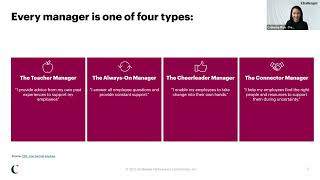
Jeff Rosset identifies four management styles and argues the Connector approach is most effective. Connector managers triple the likelihood of high-performing direct reports and drive 38% more discretionary effort, 20% higher retention intent, and 40% better engagement.
Chapters
There are four types of managers in change. As you look across the board, I'm sure you're constantly thinking like, am I a teacher? Am I a cheerleader? Am I connector? Let's go through each of these individually and then see if that is something that you resonate with. For the teacher manager, they provide advice oriented feedback. They direct employee development. They rely on their own strong track record as an individual contributor. They also consider their approach to be correct in part because of their experience and expertise in doing that job. They often say, I provide advice from my experiences to support my employees. Then we have the always on manager. They provide frequent feedback and coaching and drives employee development. They regularly go the extra mile to give employees in the moment coaching and feedback even when they lack their own personal experience in that specific skill. They often say, I answer all employee questions and provide constant support even if it's through the night. And then we have the cheerleader manager who empowers employees to take development into their own hands. They often give that positive feedback, that rah rah personality. And they often shy away from criticism when given to them. But they rarely obsess over details. When giving coaching and feedback. They often say, I enable my employees to take change into their own hands. Lastly, we have the connector manager who creates positive team environments while providing targeted feedback to employees. They focus more on building quality relationships and quantity of feedback. And then they give and connect employees to others for their development. When they lack expertise in that given area, they often say, I hope my employees find the right people and resources to support them. During uncertainty there is a winning approach. All right. The connector managers, based on Gartner analysis is the best approach. The always on and the teacher manager approaches tend to be manager driven and overbearing. They often leave employees feeling out of control and often ignored. The cheerleader manager approach tends to be hands off, leaving the employee little to no direction. The connector manager, however, because it's the winning approach, they triple the likelihood that their direct reports are going to be high performers. What they do is different from the others because they diagnose employees needs and connect them with the right people and resources to support them. They also recognize that in today's interconnected, fast moving world that they often don't have all the answers. With everything changing, we may never experience the things that are happening to ourselves. But they're able to find and lean on team employees or peers or other leaders to get that information in the context to help your employees move forward. And lastly, they want their employees to be involved and not dictated to. Right. You'll probably be hearing this, and I hear this within my own organization as well. When you roll something out that's really big and it's going to be a big change, please involve me because I want to know what's happening and I want to have a say. If it's going to affect me, I want to be involved. So now that we know that connector managers is a winning approach, what exactly is it that they're winning? Right. So connectors win across the board. When you're an effective connector manager, you're able to not only boost performance, but you're able to lead your employees to know how to do their job better, to work harder, to be happier, and to stay longer. These are all the results that we want. Helping your employees find the right people and resources to support them, especially during uncertainty, improves outcomes far better than any other group. Here you'll see on the board, starting at the top right and going clockwise, an effective manager increases the impact on an employee's discretionary effort by up to 38% or an attempt to stay at the company by up to 20%. Then we have engagement going up 40%. Right. And then lastly, skilled preparedness by up to 24%.