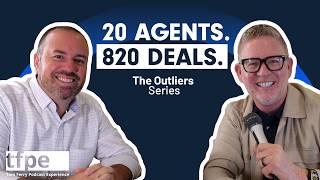
Doug Edrington's 20-agent Berkshire Hathaway team in Chattanooga scaled from 520 deals in 2024 to a projected 820 in 2026. He runs a text-bot for lead intake, pulls 800-900 leads monthly from Zillow, Realtor.com, and Google, and uses AI coaching data to train agents. The shift from family business to merit-based operation meant letting go of control and redefining what success looks like.
Chapters
Have you ever asked yourself, why is it that some people seem to constantly outperform their potential? Call them an outlier. While other people with the best of intentions fall dramatically below or just below their expectations. And listen, they're not bad people. They set big goals, but they don't align their behaviors with what it is they want to accomplish. The next 7 shows, this quick little series I'm doing where I'm interviewing the outliers. What's the psychology? What's the mindset? What do they do that cause them to outperform their potential? Enjoy the show. Okay, so one of the lessons and insights from a 20-year veteran who started his brokerage, call it 8 years ago, as a team ridge, who in the last couple years has gone from 520 transactions in 2024 to 625 transactions in '25 and is pacing for 820 transactions this year. Always lots of lessons in that kind of growth. Doug, is this like the 5th time you've been on the show?
It's been a few. Thanks for having me back again.
Right. Of course. I mean, okay, legend, legend on like the FSBO role play, which was like transferable if you didn't ever work FSBOs, transferable to just good communication, being of value, getting to a yes, and all kinds of other team-related stuff. So for the person that hasn't met you yet, um, give— so 21 years in the business, Chattanooga, Tennessee, Berkshire Hathaway. Mm-hmm. Um, give them just a little insight on what the operation looks like today, the team, and then we'll get into a bunch of the nitty-gritty, then the psychology stuff.
Yeah. Yeah. So, you know, we're, we're floating the 20s of agents. You know, it comes up and down a little bit as, as we were looking for talent and identifying the right people. But on the operational side of, you know, I've got Heath, who you know really well, our COO. He has a full-time assistant. We have a listing manager. We have transaction coordination. We've got a 3-person marketing team. On top of that, we hired, as I told you, a really awesome year-old person, not old person, but year-old gal who is actually consulting with our marketing team for social media.
Shout out to Courtney.
Yeah, yeah, Courtney, Courtney. And so she just started with us. And so that's awesome. We're excited about that. Yeah, a few more, a few more employees to just help keep it all together. But it's, it's, it feels small, but it feels big at the same time.
Well, and mom and dad work there.
Oh, yeah.
It's a family business, which, you know, I love. I mean, my boys are with me. I was with my dad forever. That's exciting. Um, so there's a lot of things we want to unpack, uh, but when someone hears about a teamerage, right, so it's a brokerage operating as a team fully. Can you, can you describe what that means so just people get like the— if they've never heard that phrase before, what it means?
Well, I mean, a lot of people understand what a team is, and, you know, after running our team for 13 years with the same brokerage, we, we just blossomed to the point of like, hey, we've— we, we need to really control our culture because there's nothing worse than being in a meeting and then realizing that you're surrounded, especially when you're responsible for a team, you're surrounding your team around others that don't have similar goals. Yes. And so it's like, how do we control this culture? Right. And so we took the crazy plunge to say, hey, let's open up our own brick and mortar and let's roll with it. And relationship with Gino helped us out, you know. And so we, we continued with the Berkshire Hathaway brand and it's been great.
Love it. Love it. So again, fully operating as a team. So you're a, you're a leads team. You've got Zillow Flex, you've got Realtor.com. Google, past clients, Sphere.
Yeah, generating a lot of leads, right?
Generating a lot of—
yeah, I don't know if I answered your question directly, but I mean, yeah, we are a brokerage that runs exactly like a team. There's, there's no solo agents per se, right, as the industry knows it. But, but there's a lot of individual personality within each person. And I want them to also be able to embrace that along with the brand of the team.
Yes. So you've also been able to maintain like an incredibly high per-person productivity, right?
And yeah, last year it was like 28, 28 units per person last year, which was great.
Which is— I mean, do you have anybody on the team today that's doing like 100 deals on their own? Like, no, not like your dad.
Not now. You know, he, he was trending that way, and finally he's like slowing down and doing like 60 deals a year, you know.
That's funny, slowing down. Your dad's a legend.
Yeah, you know, I think he was up near, near 90 at one time, so, uh, but, um, But yeah, no, uh, we're not quite there yet, but I can see it coming. You know, a lot of times we've given opportunity for some of our top agents to figure out, okay, how can they make money through other avenues, right? Um, and so taking on other responsibilities. So, so I think we have people on our team that absolutely could do that if that was the focus, if that was the goal. But, you know, 100 houses, that's a lot of houses.
That's a lot of transactions.
Yeah, we have a handful of agents that have their own assistants within our team too. So, uh, I mean, yeah, it's, it's, uh, it's It's, it's, it's not always about who sells the most houses, even though we're like super competitive.
Sure.
Um, and our team does sell the most houses in Chattanooga, but it's, it's, it's like that quality of life. How do they make the money so they can have the life and have the freedom that they want?
Love it. Love it. So one of the things we were talking about off camera, I think it'd be interesting, is we're talking about the, the role of a CEO, a leader is, um, you know, famously Tony Robbins has talked about this for a gazillion years. He would say it's pattern recognition. And the way he would describe it is he said, you know, like, if I took one of my kids when they were like 12, and they were like, hey, Dad, let's play a video game, right? I would get on there and I'd be like, I don't know, right? And they get on with like their eyes closed. They go bing, bing, bing, bing, bing, because they know the pattern. They know what's gonna happen next. Where someone like me, I had no idea. So I always felt sort of lost and confused, which is how a lot of people feel in the market, right? Senior people, experienced people, brand new agents, everybody in between. Like, What's really happening in the market? What do I do? So I'm just curious, like, what are some of the patterns you see that if someone was listening right now and they want to make sure that they're not, not so far on the cutting edge that like they might get in trouble, but like they're paying attention to the most important trends, the things that are impacting our industry today, what would you say that kind of 2 or 3 of those are?
You know, the— we're in a world of so much lead generation, right? Like, like especially from a team perspective. I mean, I think we're I shouldn't say I think, I know we're floating between 800-900 leads a month.
Yeah.
And one of the patterns I've seen over the years is, is, you know, one lead source becomes really exciting. And then, and then what ends up happening is I think we take it for granted, we get accustomed to how easy it is, and then that lead source changes on a dime. And it's just like all of a sudden the way it's delivered to you, or, you know, arguably the quality of the lead, which just means where are they at in the funnel, cost of the lead, the cost of the lead, definitely. And so So, you know, what, what seems to happen, you know, especially when you think cost, you know, you know, referral fees change or the cost per lead changes, and next thing you know, you've got to implement that either in— either if a solo agent's buying that lead on their own, you know, they've got to think differently of like, is it worth it or not? As a team leader, you know, they're accustomed to what they've received, and when you change a single thing on them, it's like, how do you get them ready for that change? So, so, you know, you got to make sure that I feel like every month you're reintroducing old ideas, you're constantly introducing new ideas at the same time. But, but you've also got to keep running the drills over and over again, right? Because it's, it's easy to— for people to get to a place of entitlement. And I don't mean that like— I'm not sitting here knocking on my team saying that they're entitled by any means, but we— I get entitled when I'm used to one thing and then it changes. So, so I mean that in a, in a natural way. When that changes on you, it's like, okay, are you willing to move fast? Yeah. When we were walking over here this morning, you were like, man, it just so many things are happening so fast.
Right.
And so making sure you or your team has a really good mindset around like, this is the wave we're on and waves die.
Yes.
But the next wave comes.
Yeah.
And so, so it's, it's, it's crazy to think you're just going to ride the same wave forever and ever and ever. It's going to change. So, so having that, that mindset of, of being mobile to bounce from one scenario to another, it's really, it's really important and valuable if you can maintain that, that culture.
So, so stay on that. Let's pull on that thread for a second because I think one of the important distinctions we've talked about forever is, um, you, you can't just marry one lead source. No, because if you do, something can change, right? But then for a lot of people where they struggle is, you know, first of all, how many leads can, can an average agent really manage effectively, right? So if you have 800, and for easy math, I don't know, you had 40 agents to make it easy, right? So we know how many leads everybody gets the first month. But then they get the same number the next month.
Oh, it's, it's too—
and then the same number the next month and the next month. And all of a sudden, now they're potentially buried. So, so for a lot of people, maybe the person watching, I don't know, maybe that, that's what they're trying to get to. And I think the answer for them is it's having a multiple strategy, like not just putting all your eggs in one basket, having lots of different eggs across lots of different baskets. But how do you recommend— like, your team could probably feel the same thing other teams have felt. And some agents, they get hot on one open house, and they got like 80 people that come through back in the day and they're like, everybody wants to buy the house. How do you manage that?
Well, you know, if you look at it from a perspective of like, okay, what's the challenge that we had? How do we face it? This was a challenge we, we were facing last year because our team in Chattanooga, I mean, we've been known as like, okay, you've been the Zillow team for a long time, you know. Historically, for the past couple years, we've had about 27% of all leads in our market. Yeah. Okay, just recently through all the turbulence, crazy, you could say the craziness that's been going through, they just bumped us up to about 35% of the marketplace. And like, so we just got a big lift, believe it or not, um, with Zillow. Simultaneous last year, we just bought out realtor.com, which is like a very rare thing. And then I'm just finding out that realtor.com now is working with us to where, you know, they, they, uh, there's other agents in our market that, you know, claim they have realtor.com. All they're getting is our overflow, because if we can't— if they can't connect with us, they send it out, and then they actually kick us a referral back. And so, so it's like we're still making money even when our competitors are selling a house, right? So, but I say all that's the market VIP product, right? Right, right. Absolutely. And so, you know, our, our first world problem is we are generating more than our people can handle.
Yeah.
And so now, so I want them to make sure that our clients are getting really good quality, the people they touch, but we just don't get to touch every single person. So this was like a problem that we were facing last year, right? And it was like, okay, conversion is going down, not necessarily because the quality of the, the transaction or the communication between the agent of the customer. It was just we aren't touching every single customer. So one of the things we did—
a leaky funnel.
It was a leaky funnel, right? And so last year it was like, okay, what do we do to solve this problem? And like, I look at it like there's like kind of 3 ways to do this or to identify the problem. You know, one is like ask your people, you know, it's like, okay, what are you, what are you facing? What are you going through? Because they are actually our team is in the trenches. They're the ones driving down the road and their phone is like, you know, ding dong, all the different things. And they're just like, what am I doing here? Right? So I want to know what that stress is going through. And then it's looking at the data. What does our conversion rates look like? And then it's also going with your gut once you have all this information for me. And so one of the things we identified is like, hey, we need to maybe restructure we need to restructure on how we're distributing leads. It's like, okay, it, it, you know, some people can handle a bigger load than others, right? So how do we make sure we're getting it to the right person? Then we started really playing with AI last year and had a lot of fun with it. So it's like some of these leads come through as we refer to as a registration lead. It's not always a live phone call. Well, I want to get those to our agents, but I also want to make sure that we don't drop the ball. So now we've got like the text bot going out and, man, it is Wow. I mean, you know this more than anybody. Like, like I'm role-playing with our text bot that— shout out to Ethan on our team who, who built this thing from scratch. This isn't a purchase thing. This is something we have made. Yeah. And it is impressive. Like, it's like ding, ding every day. It's like, schedule an appointment for one of your agents. Which one should it go to? And it's like, this is cool, right? This is really cool. And so a modern way—
I don't like call 5 restaurants. I go on like, uh, you know, OpenTable or whatever. It's the same exact— you're actually providing a better experience for the client.
Absolutely.
Okay, hey, I know I'm interrupting the show, but check this out. You know, when I built my business back in 2004, I was very clear: whoever gives away the most high-value content for free is going to win the game. And I think it's one of the big reasons why my company and my 193 coaches have been named the number one coaching and training company in real estate for 12 years going. But my question is, like, We do all this stuff on content and, you know, video, podcast. But have you ever been to tomferry.com/tools? tomferry.com/tools, T-O-O-L-S. If you've never been, you should check that out today because there is so many playbooks, systems, strategies, marketing hacks, tactics from top agents, from coaches. There's so much there. If you thought the podcast is good, tomferry.com/tools. Check it out and then send me a DM on your favorite social channel and let me know what you think. All right, let's get back to the show. Did you hear about the Chick-fil-A bot?
No, no, no. What's the Chick-fil-A bot?
So for—
is it open on Sundays? Is it open on Sundays?
Well, they created this Chick-fil-A bot and, and it— I think it was on Reddit where it got so viral. People were using it to like claw code. Like they were like, building on the Chick, which cost them millions of dollars.
I'm not following. What do you mean they're building on it?
Okay. So Chick-fil-A has their, their version of this.
Okay.
But it's a full large language model. So people were like, hey, analyze my taxes for me. Hey, figure this out for me. Hey, dude. Hey, I, I think I might have cancer. What do I need to do?
Like, no. That's hilarious.
So, so instead of it just being, hey, I'd like to get my order. Can I get this and that delivered?
Oh, they're having real conversations.
They started really going like, hey, let's do some therapy on my Chick-fil-A. So, so watch that. The safeguard is you got to figure out what is your— what is your monthly use? It's like with Jason and AI Marketing Academy, where I was like, like, what's the— what's the monthly usage? If it goes above this rate, we know somebody is not doing something nefarious. They're just having fun with your—
Yeah.
Yeah. So just fun, fun training.
Oh, we've seen all the transcripts of our bot Alex that we named him. Him or her.
Right. Are you anonymizing the data? Are you doing anything with the data? You know, like how we do with Revy. Every coaching session completely anonymized. No names, none of that kind of stuff. But then we're able to put it into our own large language model, and then we got all the behavioral analysis of all the best agents and teams that we're working with around the world. Have you thought about that? You might not have.
I just did now.
Okay.
A light bulb just went off in my head. That's, that's really interesting. I hadn't really thought about that. We've been doing this for almost a year now. So we probably have enough. I'd say we definitely have enough data to, to do something with that. So that's really interesting. So it sounds like another coaching call.
Well, so I'm talking to my friend and I'm, I'm talking to my friend here. What I would be thinking about is if, like, what are the top questions they ask? And what is the order and frequency of the questions that they ask? They're, and they're asking the bot over and over again. And, and you can then start to think about from a marketing standpoint, from an email standpoint, from an advertising standpoint, from an onboarding of a client standpoint.
This makes a lot of sense. That's good.
We, we figured it out through our process. We're like, hey, when someone signs up for coaching, they ask these 6 questions. And it's like, these 6 questions are the most important questions. So now if I was presenting coaching to an audience, I'd be like, there's 6 questions you're gonna ask me. 1, 2, 3, 4, 5, 6.
Tom, I love how big you think. This is— I just sometimes I'm just like, well, that makes a lot of sense.
Yeah, this is why we're friends.
Yeah, yeah, yeah.
We were literally drop— coming up the elevator. I'm like, man, I'm so proud of you because he's grown so tremendously. All right, so back on conversion. So one side of it is They're, you know, you got all these leads, you got multiple lead sources and that's big. But that actually leads me to one of the questions I wanna ask you. So how do you decide if a strategy is no longer working? What do you analyze? Is it people? Is it systems? Something's not working in the business. What's your process for trying to solve it?
Well, it's kinda like I said earlier and, and, and, you know, when we identify a problem, it's rarely we're sitting at the desk and we're, yeah, we're playing on the computer and figuring it out. Usually it's a phone call that comes and it's like, an explosion happening, right? And it's like, cool, this is a gift, this is an opportunity, there's a problem we got to solve. So, you know, if I'm driving down the road, it's, it's, uh, I start calling people. It's like, hey, what do you think of this? What do you think of this? What do you think? I start asking the people, right? But then there's also the data side of it. So I'm going to our COO, I'm going to our operations manager, and I'm like, okay, what is the data absolutely saying about this situation? And, and then it's like, okay, what can we test? To improve this? Sometimes it's just, it's obvious, it's so obvious. Yeah, but sometimes it's not.
No.
And, and so it's trying to figure out what do you do. You got to follow your gut at the end of the day. Um, there are some times where on paper, on the computer, it's like, well, it could, we should just be able to do this, but your gut says, you know, it's just not going to work out that way. Yeah, right. So it's, it's following your gut at the end of the day, but an educated decision based on the feedback from your people, the, the, the data, but But also, you know, I think you taught me this a long time ago. The one of the questions I always ask myself, what is the unintended consequences that are about to come from this decision we're about to make? Because if we're already in a—
one door, two door, Jeff Bezos—
if we're already in a tough situation, let's not just make a knee-jerk reaction to get into a different tough situation. So let's try to play 2 or 3 steps ahead. And oftentimes that, that, that's like, oh wow, we just, we just missed, we dodged, we dodged the ball.
Right, right.
And so, but But it is execute fast, be willing to make changes right away because we could, we could, you know, kind of talking about the problem where we were just dealing with, it was like, okay, some of it's tech, some of it's conversion on people, some of it's lead distribution. Yeah, right. And, and it's, and it's like, okay, telling the team, hey, we're going to be in the kitchen and we're testing. I don't know how this cocktail is going to taste when it's all over with, but we're going to at minimum shoot for 30 days unless there's a blaring obvious we've made a mistake and we're going to change it. Yeah, I think the transparency to our team is really valuable to keep them malleable to deal with this stuff.
I agree. You know, informed, involved, empowered.
You know, you and I both deal with companies in our, in our industry that, you know, they just make changes on you and you're like, I don't understand why. I don't understand the data. And it creates frustration.
You get informed by a press release.
Yeah, really?
Okay.
Yeah, yeah, that's, that's, that's the new thing, right? And so, so keeping them in the know helps them also be in the kitchen with me, and it provides feedback. I mean, generally we have a problem, we make like a Slack channel on it, and we're like, hey, this problem, I need feedback nonstop. And it's not for Doug, it's for all of us, right? And our clients. It's like we need this feedback loop to keep telling us what's going on, because if we don't have the feedback, you know, for some reason I thought the data said it looked good, but then I realized you're telling me it's falling apart, right? You know, so, right, it's important to know that.
Hey, I'm interrupting my own show with a little What are you doing August 3rd through the 5th? Well, it's going to be my 23rd, maybe my 24th. I should probably know that. Annual Success Summit, where thousands of the best agents from around the world gather for networking, idea exchange, and making strong commitments. So September through December are better than they were the year before. So I'd love you to write down those dates. And if you're interested, check out tomferry.com. Tomferry.com/success. That's tomferry.com/success to find out the best ticket rate, because I can't wait to see you face to face in August. Do not miss this. Mark your calendars, get it in there, and I'll see you at the summit. Now back to the show. A friend of mine once said to me, uh, always be cautious. We can interrogate the data so much that it'll eventually tell us what we wanted to hear. Oh, yeah. Do you know what I mean? Like, you know, it's gotta be this, right? It's gotta be this.
But it's like, it's like, like our, our, all of our AI bots that we're dealing with, like ChatGPT. I, I'm now jumping into the, like, the incognito mode every now and then because I'm like, I don't want you to bias. Don't tell me what I wanna hear. I like, I, I need a non-biased answer. Yeah.
I love it. All right. As you grew the team, what were some of the hardest things you had to let go of, right? Like the controls. What did you have to let go of? And then like, when you did, what happened?
That's a tough one. Um, kind of two things come to mind. One was letting go of production, which shouldn't be for everybody. And maybe we save that for later. Maybe you don't want to go there. I think the other one really is moving from a family business mind. Yeah. And I'm not even just talking about my family. It's like the people that have worked with us for many years, you know, we even say it in most small teams. It's like, hey, we're like family.
Yeah.
Um, but the reality is, is running a business, running a business is very different than a family situation. There's a head of a household and that person has to keep pushing in a family, and maybe the kids don't want to go to— it's not always America, wherever they need to go, right? And so it's the same thing in, um, in business. It's like, you know, maybe you've got agents to a point where they're happy, and as a team leader, you make sacrifices, oftentimes financially, to keep them happy. But there becomes a breaking point where if the company is not growing, it's dying. And so we've got to make some hard decisions, which can upset some people sometimes. Yeah, right. And so, um, you know, I'd say, I'd say like these hard decisions you got to make sometimes is, is it, it was harder in the past than it is today because the culture has shifted to a healthy operational business. Whereas years and years ago, it was, it was more that family business, like, hey, we're gonna go this way.
Yeah.
Or we're gonna spend money on this. And yeah, the meritocracy way of doing it, right, does— it just doesn't work at scale. What do they say?
It's like, uh, you know, small person, you know, family is like 5, then it's like a tribe, and then it's like a city or a village, right? Village, and then it's a city, right? And that's like you know, 5 people, 15 people, 50 people, 500 people.
Yeah.
And each of those has to be— it's a different management style. Yeah.
And it's not— and you asked me like, you know, what I had to let go of. It's not that we had to let go of people, although that has happened, right? Sure. It's letting go of the mentality that I've got to keep everybody happy. Yeah. Because it never— I've clearly understood that you cannot make everybody happy. But you can, you can work towards being respected by the majority of the people, right? Um, again, can't even always have 100% of that.
No.
But, but, you know, if, if, uh, I mean, there's decisions I make that, um, our team members will literally say, man, that was a really fun wave that I was on. I really like— I'll give you a great example. We had in, in testing, um, we had we had, uh, talking about trying to get conversion up, we had divided leads up based on price point. And it kind of makes sense, like, you know, if you're a really great salesperson, you've got the trends, you know, they— what do they want to be rewarded with? They want to be rewarded with either more, more opportunity or more valuable opportunity to them, right? And so we made, uh, we made a scenario where if you were in the top 10 agents on our team, you could set a bottom price point on Lead Flow. And I, and I— this is my idea. Yeah, I thought it was a great idea. Um, and they all were very responsible in the price points they set. They set them way lower than I thought they would have. Yeah, I thought they were going to be like, we're going to put them really high and be the luxury agents. Yeah, no, they set them like way below our average price point. They just wanted to avoid like lots, like, you know, like the— we're in Tennessee, like there's a lot of $15,000 lots. Yeah, well, by setting a price point, um, in our system really low, what it did is it forced a ton on everybody that wasn't in the top 10. And next thing you know, the, the top 10 had average price points of leads that were more than double of the average of our market.
Yeah.
And a lot of our other team was saying, hey, these leads suck. You know, we've heard that before. And then I'm like, wait, wait, wait, leads don't suck.
It's all the same leads.
But then I dug into it. I heard the feedback, then I looked at the data. I was like, oh man, this does kind of suck for them. And so we made a quick change. Now the guys at the top, I went to them, I was like, hey, that was a fun ride for you guys. It's not sustainable. But also what I'm scared of is, you know, I'm making the decision now, but the market may make a decision for us later.
Yeah.
And the, the, what you're used to in that high price point may not be there for long, whether my decision or your decision or the market's decision. And what, what is that going to do to your head when all of a sudden you're getting half the price points you're used to, where all of a sudden you're going to say, oh, this team is no longer for me because, and now I need to go out on my own. And we know that story. Yeah, like, you know, any agent that has ever left a team to go be a luxury agent became maybe an assistant for a luxury agent, you know.
Like, it's just rare that that doesn't always work out. Yeah, sometimes, sometimes, but yeah, it absolutely can, but man, it's rare.
So So I don't know, to answer your question, or am I just—
yeah, no, it's good. So yeah, but control is always an issue, right? Control for an individual agent who's responsible for everything, uh, control is an issue when you suddenly hire an assistant for the first time, say, you do the paperwork, but hold, let me do it. Hold on, hold on, not like that, right? So, so I think, think about when we were, um, in with Jill Biggs, right? And Robert Refkin came to our mastermind.
Yeah, that was interesting.
Yeah. And the question, you know, of like 20 that I asked him that day for us was, hey, so, so tell me about like 13 years ago Rob versus 13 years, you know, later today. What was the most important thing? You remember his answer?
Every 18 months, can't be doing the same thing.
If I'm doing the same thing I was doing 18 months ago, I failed as a leader. And that's a hard one. I know for some of my friends watching, especially if you, you're in a leadership role or you are, uh, you know, the, the— it's not my line, I don't know who came up with this, but like, yeah, I'm 31 years in the business, but I just repeated 31 years in a row. Meaning I just do the same thing.
It's, it's no, no, yesterday downstairs, like, like I wrote down at the end of the day, it was like, you know, you asked like, hey, what's circle of things you're gonna— you're focused on? And the one I wrote down is like, what am I doing 18 months from now? Because I can't be the exact same thing.
No way, no way.
So that was, that was a good wake-up call, a reminder.
So let's go back to pattern recognition. The first one you said was don't fall in love with a single lead source. That's how I interpreted it. What do you think is another pattern, something happening in the world today that the person listening right now to someone that's gonna, you know, running this monster operation, number one in the marketplace per person production, you know, blah blah blah, all the, all the accolades. What are the other things you're looking at right now that you're like, oh, I better get on that? Or hey, this, you know, the train is starting to leave and I want to make sure I'm on the train before it's gone.
Well, one thing that we're really focused on right now is how do we, um, Porsche, correct me here if I'm not answering this on your, on your tracks here, but we're really focused on how do we generate more opportunity where the customer wants to actually meet an agent before they meet a door.
Yeah.
And because if you think of like the value of a consult versus let's just go look at a house, right? I mean, because we're generating, we're generating leads left and right that are open a door, open the door. And don't get me wrong, love those leads because it gets us in front of new people.
Right.
But, but what we really want to focus on is, is how are we, how are we changing the consumer experience to say, you know, you know, buyers shop for homes, the smart buyers shop for an agent, right? Because there are too many agents out there that can answer a phone and don't have the experience, or are part-timers, or, you know, whatever, right? And so So we, we've, um, we've, we've kind of played with this on our site, you know, theeddingtonteam.com, um, in Chattanooga. Like, we've— and we're running ads behind just a section of our site that is, that is like, uh, we jokingly call it like the Tinder of real estate, swipe left, swipe right. And we're giving the consumer not just the power of choice of houses, but we're giving the choice of agents. And, and we're running ads behind it. And every single— like, literally right now, we're like one for one a day. Yeah, we're getting a lead one for one a day. And they are choosing an agent, you know, shout out to Jordan Taylor on our team. She is, she is, she just loves animals more than anybody I've ever met. And she's one of these individuals on our team that says, you know, for every home I sell, I give a portion of proceeds to the local, the local McCamey Center. And, and but they house dogs and that sort of thing. And so One of the— when we launched this, you know, she was one of the first ones that got a click. And it turns out, veterinarian. And she's like, I need to buy a house. I also need to sell a house and I don't have to sell it first. And so it was like under contract, plus the listing, on and on. And we were like, is this a fluke? Are we on to something?
And so it's called Match.com. Our friend Spencer Raskoff now runs it.
That's what it is.
You're like, yeah, you're like, before you see a door, go through these faces. Which one of these faces is early Facebook, right? Like, yeah, who looks cool?
So we've been having fun with that. I love that. We've been having fun with that. That's working. We're working on pushing it further. We just— we stole some of our friends' ideas. You know, we're talking about Jill Biggs a little bit, but, you know, stole her billboard idea, which has worked really well. We just put plastered 12 billboards across Chattanooga. I don't know if I told you that.
You haven't told me.
Yeah, we got 12.
I would have showed it yesterday.
Yeah, we got 12 across downtown.
What does it say?
Oh no, no, it's the, it's the, we sold 625 houses your cousin sold too. Like, you know, yeah, yeah, yeah, list responsibly. The best compliment is stealing Jill's ideas with her. I did reach out, I was like, hey Jill, so I need your permission.
You guys are too close.
I was like, I need your permission, I'm stealing your billboard.
Doug, as long as you put my face on there, you put my, my hair on you, right?
Real small down the corner. Um, but you know, uh, we're working, but I think, I think the next version of our billboard is, because you've always We've talked about billboards for a long time. We haven't really done it because you're always like, what is one thing that you can do? Yeah, that no one else can say they can do, right? And so I think, I think where we need to head next with the billboards is probably start advertising this. And I don't know, it's something we need to work on probably off camera, but it's like, what's the right messaging so consumers can understand we are the shop that you can actually choose an agent? Because have you ever walked in a car dealership?
Do I tell them the ideas that I'm thinking about right now, or do I Save that. What do you think? Um, see, I wanna see it in the comments. I wanna see it in the comments.
If, uh, don't tell 'em on camera if, if it's gonna— yeah, I'm just kidding. I— no, no.
You know what I would do though? I think I would write a— I would test a series of blogs about the mistakes, uh, that people make when buying in this neighborhood. The mistakes they make when they're buying it. And I would do every single community in your marketplace, the mistakes that they make.
Okay.
And how to avoid them. Right? Like, hey, they overpaid. Hey, they, you know, the deal fell apart. Hey, they, you know, they, they were shopping in the wrong price point. They didn't meet with the right lender. But it all should just come back to what you need is a consult before you look at doors. Look at, look at doors online. The modern buyer, maybe this is it, maybe it's the modern buyer, right? But people want to avoid mistakes.
So you're saying like the consumer is shopping for homes, they maybe fall in love with an area, they start doing their homework on the area, they trip across the blogs and through AI, probably of some sort. And then as they read that, they're learning more about who wrote it. And then next thing you know, it's I need an agent before I— I love that. I love the funnel.
And then, and then click here to select the right agent for you, right? Like, first of all, just the consumer choice side of what you're doing, I think is brilliant. And I think a lot of people are going to be like that if you have a team, right? If you're a solo agent, you're like, it's me, you know what I mean?
Well, there's nothing worse than walking on a car lot and then that car salesman walking to you and you're like, that's not my guy. Oh my God. Like, like, but that's the one that's walking towards me because it's their turn, you know?
100%.
Imagine if you could walk into a car lot and you actually got to— here's the lineup and I would like to go talk to this person, right? Oh no, I want to go talk to this.
I want to ask all of them a question. What kind of car do you drive? Yeah, you know what I mean? Like, I'm at the BMW dealership and none of them drive BMWs. Like, what's going on?
Uber to work.
Yeah, you try and recruit them. So I think, I think something around— I would test something around the mistakes to avoid when buying in Community A, B, C, D, all individual blogs. Okay.
I like that.
I think that could be really interesting, but then I would also think about going back to the data side of what you have inside all the chatbots. Right?
So— Yeah. What, what questions have people been asking?
You know, I'm just giving, like, a hypothetical. Right?
Sure.
So, so, you know, in the last, 12 months, 11,493 home shoppers in Chattanooga asked us these 5 questions. Something like that. You, you know, kind of Jay Abraham, big, provocative, interesting hook.
Absolutely.
As a headline. And then that could be an ad, that could be a blog, that could be a video that you shoot or somebody else shoots. Um, I think you're sitting on a goldmine with— I mean, the data I've got, I've got data from 2017, every coaching call, right? Mm-hmm. Through a pandemic, through interest rates at 8%. So you, you start to see the patterns of what's important, what's not important. And I think what you're sitting on and the insight around what you're doing with the sort of match, like pick, pick your agent. I mean, it's, you know, Spencer Raskoff, right? He's got Match.com, uh, Christian Mingle.
That's crazy.
Yeah. I mean, so former CEO of Zillow is now in charge of Match.com, and I think they have like 8 or 9, you know, like dating sites. Christian Mingle, Farmers Only, like that kind of stuff.
Are you an investor?
No, no, no. He was— he, you know, the company was already public and he came in to take it to a whole new level. And Spencer's— I was just texting him a couple days ago. Yeah, a super smart guy. Dating, real estate, you're putting the two together. I think it's brilliant.
We'll see what happens.
What do you guys think?
Well, I know what's—
in the comments, in the comments, we need to know what do you guys think. So I'm gonna throw a couple things to you, and I wanna just get your input. So you, you've flirted with AI, and you've mentioned AI, and you've implemented AI. Leads, AI, YouTube video, because of the connection to Google. Right? Like, that just makes sense with Gemini. Gemini, I don't, they don't really publish as, as often as I would like the data behind which AI tool gets the most. We're seeing a decline in ChatGPT. That's kind of all over the news now. I think people have kind of figured out that Sam Altman might be right. You know, so Perplexity, Groq, Claude is now being used kind of as the same way with a large language model, but it's obviously more than that. But, man, I think a lot of people, including myself, including myself, 18, 20 months ago, I was like, man, Google's missing the mark. But when they came out with Gemini, I'm like, checkmate.
It's making sense.
So YouTube, I think that's another big opportunity for people. What are your thoughts on that?
I mean, I'm going to listen to my coach because you're on top of it and I'm trying to run a team, right? And so, you know, you know, I'm just excited because we just hired, as I mentioned, you know, we've hired this consultant in marketing and she worked with you for a long time. And I'm just like, I feel very aligned because it's, you know, the who, not how mentality. So So yeah, I mean, yesterday I was texting her, texting Heath, and I'm just like, hey, we're doing this right, you know, just making sure. So, so that's, that's what's next for us.
Courtney. Courtney's awesome. Okay, uh, two last questions. What does coaching do for you that you and Heath can't do on your own?
Um, gosh, it's like, it's like we're, you know, so a little analogy, it's like we're, we're walking down the path and then you got Tom Ferry flying over with the flashlight saying, watch out watch out for this, watch out for that. And we can't see it coming because we, you know, I feel like we've experienced a lot, but you and your organization has collectively experienced a whole lot more.
Yeah.
Right.
And so, so it's like crowdsourcing danger and victory.
It is. And, you know, you can't— in some really hard decisions, like you just can't throw it out on Facebook and say, what do you guys think about this?
Right?
You got to have someone on your side.
I don't recommend, do I fire my best friend?
Let me know in the comments. Yeah, yeah, yeah. I mean, there's just some things you just can't share, right? Uh, it wouldn't be wise at least. So, you know, uh, you know, you guys help us put a spotlight on everything that we're, we're not seeing yet. I mean, I just ran a project past you yesterday and you were like, no. Yeah. And I'm like, okay, I've got to reframe this. So, but it puts me in a challenge to figure out, okay, I'll never forget, uh, I don't know if you remember this or not, but I'll never forget when, you know, we're at the team, I'm telling you, I'm thinking about starting a brokerage. And you were like, put it on paper, let's go over it. This was 9 years ago or so. And, and after we go through it all, you said, do you remember what you said? No, you said I would not invest in that company.
Oh, that sounds like something I would say.
Yeah. You said I would not invest in that company. And I said, why?
What did that mean to you?
Well, I was like, I can get Tom Ferry's money. No, I'm just kidding. I was like, so I can change this a different way. No, no. But it was just like, okay, obviously I'm not asking for investment, but of course I would want everyone to say, I want a piece of that, right? And, and you know what's funny? It went exactly how you said it would go. It was, you know, I had this list, I thought these agents would come, I thought it would go this way with traditional broker, 90/10 split.
Yeah, all these different things I thought was gonna add up all your resources that weren't on your team.
Yeah, you've been there, done that with a few.
We've all been there, of course.
And And so, so it forced me to change the path. Now, I was stubborn in some ways and I hung on to some things. I was like, no, no, no, I believe in myself. I've got it in my head, which I think is still important to do sometimes. But, but there were many things that, that you cautioned me on. I still, I still took a risk on and it went exactly the way you said it would go. And it was like, okay, let's pivot as fast as possible. But there were enough things that we still did that you told us to do course-corrected us, right? That kept us in a healthy path and going in the right direction. So, so, you know, I mean, there's, you know, it's just like there's the spotlight and having the coach there and the right coach. And but then the other part to it is the ecosystem. I was going to ask you, I mean, you know, like some of my best friends are— I mean, you're the, you're the master connector, right? And, and, you know, there's a client who at this event that we're at of yours that came up to me yesterday and, and I had not met him before. And he said he's been in the ecosystem for 3 years and I had not met him. I hadn't heard his name. And I, it was rare for me in this environment, in this room that's in that I hadn't met him. I was like, how long you been in coaching? And he said, about 3 years. And I said, really? And he says, I'm a, I'm an introvert.
Yeah.
And I was like, But are you? Yeah, because you just walked up and said hello, and you're also in this room, and you're in this room. So maybe it's your—
birds can't be, but maybe it took you 3 years to grow for it.
And, um, and I literally asked him— you'll probably like, like want to smack him when you hear this— but I was like, are you in a mastermind group? And he says, what's that? Really? And, and so we had this super deep conversation.
Yeah.
And, and I'm not wanting to overcommit to another mastermind group, but I immediately was like, I looked around the room and I saw this person. I was like, hey, you need to meet this guy.
Yeah.
After I explained to him what a mastermind group was.
Yeah.
And I was like, you know, you just need maybe 5, 7, 10 people max, probably too many.
Yeah.
And you guys just need to use— you'd be the boss of it. You just set a time, send out the Zoom link and say, hey, we're going to meet every time this week.
Yeah.
And, um, you know, I mean, it's magical. It is. I mean, for me, like East Coast Mastermind, right?
Right.
You know, I mean, that thing went for like 8 years. A long time. And, and, and there was a chapter where it was time to really close that down. But we're all still besties. Like, we— and you look at it, it's like the call doesn't— isn't needed anymore because the text thread still goes on. You know, it never ends, right?
Yeah. And everybody in that group is a legend today.
I mean, you know, it was a special, special group of— it is a special group of individuals that I don't know, but we wouldn't have had that had it not been here. Yeah. And, and I remember it starting in the beginning. I was like, wow, these people are not in my market, they're not in my brand. I got to eliminate some brands that I could see as competition that like, I don't want those people to be in it. And it was— and we all felt the same way.
Yeah.
And, um, we were all at different levels of our business and, uh, and we all had something to give. And so then it turned into traveling together and having fun together, like, you know, hanging at the beach. Some people are like, oh, I don't want— I don't need someone else to vacation with. You don't have to do that. Yeah, but if it's a good relationship, it's probably going to evolve to that.
Exactly, exactly. Well, all right, so as we wrap this, uh, first of all, do you think that I, uh, when I said to you I wouldn't invest in that company, do you think that was personal or do you think it was just business?
I think it was both. Like, from a place of love, you take it personally? No, no, no, no, that's the thing. I didn't take it personal at all. Yeah, when I say, when I say it's both, and it was a personal— Tom's like, I don't want my friend to screw up, right? And so it was more than just business, you know. So, um, so I appreciate that. Yeah, thank you.
I appreciate you. If they want to reach out and talk to you, whether they're a broker owner, a team leader, or an individual agent, if you, if you are on my YouTube channel and you search Doug Edrington, you're going to see he's been on my show a bunch. That the FSBO script stuff, still, like, anyone—
yeah, that's fine.
Like I was— I saw on your YouTube channel, I watched the Doug Edrington, I got my first listing. And I was like, yeah, I mean, it was really good stuff.
Yeah, thank you.
And today, this is the, the more mature, more evolved, you know, even better leader version. So like, I can't wait to watch the show again.
I appreciate it.
And we're gonna work on a couple of these projects. I already know.
I know we are.
So how do they reach you if they want to connect?
Um, you know, Doug Edrington, you know, yeah, Instagram's the best way. You know, my cell phone is on every website, like like all of us realtors are. So, you know, reach out in any way, shape, or form. Um, Instagram's probably the easiest, so give me a follow. Love to connect. Um, if you follow me, I will reach out. Uh, I want to know— I want to know who you are. I want to learn something from you.
Yeah, that's smart. That's the way to do it. So can't wait to read the comments. Maybe send this to a friend that might be in a situation where they're like, hey, I need to scale. I need to stop doing what I'm doing, you know, for the last 18 years, every 18 months, got to make that change. Um, I appreciate you, and I appreciate you. Thanks so much for watching the show. Hey, if you're listening to this in a podcast and you're saying to yourself, I might be underperforming my potential and I want to become an outlier, go back to the show notes, click that link, schedule a session with one of my teams. Let us help you become the outlier you deserve to be.










