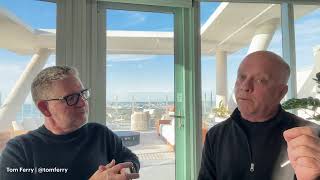
Tom Ferry interviews realtor Kirk Kessel about what separates top performers from the rest. Kirk credits consistent daily routines, data-driven decisions, and rapid corrections when goals slip. His team uses an AI coaching tool called Revi trained on real sessions to keep everyone accountable.
Questions this video answers
$94 million
About $400–420 million (team), with the whole team a little over $500 million total for the year
43 years
Approximately $1.2 million
In the high 60s (around 60–70 transactions)
Chapters
Happy Monday, wherever this finds you in the world. I'm sitting with one of my closest friends on the planet, Kirk Kessel. Compass Real Estate, Melbourne, Florida. Space Coast. Kind of, you know, think, I guess, to be east of Orlando. Cocoa Beach.
Cocoa Beach. Vero beach area. Yeah.
So. So you're sitting there and we're interrupting your day, and we thought we would share why we're interrupting your day, and I think you're going to appreciate it. Kirk did $94 million in personal production last year. He and his business partner, Dwayne, they worked together. And then how much volume and transactions did the team do?
The team did another 400 and almost 420 million. So we're a little over 500 million this year for the team.
So most of us can't relate to having a team that can produce $400 million in volume. What we can relate to is what does it take to be the kind of person that can go out and consistently produce, in this case, just shy of $100 million. And so, for the record, your average sales price is 15, 20 million.
No, no, no. My average sale price is about 1.2 million.
So.
So for Dwayne and I. Yeah.
So your personal transaction count is like in the high 60s, kind of in that range. 6,070s.
Yeah, exactly.
So. So here's the. Here's the thing that I got a ripple tick. Well, you know, not bad for guy that barely ended in high school. This is a live show, ladies and gentlemen. By the way, we are live in San Diego. We're about to do our annual elite retreat conference where we're unpacking. What is it that the outliers do? The people that are over performing their potential versus some of our clients? Now, listen very carefully. If you're a client, you're watching this. They have a goal here, but their behaviors are here.
Correct?
They have a goal. So I would say they're underperforming their potential. They know they can do this much, but they're only doing this much. And the key insight is it's their behaviors, right? It's their behaviors. Kirk has a different set of behaviors as an outlier. So I have six questions I want to ask you, and I think this is going to be extremely valuable for you. And by the way, I just interviewed seven other agents like Kirk about what they're doing. So watch for that to be released on my podcast and of course, on my YouTube channel. So, Kirk Kessel, how long you been selling real estate now?
43 years.
So does somebody have to be 43 years in the business to become wildly successful?
No, absolutely not.
Can somebody do it in 18 months, two years? What do you think is the appropriate time when either you begin to grow like crazy or you flatline and repeat the same year over and over again?
Well, I don't think you flatline. I think you just look at what you did last year and you say, how do I improve it? By 10 or 15%?
Yes.
And we constantly work on consistency. I mean all the interviews you've done today with all the other agents, it's, they're all consistent. They get up at 3 o' clock in the morning, 4 o' clock in the morning, 5. But they do the same thing seven days a week and that's how they're producing what they produce.
You don't have to get up at 3 o' clock in the morning.
You do not. I don't get up at 3 o' clock in the morning. But we did meet someone that did. Yes.
So, so one of the things you'll. For all my coaching clients, you know, we, we built this AI solution called Revi. And Revi is, it was Tom, then it morphed into Revi. And what this means is we took an approach with a large language model like an AI tool. The unfair advantage that we have is over 230,000 completely anonymized coaching sessions. So you're never going to hear like his coach, Jason working with him and Dwayne and them talking about like who's sleeping with who in the office.
Right.
Like all the personal stuff goes away. It's the business stuff, it's the data, it's the insights, it's the marketing, it's the tactics. That's what we were able to basically teach and use as a learning tool for our AI solution. What we've done recently is we've quasi announced that we are now the only coaching company that I'm aware of that within six sessions I can map your behavioral outlier. Are you going to be that person that goes out and performs at a really high level or are you going to be that person who sits, sells a lot of real estate, never has enough time, always frustrated, always kind of in maybe a state of pressure cooker drama? They're underperforming their potential. There's six things. So I'm going to ask him some of those questions and we're going to unpack his six things and I think for you, I think it's going to be really valuable. And it's a live show. So what the Heck, here we go. Question number one. Kirk, walk me through the last time you missed a goal, and what did you change after doing?
So we started out a little bit slow the first quarter of the year, and so we ended up catching up. And we had several other people on the team do the same thing. We had several that started out really well. The whole goal was, okay, if we're behind in January, what do we have to do to get caught up in January? And we doubled up on everything we did in January, and we caught up. We exceeded our goal. Our goal was to do 80 million, Dwayne and I, and we did 90, almost 4 million this year, which is the best we've done. For the year. For the year. But. But we. We missed that. We missed our goal, you know, one month, and then the next month we're like, hey, what are we going to do to get caught up? Yeah, we never wanted to get a whole quarter behind. That's really hard to get.
So you said January twice. Like, we missed January. Then we had to get caught up in January. But you meant, like, we miss our results in January. Now we got 28 days, which means.
We were probably doing too much partying over the holidays because December is what brings in January's income.
How often do you miss goals? Like how. How often do you two miss the target?
Not often. Not often. We miss it sometimes with the team because we're trying to focus for the team. We want our whole team to build a produce. So, you know, our goal, Our goal is to do a thousand units. We don't buy any leads. I mean, you know our whole story. Yeah, we. We do it all organically. So if we're doing a thousand leads, we're making phone calls, we're doing YouTube, we're knocking on doors, we're hitting our sphere, we're doing company events, we're reaching out to the community to do that stuff.
We call that low acquisition cost, high profitability.
Yes. So.
So you answered the question perfectly, which is, hey, if you miss the target, it's what do you do the following week to get yourself back?
Immediately. Immediately. Don't wait a month.
So question number two is, how did you decide whether a strategy isn't working versus you haven't done it for long enough.
You haven't met Duane long enough. Duane analyzes everything, so he's got a metrics for everything. So even when we do marketing on a property, he can look how many people have seen the house, how long they were on the house. Do we have the wrong picture? On the front page. I mean, he'll literally sit down and analyze every single property. He does the same thing with the YouTube. I mean, he's very analytical. So if you're not analytical, you have to have somebody on your team that is analytical that can look at that data. It's all about the data.
Exactly. So we talk about data driven decisions all the time, versus the emotional reaction, versus the shiny penny, the next new thing that gets in your way. So what about this question? What's the behavior, your business that you do even when you don't feel like it?
It's the same routine every day we just talked about. Number one, I get up every morning at the same time. I do, I do my exact same routine all day long. I do Bible study, I go to the gym five days a week. I play tennis three days a week. I go to yoga two days a week. I mean, and then I'm at the office. My first appointments at 10, my second one's at 12 and my third one is at 2 o' clock and I don't do any appointments after that. All I do is wrap up my day after 4 o' clock in the afternoon. So it's the same thing every day though.
Okay, so have you had any days in the last 43 years where you didn't feel like doing it?
Yeah, many, many days. Yep.
So, so what is the difference, do you think for you, like, hey, Kirk, it's in your schedule. You don't have a choice. Like, why do you show up and perform at your best regardless?
I love what I do. I mean, it's one of those things I don't need to work. I mean, I do development, I do a lot of other projects. I do a lot of my gints. But I love what I do. So for me, it's at the end of the day, it's like, what's going to motivate me to get me to, to that next goal? Is it making 2 million? Is it making 5 million? And then what? What is the purpose of making that money? What are you gonna do with that money?
Right.
In our case, we both want an airplane.
He wants an airplane. I want to fly out. Yeah, so. So what's something in 2026 that you're leaving behind in 2025? What's something you're going to stop doing?
Boy, I have to think real quick. We've ramped up on some stuff. We've ramped up on a magazine. We do a magazine that's extremely profitable. We get anywhere from three to Five listing appointments per month on that magazine. The big thing that I think we've changed, and we're still doing the state of the market, which you got us to do every single month.
The blogging specifically around our whole AI Large language model strategy hasn't killed.
Yeah. I'm trying to think what we're gonna know.
What if you stop. Yeah. What are you gonna stop doing?
Oh, boy. That's a good question. Because everything.
Do we need a photo, Freddie?
We probably gotta call Dwayne. Yeah, yeah, yeah, yeah. Because the reality is we tweak it so often. Yes. I don't know that I would say we're going to stop something specifically in 2026. I would say we're going to stop something every month. And so we might run a program. We might run this magazine for six months. If and we make a decision, is that magazine going to work after six months or 12 months? They don't work the first month. You're not going to send a magazine out and get five listed calls. It just doesn't happen that way. It's all about consistency.
I love it. All right, so. So when results stall. Because they all stall for all of us. When results stall, what's the first thing you begin to examine?
What we're not doing. Right. Meaning are we making the phone calls? I mean, we still. After 43 years, Dwayne's been at 30 years. We still make our phone calls every day. Every single day. I've got a list of phone calls I gotta make. And the goal is to set the appointments. The goal to set three appointments per day. So.
So you. Something is awry. Right. A lot of people will say things like just, the market just feels weird. Right. And your. Your facial expression told me everything. Like the. The outliers never say the market feels weird. They're like, what am I doing? Yeah, what am I doing that is causing weirdness?
Exactly.
What is. What am I doing that is causing my listings to be stale and not sell right now? What am I doing? It's always internal versus external funk.
So. So, for instance, when we go on a listing appointment, Joy and I typically go together. We take Leslie, our ops manager, with us. So the three of us go. It's a. It's three dynamics. She creates the whole team. It's really nice that the dynamics are great. We don't get in the car, though, and talk about problems. We get in the car and practice for that listing presentation. So when we get there, we're ready to go on stage. I mean, if you're if you're doing an audition, which is what we're doing, we're auditioning. So when I get there, I don't want to be thinking, oh, I got a deal that's falling apart. I'll deal with that when I'm going my appointment.
Right. Especially we're talking about a multimillion dollar property.
Talk about a 400. It doesn't matter. Anything. Yeah, anything. I don't want to lose any listing.
But, but every client gets the same sort of professionalism and I know everyone watching the same course.
Right.
That's what we do. But I think it's fascinating to hear a 43 year veteran with a 30 year veteran partner who now bring their ops manager on every appointment because she's going to be doing a lot of the work anyway.
She pulls it all together and then what she, what she also brings is she brings a really soft, nice approach where Dwayne's really all about the data. You know, I'm the dancing bear that just jiggles and makes fun and has a great time. And then Leslie's like, hey, let me tell you how we're going to put all this stuff together and make it a pretty package.
Yeah.
And it works. It works. I mean, we're batting nine out of 10 listings.
So when results stall, you examine the tactics, you examine the data. Right.
It's always the data, Dwayne.
Yeah. It's not an emotional thing. I think this is, you know, if you, if you're looking for something to latch onto in 2026, it would be stop making decisions based upon emotions.
Correct.
Only make decisions based upon data.
Correct. Right.
And if you're like, well, Tom, I don't have enough data. Well, then start tracking and measuring everything. Because the numbers don't lie.
The numbers do not lie.
You're like, hey, I went on 10 appointments, I took six listings and half of them haven't sold yet. And they're draining me every single day. Houston, we should be able to self examine very quickly. We've got a conversion problem, we got a pricing problem, we got an expectation problem, we got a seller follow up. Like, you should be able to examine all that and make some corrective decisions last.
And when you go on an appointment, those sellers want to know that you know the data. So a common question we see a lot now is sellers want to know, hey, how many of those listings that, that you take are you selling? Dwayne can tell you exactly to the percent. It's 27.5%. That's every listing we take. And next year, our goal is to take more listings and sell more on listing. It's certainly a lot easier to deal with ourselves.
Just to be clear, someone else can say the same thing. Did you say what percentage do you sell or what percentage do you sell on your own?
What percentage of our listings do we double end?
Okay, thank you. Double said 27%. Some of us won. What now you only sell 27% of your listings.
We double in 27 and a half percent of our listings. And our goal next year is. Is to get up in the 30s. We want to be up around 35%.
I love it. I love it. So, last question. So, Kirk, because we've been best friends forever, like, we sat in rooms watching my dad. We were the only two young guys in the room setting goals, dreaming about what's possible. He actually did buy jets. I didn't. I look back at all those times, and the one thing that we know, especially when we look at the data now, 230,000 completely anonymized coaching sessions as the sort of learning mechanism for our AI. We basically see this one trigger, right? And it is. There's six. But the one I want to talk about specifically is when you have a coach, how do you interpret that coach and what the data set was? The outliers, the ones that are repeatedly outperforming their potential. Right. You. Works less than you could probably imagine. Those people see coaching as a mirror. It's like you're looking. You're talking to Jason. You're looking in the mirror, and you're like, okay, I need to get better.
Right?
What do I need to do? It's this very, like, one might say, that person doesn't need a coach. No, actually, it's why they have a coach, because they get a second set of eyes and a second set of ears. Examining and reexamining to make the appropriate adjustment to how my behaviors are showing up in my business that way versus the ones that are underperforming their potential. And again, I want to stress I have personal clients that are underperforming their potential. And you know, my clients, they are the rock stars of rock stars. But their expectation is here, and their behaviors are here. And this is the gap of their performance. And it's a big. And it could be hundreds of transactions, tens of transactions, millions of dollars in commissions, a hundred million dollars, that gap of performance. And what we see is this group over here. When they show up on a coaching session, you know what they do? They talk about the problem. Seven Times more than the people that are the outliers. The outlier goes like this. Hey, Coach, I had an off week. I totally missed Wednesday and Thursday. Friday I got back on track and I worked Saturday and Sunday when I had some scheduled time off. I'm up to speed with all my calls and I'm crushing my appointments. The non outlier, the underperformer, they show up and they're like, oh, my God.
It was such a trauma.
You're not going to believe. And then this is going on and that's going. They. They take all this time telling a story, and I don't think this is just me talking out loud here. I don't think it's an avoidance mechanism. I think they just need to release. I think they need to release. The challenge, though, is when you're in a coaching. I mean, imagine having a conversation with your child who's underperforming in school, and all they want to do is tell you stories about little Johnny and little Susie and everything and Jose, and you're like, wait a minute, all you got to do is do your homework.
That's it.
Do you know what I mean? So when I say to you, because we've been friends forever and you've been a coaching client back with my dad and then with me, you even were a coach for me for a while.
A while. A little while.
I feel bad for those people.
Me too.
Why do you coach today and what do you look for from the experience?
Now, the first question we ask our coach. We have two coaches.
Yeah.
We have Tasha and Jason. Love them both. Excellent. First question we ask is, what's the secret sauce that someone told you this week? Because they're coaching four, 40 to 50 to 60 people. I want to know what the secret sauce is. And if they don't know, they know. I'm going to ask that question. That's the very first question Dwayne and I ask every time we get on a call. What's the secret sauce? What's someone doing that we're not doing that's making them money? Because all we want to do is we want to work less and make more money. That's the goal. That is the ultimate goal. Work less, less, less. Make more or more.
Yeah. So it's almost like the coaching for you is you're crowdsourcing through your coaches. You go talk to all those people and bring us back the best idea.
Bring us back the sauce. Yeah.
Then how do you and Dwayne sort through what, you know, shiny penny syndrome is Real decision fatigue is real. How do you and Dwayne then sort through what gets action and what is a. Not at this time.
We're lucky if we get one, you know, one shiny penny thing each time. I mean, we're looking just for something someone's doing. Hey, this guy's doing YouTube me, this one's doing direct mail. Hey, this one's. And so then we decide, hey, is that something that we want to add to our, to our. Basically our, our, our bill, you know, is that something that will help us be a better agent? We always looking to service our clients more. So what can we do to give more service to the client? How can we get the household. We're in a neutral market. I mean, Florida is a neutral market. It's not a buyer's market, it's not a seller's market. You got to create something to get the people excited. And if it's, if it's a new property in great condition, it will sell. If it's an old property that got insurance issues, it will sit there and sit there and then what happens is, you know, we're, we've, there's a lot of expired stuff that we didn't have a year ago and we're working the expireds right now really hard. Really hard.
I've been hearing that from all the veterans and a lot of like one of the brand new agents we Talked to today, 35 listings taken in his first six months with US and ended up finishing the year at 32 transactions. He's like, I'm just calling Fizz Bos and expires.
Yeah.
He's like, I don't know any better. He's only two years in the business. He's like, they just look like people that raised their hand. So I love that. So as we wrap, I'm trying to do more lives. I don't know what kind of lives we're going to do, but right now I'm live from San Diego, California, about to go work with 2000 of my besties to talk about outliers and people that are underperforming their potential to try and close the gap and help people achieve more of what they want to achieve and do it with less stress, do it with a little less time, and really do it with more joy.
More joy.
That's what it's all about.
What we want.
We want more joy. So thank you for being in my community. We're going to sign off now. We wish you all the best. Have a great Monday. Hey, go set an appointment and think about what's going on up here. Think about some of these things we discussed. And how would you answer those questions? All right. Peace.










