Ultra Wealth Debit Spreads April 16th, 2024
Live teaching session led by Jerremy Newsome explaining debit spreads (option spreads that cost a net debit) and when to use them. Key concepts: debit spreads are directional with limited risk and limited reward, typically use same-expiration long and short options (e.g., bull call spread, bear put spread), and are often used to reduce cost of buying options or insurance (commonly implemented around earnings). Multiple real examples are given with explicit strike/premium math, plus broker entry (vertical spread) and margin/assignment implications.
Questions this video answers
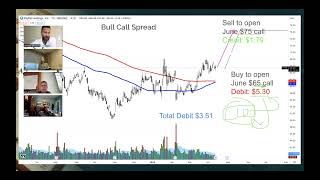
Buy June $65 call cost $5.30; sell June $75 call brought in $1.79; net debit $3.51; spread width = $10 → max profit = $10 − $3.51 = $6.49.
Buy 180 call cost $6.20; sell 190 call brought in $3.40; net debit $2.80; spread width = $10 → max profit = $10 − $2.80 = $7.20.
Chapters
Cool. So I got the two of you here. If anyone else shows up, I'll let them in, but I'll make sure I record it. For future reference. What we're talking about today is debit spreads. Where did the. Where did it go? It pulled up and everything. I was all excited. There it is.
Okay.
Debit spreads. And we talked already a little bit about credit spreads, about just how those are structured, what they're called, the names, how you can put those trades into the broker, that type of stuff. And we'll. We'll be doing a little bit of that again today as well, just so we have a visual identification how to do that. But we're talking about debit spreads today and just really kind of COVID what they are. And then later we'll be talking about ratio spreads and calendar spreads. So that we want. That's next week. So once we know a little bit about what types of spreads certain things are, we'll kind of start going into a little bit more of the advanced option stuff. So debit spreads are called debits because, as you likely have referred or inferred, they cost you money. But these are an asset since you were buying them. And so what that means is that, again, you have much more unique levels of protection with debit spreads. They generally don't require margin. I've never seen them require margin. It's just the actual cost of whatever it is that you're spending that's your max risk. A debit spread is. They are directional positions. And believe it or not, debit spreads are actually similar to a covered call when owning shares and selling a call against stock ownership, because if you do it with the same expiration, it works the exact same way. So I know. I'll show some visual examples of that in just a second. But debit spreads have limited risk and limited return profiles. So they are directional, meaning they only make money if you get the direction correct. But let's go look at an example of a debit spread. So we all know how buying calls works. So if you buy stock and it goes up, obviously make money. We all know that. And if you also want to make money, you can buy a call option. And if the stock goes up, then you make money.
Right.
We all kind of get that. But what if your analysis says, I think it's going to go up? I'm not totally, amazingly, absolutely sure that it's in a bullish trend. It might trade sideways for a while. What could you do? Well, in this exact example here, if you are buying to open a June $65 call. You would all agree that you're bullish on PayPal. We all know this is a bullish strategy. But here's a fun question for you. How can you reduce the cost of this transaction and still profit from the upside move? What could you do? Joe, what do you think?
They sell a call, but that limits your upside.
That's correct. It does limit your upside, but it still gives you profit if it goes higher, just like a covered call. So you are 100. Correct. You would actually sell the 75. In this example, you would sell a $75 call option. What that does is it still gives you all of this upside room, and it begins to cap your profits once the stock, or if the stock starts going above 75, what you'll notice. And again, we'll talk about this next week. But what you'll notice is these two have the exact same expiration. So if.
Yes.
Is that you. Is that you question, Eric?
I'm sorry, no. My wife had her. She's on customer service. I had to take her SIM card.
Out of her phone.
I'm back.
No worries. No worries, no worries. I just didn't know if you had a question. Yeah, so in this example, Scott, so you. You bought the June 65 call, and then you sold the June $75 call. Now, the cool part is when you do this as a debit spread, this can be done at any time, meaning you can buy the $65 call on a Monday and you can sell the $75 call on a Friday. You can do them simultaneously. In fact, you guys all know covered calls very well. When you do an option expiration with the exact same expiration, this works just like a covered call. It's the same exact process. The only small downside is you have something that expires. So, right. Stocks never expire, but these. These options do. So if you're buying this particular call option, this call option will eventually expire, right, in June. But this sold call will act the exact same way as a covered call, meaning you will spend money up front and you will bring some money in after you sell the call. Scott.
Are you still, in this instance, looking for one to pay for the other?
No. No. Good question. Very, very much like a covered call. This is going to bring in some premium, and that money will offset the cost of this purchase a little bit, but not very much. Yeah. And in just a moment, I'm going to show you some risk reward ratios, because really, when I look at debit spreads, I look at Risk reward ratios more so than how much the premium is offsetting by. I really look for how much money you can actually make in the middle. So we're going to go through that in just a second. But, yeah, great question. So think about this as the exact same way as a covered call, except instead of buying buying stock, you buy the call option. So you buy a call option, sell a call option against the call option that you own, both of them with the exact same expiration dates. Now, why do you think that you would do this, Eric? What's the benefit of this?
Can you tell me? So you don't own any shares? No share ownership.
Correct.
And what's the price today? 65. 44. Is that what we're using?
Yep, yep.
So you're going to pay for the ability to buy it at 65 and sell it. 75.
Yeah. And so. And so what you're doing is you're reducing the cost of the actual spend. That. That's really it. Like, you're just spending less money. And if you spend less money on something, you're decreasing your risk. Right. So this particular position is called. The name of it is called a bull call spread. We're trading calls. It's a spread because you have two different options, and it's bullish. So you can make money in this position if the stock goes up. In fact, you can make a lot of money if this position goes up, and it simply reduces the cost of your call option. So this is a, this is a real example. I took these just the other day. So if we're, if we're to buy to open a June $65 call on PayPal, we know that that's bullish. That's going to cost us money. Right. So it cost us $5 and 30 cents. If we sell the June $75 call option, that brings in money a dollar and 79 cents. And since they have the same expiration, all you do is just do the difference of the math and the total debit now becomes $3.51. That's the money that would actually come out of your account. So you have the difference of, Instead of spending $5 and 37, $5 and 30 cents, now your account would only spend $3 and 50 cents. So you saved yourself. You saved yourself some money. I don't know if I did that exact math right. It doesn't look like I did debit. 530 minus $1.79. Yeah. 3:51.
Well, when, when you're buying to open, though, at 65. If it goes past that, why would it be a debit? Because you're making money at that point, right?
Well, this, you're making money on the option. So the option will go up. The reason that this is it's a debit even when you buy the position. So if you don't even have anything up top, the reason that it's a debit is because you're spending money out of your account.
Gotcha. But when you cash out, if you, if you were to cash out at the 75, you're making $10 on the contract, which would pay you out that full 530debit credit, right. Plus the gain of the stock or no.
Yeah, correct. That's correct. Because all you have to do if you're, if you're bullish on a call option is if the stock goes up after you buy a call, anytime you sell it, the option will increase in value.
Tom.
So if the stock is going up to, let's say it goes up to 75, as an example in this particular trade, then this option would have, it would be worth at least, absolute minimum $10. It has to be worth at least $10 because this is 75, 65. The difference in those two numbers is 10. So if PayPal went from where it is now all the way up to 75, this call option right here, which is what was once a debit of 5, 30, if you sold it would now be worth $10, which is a credit. And your profit is the difference between those two numbers. But what if it just goes up a little bit and goes to 70 and kind of starts trading sideways?
You're still making money and. Well, it depends what the break even is. Usually it tells you when you buy it, it says your break even cost is whatever.
Yeah, well, break even cost is always going to be the cost of this plus this.
So 70, 30.
Yeah, that'll always be your break even cost. Whatever your money, whatever the amount of money that you're spending, plus the actual strike price itself is always your break even if it goes there at expiration. Right. Keep that in mind because you can sell an option anytime you want. So if you buy this option, you can sell it 20 seconds later if you want to, and just be. And make your profit on the debit. Right. So if the transaction costs $5 and 30 and you sold it for $5.80. Right. You would have captured a 50, 50 cent profit on that call option if you bought it and sold it 20 seconds later. But in this position, this is a debit spreads, literally a covered call without share ownership. Because what you're doing is you're limiting your upside potential. So if the stock absolutely screams and skyrockets higher, then like, let's say PayPal in this example goes to a hundred, you miss out on all the upside, but you realize a absolute captured profit of those two, the difference between those two contracts. Because here's how you want to do the math. The math, AKA the risk reward, is what's your risk? So in this example, your total debit, instead of $5.30, is $3.51. So you've reduced your transaction cost. You take your total debit, and then you subtract it between the two different strike prices. So 75 minus 65 is obviously 10 minus your debit. And that gives you your total risk reward on this trade, like the risk reward ratio. So you have $3.51, and then we know 75 minus 65 is 10. So that's the difference between the two strikes. And then you subtract the cost of the actual option, which is $6 and 49 cents. So this is a. Your risk reward is about. It's about a one to two risk reward ratio. So you're risking $3 and 51 cents to potentially, best case scenario, make $6 and 49 cents. And that's if the stock just absolutely crushes higher, like really, really, really has a big, big, big, strong move. Otherwise, realistically, in a trade like this, you're kind of hoping that it pops a little bit, it rests, and then. True or false, Eric, if a stock does this, can you buy back this sold option later, anytime you want for a lower price than you sold it for?
Yep.
Stays low.
And then you would still have this one. Yes or yes. Yeah. And that's the cool part about a debit spread, right? A debit spread is the exact same thing as a covered call without spending any money for the shares. Pretty nifty. The downside is, of course, you're buying an option. So options have expiration date, so you still have a little bit of time pressure. But if you, if you buy a lot of time, right, you buy tons. And so instead of buying June, you buy like December or something, and then you sell a call against it. You have created a limited risk. And that limited risk is a lot cheaper than an actual stock is. Right? Because the stock can go to zero and you buy a lot of stock, you can lose a bunch of money. But if you buy a bunch of call options and do a covered call, AKA a Bull call spread and you're just owning options. You never have to buy the stock at ever. And so then your investment's a lot cheaper. Eric, do you get the dividends if you own the options?
No, you don't own the stock.
Yep, that is correct. You only get the dividends if you own the stock.
Are you going to tell me something else amazing?
It would be cool. But yeah, you're like. And you still. No, you don't get the dividends. But it. This is a really, really, really fun strategy. I'll show you. Obviously, when I do this, because I don't just do them all the time. There are certain times I definitely implement debit spreads a lot of. But most importantly, the thing to realize is in this particular trade, really what you're doing and the only thing you're doing for me, anytime I do a debit spread is I'm trying to simply reduce the cost of the thing that I'm buying. That's it. I'm trying to reduce the cost of the thing that I'm buying. And I'll mention this in the next slide, but the 99 of the time when I do this trade, it's over earnings and it's with puts. So we're gonna get into that. Just a moment. Okay. Because I want to reduce the cost of my insurance as much as I can. Go ahead, Joe.
I'm just wondering like, how that physically works then. So if you don't, like, if you do the two together and you don't. You let it go to expiry, then nothing happens as far as shares because they net one another often.
That's correct. You got it.
If you, if you set them up separately though, would your broker look at it like you, you buy the one and then sell the other? Like, would it. No, it wouldn't do that. It's still.
As long as they have the same expiration date, they will co connect. Yeah. So what Joe is saying is if the stock, let's say the, let's say the Stock closed at 85, she's making sure that you're not going to have any risk issues at all. And there will be no assignments of any options or any chairs. Nothing's going to happen. If PayPal went up to 85, which is far above the sold call, same thing would happen with your covered call. You would sell your shares, AKA you would sell your call option here. And this sold call would buy a close based on this long calls assignment. So it would just close each other out as long as it has the same expiration date. Okay.
I just wasn't sure yet. They would, they weren't done at the same time. If they handle them separately, it's still being at the same. But it could be at some risk then.
But yeah, no, Great.
Okay. Yep.
Great question.
So if, if it did go to 85, you would capture the extra $10 premium on your buy call, right?
Or no, no, you have limited your upside. So your maximum profit on this trade would be this number right here, 75.
You're selling it. You're. You're saying to sell it at that point. I got.
Okay.
Yep, exactly. So you are. Technically there's something called. You're called delta cap at that point. So you can't make any additional money above the sold call, unless if you.
Cancel the sell and then you say, I'm going to buy. Well, then you would buy it at the upper.
Yeah, totally. Exactly. So let's, let's say PayPal does this and then does this and then does this and then does this. And you're like, okay, cool, this option, because PayPal is a little bit higher than it was. Let's say this option is worth $5, right. A month from now, the option up top, let's say, is only worth 25 cents. So that means you've only lost 30 cents of time value on this call option down here. But the super far away out of the money 75 sold call has lost a dollar and 50 cents. So then you could absolutely buy to close this sold call. Right. So you get out of that sold call, and then what happens? Hopefully, you know, in the stock, you. It gets a really good push. And now this option is increasing in value, obviously, because the stock is going up and you have no more upside protection because you bought the sold call back for a profit. Make sense? All right. We're getting into high school math a little bit, though. Calculus is next week, so strap in. I'm not here that day.
Yeah, I might not be either.
I plan to make a million bucks.
With second grade math.
Get your TI83s out. Yeah. All right, so this is a bull call spread. Now, notice the trade that I'm looking at here is, you see, earnings is actually coming up. I do this trade a lot on earnings. I do debit spreads all the times over earnings. So what's fun about this trade is what happens if PayPal does not have a large bullish move on earnings, but it has a little bit of a bullish move. So let's say it has a. Let's say it opens at 69. Right. Pops up a little bit. Well, this option is wor. This option is increase in value or at least stays the same. And then this one is decrease in value significantly because earnings are over, implied volatility is over, and you're still far out of the money. So like I said, then in that case, you have still, you still have your long call, Tom, which makes money if it goes up and you just buy to close this one up here, capturing a profit, reducing your risk and reducing your downside potential. And then if PayPal does have a huge move of earnings, right, let's say has this monster bullish move, you still are able to capture this $10 of profit in the middle, and it only cost you $3.51 to do that, versus $5 and 30 cents. Because when you have a big enough position, right. If you buy in the calls like that, that really matters. I mean, you're essentially decreasing the cost of this thing by like 35%. So let like, let that sink in for a second. Right? You're really decreasing the cost of this position quite significantly. Okay, so this is a bull call spread.
Jeremy.
Yep. Hit me.
When you set that up in your broker, can you set it up as a vertical and just do a big spread on it?
Yeah, that's the exact way it's set up. As long as it has the same expiration date.
Okay.
Yep. And I'll show you guys on that. But yeah, absolutely. And we'll go, we'll go look at some of those examples because what, what, what Scott's saying is like, well, how about I get a bunch of money in the middle? So instead of $10, maybe like $25, I just get paid a little bit of money just so that I can reduce the cost of my transaction. Maybe I don't have to pay for any commissions. Right. Because the, instead of buying, let's say, let's say he's looking at a $95 call option, right? So he's looking for a big, big, big chunk of profit, but he just wants a little bit of reduction in cost. So you're thinking, Scott, just setting it.
Up when you click on it just to say like it's already, I know the dates are the same and all that. And you just change your cell price. Because a vertical, usually it's like a five dollar difference or a two dollar difference.
Yeah, it can be any, it can be any difference. So let's go look at, let's go look at one for Boeing really quick. So this is Boeing.
If you're doing that, wouldn't you just buy downside protection at the same time? Because it doesn't cost you anymore.
Well, anytime you buy downside protection, it does cost you more. Right, because you're buying. Because you're buying a put option. Yeah. So like here, here's an example. So let's go look at Boeing really quick. Although this isn't probably the actual best example ever. But if I was to buy a 180 call option. Right. It would cost me, let's just say $6 and 20 cents. Okay, so we got $6.20 here. Eric, what call. What call would you like me to sell? In this example, There's only right answers.
Something that would bring some money in.
Yep.
I don't know. You could sell the 190.
Yeah, you could sell the 190. So that'll be. So you already know that that money is now 190 minus 180 is 10. And so if I look at 190 and we're going to be bringing in $3.40. All right, $3.40. So that will be our cost. And so our total debit is 620, minus 340. That's your total debit on this position, which is 280.
Okay.
That's your total debit 280. And your spread is $10 minus 280 equals. So 10 minus 280 equals 720. So this is a pretty good trade. Right, because you're. You're spending $2.80 to potentially get $7.20.
Boeing. If Boeing bounces up.
If Boeing bounces up. Correct.
Above 190.
Exactly. Above 190. Precisely. But what if Boeing keeps going down a little bit lower and this 190 option becomes very, very inexpensive? Could you then, at that point in time, buy to close it and still have your 180 call? And the answer is yes. Just like a covered call. Right. If you buy a stock and the COVID call goes down, you can buy this, the COVID call back, the sold call anytime. So in order to get into that trade, Scott. Yeah. For thinkorswim, you'd right click on it. And since you're buying it, you would come in and click buy because it's a debit and you come down to vertical.
All right?
When you click on vertical, it will automatically update the strike prices right here. And you just have to go in and put in what strikes you're selecting. So in Eric's example, he talked about the 190. Right. So you have 180, 190. And you'll see right here where it says debit. And it's green because the transaction is actually going to cost you money. But if Boeing does bounce and it goes above 190, this trade would be profitable, and you'd be able to sell your entire spread, right? You'd be able to sell both of these contracts for a profit, the whole thing for a $10 profit. So your return, right, is $10 minus the cost of your investment. Okay, now here's when I do this trade a lot, because right now, it might not. It might not seem like you're like, all right, well, when does Newsom. When does Newsom do this trade? Here's when I do this trade very, very often. And I did get into this position that we're looking at right here. So I am in this one. I do this one all the time because you guys all know I'm kind of a perma bull, right? And I like, I love to buy stocks. So if I'm buying stocks and I want to protect my downside, but I don't want to spend a ton of money for insurance, I will get into a bare put spread. So. A bare put spread, guys, you already know all this. That's. That's the beautiful part. We've already done both transactions. All we're doing now is we're just adding a little bit of complexity. We have now bought to open a 165June put. You guys know what that is, right? So you're buying a put. Nothing special here. And we've actually also covered selling a put. When you combine both, however, you have an insurance position that protects your downside. And then you have sold a put, which is a bullish position that now decreases your total downside protection.
To the.
Price that you sold the put, but it decreases the cost of the insurance. So in this example, buy to open a June 165 put. Plain and simple, right? Just a pure insurance position, right, Eric? And then once you have that put option, I've sold a put option against that put option that I purchased, bringing in a credit. Now, if I did this, and I also did a collar on Tesla, which I didn't do, I just couldn't find any premium for it. If I sold a call up here, could I still do this trade? Yes or yes.
Could I?
And the answer is yes, right? Because if I sold a covered call and bought a protective put, that's a collar. And then one additional step is instead of having just the sold call and the Bought put. I have then sold a put against the purchase put to have to decrease the cost of my insurance. Let that sink in for a second. I love the Perplexed Faces, though. It's my favorite. It's the best. Now, if you're bearish on a position and you expect it, that maybe it could go down. This is a trade that allows you to get paid a little bit of money so that you decrease the cost of your total purchase. And you can make money on the downside without having all the money exposed on your puts. Because sometimes Scott's a little scary. Just straight up buying puts. Right. You're like, man, I think the thing's gonna go down, but it's really expensive. So I'm a little bit scared just buying the put option. Well, okay, well, instead of just buying the put option, what if you simultaneously also sell a put option, same expiration date. It reduces the overall cost. So now instead of buying for 10, you're going to buy it for 851. So you just spend a little. Spend a little bit less money. You're spending less money than $10. This is. You're getting this thing for 15% off. Eric, you're still getting downside protection.
How do you get downside protection? If you sell a put, that means you're going to have to buy shares at 125.
You're correct. But what's above that?
The one that will allow you to get out of the shares.
Correct.
They cancel themselves out. So this is.
Okay, so you have. So you have a put. So this put's going to be making money as the stock goes down.
Yeah.
At what price do you stop making money on this position?
When it expiration. If it's not in the money.
Okay, what's another answer?
125.
125. Yep.
Oh, right.
So you guys see this little horizontal line down there that I have drawn? So this trade is profitable until it gets to 125. Once it gets to 125, the trade stops being profitable.
Yeah.
Okay, so this is. Remember your. Your brother? Yes. Last week, Scott was asking about covered puts, which is shorting the stock, and then selling puts against the short stock. The exact opposite of covered calls. This is a. This is that trade, except with options. Right. Never owning shares, ever. Meaning you're able to make money, Eric, and reduce the cost of your transaction. And so that if the trade continues to go lower, you still make money, but you stop making money at 125. And like you said, that's where Your. That's where your insurance kind of runs out a little bit. That's all.
So this is don't own.
Well, that's the cool part. You don't have to. In fact, our very last class on Tuesdays, I'm going to cover everything that we're talking about with never owning shares ever. So you can do everything in human existence and never buy a single share of a stock ever again. Meaning you can get into a collar on an option trade, you can make money on the downside, you can buy a reverse collar, which is buying a put, selling a put and then buying a call option. You can do them with different expiration dates, the same expiration dates. You can start adding all kinds of really, really fun complexities, all on a particular trade with never owning shares ever again if you don't want to. I happen to love share ownership, so I'm never scared of it. But again, I will do this trade, and I am in this trade right now. I do this trade a lot to protect myself over earnings. Because what I'm saying when I do this trade, Eric, is I'm saying I do think Tesla goes down on earnings, but I don't think it goes down to 125. That's what this position says. I think it's going to go down. I just think it's going to go down a lot, Scott.
So on your buy option, if it closes anything below 155, you've made money on your buy, you won't get triggered into selling it, or would you have to still sell at that price if it, if it goes to expire?
So, yeah, totally, yeah. So as long as it would have to close above 125, if you hold the expiration date for you to be assigned this option and not this option.
So this is a trade if it closes at 140.
Yeah, yeah, yeah, exactly. If it closes at 140. All right, so it closes at 140. You would have to sell your shares of Tesla and you'd be selling those shares at a cost effective price of 165, because you have a 165 put that expired in the money. And this one, this one would just have evaporated and gone to options heaven, but you still would have received the $50 that you would have made from this trade, so that cash would have still hit your overall account balance. So even though you sold the stock at 165, that's now trading at 140 if you held this trade to expiration. Because as you Know, you can close this trade anytime you want, but if you hold it all the way to expiration, the. The time that you end up in trouble is if it closes in the middle of your 165 or 125 and you did not want to actually sell your shares. That's when you can get into a little bit of a pickle. But that's.
So you primarily only want to do this if you own shares then, just as a level of protection?
Yeah, I think so. I think so.
Otherwise you'd be short then, right?
Correct, Correct. But the truth is, Joe, that's going to happen anyway, even if you don't do this trade at all. So if you didn't do this trade and you just bought a put option and that's all you did, you still have that risk if that option closes in the money at expiration. Yeah, that's what's cool about the. The strategies is it's all about expiration. That's why expiration is so key. Oh, you guys are really.
You would still buy it at the 165 cost, right? Not the 140 cost. If it closed at 140, well, you're not.
You wouldn't buy anything because you bought a put. So you'd be selling shares at 165 cost. That is correct. Yeah. You'd be selling the shares effective at 165 even though the stock is at 140. You're exactly right, Scott. You'd be selling the shares at 165 because that's the strike price of the. Of the insurance position that you bought, which, again, if you wanted that to happen, is not the biggest. That's not the worst thing in the world, right, Eric? If the socket. If the sock is at 140 and you're like, man, I'm just gonna. I'm just gonna let my shares get put away from me and I'm gonna be selling my shares at 165 and they're trading at 140. Good riddance. I'mma sell them and then I'm going to try to go buy them back at 138 or 137. I'm try to buy them back cheaper if you want to be in that position. Now, this is an important one, though, because this one is a very, very good strategy. Again, if you own shares over earnings, if. If you own shares, maybe you don't, but if you're on shares over earnings and you're already going to buy an insurance position to protect Yourself selling an option against the option that you bought essentially is free money because you were already gonna. So let's go look at, I'll go through these slides really quick and then we'll go do some real life examples. So when you should you implement debit spread? So these are very fun trades over earnings. Maybe you're just simply trying to reduce the cost of an insurance position. You know the trend of a position. But it has some levels in the way to really push through before it has a big breakout. So you, so you want to get paid to wait, right? So if it has to break through support or break through resistance again, simply doing a covered call or a covered put. And I'm also like, Scott probably knows I will get into a debit spread if I know the stock is super expensive and crazy volatile and I don't want to be in the shares. Right? So like on smci, like if it's a super, super wild mover and I don't wanna, I don't wanna be holding through all that volatility, then I will just get into some type of debit spread. All right, so let's go look at some examples really quick. Let's go look at, I don't know, trying to think. All right, let's go look at Google.
Ask a random question while you're pulling that up. Yeah, of course, if you're buying a put and you're selling a put and they both land in the money. Well, or, and you have shares will automatically execute the sell put. Or will it take shares?
Good question. All right, let's go over that right now. That's a, that's a really great question, man. All right, so here's an example. So a bunch of you guys have some Google shares. Let's say you bought some Google down there, right? Everyone's in some shares of Google. Google goes higher. Boom, boom. Okay, cool. So Google goes higher and you get into a collar. The strategy, you guys all know, right? So you're selling some calls up here. So you sell calls and then to get into a collar you do what, Eric, Buy some puts on. Exactly. Sell. Precisely. Sell calls. You buy puts and you get a net credit. Like amazing. All right, so this, this is just a good old straightforward collar. But you do a load of research, right? You're looking through some option chains. You're like, you know what, there's, there is some premium down here at 130. And I don't think Google is going to go down to 130 on earnings. Like it sure could But I really don't. I just don't think it's going to go down to 130 over earnings. So what could you do?
Sell some puts.
Sell the puts. And those puts would be attached to this put as long as they have the same expiration date. And what that means is if you would have gotten a net credit, right, so you're bringing in money. If you're bringing in money for the collar, right, selling calls and buying puts, so you got paid in that credit. Wouldn't you just be receiving even more of a net credit now, Eric? Because you sold some puts and so you'd be receiving even money. And let's go. One more thing, Eric. If Google gaps down on earnings and opens down here at 140.
Could you.
Close the entire position? Buy to, close the calls. Sell this put. Buy to close this put and win on the trade. Yes or yes?
Yeah, as long as your expiration is not the same day earnings.
Exactly. Yeah, exactly. You nailed it.
What is keep your shares and collect all that money.
Correct.
Yep. That's pretty cool.
It is. It's really nifty. I need you guys to go over.
That again because this is where I'm at with amd, because I'm bleeding so bad on it, I'm surprised I'm standing.
That's Tesla and me right now.
Well, if I go over to amd, I mean it should be, shouldn't be that bad underwater. But if we're looking at amd, let's say again, remember, all, all strategies are all about your cost basis. It's all going to boil down to what's your cost basis of, of any position ever. So let's say your cost basis is 175 on AMD. So earnings are in two weeks. And let's say we bounce nicely here off of the 100 simple moving average.
Right.
Which we're doing. You know, essentially now they pull down to the 100 and we're starting to bounce. All right, so you sell a 195 covered call. You know how that works, right? So you, you would be, you'd bring in some money and if, even if you're underwater a little bit, you buy to open a 170 protective foot. Now it's going to cost you a little bit of money, right? And your cost basis is at what, 175 in this example. So even if AMD tanks over earnings, Tom, you're still, you still have the chance of losing $5 in this example. But that 170 put is going to cost You a decent chunk of change because the stock is at 163. So what strategy could you use to offset the cost of that 170 option? Another put. Yeah, precisely. Sell a foot and then let's say you sell a put at 135. Let's just go look at this on the option chain right now just so we can see in real time what it would look like. And we'll come back to this chart. So amd. So we pull up AMD and again, let's just look at it for regular maze expiration.
Tom.
So 195 covered call, you bring in two bucks. Okay, so this one clear this out. All right, so 195 covered call is going to bring you in, Mr. Scotty, $2 for May expiration, which will definitely put you at a profit. If you got called away, then a 170 put is going to cost you a bunch of money. Right? So a 170, which is an in the money put is going to cost you $13. $13. I'll do this in red, since it's a debit. Okay, may 170 put $13 per hundred shares. So now your total net debit is going to be $11. Right. The way, the way to decrease that debit since you bought the put and you own those would be to sell puts against it. So if you went down and sold a 135 put sale, sell the May 135 foot sale, you bring in an additional $35. Now obviously that doesn't get you totally out of the woods and you still are going to be spending a debit on this particular, on this exact trade with these exact numbers. But this one would have reduced the overall cost of the trade by about 10 to 15%. And the downside risk? There was only one downside risk. The only downside risk is AMD has to go lower than 135. And at that moment in time you start losing money on the options. Now, when I say losing money, all I mean is your shares are no longer protected below 135. So on this trade you would have full insurance coverage from 170 to 135. If AMD starts going below 135, then at that point you're no longer protected.
So if it closes at 150, what happens to me?
You tell me. So on expiration, you're in your shares, it closes at 150 for the May expiration. What happens?
I think I'm buying A bunch of shares at 170.
Nope. You have bought the put at 170. So since you bought a put at 1 170, what does a put do?
I would have to sell the put at 170, which means I'd be short shares, which means they would take them from me. Correct.
You, you already own them.
Yeah, I know.
So since you own them and you're buying an insurance contract, you'd be selling your shares at 170 if, if AMD was at 150. Right.
So I would still lose money, but minimum loss.
Well, I mean, let's imagine you didn't have any, any contract insurance at all. And it's at 150. All right, so. And again, people do this all the time, right? People are in stocks all the time and have no insurance at all, ever over earnings. They just, they just hope and pray for the best.
So instead of me freaking out saying I'm just going to take the six thousand dollar hit that I'm at right now, do this option. And now that if we'll use the 170, I'm only off by 11 bucks. So I would only lose the $11.
Correct.
All right.
Depending on how many contracts I have. So if I do it for one contract, technically I could do three contracts.
Right? Right, Right. Right. So again, that's, and that's what the, that's what the beauty of any, any overall position is, is it just, it all boils down to cost basis, right? Because at any point in time, let's say for example when AMD was 185 here, and your cost basis is 175, if you got into a collar on that update, so sold a call, bought a put, you have full protection on the downside. And if you ever buy a put higher than your cost basis, you can always sell that option or you can always exercise the option to sell your shares at the higher strike price.
Which.
Is the cool part. And that's, that's what makes options amazing. Is it again, just allows all of us or anyone to mathematically create your risk parameters on any position ever.
And if, if it were to close at 171, nothing happens. I just get the premium on everything, correct? Well, not the premium on everything, but I'll get the premium on the covered call, correct?
Yep. And you would have, and you, you would have bought insurance, right? And you would have spent some money, but the stock is now at 171, earnings is over. You have, you have essentially bought two or three weeks worth of time.
And.
Now you're like, okay, cool. Well, now AMD is at 171. Now earnings are over. Now what should I do? And now you get to kind of create another position. And then hopefully at that point, again, depending on your risk tolerance, you can always sell another covered call and then hopefully maybe get into another put that's lower. Because really at this point, again, it just all boils down to risk. For example, if you got into a May option, you could buy a 140 put and sell a 195 call and make no money, right? You break even on the trade, but you now have the ability to sell your stock at either 195 or 140. Those are the two prices that you could sell your shares. And if you don't want to do that, right, you don't have to. But if you bought AMD at some point lower than 140, then it wouldn't have mattered because again, 1, the 140 strike, right, that's creating that collar that 140 is above AM. If it was above the price that you bought the shares for, you're all good to go. So that's why cost basis and timing is so important and valuable. P.S. i like a, I like AMD here. I think it's a really good spot to bounce. I mean, first time it's interacting with the 100 in quite a long time. Just need to, it need to have a little bit of a pullback after a 400% increase.
You know, the last pullback was 31%. And this is about a 31 pullback. So I'm hoping it doesn't do the previous one, which was 66%.
So. Yeah, yeah, exactly. So this one was this, this was July to November. Yeah, it was 31. Yeah. This one was. This was the big one right here.
Yeah, that was like 60 something.
Yeah. But even in this one, what you'll notice is if we, if we just zoom in and just kind of analyze it for a second. So let's just, let's just say hypothetically, right, that you bought. And again, this is why practicing and backtracking is so fun. Let's say you bought AMD here, right? So you bought on a pullback. You were still net profitable for a period of time. And if and when you were net profitable, if up there you got into a collar right, on AMD and then the stock dropped, you'd be protected. You can see how it comes into the 100. It bounces off the 100 and then once it breaks below the 100. Right. You got to suffer through a little bit of pain, but you can see how it interacts with the 200. Bounces off the 200 trades back up into the 100. And that would have been again, a great time to implement some type of protection strategy. Right. Selling some calls, buying some puts, that kind of thing. And you're absolutely correct if you did. Depending on, you know, the timing and the cost basis and all that kind of good stuff. Even if you had to take a 5 or $10 per share loss, if you bought up here and then didn't sell your shares until somewhere over here with a put option, you can see that if you got liquid, then you'd be able to rebuy your shares some other price lower than that. But for me and for my particular purposes, I, I really like this pullback, man. I think this is a nice, needed, healthy pullback because this is right from October to here, we're up 140%. That's a, that's a lot, right? And so now we just need to pull back to the hundred. And so we've taken two, two months. So from the top of March till now, we've pulled back. Yeah. 25, 26. That's a good pullback. In fact, this is probably a spot to buy a little bit more. I did good, good spot for it.
I might be buying something. Yeah. Let's talk a little bit about how these different strategies affect margin. Again, like right now with my put sale, I'm using margin for that.
I know you are. Yeah. So remember this put sale, there's nothing you can really do about this particular trade to bring in credit because you have already sold it. But let's just go through it. If you, if you bought a put here. So this is a, this is a sell and this is a buy. This would be a bull put spread. And so you would need margin on this, on this trade. But the only margin, the max margin you would need would be the difference between those two numbers rather than whatever it, whatever is on hold in your account now. So this would, it would decrease your margin because you're now you bought an insurance on the. To protect that position.
Okay.
So your margin would absolutely decrease.
And.
Try to think of a trade. So let's go to, let's go back to Google. So if you have shares of Google and you might not get caught around Google either, which is awesome, that'd be so much fun for you. So if you have a put on, let's say you bought this put to protect Your downside, because remember, you want to buy puts as high as you can. So if you bought this put, you own it. Now it's your asset. If you sold a put against that put, there is no margin requirement. Zero. Because you own an asset and you sold an option against that asset. So there's no margin requirement. So this is now a debit spread, which is a. This, this exact strategy would be a bear put spread so that you could make money if Google actually goes down and you begin to stop making money once it goes into the negative put sale area.
Okay, so is the call that I sold, is that using margin?
Nope. Never.
No. Because I have the shares.
Exactly. Okay, you got the shares, so you're covered, meaning you bought the asset. So anytime you buy an asset and you sell an option against it, you never have margin requirements.
Okay.
Did you get called away, Joe, in Google?
Not yet. It expires on Friday.
So it's gonna be close.
Close. We'll see. Another nail biter.
She's just sitting around waiting, which is the. This is the best part. I love waiting. Right, Eric, isn't it?
Yeah.
Yep. Yep. Okay. So, yeah, this is so. So again, let's imagine for example. There's so many ways you can do this stuff, guys. That's what's cool. So let's, let's use Eric's example on Apple. So he has a covered call at 185. He brought in a dollar and some change on it. $54 I think, when, when Apple's up here. Right. And he knows, he knows it's nice and high. It had a big, big pop. It's into a little bit of a resistance. And he already sold the covered call and he wanted to get into an insurance position, but he can't spend that much money on it because he didn't receive a bunch of money from the covered call sale. What could he do?
Could buy a put at 172 and sell a put at 158 or something like that.
Hey. Yep, that is exactly correct. And if you did that, you would still have downside protection. Correct, Eric? Yep. So until when?
172?
Nope. Other way around, You'd have total insurance protection all the way down to 158.
But wouldn't I exercise if it fell down? Wouldn't I just exercise that put at 172 and sell my shares. 72.
Yeah, you could.
Or I could just close it all out and profit on the sell that put.
Exactly.
Buy the other one back.
Exactly. You would just Exit. This bare put spread is what you would have created right there. And you exit that trade. You make some money on it.
And.
Like, all right, cool. And, you know, do it again. Go ahead.
In this example, say Eric waits until he sees, okay, he sees four big bear candles, right? And he goes, I don't think there's going to be a fifth one. Can he sell the first put at 172, and then when that big bull Cano comes in, do the other one, because now it's worthless.
I love you, Scott. I love you, dude. Yes, brother. Timing is everything. You're absolutely right. So when Scott just said he goes, wait a minute, wait a minute. Can I buy a put here? Big bull candle. It's out of resistance. The puts are going to be cheap, right? They're not going to be that much. Can I buy a put there? All right, Tom, I'm glad you got that little breakthrough, man. That's good. So buy a put. It's like, all right, sweet. So I bought a put. It was super cheap. Stock was going up, right? And then we have a bunch of down days in a row. Boom, boom, boom, boom, boom. Bunch of down days. He's like, all right, now I want to sell a put because it's going to be a very. It's gonna be much more valuable, and I want to bring in premium for selling that put and potentially pay for that entire put purchase with this put sale. Still limiting your downside protection. But again, if you're like, I don't think Apple's going to go to zero and Apple starts to bounce a little.
Bit.
You'Re absolutely correct. That put sale right there, you would own the put to sell it against. So you would have zero margin requirements to do that trade, and you bring in more money because you did it at a better time.
Tom.
Buy puts on big up days and sell puts on big down days. Yep. And again, also, just. Just to make sure that we're clear, you don't have to do these. I just want to teach you to let you all know that they exist, because there are really, really good times to do these strategies, because for me, I'm normally doing a bear put spread over earnings where I already have shares. I generally already have a covered call, and I'm doing a bear put spread just because I don't want to pay as much money for insurance. Right. So I'll. I'll buy a put here, sell a put on that day. So I. I have an insurance position that looks something like this. So I go, I don't think Apple's going to go to 155 over earnings. So I just simply pay that premium, Tom, and I receive that, you know, that discount. But if Apple does go to 155, kind of like Eric said, then I just close the trade out. Right, Eric. I exit the whole trade. I make my money anyway, and then I take the money that I made from that trade because that trade is a bearish position. It makes money as the stock goes down, but only to a certain point. And once the stock goes down, then I just close out that trade and bring in profit. Done and done. Was that a brain teaser for you family?
Yeah. Yeah.
We'll need to process. Yes.
Yeah. Okay. Cool, cool, cool, cool. Well, it's not going to get easier on Tuesdays. We're talking about calendar spreads and ratio spreads next week. And then we're going to talk about option collars in the very last Tuesday where we do all of this with zero stock, no stock at all. Just having fun with options. Again, I just want you to know that these all exist by, by all, by no means do you ever have to do any of these trades to make money. You can just buy stock for the rest of your life, sell covered calls and get into a collar and be happy as a clam and water. That's perfectly fine. I love this stuff. I always have and I nerded out a long time ago and just studied all of it as much as possible. And they are very, very fun strategies. And when you start implementing them, my suggestion is feel free to practice some of them on paper because a lot of you might have noticed if you ever get into an options trade, a lot of your options trades, they don't work. Like if you just buy calls like the stock doesn't go up and you lose a, a good chunk of money. It's like, well, why not just lose less? Right? Because if you buy a call and sell a call against it for the same expiration, you're just naturally going to lose less money if the trade doesn't work, right? Yep. So, all right, well, I'm. We're gonna be back Thursday. Your homework is feel free to re watch this. If you want have any questions, just message them to me. I'm happy to answer your questions, review any of your positions that you guys have. Look over anything. Earning season is upon us. So that's why I want to make sure that you guys know some of these strategies because there will be, there will be some very fun. I'm gonna be scouting probably in the next week, I'm gonna start really scouting hard bull put spreads over earnings. Bare put spreads over earnings. Put sales over earnings. Iron condors over earnings. I love doing option trades over earnings because you can. You can literally make money as long as the stock doesn't move at all or moves a bunch. And if you have a general idea of which one's going to do based on all the things we already covered in February. Right. Gap analysis, short float, things like that, you can start creating really, really fun strategies that, with very, very minimal risk to make explosive gains.
Cool.
And ultimately, obviously, the goal is you make some money over a period of time, and then you can take some of those money, and then you can start applying it to these really crazy, explosive strategies on. On earnings, just in case a really cool one hits. So stack some profits, make some gains, take those gains, buy some. Some flyers, as I call them, as a just in case, and then have a party.
Explosive gains sound good?
Explosive gains sound good?
Yes.
Yes, yes, yes.
Did you guys end up doing the call yesterday?
We did, yep.
Can I get that link?
Yeah, I'll send you the link. It's just the place in the. In the playlist, but yeah, I'll definitely send it to you, brother. No worries.
All right.
All right, family. You guys are the best.
Thanks.
You are, too. Bye.
See you.
Bye.