What Creators Can Do & AI Can’t (with Jim Louderback)
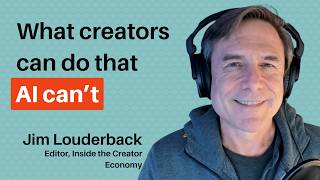
Jim Louderback traces the creator economy from blogs to TikTok, explaining how creators shifted from platform monetization to owning audiences through email and Patreon. As AI floods content, he argues creators must lean into what machines can't: weirdness, trust, and authentic community.
Chapters
People who are 2, 3, 4, 5 years old now, who AI will be part of their entire existence. How does their trust level go with AI? And at what level will they trust AI more than a human? The tragedy of the platforms is that I built my YouTube channel, my TikTok channel, one by one, ten by ten, based on what I was doing myself. But when someone subscribed to me, and you know this so well, I don't know who they are. I don't have access to their email. I, we don't have that connection. You know, it's really been for the past 9 or 10 years that creators have realized they need to build their own destinations and ways to own that audience.
Hi, Ravel.
Hey, Alice.
So we're recording this episode in advance of South by Southwest, and we are talking today to Jim Louderback, who is a longtime journalist. Leading light in the creator economy. He has managed and run VidCon. He had his own TV studio before that, first internet TV studio. And so he's a really fascinating person to talk to. And actually, I connected you to Jim a few months ago. So tell me a little bit about what you and Jim got into and kind of what is interesting to you.
Jim is someone who started off as a programmer, as a technologist who moved into media. Before the web itself came along. And he has this experience where he goes from seeing the very first web browser proposed in the early 1990s through the emergence of the web and blogging and video and running VidCon, which is the, the primary conference that brought together all of these creators. And we really talk about how social media has evolved, how the internet has evolved, and what it means to create in the We dig a lot into the relationship between people, uh, who are creating online and fans and communities and the, the nature of human connection, especially as we see more and more AI.
Right. And obviously it's a tumultuous time across the board. AI has a lot to do with that. And the creator economy and the way people can earn money is often up for discussion because the mainstream platforms have not really been, you you know, remunerating them for their contribution. So it, it is really interesting to hear Jim's point of view on that. And just to quickly switch gears, while we are at South by Southwest in Austin next week, you will be on stage with a couple of our former guests, Bridget Todd and Rudy Fraser, talking about how creators can break those algorithmic binds from the large platforms. True story, we actually submitted the entry for this panel before Divine was even conceived of. So it's great that we are now part of that solution. So that will be held at the Austin Marriott Downtown at 2:30 on Saturday the 14th. So please come and support us there if you can. And if not, we'll be putting the recording out afterwards. Jim will also be speaking in Austin at 10:00 AM on Friday. So look him up for his speech. And in the meantime, let's take a listen to your conversation with him.
There are few people in the world of social media and world of creator economy who have been there from the era of magazines and desktop computers all the way through the arise of social video to the era that we are in now where we're addressing the impact of AI as Jim Louderback. And so Jim was the, the CEO of VidCon, of Revision3, uh, uh, online content company, PC Week and Ziff Davis. And so I'm really excited to have Jim on this program because I've admired his work for a really long time. So welcome, Jim.
Thank you. It's great to be here. Same with you. It's, uh, I'm honored to be here with you with all that you've done.
Today you run a newsletter inside the creator economy and you're also on the board of a public radio station, KQED. So I'm really interested to hear your perspective on where are we going and how did we get here? Because so much of what this podcast is about is trying to understand how do we end up in the world of social media as it exists today? Like what were the forces that pushed us here? Because there were many different paths it could have taken. I would love for you to sort of talk a little bit about your own journey of, of how you ended up finding this community and studying the evolution of the internet, because you followed it from sort of the very earliest days of the web until today?
It really starts from when I started in media. So before I got into media, I was a— really early on, I was a programmer and I was working with these new things called microcomputers and PCs. And I started writing about the development work I was doing and suddenly got published in things like DBMS and PC Week. And I was like, wow, someday I might have a column in a computer magazine. That would be so great. And I applied to this magazine, PC Week, to run their reviews. And they hired me, much to my surprise. And I got a column, like, in PC Week, like, 6 months later. And I was like, I've arrived, this is great. And then about 6 months after that, I went to the, I think it was the second W3C conference in 1993 in Chicago in, like, some nondescript hotel. You know, Andreessen and all these other people were there. And I was like, oh, blogs. Oh, anybody can get a column in a computer newspaper. Just by starting a blog. And so that was kind of the moment where I was like, "Oh my God, I worked hard. I just got this, like, somebody handed me this column in a newspaper and now anybody can do it." And I could have either railed against it or embraced it and I embraced it. So that's kind of how it started. And I think it goes way back to when we first had blogs and we first had web pages and we first had web ads. I mean, remember the first Wired web ad? It's like, "Click here, you know, you will." So to me, that's where it all started. And then I ended up going, you know, building magazines and then websites in the news space and launching a cable TV network about technology where we were the first to put geeks on TV. And we actually handed out QSYF 320x200 digital video cameras that plugged into people's PCs so we could put them on television. We were the first ones to put real people on TV.
You had to give them the cameras.
We did. We did a deal. I did a deal with 3Com, right? Because they were the ones selling it at the time, and we gave out 10,000 of them to our fans. And then from there to building a YouTube network of creators and running events about the space and everything. So yeah, I've been covering it, user. I think the thing that for me is most important is I'm a user. I love using this stuff. And everything's, every time something new comes out, I'm like, well, I'm gonna try it.
Yeah. You know, and, and so, you know, one of the things you're most well known for is being CEO for many, many years of VidCon. You know, Hank and John Green were very early YouTube and social media creators. They were on all of these sort of Web 2.0 platforms and they had this idea of bringing together the creators and the fans, having some sort of event in person. And VidCon has grown to be this weird thing that is like a cross between an industry event and Comic-Con with tens of thousands of people. But I wonder if you could talk about, for folks who, who don't know about it or haven't showed up to it, what, what is it and what role did it play in sort of connecting creators with their fans and making it real?
Yeah, look, in 2010, Hank and John Green had an idea that they were, you know, they were early YouTubers and they were connecting through the camera and through the internet and through the screens, but they realized that there was power and community in real life. And so they said, hey, we're going to do this thing called VidCon. We're going to get 30 of the top, you know, creators at that time together and see if anybody wants to buy a ticket. Put it together. They launched it. It was in the hotel across the street from CAA in LA. And I actually ended up finding out about it. I was trying to get Hank and John "Would you like to come to join my YouTube network of creators?" And smartly they were like, "No, we're gonna stay independent, but hey, how'd you like to be on our advisory board and speak at this VidCon thing?" And I was like, "Yes," 'cause I'd been going to events and doing them for a long time. And so that from, you know, 1,200 people in the basement of the Hyatt Century City to 2 years later it moved to the Anaheim Convention Center and it grew. And I think the most we ever had was almost, you know, almost 100,000 people in 2018, 2019. The event itself, the way I used to describe it when I was running it is, It's an industry summit. It's a creator conference where we teach people how to be creators. And it's a fan festival. And so you are, you're a convention, you're a summit, you're a festival all in one. And the reason why that was so important in the early days of the creator economy is because those of us in it, you know, 2010, 2011, 2012, 2013, we knew what YouTube was. We believed that we were, it would change the world and that we were changing the world. But everybody else in media was— they looked down their noses at it, were like, "Oh, that's just UGC. Nobody's gonna watch that. That's awful." And what VidCon did was it legitimized it. And because you had the fans there, and because you had started out with 30 of the top creators, and, you know, we went up to almost 400 of the top creators around the world, and you had the industry there, the people building all of this together, companies could bring— ad agency people and execs and media people there and say, look, look, look at what's happening. There are 30 or 40,000 fans, most of them teens, who are getting Beatlemania-style craziness in their eyes when their favorite creator just walked by. And you have no idea who this person is, but they're bigger in many ways than the people you're putting in your ads and the people you're putting in your TV shows and the people you're putting in your movies. And that was really clarifying for the entire industry and really helped legitimize the fact that creators lived in the same space as movie stars, as actors, as other kinds of influencers.
You know, and it's fascinating cuz they, they live in the same space and, you know, at this point they were still, you know, early 2010s trying to figure out what the business model is like, what it, like, how do you make a living on this? They figured out that they could have an audience. They figured out how the people, wanted to do it, but this is, you know, this is the era in which Vine, which we'll talk more about, starts to become a thing eventually, which with Musical.ly, which becomes TikTok, with YouTube, all of these things, they, but they don't have a business model originally. Originally it was just like, well, well, you know, we figured out the technology to put you online and talk to people and connect to people. And they had this thing where you had a dynamic where are you creating a community or are you creating, you know, are you creating a celebrity with an audience? I wonder if you could talk about the. The tension that has existed within social media around that.
Yeah, look, I worked in television before I got into this, along with other things. And I learned because I, I saw the, the anchors, I saw the talent there. And traditional media have walls in front of themselves, traditional people in front of the camera. They do all these things to separate themselves from their audience. They have teleprompters. They have people taking them from the studio to the car to the place to here and there. And all these things designed to separate them from their audience. And when they communicated with their audience, it was a megaphone. There was no back channel. I mean, when I was editor-in-chief of PC Magazine, you know what our back channel was? It was letters to the editor. There was no dialogue. We had community on CompuServe and other places. But what these creators did is they woke up one day, no fans, no followers, no friends, no subscribers, put a video out on one of these channels and they built their audience by themselves, one by one, 10 by 10, thousands, millions. And they realized that it wasn't the network exec, it wasn't the publisher, it wasn't the editor-in-chief that put them in front of the camera or in the magazine. It was their fans. And so they had this because they're the ones that put them there. They were naturally community-centric and they built communities around themselves that it wasn't just them with a megaphone, but it was talking together. And these communities that started to emerge around these creators, it was a little bit like the creator sat at the center of the community, but the connection between the community members was almost more powerful than the fulcrum of the creator sitting at the center.
Yeah. And eventually we get these sort of stans, we get the, the Swifties and the, the K-pop fans and everything else where the fans themselves who've come together with this common tribal identity end up being very powerful social forces and that the creator isn't dictating what they can do. They're more of a convener of communities.
Yeah, exactly. They, and the smart ones who figured it out started thinking, hey, I'm making a little bit of money on YouTube. Now YouTube started their AdSense program where they started cutting checks to creators in 2007. Just 13 creators, but it grew. But, you know, I could start making money by leveraging this community that I built, whether it was by selling them a t-shirt or selling them coffee or building a private community. And other things developed there where the platforms— I mean, we're getting ahead of ourselves a little bit, but the platforms became very much of an awareness vehicle about converting to these places where the creator would own all the means of creation, connection, and monetization.
Hey, just a quick interruption to ask you to follow Revolution.social on your podcast app or on YouTube. And if you're already following us, please tell a friend about the show. Thank you so much. My own work is, uh, it's, it's very informed by the history of, of social movements, the history of, you know, economic movements for people controlling their own means of production. And so, you know, dating back to the, you know, 19th century anarchists where you have, you know, seize the means of production, you want to seize the factories. And then in the late '90s, early 2000s, I was part of a movement of media activists where we would, you know, talk about seizing the means of communication. We would build open source tools, we build all these technologies where you would own these means of communication. And what we see with the first social media creators is at first you have the YouTube model. At first you have the TikTok creator funds. You have this way in which the platforms themselves give money to the creators on the platforms. And one of the things that I've found fascinating going to your conferences and your sessions and the most recent one, the Billion Followers that we were at in Dubai, is how much that is no longer the case. How much the, the creators use these platforms, but they've figured out how not to be dependent on the platforms to some degree because they know that, you know, they don't own that means of communication. And so they're, they're building business models outside of it. So I just assumed that the ads I was seeing went to the creators and, and that exists on YouTube long form. But I wonder if you could talk about the, the evolution of the economy of creators, the evolution economy of social media today, which is not that at all.
Yeah. Look, YouTube is really the only place. I mean, Twitch arguably as well, but YouTube is really the only place that takes a very large share of the revenue that it brings in and shares it with creators. Primarily long form, as you said, but, uh, there are other ways as well. And there are some creators who may have 2, 3, 4 million followers or subscribers, not a lot, but they make so much money on AdSense and the deals that are being sold by YouTube and the money that they're sharing with them. They even share a piece of the premium revenue that they get with creators that they don't care about anything else. You gotta be like, you wanna do this? Like, nah, man, just fine the way I am. But that is not the majority of the creators. Most creators, get a little bit from YouTube, they get some from YouTube. If they're on TikTok or Instagram, they're getting nothing, virtually nothing. You know, there may be a few pennies here or there. There may be a couple that make it, but across the board in most of these cases, creators realize that, yeah, it's nice to get a little bit checked from the platforms every now and then, but I need to make more money. And the way I do that is by owning the connection with I would love to have it with my whole audience, but with the most valuable ones, the ones that are my biggest fans. The tragedy of the platforms is that I built my YouTube channel, my TikTok channel one by one, 10 by 10, based on what I was doing myself. But when someone subscribed to me, and you know this so well, I don't know who they are. I don't have access to their email. We don't have that connection. And so, you know, it's really been for the past 9 or 10 years that creators have realized they need to build their own destinations and ways to own that audience. And so, you know, you could tie this into some of the stuff with Mastodon and other things that are super smart in the way that that works. But in the end, your list and the way you own and connect to your biggest fans is the most valuable thing you have as a creator. And creators have figured that out.
And, you know, fascinating is like the subscribers, because of the interest graph, because of the way in which algorithms work and drive attention, everything else, the subscriber counts, which are very easy numbers to see, you know, the billion followers thing, they put the subscriber numbers all over the place and that was the big, you know, focus. But that's not the audience you reach. You know, the audience you reach is like, okay, who is seeing it? And we have all these people who are, you know, I see tons of content of people, creators I like who I'm never, I'm not following them. It's just this, you know, they're good at playing the algorithm, but how are creators connecting to it? Because I know that like you could create a, you know, a Beehive or a Ghost subscription or, or Substack where you send people an email newsletter and that works because we're falling back on the email protocol. But if you're a video creator, or you are making some other kind of content, you're a streamer, how do you— how are people directly connecting with that audience?
You know, there, there are a bunch of ways to do it. One is to just come out and say, support me, join on Patreon. Patreon's a company that allows you to be a patron. And it's been around for a long time, started by a YouTuber. And, you know, sign up for $100 a year, $5 a month or whatever, and you'll end up with —be the super fan. Yeah, be the super fan. So that's one. And the connections that you have, but it's funny because it does come down to email, mobile phone, and credit card. Like those are the identifying things that you as a creator want to have to be able to, you know, at some level. And it's that, it's going through platforms where it's like, look, you like my content because I'm an expert at beekeeping. I'm not, but imagine I was. And you wanna know more about beekeeping. Well, guess what? I can tell you the secrets of beekeeping if you sign up for my course. And I could do that on Kajabi, I could do it on Teachable, I could do it on others. Or you know, you could build a private community where you say, hey, look, like I write a newsletter every week about the creator economy. I haven't done this yet, but I need to, and I need a platform to do this if anybody's listening where, look, it goes out every Monday. I put out the things that I think are most important. I'd like to have a community where it's like, look, we're just gonna hang out on a WhatsApp channel for an hour every Monday, a couple hours after I publish. Just talk about it. That's another way to start building those connections. And the thing that's fascinating is when you're talking to somebody and you're a good creator and you're reaching out to them through the power of video, you build these, you know, we call them parasocial relationships, which is kind of a weird term, but basically the— I've seen this with creators all the time where their fans, their community is having a conversation with them, but it's a one-sided conversation, but it feels two-way. I'll be walking down the street with a big creator. Somebody will walk up and say, "Oh, Phil," or, you know, "Oh, so-and-so, hey." And they'll start talking about something that came up in the video that they just published as if they were in the middle of a conversation that they just picked up again. And the creators are like, "I never met you before." But because it's the topic, we can talk about it. So it's really fascinating to watch that work, leveraging that with the biggest fans to create a financial incentive is what lots of creators have gotten really good at.
You know, it's fascinating because I'm thinking about this, like, that celebrity culture didn't exist before cinema, before television. Like, we, it is not actually a really old, like the traditional celebrity culture with the gatekeepers and the things and the publicists and this, this attention that is actually relatively new because we didn't have celebrities where you had any kind of relationship to more than 150 years ago before these things. But the parasocial relationship that we have now with people is absolutely fascinating. We saw that with the early days of Twitter, where originally when we signed up, it was, there were no celebrities. I think Robert Scoble was the first celebrity on Twitter. And, you know, Scoble is a very much a tech industry blogger and he writes about it, he covers it, you know, it's all internal to the tech industry and he at one point tried to have more than 3,000 followers and Twitter didn't let you have more than 3,000 followers. There's a big technical difficulty in making it work. But the leap from there to Twitter going and saying, okay, we want celebrities, we, you know, I've told this story before, but we sent Adam Rugal, who is doing business development, down to LA to find a celebrity. This was earlier, 2007, I think, in Twitter. You know, there are thousands of users of Twitter, and he finds this— the assistant scriptwriter from My Name Is Earl, who is a comedy writer, and he was great. Like, his stuff was so funny, but it took years before celebrities realized that they wanted that direct connection and they wanted to get rid of those gatekeepers And now if you talk to young people, the idea of a gatekeeper is this idea of something kind of false, this idea of something, you know, I'm wondering if you, cause you went from going through those gatekeepers, working at Ziff Davis, writing at PC Work, and then building a media network without those gatekeepers to platforming a world in which creators don't work in that way. Talk about the gatekeepers and the way in which. The new media, like the social media companies act in some ways as a gatekeeper?
Yeah, they're very much a gatekeeper, but they're more of a democratized gatekeeper in that as long as you can figure out how to rise through the algorithm and you have some talent, you can build connections and build audiences. It's funny, we had the gatekeepers were the people sitting in the smoke-filled rooms and sitting in the big corner offices. Yes, you can do anything you want now and you can reach an audience if you can wake up anywhere in the world and reach an audience anywhere in the world. So in that sense, we have liberated ourselves from the gut gatekeepers. I'm putting that person on because I feel it in my gut, to letting it be algorithmically, mathematically, and other ways assigned. But we still have gatekeepers. And also, as an aside, it's kind of ironic that a lot of the biggest creators now who built it up this way without gatekeepers really are now going back to the gatekeeper saying, give me money and put me on Netflix, give me money and put me on to be. So there's a little bit of the kowtowing to gatekeepers kind of happening again, which I think is a little weird.
You know, it's fascinating because, you know, so much of the fear of social media is what happens when we don't have gatekeepers or what happens when we let AI decide everything. Are we gonna continue to see this sort of conflict back and forth between, I want a direct connection to my audience. I want to build an audience on algorithmic different things. I want gatekeepers. I don't want gatekeepers. Hannah Gadsby. Became famous for her Netflix, you know, comedy thing, and then burned the bridges on that relationship and went back to just posting her own specials on YouTube. So it's a big conflict.
You know, I have, I have a thought, which really just came to me as we started talking. I believe that one of the ways that, you know, discovery, gatekeepers help with discovery. And when there were 3 TV channels or 100 TV channels, you had gatekeepers putting people out there. Happened in the music space where certain people got discovered and then they had CDs or albums made. I think about curation now and in many ways we need curators, right? You can't watch everything, you can't see everything. And so I program events, I pick speakers to go on stage at events, I'm curating that event, I'm a gatekeeper, but it's my own sort of taste, style, whatever that I put on stage and The same goes for my newsletters. You know, I do the same thing. I curate what I think are the top stories and I put my opinions in on there about what's going on in the creator space. We need curators in the world. We need our friends to send us things, our funny Instagram things, or we need, you know, we need that. You could just go out into a field and just hold up a sign and say, pay attention to me. People do that all the time in many ways. And you could build a community that way too. But that's about the only sort of— that's then the physical boundary of where you are as your gatekeeper. So gatekeepers inherently, if you switch it around a little bit and just call them discoverers or explorers, I think it sounds a little bit better. Curators. Curator. I know, I'm trying to think of a non-word for curator, but that's what it is. And— Well, museums have curators.
That's right. Like it's a profession.
Yeah. Will necessarily want, like, people that we think know my tastes that, you know, I like, I look up to them, and when they recommend something else, I'm probably going to go check that out too. But that's a gatekeeper as well. It's just when you institutionalize it in a way where there's vast scarcity of slots that you can fill with people that you think are worthy— that's early television, radio, whatever— that's where it gets kind of— that's where it gets squishy feeling because then you're like, ew, it's just the people, you know, do I really like you? And there aren't that many of you.
And who are you curating for? Are you curating really for me and my community, or are you curating for a set of people that represent a set of institutional constraints and values? You know, you have this sort of hegemonic set of ideas which align with the government or the society or the elite institutions of a country, what makes economic sense, what sells versus what is You know, not selling, we have the, you know, massive debate about whether or not people were allowed to call out what was going on in Gaza, for example, and boycotts back and forth. Or you saw that in Hong Kong when there was the pro-democracy protests where society was ripped apart between pro-China and pro-democracy, you know, pro-Communist Party. And then you had sort of a tearing apart of that and I'm wondering if this is related to some of what you've talked about with this idea of a trust graph, of this idea of like, who do you trust? Who do you give that value of creation? And how does that work?
Yeah, you know, for me, it's more around having been, you know, both on the commercial side and on the creation side of this industry thinking, you know, and again, cynically, you know, you're talking about Hong Kong and I'm thinking about brands. People doing things to build businesses and sell it to brands and make space available to make money that way. But again, that's kind of where my head's coming out with trust. And now the thing is with trust, and I have this vision, the social graph, the stuff that you built at Twitter where people connected each other by following, which you guys even primed the pump on because early days of Twitter, you'd be like, follow these 20 people. I don't remember who they, like Veronica Belmont got huge because of that. Love Veronica.
Oh yeah, there was the recommended followers. There was like, We don't know who's doing it. And then there, you know, this, this was mostly created after I left, but there was this idea of how do you give a way in which you don't just show the most common posters? You know, this was the very first algorithm. It was a human curated algorithm because originally when you went to the Twitter site, you saw the most recent tweets, you know, and, and some of them were boring. Some of them were boring. You know, I, I went to this conference, Play. It was at UC Berkeley. This was for very early days of, of social media and Twitter was around and Michael Arrington was still CEO of TechCrunch, and he had Ev Williams on stage and he was interviewing Ev Williams. He goes to Ev and he's like, what is this Twitter thing you created? And he, you know, Arrington is sort of famously kind of an asshole. And so I'm sitting there in the audience and I'm like, you know, I tweet intending to mean my audience. Oh, Arrington's being a total asshole to Ev on stage at the Play conference. And 30 seconds later, Arrington's like, why don't we put up Twitter on the screen?
Were you there? No, but there was a lot of buzz around that one.
So he puts it up and, you know, this is very early days of Twitter, so it's not huge. And because Twitter was so small, it showed the most recent tweets on the homepage. And then he's going, and our audience is going like, "Oh, who the hell is Rattle? Like, what the hell?" You know, and we sort of, the barrier between screen and audience and everything else all falls down. But at the time, Twitter was really teeny. And then as Twitter grew, it got to the point where you saw all sorts of random things. There was no restriction on the amount of things you post. If you posted too much, people stopped following you. And so Twitter was trying to figure out, okay, how, how do we make something that people can discover? How do we, how do we find the good stuff? Yeah. And this was before there were algorithms. And so there was this recommended followers. And so if you got put on that list, of, you know, friends of Twitter and, and you've got millions of followers often who, people who had no idea why they were following you. Yeah. It wasn't, it was the anti-superfans. Like they weren't engaged. Um, but there were lots of them.
Well, and it was a good, it was smart because there were people who were saying interesting things and it helped increase time spent with the platform, which, you know, and it showed people what the platform should be used for. Right, right. But anyway, to get back to trust, in the end, you ended up building trusted relationships with Veronica, with Kevin Rose, with some of the other people that— with Scoble as well. And now, as I see all of these platforms starting to be flooded with AI-generated content, and I'm not going to come down on the side of it's good or bad, it's just that it's not human. And so when you think of who and what you trust, first of all, The metrics that a lot of brands have used to try and figure out what creators to work with, like what's, you know, what's your engagement, what's your views, what's your followers, what's your likes. A lot of that, and most of it is being gamed by AI right now. And so they're not really, you can't really trust those as predictors of value for a brand deal, predictors of value for other things. When I wanna buy, you know, a new computer or a new phone, there are people I trust tech reviewers and other people. And there's a lot of other people out there that I look at like, I can't trust what you're saying. I want to go on Amazon and I look at those, you know, 5-star reviews. Uh-uh. And so—
You know that they're mostly fake. That's why I said, uh-uh.
And you can't trust them. So I think about the idea of who are the people we trust? Let's start out with who are the 10 people we trust, the 50 people we trust, and at what level do we trust them? And then who do they trust? And does the associative property of mathematics work there where if A trusts B and B trusts C, does A trust C? Or is that commutative? I don't know, it's been a while since I took that. But anyway, can we do that? And can we create that sense of if I'm a creator and I'm building a community and people trust me, can the people who trust them also like, you know, it's the Kevin Bacon thing. How far do you have to go away from Kevin Bacon to trust Kevin Bacon?
You know, and that's why when creators you trust, when creators you have a parasocial relationship with, that's why what they like, why their brand, like what brands they use, what brands they endorse, what brands they choose to advertise with matters. Why it works is because you have this, this connection with them. You know, I've had this fascinating debate about whether or not, maybe a debate inside my own head, but a debate about What is the future of advertising in the era of AI? Because if we have AI agents and we know that these AI agents are now acting as therapists, acting as, you know, parasocial artificial intelligence lovers who are always there for you and always responsive, and sometimes they're sycophantic and they, you know, they cause people to go off in all sorts of crazy ways. But we are constructing a lot of trust with these agents that learn more and more about ourselves. You know, the crazy part is now they're all go, we'll just run ads. So like that'll destroy the trust. And I know you talked about that, but will we no longer trust ads at all because we've imbued so much trust in this AI agent that we believe has our own interests in mind? And then we will just rely on the AI to tell us what to buy.
It's a good question. And I think you have to look at it at different levels of the buying journey, right? At the discovery level, it's like, look, I don't know anything about Huawei phones. And then I saw an ad for Huawei phones. Okay. I now, now I know there's a thing called Huawei phones. I'm aware of it, but is it any good? I don't know. What's my favorite phone person telling me? So I think there's a mass ad thing, whether it's a billboard or it's a Super Bowl ad or it's something else that will cause an awareness thing to happen. And our brains, need 4 or 5 times to be exposed to something before it sticks. But when it gets down to the point of, am I going to adopt it in my life? Is it something that I am going to— and I get back to the word trust— am I going to trust to spend my money on it, to welcome it into my world, to use it? And there's the element of trust I need for the product. And again, this ties into how much trust can a person, whether it's AI or an agent or a a flesh and blood person, how much can the trust I have with them translate to the trust I have to the things that they're recommending? And I believe that there are levels there where certain people, I'm like, if they say that, they're going to push me a lot closer to it. If it's AI, I might trust but verify. And it depends. We each will have our own tolerance for trust at different levels. The big question for me is, as people are growing up with AI, not us who are coming to it in our adult life, But Gen A and whatever's after Gen A, which I don't know, maybe it's Gen AI, people who are 2, 3, 4, 5 years old now, who AI will be part of their entire existence. How does their trust level go with AI? And at what level will they trust AI more than a human? I don't know. I don't think we're gonna find out for 20 or 30 years, but it's a really interesting thing to watch.
I think that at the moment we have this giant backlash because we have AI being used in ways that are violating trust. You know, the, the, you know, I, you know, I've launched this app Divine, which brings back the Vines. And I found an old archive of all these old Vines and, and I had no idea it would be a big thing. I was just like, this is a fun internet nostalgia thing where I figured out how to, you know, with, with new technology and open protocols and open source, I can make 6-second videos much more easily than we could 15 years ago, 10 years ago. And then I was like, I wonder what happened to those videos. And I went through YouTube and I went through, all, you know, TikTok and everything else. And then I found that the Internet Archive had hundreds of thousands of these things. And I announced it at Web Summit and people were giving some polite claps and, you know, everything else and like nothing happened. And then all of these creators found the TechCrunch article and they found this thing and they, they got really, really excited, much more excited than I thought anyone would get. And they got excited for two reasons. One, they got excited because the, the videos, the Vines they had seen collections of, and they could no longer access them easily, even though they were out there on the internet. They were just not easy to access. And the other one was I had stumbled on this hatred for AI-generated content, AI slop. And I just didn't, you know, I had no sophisticated critique of AI slop. I'm just like, this is annoying. I don't like it. I'm so sick of seeing videos and having to look at the comments and see if the top comment says AI so I can move on. I guess I'm, I'm curious to hear from you is like, you talk to agencies, you talk to creators, you talk to brands all the time. And there's this world of these AI brands with, you know, fake creators with millions and millions of followers. And then, so those are high trust, like they're very curated. And then there's AI slop and AI content that is like attempting to trick you. Where is the humanity in between those two things?
I think first up, there are, you know, we crave, I believe we crave and will want human connections even as AI floods all of our, you know, all of our social platforms, our video platforms, you know, call it slop, call it whatever you want. And one of the things that I think, I mean, one of the things I love about what you're doing with Divine is it is this place where you're, pretty much, you know, hopefully you'll be able to do this going forward as it gets more popular, but guaranteeing that what you see there is created by humans, not generated by AI. But I also think that there is two thoughts. One is that there's this continuum between creation of video where AI is involved at different levels. Like you could, like I go on AI right now and say, hey Claude, I wanna make a video for Vine, 6 seconds. I wanna talk about coffee I just made. Can you come up with like 10 different ideas for me? And it would do it. And I might go in and be like, okay, boom, boom, boom, boom, boom, put it up. Up and AI— You shot it, so it wasn't—
but it was AI directed.
Right. Or maybe I edit it in AI and shove it in there if I'm allowed to do that or whatever. So there's that. Where do we draw the line there? And some of the really— some of the best AI-generated videos that I've seen have been storied out and storyboarded by humans. Instead of putting actors in or, you know, hand-drawing cel shading for animation, they've had AI generate each frame for them to tell their story. Some of them are quite good. Others are just completely AI-generated. And, you know, you just put in a prompt and here comes a video of you, you know, dancing with Sam Altman on the moon. And that kind of feels a little bit wrong. So not wrong, but it's like, that's AI and I don't want really to be there. At what level do we accept AI into our lives and not into our lives? And so it leads me to the next thing is like, look, some people like, AI slop is fascinating. Some of it is really good. And, like, and we're seeing new emergent behaviors come out around it. Like, have you seen Italian Brain Rot? Yeah, yeah. Okay. Super interesting. Right. Because it's this self-emergent community. Nobody created those characters. It's not like Paramount made SpongeBob and let everyone use it. It's like the characters were created by— via AI, but somebody said, you know, do this, put it out there. There's been entire communities built around it and story arcs and bombings and this and that and music videos, but it's this self-emergent bubbling up from the community that created it, not top-down media creating a world that then wanting other people to, you know, watch. It's almost like fanfic culture. It's totally fanfic culture, but it didn't start with anything for people to be fans of that was created by media. It was sort of emergent on its own. That I think is really cool. But, you know, a lot of people call it— I mean, look, it's brain rot. People call it brain rot. Yeah. So I think, you know, one person's slop is another person's masterpiece. Now, the last piece of it for me is what happens with relationships and trust and, you know, where that goes. And I do believe that we're going to want to know when we're watching real humans. We're going to want to connect with real humans, which means that when you get to things like events, like what I run, one of the only way going forward we're going to know someone's a human is if we show up in the same space with them and we can not necessarily touch them, but see them and be like, "Oh, that's you." So I don't know. There are going to be times when we accept AI in our lives and are happy with it. And there are going to be times when we're going to want humans. And we're going to need curated spaces that say, trust— in a trusted way, this is all human-generated, which again is why I love what you're building.
Yeah, I mean, so now we have this human-made badge and we use— we use actually a lot of technology that big companies and university developed. It's this underlying technology called C2PA, and it's a bit of chips that have been built into cameras not just phone cameras, but all sorts of cameras that track the providence of the editing. And the irony is that like, this is technology developed by chip makers and camera makers and Microsoft and Adobe and, you know, Meta. And those companies are like, oh, I'm not sure. We built all this technology and we rolled it out. We're not sure if we really wanna adopt it. And what we did with Devine is we're just like, oh my God, look, someone has been trying to solve this problem. Why don't we make it visible to the users? And this is a, you know, this concern about the providence and the origin and the history of content has been around a long time. And the specific implementation we use, this thing called Proof Mode, which was created by a bunch of human rights activists. You know, they were giving tools to journalists to record massacres and they wanted to verify that it was a real thing, a real camera, a real place, everything else, you know. Then we're taking it and we're using it for like 6-second short videos, but— That's okay. You know, the irony is that all we're doing is adopting a set of technologies and solutions that people knew were gonna be needed. And ironically enough, the big companies that funded this development and built all this technology, they aren't sure about using it. I saw today on Instagram a thing which popped up and I was scrolling through my feed and it said AI, and then I clicked on the video and it showed me the video and then the little AI warning label disappeared. And I was like, no, no. Like, I wanna click on that little, little button and see why do you think it's AI? Like, okay, is this AI? You know, I wanna, I don't want that label to disappear, but the engagement metrics said that it disappeared. You know, that I wanna get back to something you were talking about just a minute ago, which is the human connection because. Over the last few years, I've been thinking a lot about, okay, why do people pay for social media? Like, why do you pay for the New York Times? Why do you pay to be a supporter of KQED, you know, the public radio station that, that you are on the board of? Why do you pay for OnlyFans? It's not that public radio content is inaccessible unless you're a paying member. It's not that pornography is inaccessible unless you pay for pornography. Like, we have an unlimited amount of pornography, yet people pay for OnlyFans or they pay for KQED so they get the tote bag because they want that human connection, because they want to put something down. And I'm wondering, you study social media and you study the creator economy and you are part of, in charge of keeping a community radio station on board. It seems counterintuitive. It's like behavioral economics that doesn't make sense, but it's so universal.
I think we want to draw, like, a lot of it comes around to what do we belong to and where are we finding meaning and who are we? And the markers of what makes us who we are are some of the things that we end up being willing to pay for and being, and the act of taking currency that you've earned and giving it to somebody when you didn't have to for something in return creates a value exchange that makes you feel good about it. Like, you can't see this over here, but, you know, the— like, the other— some of the other things I'm a fan— I'm a fan of the Grateful Dead and Phish, and, you know, early on, pre-internet deadheads and people like that. And I've spent a lot of money on concerts and, and, and CDs. I might buy their CDs now and I could listen to them for free, which I do, but I want to have that thing because it is a valuable thing for me and it defines who I am. So in the end, what defines who you think you are and what are you willing to invest at some level to either tell the world or tell yourself? It's not like you're walking around the t-shirt with your favorite OnlyFans star on it, but yeah, right? I mean, maybe you are, I don't know, but that defines you. And I still think that that it's a stake in your own brain that says, this is part of who I am.
You know, it's fascinating because the Dead's a great example. Like they were never a mainstream massive commercial success and they rejected traditional notions of copyright. Like they let fans go plug their DAT recorders into the soundstage. I was a taper. Yeah, I was a taper. And, and, and now there are so much more versions of Dead concerts that people can listen to. There's an unlimited amount of it. And yet people still, they buy the merch, they go to the shows, they participate in it. They have the identity long after the original Grateful Dead, you know, stopped being able to be viable as a band because Jerry Garcia died. Like, The, the membership in that community was much more important than the commercial aspects of it. And it was very commercially successful, but they didn't try and control their community.
No, they let the community define what it was. And, and the community was the part that you would go to, go to a show and you wouldn't just walk to the show, see the music and go home. You'd show up early. You'd hang out in the lot with other people like you, you'd, you'd look at what the community was doing in building, you know, shirts and hats and, you know, brownies laced with things that were all part of this Grateful Dead experience that was part of who you were. And, you know, some people found that community when they were teens and then they sort of let it go because it wasn't them as they grew up. Other people just kept embracing it and interpreting it into their lives in different parts of their lives. And so That, I think it's just the same as talking about KQED, talking about Harry Potter fandom and fanfic, talking about, I mean, Italian brain rot, who knows, maybe that'll be the next Grateful Dead.
You know, there's no central organization behind the Italian brain rot, you know, but in some ways that's what makes it cooler. Like that's what makes it more interesting is that it is entirely this sort of emergent network social behavior of what's going on. And, you know, one of the things I just find super fascinating is the way in which that we're reproducing culture, but we're making, you know, so many kinds of culture and, and, and in an era in which we bemoan the future of society, we bemoan this idea of you're passive and your consumption, everything else, you're not seeing that creativity, that participation, that identity. And those are the things that. That give us meaning as humans?
Yeah, you know, I think about it this way. It's interesting watching fandom develop, and I call it the diffusion of fandom because it, you know, the early days of VidCon, we would bring the top, you know, 150, 200 YouTubers in, and everybody knew who they were. Everybody, you know, if you weren't a fan of Phil DeFranco, you were a fan of Toby Turner, or you were a fan of Jenna Marbles, you all sort of knew each other. And that has now turned into this diffused world where Gen Z— this is a study that Microsoft did, I don't know, a year and a half ago. They asked Gen Z, you know, what fandoms do you belong to? And do you belong to fandoms that your friends don't know about? Almost half of Gen Z belongs to a fandom that even their closest friends don't know anything about. And so we're seeing this diffusion of fandom. And I think as AI comes in and takes over so much of this, the worlds where, you know, our social platforms and others, we will more and more aggre— just become part of these smaller fandoms that are around that core thing that self-defines us. And Gen Z in many ways is leading the way by wanting to be part of these more human fandoms, these smaller fandoms, and really these very niche fandoms that I actually find that really, really comforting to know that there are all these little fandoms out there. You're never going to know all of them. I mean, The thing about Italian brain rot is that, you know, if you're 15, you know what it is. If you're their parents, you probably don't. Skibidi Toilet, all that other stuff that comes and goes and flashes is all part of that. We're identifying these fandoms that mean something to us and that set us apart from maybe our parents or even our peers.
You know, I have teenagers, they're 16 and 18 right now, and their consumption of social media is very, very different than mine. Like we talk about short-form video. We have all of these like short videos and we have these things like that and everything else. And there's all this discussion about attention, but they often spend time consuming media that is the exact opposite of this. Hasan Piker and, and all of these other streamers, they might watch 8 hours of someone going on and they have guests and they play video games and they have stuff going in their lives. I wonder if, you know, you could talk about, you know, we have this sort of spectrum from, you know, me doing this Divine thing, which is 6 seconds, to 12-hour-long live streams of stuff. And so much of what I see going on in the culture of young people is this profound engagement where people are watching their streaming of their stuff and their engagement. And, you know, I've thought about even with this podcast, like posting it on my Discord. Like I, you know, we have a Divine Discord and there's all these different people talking about everything else and I post clips, but like, you know, at some point soon I'm gonna start live streaming these interviews there. And why is it that our mainstream media discourse around media when we talk about short form doesn't talk about the fact that young people are also incl— consuming incredibly long-form media.
I mean, there is that conversation is there somewhere because YouTube in many ways sees it and is out embracing it with, you know, hey, the longer you're viewing, if you're watching an 8-hour video, that's great. Twitch is really, really deeply into that. And the thing about some of those longer forms, again, it goes back to community. You watch that long-form stuff and it's a chat. It's exactly. There's all this engagement and the smart streamers acknowledging the chat. You exist. I'm commenting on what you just posted. I'm putting that up on screen so you can see it. They're not doing it for everybody, but it validates your existence. And I think people can hang on for hours because it's interesting and they like what's there, but they're getting validated and they're con— there's a connection you feel to other people that happens throughout, through that. I forget her name, but there is a, a Twitch streamer who's an AI construct. Who's AI animated. It's a, you know, it's a, it's, but it goes on and on and on. And I was, I dropped into the stream recently and there were, I don't know, like thousands of people just commenting and the AI was pulling people out and talking about it. It's like, I was like, the fascinating thing to me is not that people watch this, but that an AI can be at the center of it as well. I'm not sure where I was going with that because I didn't answer your question.
No, but it's interesting because the AI at the center, in some ways the AI is more capable of of in real time keeping track of those, you know, that comment stream. Because as a human, you can't be talking and seeing the comment stream go back and forth. But, but an AI actually in some ways is more capable of keeping all of those different threads together and bringing it to the community. But the only reason it's interesting is the community of people participating. If it, you know, would it be interesting if everybody commenting themselves were AIs? I mean, we have Maltbook, which is this social network for OpenClaw. And, you know, I send my OpenClaw agents off to go talk to people.
Go hang out on Maltbook.
Or go research stuff or share what you've learned and everything else. But I don't find it interesting to myself at all. Like, I go and I read them and I go, this is like, this, this does not seem, I'm, you know, I'm not the audience, but I don't know that it's a bad thing that people are choosing to use in sort of an, an AI stream as the community convener.
Oh, I don't know about that.
Because it's still community.
Yeah, and you're right, because it probably is a bunch of bots out there doing it as well. But it's, you know, it's— I know, by the way, the Twitch streamer is Vedal, V-E-D-A-L 987, in case you want to go watch it yourself. I don't have a lot of answers on this. I just— I watch the behavior and I think that people are looking for connection and they're looking for community and they're looking for things to identify themselves in this world where it's very hard to find those things. Very hard. I mean, it's all around us, but these are the sort of new ways that people are identifying with this and themselves. And media has gotten to the point where there are a zillion channels that you can identify with and be part of yourself if you want, or you can make your own channel and put yourself in the center of everything, as Sora too has shown us. So I think that's going to be another interesting aspect of what happens when we put the me in media and all the media is built 100% just for me, with me as the star. It's like the narcissist in all of us is just going to be overjoyed.
Are we going to like that? I mean, because the reason we join these communities, the reason we join these live streams, the reason we join everything else, the— all of these sub-communities, is because you feel like we aren't looking for the perfectly curated me. We're looking for a we. We're looking for a sense of belonging, like you know, one of the ideas that happened at the Odeo office when we were doing the prototyping, it became Twitter, was we actually sat down and we said, okay, everybody describe a way in which you use computers to communicate with people. What software did you use in the past that really made sense for you? And there was one, which is Tony Stubblebine. He's now CEO of Medium, but he, at, I think he went to Grinnell, but, um, or, and he at, at university, he had had this system, which was a Unix system and they could do like these little status updates and they would go in and they would do these little status updates and it had been updated eventually. So it wasn't all just command line, but it was just like, what am I doing around campus? And what have we updated and everything else? And this is to me, one of the real examples of what became Twitter. Like, what are you doing? And Tony talked about how important it was to feel like what your friends were doing and, and. The, I guess the point of the story is that the human activity that we do— humans evolved a couple hundred thousand years ago, and we evolved for a whole bunch of basic needs, and we evolved to, to find love and community and family and care, be cared for, and to get food and to, to entertain ourselves and do all these things. And the technology and the society and the culture those change over time, but the human needs don't change because those are, those are sort of genetically and culturally wired into us. And so a world in which you could have everything about me, that appeals to a certain kind of narcissist, which we've always had in society, but it doesn't appeal to most of us. Most of us want a human on the other side of it. Most of us want community. They want to be loved. We want to do things. So are we gonna create social media? Like, it seems to me like we're just gonna create social media that under new sets of, of dynamics gives us the same thing that we have always wanted. Yeah.
I'll also say, I don't, I don't disagree with you. I think you're right. But remember, we are not just one thing. The, the, the human rabble, the human gym is not a monolith. It is different things at different times. And so there, there are times when we wanna hang out and, and be part of a community and, and go for that. And there are times where we may wanna just just be like, I wanna tell a fun story and maybe share it with my friends, or I wanna be a different sort of person and do different sorts of things. And this is why you can be just as happy watching Divine 6-second videos and get entertained for an hour and spend 8 hours watching something else because you're in a different— we are multimodal, multi-context humans, beings. And I think a lot of different platforms and types of media have emerged to really sort of, I guess, not take— I guess take advantage of is the right word, but I didn't want to be that strong, but to really play into those different aspects of ourselves when we're feeling that way.
Yeah, like we are lots of different things. Like we're not always the same thing. We don't all the same way in which we're doing it. One thing that I'm really curious about is the way in which we respond, the way in which we engage. And you saw YouTube go from its very first version where people are uploading cat videos and things like that to growing up. And at some point YouTube created these video replies where it took the replies that weren't just the text replies, sort of the comments down at the bottom, but they played with the idea of me putting up a video and then another video reply and another video reply. And people have edited them together, but it isn't a huge aspect of YouTube today. The social video platforms, they aren't stringing together The videos from one person to another, responding to each other. And I'm, I'm really curious why, cuz one of the things I played with Devine is I have a branch of it that lets you, instead of doing an odd, like a text comment, let you record another 6-second looping video as the comments. And you get these sort of threaded sets of discussions that are all video that you can watch through. Why did YouTube stop doing that? I mean, it's still possible, but it's not. Central. I'm wondering if you have any sort of insight having been at VidCon, having covered it through the introduction of that. You know, it's like, because it never worked.
I mean, I can't tell you how many times people came to me and said, I'm, I'm building a video Twitter. It's going to be great, right? And, and that was sort of what— isn't that kind of why Twitter bought Vine? Because they're like, oh, it's a video Twitter, let's put that out there. And, you know, that was their initial vision. I don't know, but that's my my hypothesis. And it turns out, you know, that sort of back and forth video chat never wasn't really something that people were interested in. Why is it? And again, I don't have a good answer. So this is me just asking more questions, but is it because nobody figured out the product dynamics to make it work? Or is it because it's just not something we really care about?
The original thing is more important and it degrades as you get the back and forth.
Yeah, but we like to do remixes, right? Yeah. So I'll do a remix of something and I'll put my comments in, but I'll turn it into its own thing.
So you need more curation. Yeah, you need more original content, right?
Yep. So just like, oh, that's, you know, that was like the coolest thing ever, I think I'm gonna go out and have a smoke, you know, that's not gonna work. But, you know, if I can then go and, and actually tell my story as it intersects with your story and build a new story around it, that gets interesting.
Speaking of things that people, you know, 1,000 people have tried 1,000 different kinds of social media apps, like, and you've had everybody show up and pitch you different things over time, I'm sure. We've had many social media platforms. We had MySpace and Friendster and— Dogster. —Six Degrees, Dogster and— Catster. And Yesster, or Yee, which is like you press the Y button. Yeah. Um, Orkut, don't forget Orkut. Orkut. And, and Vine grew up to 200 million active users and then whittled away and, and, uh, people moved on to other social media things. What happened?
Well, look, I mean, I think the Vine thing, um, was purchased because you guys thought Twitter thought it was something that it wasn't, but they also just sort of lost interest in it. But Vine, you know, without Vine, I'm not sure TikTok would have, or Musical.ly would have been it either. So there was a little bit of the, maybe Vine had to exist and die for TikTok to be born. I'm not sure I believe that, but I'm putting that out as a possibility. The other thing I will say— It helped. It helped, yes. The other, it paved the way. I mean, I remember when Vine was big and at VidCon, I said to Hank, I'm like, Hank, when are you going to launch VineCon? And he laughed at me, which he was right to do. But I also think that the launch of Divine, you hit a moment in time where there's a lot of nostalgia around 2016 right now. Yeah, isn't that fascinating? And I think you kind of hit the zeitgeist with that. And I think your challenge is to keep it going as if that fades or when it fades, because It's so funny for me to think that 2016 was such an innocent time that we all want to go back to. But that's kind of—
I mean, this is the year Trump got elected. Like, people don't remember the end of 2016. They're nostalgic for the beginning of 2016 before Trump became the Republican nominee, before he got elected president.
Yeah. 2016.
A moment in which you thought, you know, the United States was going to get its first woman president. A moment in which you thought that sort of, this Obama-era kind of, you know, more inclusive, you know, liberal democracy was going to continue. And it was also the moment at which it hit its crisis.
Yeah. It's also, by the way, the heart of Gen Z is now 20s, you know, mid to late 20s. And so they're sort of reminiscing about their teen years. Their own childhood. Yeah. Before everything got so complex. I mean, My son's 26 and he was just telling me yesterday, he's so excited about Pokémon Red and Green that just came out because it's like, yeah, this is the first Pokémon game I played and I'm going to buy it and play it on my Switch. And I was like, okay. And then you'll see that it wasn't the thing you remember now, you know, or it'll feel really good and it'll feel really warm and it'll be really fun and you'll play it all the way through again. I mean, who knows? We all have that nostalgia. I think that pining for the days of our youth, whether our youth was when we were 13 or 23 or 33 or whatever, and you just happen to hit on one at a time with, you know, kind of the right thing, the right idea. And I think layering in the no AI was absolutely a smart thing too. So, you know, yeah, keep it up. I'm psyched. Yeah, I know.
It's fascinating. The people who are most excited about it were the people who were too young to use Vine originally. Like it's a whole generation of people who have seen the compilations and they've seen the thing and then they've seen what happens in social media and they see what's going on and they're like, well, maybe this alternate history is possible again. I have built so many social media apps. I have built so many different things. And the ones that succeed are never the ones you think are going to succeed. You know, right before this, I was building a Facebook groups type app that provides signal level encryption. And it was very, very, It was eat your vegetables. It was like privacy and groups and all the different functionality. And everybody'd be like, oh, that's really cool. But my community's on Facebook and like they have no problem with what's going on. Why, you know, we don't like Meta, but we're not gonna move. And I built Divine, which is a little bit of a fuck it. I'm just gonna have fun with these videos and put things together and see what happens. You know, we'll see if it actually takes off, but it got a lot of attention and it got a lot of excitement. And, and Twitter was the same way because when we, you know, we had been doing this podcasting company, Odeo, which is a very serious company that got lots of press and lots of excitement. And I'm sure that you, you followed it in its day and we were—
Oh, we put, we put our stuff on it. Revision3, we put Dignation on it. We put a lot of our stuff. We were like, you know, we were big fans of Odeo. Yeah.
And Odeo was, was this amazing thing. And then, you know, Apple came along and provided this kind of really crappy, but functional implicate, you know, iTunes integration into, you know, podcasting and it showed up on your iPod and it just worked. And they didn't have the beautiful interfaces and the discovery stuff and everything else. And, and, and Twitter was this weird-ass side project of text messaging. And, you know, at the time, uh, there was Flickr at the time, there was Odeo. There were time, there were the, all these like like there were all these blogging platforms. There were very serious startups that were doing serious things that were interesting. And Twitter, you had all these codes. It was like dodgeball, you know, it was very— and yet Twitter of that era is the one that is still around. It is still massive, you know, renamed X. You know, building these things is so weird. Like the things you think are gonna work don't work. And then things that you're just like, oh, this is a weird side project. Let's play with this thing somehow. The timing gets right. You know, I think the timing of Twitter was right. It was around early enough that it made sense as an iPhone app or like iPhone web first. So maybe now's the time for, you know, Devine to come back or maybe it's just a, now we get to, you know, see all these old videos and it'll be fun and we have to build something new. But, you know, the point of Devine wasn't to build a Vine revival. The point of it was actually to show an example app of a kind of social media built on a set of user rights. User owns their name, their algorithms, they get say to, you know, solving all these problems that you saw come up with at VidCon where users have agency and they can move between platforms. Like, can you move from Substack to Ghost? And the medium through which we did it is this video app where we reside, revise these videos. What should creators be fighting for? What should users be fighting for? What, like, we have human agency. We are part of this. We are not passive consumers in this. And users get to choose where they spend time and, and how they spend time and how they engage with people. Creators choose where they publish, how they publish, what kinds of things they, they publish. What, what should people be doing so that we get a better future?
I think creators themselves need to focus more on what makes them human, identify what are the things that they can uniquely do that AI can't. And then build community around that. Like, if you do something and then you think, "Oh, AI could have just done that," maybe you need to do something different because if you don't lean into the things that make you uniquely human and build audiences of people that want to connect with you because you're human, I think we then just end up in this one-to-end world where all media is crafted specifically 100% for us and we have no fandom, we have no culture, we have no connections. And I find that to be a scary and disappointing world where everything works that way. So, build what makes you human, connect with other people, whether it's in the real life or it's through these platforms. And, you know, and embrace your humanity, however, like, sticky and weird it is. Be sticky and weird.
Be weird. Be weird. Weird is unique. Weird is different. Weird cultivates stuff. Like, You know, the internet was built for weird.
Yeah. And the little pockets of weirdness you find around the internet, still there, still really fun. And not everybody's going to get it. And that's okay. You don't have to— people said, "I want to be the next MrBeast." It's like, no, you want to be the next, like, iconic thing that nobody else is and is not replicatable.
That is such a great way to wrap this up. Like, like be yourself, be weird, be unique, and cultivate a community.
Exactly. Embrace it, love it, support it, cherish it, help it grow. And who knows, maybe they'll, you know, subscribe to you for $10 a month.
Awesome. Thank you so much, Jim. Thanks. Thanks again to Jim Louderback for coming on Revolution Social. Our intro and outro music is a remix of the Italian anti-fascist song Bella Ciao, courtesy of White Records.
This episode was edited and produced by Eric Johnson from lightningpod.fm. Our executive producer is me, Alice Chan from Flock Marketing.
Don't forget to subscribe to the podcast and share this episode if you loved it. Sign up for our email newsletter at revolution.social.
And for more interviews like this one, follow Revolution Social on Apple Podcasts, Spotify, YouTube, Nostas Fountain.fm, or wherever you get your podcasts.
Podcasts. And to paraphrase the Zapatistas, subcomandante Marcos, we need a social media revolution to make revolution possible. We'll be back next week. See you then.
More from Jim
Day 2 of Creator Week is about to start.. what it's like for an event producer.. #creatoreconomy