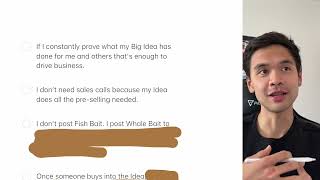
In this monologue, David Molina explains how he generated $4 million by prioritising the sale of ideas before any concrete offers. He argues that ideas are frictionless, automatic purchases – people either like an idea or they don’t – and once an audience buys into an idea, any subsequent product becomes a natural next step. Molina introduces the concept of the "idea seller" and outlines the principles that guide his business: develop a single, proprietary, big idea (his "Likes and Cash" concept) that serves as an unfair advantage; target high‑value prospects with "whale bait" content rather than mass‑appeal "fishbait"; avoid spending time on indecisive prospects he calls "maybe Marvins" and focus on believers; use a single offer with multiple tiers of access instead of a suite of products; and rely on the idea itself to pre‑sell, eliminating the need for traditional sales calls. He backs these claims with concrete examples – plastic‑straw activism, $104 k monthly recurring revenue generated solely from a Google Docs‑based idea, and audience metrics (230 k Twitter followers, 16 k Instagram). He stresses that ideas must be monetizable, protected (e.g., patents), and scarce to translate likes into cash. The overall message is that selling ideas first dramatically reduces friction and amplifies downstream revenue.
Chapters
I made $4 million online, and the TL;DR and one of the biggest lessons that I got is that selling offers is really hard, but selling ideas is really easy. And if you sell ideas first, then selling offers second becomes easier. So the thing between, or the difference between, how I see people who sell ideas and people who sell offers offers isn't the first step in the funnel. So in the first step of my funnel, I don't have a lead magnet or a low-ticket thing. I'd rather sell people into the idea, because if you sell people into ideas, if you get people to buy into, it makes it much easier for them, for people to buy. So an example of this is something like as silly as plastic straws, right? So People aren't buying paper straws and they're buying metal straws, which are arguably worse than plastic straws. So why do they do that? It's because at some point we all bought into the idea that plastic straws kill turtles, right? So when you sell ideas first and you get that into people, then it's much easier to sell them an offer because people cannot choose to buy an idea. They can choose to buy an offer or not, but they can't choose to buy an idea or not. It's something automatic. It's almost like a smell, right? You smell something and either like it or you don't. Or like a song, you listen to a song, you either like it or you don't. But if you like it, then it makes it much easier, for example, to sell you a candle of that smell. Or if you like a song, then it makes you more likely to buy a concert for that person, right? Or add it to your Spotify, which gives them some sort of royalty. So selling ideas first becomes much easier overall because then your offer is the natural next step. If they buy into what you're representing, to the idea that you have, then the offer is the natural next step. So I call people who sell ideas before offers idea sellers. And these are some of the things that we believe in as idea sellers that make us operate our client business in a much less friction way. So number one is people can copy what I do and people can copy what I say, but nobody can copy how I think. That means that my ideas as an idea seller are my unfair advantage, meaning that if I can develop one, the only place that they can get it is me. If I can develop one that resonates with people, it only came from one initial place. Ideas are the asset that lasts longest and spreads fastest, and that is why I base my business off mine. And you can hear this a lot. Like, I was in Florence, Italy recently, and it's a beautiful city, and we still talk about the ideas that, that idea, that, that city kind of gave birth to. We associate aesthetics with Michelangelo, we associate mastery with Da Vinci. So we think about these things and they are They're the longest, they're the most lengthy. So if they are the longest and the most powerful tools we have, then it makes sense to base your business off yours. My idea, for example, is likes and cash, and people who don't know me are saying it, and it's spreading faster than me, right? And though that's like kind of the thing that always sticks, that's why I'm so adamant about you need one. You need to find one so that people will associate it to you. and then your business will catch fire because of it, because the idea is more flammable than the entrepreneur. And if you base that off first, then every single offer that comes after, low, mid, and high ticket, becomes easier. The highest ROI thing then that you can give your business is one big idea, because then I think about it kind of as if it was a color that didn't exist before, that you're the only place that they can get it. You're the only place that they can see it. And once you have it, then you paint your entire business with it. You look different to everybody in town. That's why one big idea gets you to $1 million. It took me to $4 million. It can get you to $1 million if you— if the idea is right, if it spreads correctly. Me as an idea seller personally, I run a business, not a show business. Like, it's cool if the idea Spreads and all, but if it's not making you money, then what's the point, right? As an idea seller, I don't tolerate maybes. So for example, every second I spend convincing what I call a maybe Marvin— a maybe Marvin is somebody who's like, maybe later when I have the bandwidth, it's not the right time right now, maybe I don't know— every second you spend on those maybe Marvins is a second you could spend working with a believer. Because there's many people who your idea has touched. So go to them instead. They make much more sense to convince. Every single ounce of energy you convince trying to come to convince a prospect to work with you, it takes half that to convince other people to work with you. So why would you spend it with maybe-martins? If I constantly prove what my big idea has done for me and others, then that's enough to drive business. Because you don't need to kind of perform a character in the internet. You don't need to be somebody that you're not. All you need to do is you're a servant of the idea more than yourself. People don't like it when you get rich off them. People like it when you get rich with them, right? So when you prove that it's the idea that we're serving, it is much less friction, much more likely that you'll convert somebody. As an idea seller, I don't need sales calls because my idea does all the pre-selling needed. And if you're the only one who can provide it, then you'll find that on these sales calls, like you are saying kind of the same things over and over again, touching the points right over and over again. And what that does is provide context on how you can help. Your idea provides that context for you. And therefore sales calls are not needed. Me, I got to $104,000 in MRR just with Google Docs, because the idea did the pre-selling needed. It didn't need me. My idea sells better than me or a team ever could. This does require, however, not to post fishbait. Fishbait is content for the masses of fish. I personally, as an idea seller, I post whale bait because that attracts whales with the problem I solve with my big idea, the attitude to solve it, and the money to pay for it. If you build an audience with fishbait, you will get a lot of, "This is great, thank you." You'll get a lot of applause. But I have a big audience on Twitter, like 230,000 followers and like 16,000 on Instagram. And a big audience is not what it used to be. It's really not that profitable unless you actually monetize. And you do that with whale bait. That's why I'm so— well, the name Likes and Cash actually came from PTSD. From me getting to 70,000 followers and then talking to somebody who had 900, and we were making the same amount of money, $30K a month. And I'm like, what am I doing wrong? And it's because he posted whale bait religiously and I posted fish bait, and the difference was found in how much money we made. Because if your audience isn't getting you money, then what's the point? Once somebody buys into the idea, The next sale is natural because it's just about how much access to me they want in order to install it. That's why I don't sell people into, you should buy this course or this mastermind or this program or this community. I just offer, these are the levels you can have to me to install it. If you'd like this idea, then choose, right? I don't have different offers. I have one offer with different levels of access, which makes it easier because I only need to convince people of one thing. Not multiple offer suites, just one thing. If you like the idea, then the next question is not about what do you buy, it's which level of access would you like. You can do this because my idea can help many people as an idea seller, but only I can provide it. That makes you by definition the scarce resource, because if they buy into that, then nobody else has it. You own the URL. You own the domain, you know, you own the IP and the patent to this. That's why I tell people you don't need a better offer. Sometimes you do, right? But you don't need more traffic. Sometimes you do. But what you really need is a patent. You need a patent for that big idea so that you will be the only one. Because when the supply is shorter than the demand, then the demand usually will not have to go through so much objections in order to buy. If an idea isn't getting me clients and opportunities, then it's not a big idea. Like, let's be real here, ideas are cool, right? And everybody can come up with them. But if it's not making you money, then it's not carrying its weight. It's not doing much for you. So it has to make money in order to qualify as a big idea. Because likes are cool, but likes and cash. And that's a big kind of my, my thesis. I don't think you can see it. There you go. Likes are cool, but likes ain't cash. If you don't— if you have a big audience, I've got there, it's really not a big deal. And it's even less worth it now than it was before, because now anybody can build an audience of volume. If you have an idea, then you prime yourself in order to actually monetize it later on. Because you will get many likes, right? It's easy nowadays, it's so easy. But likes ain't cash. You gotta be able to monetize it, or then you're not doing much with it. But these are some of the things I believe in as an idea seller, and this is how I operate my business. And hopefully maybe you can take some of these for you and apply them, because it truly is the summary of $4 million made over these 4 or 5 years. Is that selling ideas first allows you to sell much more in the backend than if you sold offers first.