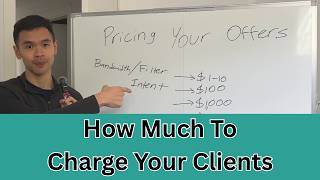
In this YouTube monologue, the speaker argues that successful coaching, consulting, or personal‑brand businesses should offer multiple products at a range of price points, much like a gym sells day passes, weekly memberships, protein bars, and long‑term contracts. He frames pricing not as a pure conversion problem but as a strategic tool that shapes client behavior, filters prospects, and allocates the business owner’s time and energy. The talk walks through a decision‑tree of price tiers: $1‑$10 – used to capture attention, build bandwidth, and filter for genuine interest when there is a bottleneck (e.g., limited API usage). Free or trial offers belong here. Around $100 – serves as an intent detector; most of his clients first paid roughly $100 before becoming high‑ticket customers. This tier weeds out casual browsers while still being affordable enough for serious prospects. $1,000‑$5,000 – signals a commitment of the coach’s time and energy; appropriate for recurring coaching, consulting, or done‑for‑you work. The exact number is less important than the psychological jump it creates. $10,000‑$20,000 – reserved for long‑term, high‑touch engagements. The speaker prefers to move clients to this level privately after they have proven competence, rather than via a public upsell funnel. $100,000+ – enterprise‑level contracts; the speaker shares his own experience selling a company for a six‑figure sum as an illustration. Throughout, he emphasizes that the bulk of revenue in a coaching business comes from the backend (private, high‑trust deals) rather than the front‑end offers. By deliberately choosing what each price point “does” – filtering, signaling intent, allocating time, or building long‑term relationships – a business can maximize lifetime value and create a flexible, scalable pricing architecture.
Chapters
Alright, today we talk pricing and the title is actually clickbait because it's not about what are you going to price your offer, it's what are you going to price your offers, plural, because I believe you should have multiple offers in your business and you should, if you run a coaching, consulting, personal brand, I think it's a very useful frame to think of yourself not so much like a coaching personal brand consulting brand, but more of as a gym. So A gym has multiple offers. You can sign up for 12 months, 6 months, 3 months, but you can also sign up for a day pass or a week. You can buy a protein bar, you can buy a drink, you can buy something at the vending machine. And so the gym gets it because they understand that the game from having people enter the gym is not to get more clients, is to extract as much LTV, as much money as you can from the person before they forget about you. That's just how the game goes. So when you have multiple offers, vending machine, 1 week, 3 months, 6 months, 12 weeks commitments, what you allow yourself to do is you make more money because you touch on people at different price points. You touch on the entrepreneur who's willing to be there for a long, long time that's just settled there, but you also bank on the guy that's just there for a weekend, wants to bang out a workout for 1 day, right? You can still make money from both. And I think that's a very useful way to see a coaching business. Now, what should you price your offers at? I feel like the question that we should be asking here is not what will convert to the best, because that is so dependent. What will convert the best? I can tell you the offer that will convert the best at the highest rate is gonna be zero, 'cause it's gonna be free. So it's not really a useful thing to have, right? A better question to ask yourself is not what will convert the best, but what do I want this pricing to do? Because different pricings do different things. It's like, man, this is gonna be kind of a wild example, right? But let's say you were gonna give somebody a gift, right? If you gave somebody just this generic gift, let's say, I don't know, like a gift card, right? Then what does that say? What does that gift do? It's like, I don't really know you too much, but like, here's something so I'll play nice, right? But if you give somebody something like a handwritten letter, then what does that gift say? It's cheap because it didn't cost you much, but it shows something, right? It shows like, I care about you. And so offers do different things in your businesses. They accomplish different goals. So if you look at pricing, not so much as a mathematical and numerical exercise, but more of a philosophy and magic exercise, you make more money because you see, oh, different offers do different things, different price points do different things. So the question I'm going to be answering is, Yes. What should you price your offer at? But also this is what these pricings do for you. So let's get into it. What should you price? Why should you price an offer at something 1 to 10? If your goal is to filter, I think you should price your offers at something from $1 to $10. I'll also bake in free with a trial as well in this category. Now, if you just have an email list or you just like are building an audience, you just want to get people inside of somewhere, then price it free. Just do it for free because like volume plays in your advantage now. But if you have something where you have a real bottleneck, for example, I sell software, right? I'm in the software business. So what do I do here is they use my API keys, which is basically I get charged if they use my AI stuff. 'cause they use my keys. In that case, if I just make it entirely free with no commitments at all, then at some point I'm gonna, you know, the bill is gonna come pretty heavy. So I do have a real bottleneck there. So I need to filter for people who are like actually interested in using that. So if you have an interest in filtering for people and you have like a true bottleneck, some sort of software, AI, or some sort of capability, or you're limited in some sort of rate, then that's a good number. Now, this is also good, by the way, to catch bandwidth. A lot of eBooks, courses, small books, they charge it as this small percentage. Reason being is that you wanna, you wanna capture a lot of bandwidth in people's minds early on. And so if you charge it for free, you might get more people who download it, but the people who actually consume it are not gonna be that many. And so you wanna capture bandwidth if you sell something at that price. This is, it's weird that the people who are like kinda, I feel like dominating in terms of like social media branding and whatnot, they're in the extremes. Like they charge something like extremely cheap or something stupid high. And they're kinda like going in that range. So it's kind of an interesting dichotomy that I noticed. So if you want to capture people's bandwidth or filter, this is a good pricing, $1 to $10. Now, $100, and this is not like definite of you should charge it at $100. This could also be like $200, $250, $700, $500. It's like in that range. So use your judgment depending on your own business. So $100, I feel like you should price an offer at $100 if your goal is to find Intent. 90%+ of my clients have bought something for about $100 before they became a client. And that's a big deal. Every time a statistic like is about like 90% of something, then that's something you should probably pay attention to. So for me, this is something I should pay attention to because most of my clients actually like from $10,000 plus, they didn't come from me selling something $10,000 plus right from the get-go. They actually came from me selling something cheap because I read this tweet the other day and I heavily disagree with it of cheap people, cheap offers attract cheap people, cheap offers attract cheap people. I don't believe in that. Sometimes, yes, that happens, but expensive people also buy cheap offers. Right? Millionaires also buy bottles of water. And so if you buy something, if you sell something for really cheap, what you do is you filter for intent. Because if you sell a workshop, a course, a template, a swipe file, anything for $100, then people don't drop just $100 for anything, right? It's just, it's not like a whim sometimes. For some people it is, but others, like, they consider it, right? So $100 is a place where you can charge for something and it cannot be justified as, ah, I just bought it just because, right? There's a reason why people bought it, right? If you bought the course on how to drop 12 pounds and do it with the keto diet, then you probably don't have a six-pack, right? There was a reason why you did that. And so $100 tends to be a really good intent finder in my case. So if you have an audience of a lot of tire kickers, a lot of people who are ghosting or looky-loos or people who just wanna study, then this price range can get people moving, or at least find you the people who are willing to pay. Now, $1,000— what should you price at? $1,000, something in that range. I feel like this is when you start filtering your time and energy. I think like for some people, this can start at $1,000, right? If you're at a, like a later stage, then this starts at a much higher price. But when you start devoting time and energy to people, some sort of coaching agreement, consulting, done for you kind of work, then $1,000 plus makes sense. And I'm not saying that it should be like $1,000 on like a one-time payment. This is something that you charge recurring. This is something that it amounts to. It's more like for you to understand, if you will, the vibe of the pricing, because like numbers are weird because they're objective, right? They're numerical. That's where it comes from. But they're also like, they also have a lot of magic and a lot of like feel behind it. An example, right? If you charge something for like $40 up to like $49, then it kind of feels the same, right? But once you charge $51, it's like, yo, what are you doing? Right? Like it feels a little different. Same thing if you price something like $4,800 and then you price it at $5,200, feels kind of the same. But the moment you go to $6,200, that 6 makes it look like, hmm, something's going on here, right? So pricing is objective, but it also has a lot of subjectivity and a lot of emotions attached to it. So a lot of these is actually vibes-based. It's not so much numerical-based, but hopefully You are kind of catching my drift here. If you can think like in more nuanced terms, this is not like Jackie told me to price at $10,000, right? It's like, it's kind of where the range of where you should do it. It's like, use your judgment, right? So $10,000, what should you price something at $10,000 at? It's not something that you might charge for it just right from the get-go, but it could also be something that it amounts to. I feel like that should be something that has some sort of long-term time commitment from you or energy commitment from you. So this is something I like to do with people. Maybe they'll buy a $100 thing in my model, because the way my model works is I sell something for really cheap. And then if people see me and consider me as competent, then they typically move on to the next area. And so I start with something really cheap and then move them on and move them on. But I don't go with like typical upsell routes of, hey, now buy this $1,000 thing and then this $10,000 thing. I'm more of a, I guess I'm at a stage where I don't really like need as many people as I used to in the past. So what I do is if I see somebody who I believe is competent, who's more of a long-term player, who gets that this game requires patience, what I'll do is I'll reach out and I'll strike a better deal with them. And I said, I know you entered through this pricing, But if you're willing to stay here for longer or do this or commit to that time, then I'm willing to play along. Or if you're willing to play the long game with me, I'm willing to play along too. And so what I found myself in is for people who are willing to play long-term games with me, I will charge this, but it'll be something I amount to. It's not something that I'll charge from the get-go. My business, and I believe good coaching businesses, they make most of their money in the backend, not in the frontend. The front end makes you more money. For example, if you're an influencer, if you have a bunch of followers, but if you don't, then you're probably better off betting on your backend because that's where most trust happens. The shorthand for making deals is, well, much shorter and you make more money because you have more trust with people. So the long-term deals is not something I would lead with. You will rarely see me promoting something like this if ever, but it's going to be more in private. It's something that once I, well, I've checked you out and you've checked me out, that's when we can have that conversation, but not from the get-go. Again, good coaching businesses make their money on the backend. And what should you price something at? $100,000? I feel like this is when you start talking about enterprise. Now, when I sold my company, I got a 6-figure payment myself, so I can't really talk about 7 figures plus, even though the company sold at 7 figures. There were more people involved, so I can't ethically talk about that. But the payment that I got, it was for around $350,000, right? Now you can aim for those payments if you sell enterprise. And, um, well, if you're watching this, then that's probably not you. Maybe you have some sort of that, and if so, then you have something really interesting that you can develop. But most people are gonna find themselves like in these four. And so pricing your offers is not a— I don't think it's a question of what will convert the best, because you already know what will convert the best. It's a cheap one. It should be more of a question of what I want this offer to do. And if you think like that, more strategically, of what I want these numbers to feel like and do at different stages of people knowing me, then you allow yourself for a lot of movement, a lot of backend goodness in your, in your business. See ya.