In this ideation session, David Molina, a serial idea‑licensor, walks through a live example of how to carve a unique positioning for a fitness coaching business. He starts by critiquing a generic "Daily 5" habit list and extracts the deeper insight that elite physiques are built not by complex programming but by committing to a few simple, non‑negotiable daily minimums. Molina then translates that insight into a suite of product concepts—The Daily 5 Protocol, Non‑Negotiable 5, Minimum Effective Habits, etc.—and discusses naming, branding, and positioning angles. He contrasts traditional workout splits (push/pull/legs, RPE, PR tracking) with a simpler "workout stack" model that focuses on stacking a handful of high‑impact exercises (e.g., pull‑ups, push‑ups, kettlebell swings) to achieve top‑10% results. He sketches a visual dashboard for tracking client consistency and transformation, emphasizing data‑driven proof. Throughout, he iteratively solicits feedback, rerolls naming ideas, and refines the concept based on the participant’s reactions, illustrating a repeatable framework for differentiating a fitness coaching offering.
Chapters
What's up? I'm David Molina. I made $4 million off of my big idea, licensing cash, and I draw ideas from people so that they can turn it into million-dollar businesses. So you're about to see an example of one which is about fitness. So fitness is kind of a saturated place, right? Quote unquote. But if you find one big idea inside all of the kind of things that are obvious to you but fascinating to others, then it can be much easier to sell. Hopefully you'll get the point once you see the example. So enjoy. Claude and Pace, what you just gave me: if you want to take your fitness and physique to be top 10%, do the following 5 daily habits: sleep 7 hours, drink 100 ounces of water, walk 12,000 steps a day, 30 to 50 pull-ups, 100 kettlebell swings every day with 1/3 of your body weight. So I take this and I think This is very valuable. Thank you. I'm gonna do it on my own and then get back to you, right? Which I don't like hearing. But let's, let's run it through this. The truth that reveals the insight. You've discovered that elite physiques aren't built through complex programming or gym obsession. They're built through non-negotiable daily minimums that most people dismiss as too simple. Your insight is that top 10% physiques come from doing basic things consistently rather than perfect things sporadically. You're essentially saying the secret isn't in the complexity, it's in the commitment to simplicity. I like that. Commit to simple instead of complex. So that is the truth, right? Basic thing consistently. Linking your insight to an idea. The idea born from this insight is that fitness success comes from treating certain movements and habits, like brushing your teeth, non-negotiable dailies that happen regardless of motivation, schedule, or circumstances. It's not about having the perfect workout, it's about never having— never missing the fundamentals. Position product as a way to get the benefits of the idea. You could position your coaching program as a system that identifies someone's personal daily 5 and builds the structure to make them automatic. Instead of selling prioritization, you're selling the discipline architecture that makes simple things inevitable. The bridge is, here's how to identify your non-negotiables and build the system so they happen even on your worst days. So The Daily 5 Protocol, 5 Negotiable Daily Minimums, Minimum Effective Habits, the Brushing Teeth Method, the 80/20 Body, Simple Stack Fitness, the Non-Negotiable 5, Minimum Daily Dose, Consistency Code, Baseline Bodybuilding, 365 Methods. So at the end, the prompt is going to ask you a few questions. Would you like to reroll, pick one of these and develop it further, Or did they miss the point and they would like you to try again? So would you mind, uh, unmuting yourself and walking me through this, if any one of these landed or you'd like to reroll?
Yeah, so the, uh, I would say that 80/20 was— that would be kind of the closest. Maybe rename that one to the 90/10, but other than that, I would probably want to reroll after that.
Okay, let's reroll. More around the 80/20 angle. Why, why was it closest, but why did it miss the mark?
Uh, because just the premise of being in the top 10% means you're already above 90% of people, and everyone's pretty familiar with 80/20, I feel like.
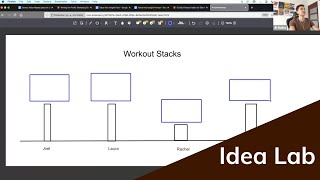
I'm gonna tell you where my brain goes off with this. And again, this is like, um, this, this is a skill that we all have, but it's easy for me to see because I'm not in, in your world. Like, you know, like sometimes you get like bomb message from a stranger and you're like, how can I not see that? Well, it's because you're inside of it. That's why you can't see it. So here's an idea. I like that you've got this. We can create some contrast here. There's a workout split, and you can create something related to a workout stack. So what is this? A workout split tells you to do push pool legs or other complicated words like reps in reserve, uh, RPEs, PRs, and other stuff that you don't really need. In my experience, I believe more in simple workout stacks. If you do 100 pull-ups, you will somewhat consistently— you will get a bigger back. Same with crunches and same with push-ups. My clients don't have time to figure a lot of the numerology stuff out, of the split stuff out, nor do they need to. We focus on stacks. The goal for the week is to stack a certain amount of reps of only the most effective exercises that put you in the top 10% of physics. We track you stacking these on top of each other rather than have you do math about how many bought other workout splits. This is why at Stacked Fitness our numbers look like this. So you can pull up kind of like, um, can pull something up like this. That says workout stats, and then you can have here something like your clients: Joel, Laura, Rachel and pull up a line, and then you can pull out a, a bar graph of how many times they did the same exercise consistently. Just the same old, for how many days did they actually do the thing. And here you can put a picture of each of their transformations. It's like, see guys, you don't need to overcomplicate this shit. You don't need to do a workout split, you need a workout stack. You need to stack up the most effective ones because they've been on it since the golden era of bodybuilding. So why are we going to reinvent it? Let's focus on the fundamentals and do workout stacks instead of splits. Shit.