In this instructional monologue, the speaker (David Molina) explains how to increase revenue by designing upsell offers that are congruent with the previous purchase. He starts by sharing typical upsell conversion rates (about 20% from a first offer, 10% from a second) and pricing multipliers (2‑5×). He argues that the most effective upsell is one that naturally follows the prior purchase, using everyday examples like McDonald’s fries and AppleCare. The speaker then illustrates the concept with real client cases—weekly $100 clients converting to paid‑in‑full, a workshop cohort generating a €3,300 annual upsell, and high‑ticket sales up to $36,000—showing how each subsequent offer built on the previous one. He stresses the need to plan a sequence of offers in advance, constantly asking “what’s next?” to keep the sales funnel moving. Finally, he offers one‑on‑one coaching to help cash creators craft congruent upsell sequences.
Chapters
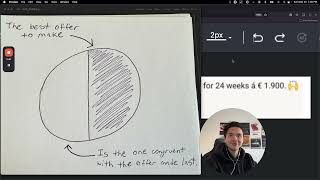
About 20% of the people who buy a one-time thing from me upsell into the next thing, and about 10% of those people who upsold into the next thing upsell into the next thing. And the increase in pricing on those— some things can be 5x, sometimes it's 3x, sometimes it's, it's 2x. And over the years I've been Like learning a little bit more about what makes people upsell. Like once you make an offer, then that's just the start of the game. Because if they take it, then one has to be thinking, okay, what's gonna come next, right? Because if somebody gives you $1, that doesn't mean that they just wanna give you $1. That means that they have a problem that they pay you to solve for $1, but they might want more. And in order to think about how to get more upsells, I find this graphic pretty useful. I posted this the other day. It's, the best offer to make is the one congruent with the offer made last. And it's my argument for why I personally believe that congruent offers can sometimes do better than better offers. So if you'd like to analyze the strength of your own offer, then that, that has a few components. And a lot of them are Well, it's not just one, right? But one of them is, is it congruent? And that's a big one. Is it congruent with the offer that you made last? So you can see it, for example, in McDonald's. So once you buy a burger, what do they ask you? Would you like fries with that? Once you buy an iPhone, what do they ask you? Would you like— I think it's called Apple Support or Apple Care, you know, the insurance. So it's the one that's congruent with the offer made last, and because it's congruent, then it typically has much higher, uh, upsell rate. So when people buy, for example, they buy a course from you, jumping from a course into a program, then using that wording specifically, it's not exactly congruent. Like, it's not natural for people to go like, okay, I bought this and then I bought that. As natural as it is, well, I got an iPhone, so it makes sense then to get AppleCare. You know, so when you think about what should the offer be after I make one, is what complements it? Instead of jump from this course into this program, into this mastermind, into this community, think if the offer before was how to solve problem X, then the offer after should probably be something about how to solve problem X better, faster, cheaper, now, right? It's the congruence that makes it work. And the cash creator understands this. It's not just about making the offers better and making every single offer along the funnel irresistible. It's also about how can you make them congruent so that it all makes sense from head to toes. So an example of this— so this is from a cash creator. So 2 new clients at $100 a week, then what makes sense after that? Then probably a paid-in-full offer. So one decided to pay in full for 24 weeks and he made money, right? So that's half of the people who took the upsell. It makes more sense because once you make one offer— and this is why I'm a big believer in just get people in motion— then people are typically very open to taking up— taking you up on the next thing. So another one, 12 workshop customers, which made €964, and out of those 12, one upsell for the whole year at €3,300. Now this is, this is a perfect example of offer congruence. Because they made one before, then it makes sense to elaborate and make the next thing congruent with the one that's before. So when you're setting up your funnel, think, how can I make the offers congruent with what happens after? And this is why, like, I put so much effort not only into crafting one offer, but actually questioning people when I work with them, and sometimes even drafting the offers with them, of, okay, what happens next? And what happens next? And what happens next? Because one thing that sucks is not being able to get the clients when you want them. Another thing that sucks is not taking the money when people want to offer you the money, but you just don't have the bridge to reach you. You don't have the congruence to go further and further and further. And theoretically, this can go in infinite ways. So this is why I've been able to close people who, you know, can pay for like $100 for something small up to $36,000, because you just think about, okay, what's next, what's next? And probably I should have thought about something else to sell the guy that paid $36,000, right? So this can theoretically go go infinitely. Thinking about front-end offers, it's alluring because that's where a lot of people are, but you'd be surprised at how many— how much money you would make if you put half the effort you put into that into getting to upsell the people who already made you money. And that's done with offer congruence, which is why I'm, I'm a big fan of this. The best offer to make is the one congruent with the offer made last. So if you'd like me to set these offers up with you, I do this with every Cash Creator on a one-on-one call, so you can reach out and we can get to it.