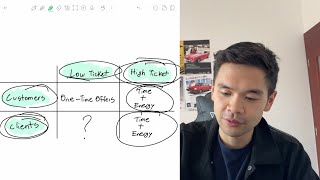
In this video David Molina explains why he is taking his group coaching program off the market and reframing his growth strategy. He argues that focusing on increasing monthly recurring revenue (MRR) is a mirage because every customer’s “wallet” eventually dies. Instead, the true objective should be to maximize each person’s lifetime value (LTV) before that point. Molina distinguishes two buyer categories – customers who purchase one‑time solutions and clients who subscribe to recurring services – and shows how conflating the two caused a 67 % churn rate. He breaks down his past mistakes: selling high‑ticket recurring offers to one‑time buyers, and lacking low‑ticket recurring offers for true clients. He then outlines a new offer matrix that aligns product type (low‑ticket, high‑ticket) with purchase cadence (one‑time, recurring) and experience format (short‑term experiences vs ongoing access). By matching offers to buyer intent, he can allocate his time and energy efficiently, keep high‑ticket clients happy, and still capture high LTV from one‑time customers through premium experiences. The decision to retire group coaching is presented as a strategic move to stop optimizing for MRR and start optimizing for LTV, which he claims is a more sustainable and realistic growth metric.
Chapters
So I took my group coaching off the market, and it typically is one of the models that you use to scale the best. Like, that's what's being thrown around. Like, if you want to scale your one-on-one coaching, then, then you do group coaching. And I am retiring it off the market because I want to fix the biggest mistake that I made in getting to $100K MRR. And it's a, it's a very subtle distinction, but if you want to get to big numbers in MRR, your goal shouldn't be to increase MRR, it should be to increase LTV. And on that journey, when I understood that, things started, things started clicking. And it's a subtle distinction, but it matters if you want to extract the most money per person from your audience before their wallet dies. So for simplicity's sake, there's two kinds of wallets, alive and dead. And a live wallet is somebody who's open to buying from you, and a dead wallet is somebody who's not. And make no mistake, everybody in the long enough time horizon has everybody inside their audience's wallet die. Like all wallets die. And that's just life because people will either change paths, they move on, change careers, lose faith in you, Or maybe they just quit, right? And you have followers right now that have live wallets and clients as well. But every single one of those wallets is on a timer, just because even, even your best and like your most loyal clients, they eventually retire or maybe they just die, right? Like things just are not forever, right? Everything changes and every single wallet will die. Understanding this and knowing that we run a business, then shouldn't the goal be to get the most out of each wallet before it dies? My argument is yes, right? And obviously you need to do it in a way that you enjoy it and have the correct boundaries for it. But specifically in a mathematical way, then yes, the goal is to get the most out of every single person's wallet before it dies, because every single wallet will. So how do you, how do you do this? In my world, I define two people with live wallets. To me, there's two. There's customers and then there's clients. Customers buy one-time solutions. They buy a one-time transaction, that's it. Clients buy recurring solutions. So maybe they're in with you on a monthly basis. So if you sell a customer type buyer, a client offer, then that's pretty overkill because they just want that one solution and they don't want any more. They're just here for that one piece. And this is why I got so much churn in the beginning and why it was like a big mistake to sell customer type, uh, client type offers to people who were just in a customer kind of way, because I was basically selling gym memberships to people who just wanted to get one workout in. I didn't really make sense, right? And that's why I got to the point where churn was 67%, and it was a big thing, right? And it came with a lot of pain, but I didn't, I didn't get it. I thought that there were different kinds of buyers, and I didn't understand, and I was blind to the fact that there's two. There's people who buy one-time things. Let's say you are, you're in a random city and you want to work out once. right? You're not gonna buy a gym membership. You're gonna buy a one-time thing, right? Does that say anything about you as a buyer? Not really. It's just that you just wanted to buy that one thing, right? And I didn't understand that some people don't need or don't want recurring things. They just want one thing. And so selling them a recurring thing creates excess or excess, you know, excess. They get too much for what they need. Right? And then you give too much to people that don't want it. And so, well, they leave, right? Once they get what they want, they just leave. But what was interesting to me after that— well, now it's interesting, back then it was angering— is that a lot of people who churned and they left, they kept buying other customer offers that I had. If they were one-time things, But they kept buying, and I couldn't predict when, right? It's hard, but they always did. Like almost every single customer offer that I made, somebody else that left, uh, declined stuff before paid for that. And that used to anger me. Like I used to cope by telling myself, hey, like, if you don't like my music, why are you coming to my concert, right? And I was too arrogant to understand that the reason why it's because— it's because they only like one song. And that's okay. You're allowed to not like an artist but like one song. Just like you're allowed to work out at a gym once because you're just visiting that city and not stay. And I did not understand that. I didn't understand that some people won't pay you on an MRR basis, but they still want your stuff because they like other songs and they will pay you in other ways. Ironically, some people, they wouldn't pay me on a recurring basis, like on an MRR basis, but they would pay, they would pay often. So their LTV was higher than some other clients before their wallets died. So sometimes I made more money from non-clients than clients. This is big. It was, at least it was for me, because then I understood that maybe there's more than one way to run a client business, not just with the MRR, but in another way, not just monthly recurring revenue, but revenue that recurs from people who may not be on the MRR part of the graph on Stripe, but they are still willing to buy, right? You just can't tell when. So let's say, like a tale of two people, right? So you get a client at $1,000 a month and a customer that maybe doesn't commit, to the $1,000 a month, but in all the products that you sell pays you roughly $6,000 twice a year, right, for various offers. At the end of the year, their LTV is the same. It's still $12K. So these two are mathematically equally valuable to you. That's just the reality. One's not a client, but they're mathematically equally valuable to you. They just kind of bought in different ways. And that's when it really clicked. The goal is not increasing MRR. The goal is increasing the LTV of each person before their wallet dies. Because some people, like in MRR, they'll pay you and that's just that optimal way to optimize that LTV. And some people will not be in MRR, but that doesn't mean you cannot get a really high LTV from them. And my head was too dense to understand this. I didn't get that you can get paid in more ways than just people on a contract with you or people on a recurring deal with you. I don't do contracts, but you understand. And that's what I got wrong. I want to, I want to demonstrate it visually so you see it. So there's, like I mentioned, in my world there's customers And then there's clients. A customer pays you once, a client pays you on a recurring basis, or like in a recurring deal. And I'm going to split these into low ticket and high ticket. Here's what I got wrong. So I was selling to people who are customers. I was selling low ticket things, and that part I did get right. I was selling them one-time offers. So that worked. Now, the people who were on a customer basis, who just wanted to buy the one thing, when I offered them high-ticket stuff, I would give them my time and my energy, and that's what created the debt. That's what created the pain, because then they didn't really want my time and recurring energy for a long period of time, maybe for a compressed time, but not for long. They just wanted one puzzle piece done. They just wanted to get that one workout in on the city they were traveling to. So it didn't really make sense to dedicate a lot of time and energy to these people because they were not gonna, they were just not gonna stay. And that doesn't say anything about them, they were just traveling, right? So why, why would I then dedicate so much of that time and energy to them instead of finding a deal that maybe, hey, if you just wanna work out for a day, this is the price, and that is it. Right. But I didn't see that. And that's what I was blind to. And then another mistake I made, there were people who were willing to become clients, a.k.a., pay on a recurring basis, and I could offer a low-ticket thing. I didn't have anything for these people. So then I was missing out on that part of recurring revenue. Right. But there are ways in which you can have low-ticket offers that don't take much from you or anything from you. and you can have recurring revenue that way. I just didn't see it. And the another part that I did get right was clients and high ticket. I would dedicate my time and energy to them because they would stay and they would pay higher prices. So it makes sense to allocate time and energy. So there were a few mistakes here. 3, 2 specifically. One is not having anything for these people. And dedicating too much to these people. Here's how I'm fixing it. So now, to the people who are low ticket and they just want to buy a one-time thing, then yeah, I'm just offering a one-time offer going forward because it makes sense. It's a deal that benefits both people. To clients, people who would pay recurring, having low ticket things that they can stay in and have some access to, that makes sense. So I'm giving them asset access. To customers who are willing to pay once, but they're willing to pay high ticket, I'm willing to offer experiences, something short, something that has a compressed timeframe in which they get what they want, they pay the price that I'm willing to deliver on, and then that is it. We shake hands on it, they get the workout in, we part ways. And to people who are clients and they're willing to pay a high ticket, I'm still dedicating their time and energy to. And that is it. Everybody fits where they need to be. And that's a big reason why I killed my— well, I'm going to kill. And that's a big reason why I'm taking group coaching off the market, because I'd rather work one-on-one with people who I can dedicate my time and energy to and they can match it. And then to everybody else who is in the, well, tourist gym kind of situation, then I'd rather sell experiences so they can get what they want. And then, you know, we part ways. I don't dedicate as much time and energy for a long period of time to them, and they don't need to commit to things that they don't want to. We both get what we want, right? Because I understood now that I cannot grow a business the optimal way if I just want to get MRR, because everybody's MRR drops down to zero because everybody's churn is 100% because everybody dies and everybody's wallet also dies. So MRR is a mirage. Like, we, we want to make it so that it's, it's permanent and it's forever, but that's not how it works. MRR always goes to zero at some point, but LTV is real. LTV never goes down. That's why I took the group, like, coaching thing off the market, because the goal isn't MRR anymore. It's just one degree apart. It's now increasing the most LTV I can from everybody's wallets before they die. And it will happen to me. It will also happen to you. Everybody right now— well, not everybody, but a A lot of people inside of your audience have an alive wallet. They're all going to die. And you need a plan to make sure that you extract as much LTV from them as you can before it dies. This is my path and this is what I'm doing. And this is why I'm killing the, the group coaching thing because I'm moving things in a way so that I'm not optimizing for MR, I'm optimizing for LTV because I genuinely believe this is the best route for the kind of business that I want to run. And that's why I'm taking the group coaching thing off the market, because the goal isn't MRR anymore. It's one degree apart. MRR is a beautiful thing when it's alive, but it always dies. MRR always goes to zero because every single alive wallet in your audience dies. It's like a mirage, but LTV is real and it never goes down. And sometimes the best way to create LTV is through a client offer that makes MRR, right? Like maybe that is the optimal way, but at the end, the goal is just extract as much money as you can before the wallet dies. Sometimes it'll be through MRR, but that's not the goal. That's the side effect. And if you make the goal to increase LTV, then you're gonna have a much easier time because you're matching people's buying mentality to the offers you're selling. And so that will give you the best chances to get the most out of you can out of an alive wallet before it dies. Because everybody inside of my audience that has an alive wallet is eventually going to die. It will happen to me. And will also happen to you. So then the goal shouldn't be to increase MRR, it should be increase LTV before that happens. And that's why I'm taking the group coaching thing off the market, because I want to make sure that I match people's offers to their experiences, to whatever they're doing at the time and whatever their mentality is to buy, not by increasing MRR, but by increasing LTV.