Bernard and David Molina show how to turn tips and frameworks into personal stories that actually sell. They call it the transformation deficit: audiences remember confessional, vulnerable narratives far longer than advice. One client grew from $10K to $50K monthly by building funnels around compassion-based storytelling instead of generic value content.
Chapters
What you're about to see is a recording of a presentation I made at Dan Coe's conference on how do you turn your value-based content and then you turn it into insight-based content. Because value-based content, it is my thesis, it attracts a lot of triers and not enough buyers, whereas insight does attract more buyers. And it's why my Instagram makes per follower 15 times as much as my Twitter. Hopefully you'll understand the distinction between each other. Once you see me write live in this recording, it was fun. I enjoyed it. People liked it. And so here it is.
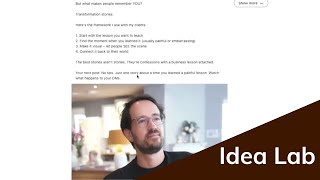
We're gonna start with this. We're drowning people in info when what they're starving for is transformation. Yesterday proved it. 3 hours analyzing viral content, frameworks, tips, no retention, but I still remember every word my mentor told me about his first speaking gig. How he froze on stage, forgot his presentation, and ended up just telling the audience about the time he lost his biggest client. Standing ovation. After 7 years building brands, I finally understood that tips are info, but stories are transfo. This is exactly what's happening on LinkedIn right now. Everyone's sharing tips, but what makes people remember you is transformations. Here's a framework I use with my clients. Start with the lesson, find the moment you learned it, make it visual, connect it back to the world. The best stories aren't stories, they're confessions with a business lesson attached.
Your next post, no tips, just write one story about a time you learned a painful lesson.
Watch what happens to your DMs. So first of all, let me, let me clean up my tear. That was beautiful, man. Good stuff. Second of all, let's say I'm your ideal client. And I'm reading this, right? And I'm really into it. And I'm like, okay, great. Like vulnerability and turning my pain and stories and tips. And then I'm like, man, this guy really knows his shit. And then maybe I'm considering some sort of becoming a client, but then you're like, here's a framework I use with my clients. Start with the lesson, find the moment, make it visual, connect it back. And then I'm like, man, Bernard, you're such a G, bro. Thank you for not having— not asking me to pay to get so much value from you. Let me take this and then I'll for sure get back to you once I implement this.
Oh, let me try your free stuff so that I can afford your paid stuff.
Like the sentences we all like to hear, right? So what do you do then? How do you change this so that it's not value but insight? I really like this example. So we're going to copy.
So I just copied it.
And then if you go to the doc I sent you, up to the top, there's the prompt. So you copy that.
This will, this will be included and it'll be, you'll get it after email or on your dashboard.
So you copy that, you copy your value-based piece of content because I noticed that value often comes more natural to people, and then you copy the prompt.
So I copied it here. So we press enter.
You've discovered something fascinating about memory and learning. Transformation beats info because stories create neural pathways that tips can't.
Okay.
While everyone's obsessing over frameworks, you've observed that our brains are literally wired differently for narrative versus data processing.
Okay.
The frozen stage story from 2009 is still vivid while yesterday's frameworks vanished. This isn't just about engagement, it's about neurological levels. The big idea is that your prospects aren't suffering from info deficit, but from transformation deficit. Okay, every piece of tactical content they consume makes them more informed, but not more transformed. They're collecting tips like digital hoarders while remaining fundamentally unchanged. They don't teach lessons, they create memory anchors that stick because they engage the same brain networks we use to process our own lived experiences. You could position your work as the bridge between having great expertise and making it unforgettable. Instead of helping people create better content, you help them transform their knowledge into transformation stories that prospects remember months later. Your process isn't about content, it's about memory architecture. You take their scattered expertise and turn it into story-driven content that creates lasting neural inputs. So some ways you can name it, I'm gonna write for you and I'm gonna show you how I, how we turn this into something. Memory anchors, stories that stick, neural marketing, sorry for strategy, transformation deficit, the experience gap, storywire brains, confession marketing.
I like that one. I like that one.
Scene setting content, the memory test, anti-tips movement. Okay, so Everybody here, including me, gets what we in the business call a CP. It's a cringe pass. So I'm going to start writing, and it might be very cringe, but I'm going to show you an idea of how this could turn into something. So some ideas that stuck to me from that were memory anchors.
I like that one.
I liked— what was it? Confession marketing. There was one that you mentioned here. No, wait, painful or embarrassing.
And I think there was one more. I'll start with this. So let us begin. You will never fail to find information. You open up, you open the feed, and there's going to be tips on how to, how I, how you can. It's almost always about information. And what people can do. But these people are often not making as much as they could be making, or as others are making. Meanwhile, other people that seem to just wing it actually getting more clients and making more money than the rest, and their strategy seems pretty bland and raw. What is it?
I still remember every word my mentor told me on his first speaking gig, how he froze on stage, forgot his entire presentation, and ended up telling the audience about the time he lost. Was it luck?
My thesis is, is, was not. It's what I call confession marketing. Right now everyone's on the information marketing train. With AI, it's 50x. They like— but the problem with that is that even though their brains are being fed Their hearts are not. The content is read, but it's not felt. The words are processed, but they're not retained. And so people end up almost knowing less after going through the info content, new post, and after, which ends up in fewer clients. When I work with clients, I have one rule. I have one rule of thumb. I have a rule of thumb that information Marketing is good. Confession marketing is better. Remember that old adage that people buy emotionally and justify logically? When did we forget that? When did it change? Never did. And compassion was one— is one, if not the most effective tactic we've got to transmit emotions, because it lowers people's defenses and it allows you to create that connection that information marketing doesn't give people. They'll pay you, they'll buy from you, and they won't necessarily be able to articulate how, but you know it's because in the middle of the information marketing age You chose compassion for yourself and for others. You made them feel something, and in the end, that makes up for the difference. See below, case study of a client using compassion marketing that went from $10K a month to $50K a month. This starts with you extracting your stories, turning them into compassion-based assets, using those as your funnel for your product or service. This is what we get crystal clear on our first call together. DM me for details.