Watch Me Come Up With 5 Big Ideas With AI (The Big Idea Prompt)
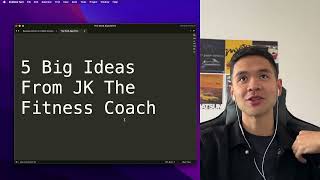
A creator shows how to use AI to extract five marketable ideas from your expertise using a "Big Idea Prompt" that encourages raw, unfiltered thinking. He demonstrates with a fitness coach persona, pulling concepts like "Be less fat than yesterday" and "Thermodynamics Over Tactics," then explains how to package these ideas as slogans and community tags to sell in 2025's algorithm-driven feeds.
Chapters
All right, so today we're going to do a little bit of testing. I, um, I posed as a fitness coach, gave it to the big idea prompt, and saw some ideas that I really liked. And I thought, this is powerful, especially in 2025 because of how algorithms are designed now to show you posts. So something interesting about how it used to work in social media— so open up your feed right now and you're gonna notice that most of the posts that you see are by people that you don't follow. They're strangers, and there's typically often, uh, very high engagement posts. They're very entertaining. And that's not the way it used to work before. You used to see mostly only posts about people that you already knew or, or you already followed. So things have changed. And the way I like to frame it was that before, it used to be kind of the age of the individual. Audiences had a higher value, personally I believe, than they have it today. I believe the value of the audience has lowered because now you just don't see people that you already follow. You see other stuff. You don't see individuals, you see individual pieces now more. So this is Terrible news for people without ideas, but it's great news if you can find yours, because individual ideas are more flammable now. If you have a good idea and it's a powerful idea, then the algorithm does reward you for it, and it makes it easier then to sell anything that you— well, your offer, because it's easier to sell people an idea first and an offer second than the other way around. Because if people can buy into an idea, then it makes them much more likely to buy into the product associated with the idea. So I'll give you some examples like Paris. The idea of Paris— what does Paris represent? It's love, it's connection, it's romance. So people will buy into that idea and then spend $10,000 or more in a trip to Paris, right? Or chickens, right? So free-roaming eggs. Like, I don't really understand or feel much of a difference when I eat normal eggs and free-roaming eggs, but I like the idea of, you know, free chickens, so I buy those, right? Or straws. At some point, for some reason, in 20-something, we associated plastic straws with killing turtles, and then nobody was using plastic straws, and people were selling the metal ones or the paper ones, and those became more popular. Right? So ideas correlate really well to money, because if you can get people to buy into an idea, then the product associated with the idea becomes a much more natural sale. So I believe personally that AI is the most powerful tool of today, and I believe ideas are the most powerful tools in history, and I believe that if we can combine those two to find big ideas within us, then we can make great things happen. Because the problem with big ideas is that they're kind of random. You don't choose typically when a big idea hits you. So if you read marketing books on how to develop big ideas, they will literally tell you some piece of advice is go for a walk, go train. Ogilvy recommended you drink a glass of wine or a pint of wine. Which is cool, but it's like knowing that ideas are the most powerful thing I have in my business, I would like it to not be random. And I think AI opens up that door. So I have a prompt in which it will question you and it'll come out with big ideas from you. It'll extract kind of your own brilliance from you because sometimes you've been inside of your work for so long that you forgot how impressive it looks from the outside. So for you it's obvious, but for others it's fascinating. And if we can find those big ideas within you, then I think it's going to be much easier for you to sell in the 2025 algorithm than if you just try to sell people into a product first. If you sell the idea first, you sell more. So I'm going to demonstrate this live and show you what I came up with. So this is the prompt right here, and, um, I'm selling the prompt on my list, so I'm going to show you how it works. So first, the ground rules. You're gonna basically— you copy and paste stuff, you upload a PDF, and that's it. And I'm going to show you the conversation later. But the ground rules is that ideas always start cringe. Like, at the beginning, you're like, I don't know. But then you start believing it and it starts turning into something. Like, imagine you go up to the metal straw marketing department and you're like, you know what, guys? You know what we should do to sell more? We should use turtles in our campaigns and show how our competitors are killing turtles. Poor, poor turtles. Like, it doesn't really make sense, but it works, right? So have a cringe fest. So also, you are allowed to ask the prompt to elaborate. So if it asks you a question and you don't really understand it, then it can be like, yo, can you help me out with it? These are valid things you can tell it. Or concerns. If you feel like AI is being— or pulling you in a direction you don't really want to go, you can tell it. It's like, I don't want to go here, let's do something else, and it'll go somewhere, somewhere else. You can move on to the next question if it starts feeling like a chore. If something feels too corny, tell it, that ain't me, do something else. You're allowed to be a kid because it's more fun if you're having fun. If you're not, then you're not going to be in that childlike, whimsical state of mind where you're really creative and it allows you to create great work. You're allowed and encouraged to rant because it extracts stuff from you, asks for more ideas, or helps you think. And you're allowed, of course, to hurt its feelings because it doesn't have any, and it'll still give you a great output, which is different from people. Like, if you discuss big ideas with people, you kind of— you don't want to be rude, right? If somebody gives you a stupid idea, you don't want to be like That sucks, right? But with AI, you can tell, hey, that sucks, give me something else, and it'll give you something else. So those are the instructions. I'm— I recorded a previous video on like me running the prompt and talking about my approach as a fitness coach. I'm pretending to be a fitness coach for this, and it was a little too long for a YouTube video, so I thought, okay, let me just— let me just show the conversation and what it gave me. So I'm going to give you some examples of what the interaction was like. So I'm like, I'm a fitness coach. Well, it asked me, what kind of work do you do? And I'm like, I'm a fitness coach. I help people lose weight and build muscle. Right off the bat, he's like, dude, this isn't gonna work. Tell me more about it. And I'm like talking about how I talk about— we start with an assessment and I do some stuff that I may not advertise. And then he's like, okay, what stuff that you don't advertise? And I'm like, I'm really big on lowering anxiety, reducing your stress, and so on and so on and so on. And this goes on for very long. I gave myself permission to talk about stuff like— let me walk you through an example. Okay, I'm getting tired. Do you have enough to take it from here? So you can ask that kind of stuff and it'll give you that stuff. So it gave me an output which I am going to pull up, I think it's here. Yeah. So Expanded Consciousness and Big Ideas. Can you see it there? Yeah. So I talk about basically I help people who are high performers in business get fit, and I'm telling them your business brain is not the same brain you should have for fitness. Your fitness brain is different from your fitness brain. Business from fitness brain. Because for business, you want to control stuff, right? You want to keep on track. On fitness, you want to let go of a lot of the outcomes because a lot of things you can't control, like your weight every morning, you can't control that, right? So treat it more like you just put in the inputs and you let go. And it gave me a— it gave me a bunch of ideas and contrast that we can use. So I'll give you 5 that I really liked so you can see how it went. And also, uh, you— I, I feel like I'm saying this for the third time in this video, and I am, but it's important for you to know that you're allowed to like treat this person really roughly and be like, I don't want this, can you give one another idea, I don't like this direction, this feels too corny. Because that's the point, it's your idea, right? It's your business, and if you don't like the way it's going, then it's not gonna get better, right? If you multiply a negative number by something, it's still going to be a negative number. Not technically, but you know, you know what I'm saying, right? You understand me. So 5 ideas from JK the Fitness Coach that I personally thought were pretty cool. So let me walk you through how I'd market this if I was a fitness coach right now. So number 1 that I really liked was Big Shirt Fitness. It gave me that one. So I like the idea of Big Shirt Fitness because I I told people, if I were to coach anybody, I'll tell them to wear a big shirt at the gym. Why? Why does this matter? Because then you wouldn't stick to, you wouldn't be concerned about maybe water fluctuations or you look different. You just wear the big shirt and then focus on the inputs, right? And then I thought, maybe this could be a thing. What if I open up a community and it's like the Big Shirt Fitness Community? And the task for every day is everybody's gotta wear a big shirt at the gym, take a picture and post it as accountability. Then the people who are ahead, they wouldn't really mind because they're already ahead. The people who are behind, they don't really mind because everybody looks the same in a big shirt, right? So the big shirt fitness is a symbol. It's a symbol to put on your big shirt because the work is for you and not for them, right? So I really like this like as a concept for if I were a fitness coach, I'm like, there's, uh, tank top fitness, people who are all about flexing, and then there's big shirt fitness who we do it for ourselves. We don't check the progress— oh, we don't check the outputs. We put in the input so that we will get the outputs eventually. So I like this one, thermodynamics over tactics. So it asked me about how are some things that I disagree with, maybe with fitness, and I said people think sometimes you gotta up your calories to lose more weight because of your metabolism and so on and so on. And I said I don't believe in that. I believe in thermodynamics over tactics. So at the end of the day, it doesn't have to look pretty, it doesn't have to be efficient, and it's okay if you don't do everything that the top fitness guys tell you to do. If you're in the calorie deficit, you will lose weight. If you're in a surplus, you will gain weight. So let's focus on thermodynamics over tactics. And I thought this would be cool as something like likes and cash. So I have my own likes and cash, and I sign off every email with it. People could sign this with thermodynamics over tactics, comma, Jakey Molina. Likes and cash, comma, Jakey Molina. It's like a saying that it allows you to like remember that North Star. And there's another one like this, this one: the goal is to be less fat than yesterday. So how I talk about likes and cash, right? It's a saying that I— it's true, it rings true, and it simplifies what I stand for. This one simplifies what I stand for as a poser fitness coach. So I could sign off an email like this: the goal is to be less fat than yesterday. Did you have a great day yesterday? Great. Tomorrow the goal is to be less fat. Did you have a horrible day yesterday? Doesn't matter because the goal is the same. The goal is to be less fat. It allows me to focus people on the process and the things that really matters. And I can see this phrase becoming a thing. It's like how I went from focusing on every single calorie and tracking everything to just, my goal is simply to be less fat than yesterday, and eventually I'll get there. And hopefully you can see how we're starting like this fitness culture, right? It's like the Big Shirt Fitness, the thermodynamics over tactics, be less fat than yesterday. We're starting to like believe and have a thing and big ideas that people can stand behind. And this matters because of the algorithm. Again, ideas stand more than individuals now. So it's important that you have yours. Calories and anxiety versus calories and macros. So this was another one on method. So most people track calories and macros, right? But I am a believer also in tracking your anxiety, because if your anxiety is high, then eventually you feel like the car's wobbly and then you crash. And then when you crash, you eat everything or you quit, and that's the way to lose. So if you track your calories and your anxiety as well it will allow you to adjust depending on how you're feeling that day. Because if you stick to something for, let's say, 3 months, you'll get more results even if you're going slower than you stick to something for 1 really intensely, and then you completely mess it up for the other 2, or you get discouraged. So by tracking your anxiety as well as your calories, it allows you to stay consistent. And that's the one thing with fitness— just consistency. And I like this one, Scale Slave Spencer. So, uh, again, hopefully you get the gist of it or how I think about fitness. Um, I don't believe in like weighing yourself so much. I don't believe in tracking how like every single little thing. I believe in putting in the inputs, then putting on the race blinds, and don't, don't think about it. Just do the things and eventually you lose weight. There are more dynamics over tactics, right? So Scale Slave Spencer is the opposite. It's the guy that he freaks out when he gets on the scale and he doesn't understand that he's not supposed to weigh less every single day. There's fluctuations in weight. So a scale slave Spencer is the guy that's a slave to both the scale where he steps on and the scale where he weighs his food, because he's always tracking the little, like, stuff that doesn't really matter, because the goal is just being less fat than you were yesterday. So you want to avoid being a scale slave Spencer. And you gotta be a big shirt fitness person. Somebody who, between standing on the scale and putting on the big shirt, they'll put on the fucking big shirt and they'll go to the gym and do the things that are required. So here are some ideas that it gave me. Now I will say, uh, AI is like a sniper rifle without a scope. It is great at shooting, terrible at aiming, but if you give it a little bit of direction, it will win you the war. So it will give you some stuff, it'll give you a bunch of ideas. Then your job then as the entrepreneur is to understand that AI is a servant and not your master. When you look at that, close it, and then you think, what ideas does this inspire in me? And this is when you got to give yourself the cringe pass and allow yourself to It is okay to be a child right now. It is okay to invent because the great ideas, they cannot be given to you by the adult self. They have to come from the child self. And the child self is not afraid. They don't stick to any rules. They just go out and play. Like, infancy conforms to nobody, people conform to it. I like that quote by Emerson. So, um, that's what it's going to give you. Right? So you take that prompt and then you use your— like, it'll take you like 90% there, and then you use that 10% to add that little bit of touch of you. And then you have your big ideas. Once you have your big ideas, then if you can convince people of them, then imagine how much easier it would be to convince people to join your stuff if you called it into scenarios. Number 1 is your coaching. Number 2 is the Big Shirt community, right? And you sell them on the idea of the Big Shirt. And now you understand that these guys have a thing— they wear the Big Shirt every time, right? Imagine how much easier it would be for your message to land if you told people, yeah man, like, the job is just staying consistent. That's all you got to do. Just take us— you got it, right? Or if you put it on a shirt, be less fat than yesterday. The goal is being less fat than yesterday. Maybe not on the shirt, but in their minds, right? And then it's something that they can remember and be like, ah yeah, JK the fitness coach told me this, right? So anyway, that's how the big idea prompt works. It extracts things from you, and you are encouraged to rant, to be rude, to be childish, to be bratty, and to have your own whims. Because this is your business and you need to be like a kid in order to extract these ideas. Because, uh, I like this quote in the Bible too. It's— I don't know it precisely in English, but it's something like, the king— the, the kingdom of heaven belongs to children, to the, to the, to the children, something like that. And it's true, because when you're in that childish state, you have no fear and people want to be like you. And people respect them. So you need to be in that childlike state, and it allows the AI to extract the best ideas from you. So anyway, that's how it works. Hopefully it was helpful. See you in the next one.










