Ladder Of Inference part 1

This is a YouTube video titled "Ladder Of Inference part 1" created in August 2025. It features a monologue or lecture-style presentation by a speaker named Sam Sa, who discusses the concept of the ladder of inference, cognitive filtering (referred to as "screens"), and personal anecdotes related to perception and interpretation. The content is educational and reflective, aimed at helping viewers understand how people process data and form conclusions.
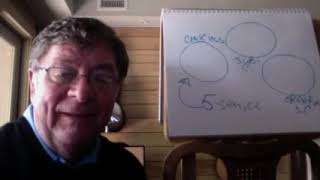
As promised, this piece has two edges to it. And one of the things that I probably want to just round into is the following. When people come to conclusions and start speaking as though their conclusion is right, very often people who disagree retreat from that conversation or find some way of advocating another position. And as I mentioned before, it's important to know when to let something go, because not every hill is a hill to die on. I'll probably say that bunches of times. But here we have an opportunity, and if you would, in your journals, start to work with me a little bit. We're going to create something called the ladder of inference. Here is where our language becomes significant in doing the work. So ladder of inference and is about something that somebody else does and something that I kind of receive and come to some kind of conclusion eventually. But we'll play forward here in just a minute. As I drew the ladder, notice on the bottom I put a little screen. And those of you that have enjoyed studying cognitive stuff probably have seen this before. So my apologies. I'll just go through it somewhat quickly. Down at the bottom, that line is to represent a screen, a web, something that filters. What it filters is data. Data is everywhere. Right now, a psychometrician would probably say there's well over a million inputs in this room. In order to listen to me, you are attempting to filter those out. So the data is trying to get in through that screen. Some of it does, and some of it you actually send back out again, you filter it. What comes through the screen ends up being my data. That's what gets in. So I want to very quickly, this is not a huge point, but I'll make sure the screen is clear to you because it's going to have so much to do with this next part. I want to get through this pretty quick. Here's my example of a screen, and I'm going to ask you to find one. The twins were born May 16, and so we have twin boys, instant family. And the doctor said, your wife can't watch them because she's sick. She had preeclampsia toxemia. She had some issues after birth. She couldn't watch them. So you got them. Well, you know, I'm young, middle of New York City, working multiple jobs, which I'll tell you about in a minute. And I said, I don't know what to do. So lean on family. Family was helping. Well, I would work depending upon the night. Some nights I'd be playing music, so I'd get home very late. Other nights I'd Be working as a night watchman. Other nights I was a teacher coach. I worked as a longshoreman on the weekends. I played a little bit of music in New York City and I had a paper route, so I had a lot of jobs trying to make ends meet. Didn't quite pull that together, by the way. But I was doing all these jobs. I would get home at night between 9:30 and midnight, depending upon where I was and what I was doing, what job I was working. When I get there, I take the hand off to the kids. I got them now. I got the twins. And as soon as one of them woke up, I woke the other one up. Now, I know this is not good parenting, okay? I woke the other one up, fed them both, changed them both, put them back to sleep again. As I did that, I then finally would go to sleep. Now I had to be up around 3:15, 3:20 for the paper route. So I would catch a couple hours sleep and try and get myself ready to go. When I would finally fall asleep outside the house, bombs could go off. I wouldn't hear them, they wouldn't. Cars would run into each other. There were probably gunshots. I didn't hear anything. Right. But if either one of those little kids made what, tiny little sounds up and running, that got through the screen. So here's what I want you to do real quick with the person next to you. This one in pairs, if you would, each of you find an example of the screen where you can say, yeah, I know this screen. I've had it before. And here it is. Sometimes it's, who walks in the commission room during a commission meeting, Some particular personality come through the door, you recognize that one. Five others came through, you didn't even notice them. That one came through. Oh, I know who that is. So there's this issue of screen that's always there. So with the person in pairs now, pairs, please come up with in about two minutes an example of the screen. Each person's got a minute. What's an example of your screen that you can remember? You're on screens. They're always there. Now this part starts to get interesting, gang. If you haven't done this before, you're going to go, hmm, So I got some data, not all the data through my screen. Now I start to go up the ladder. This, by the way, is a piece done by Donald Schoen and Chris Augris. Chris Augris is out at Harvard. Donald is the author of the Reflective Practitioner. Fabulous piece. In any event, my data next step up the ladder. I say to myself, where have I seen this before? That's perception. I kind of ask myself a question. Where have I seen it before? Now, interestingly enough, in a subconscious and unconscious way, if I haven't seen it before, what do you think you typically are going to do at that data point? Exactly. Wash it out it goes. If you can't associate it to something you've seen before, it can't stay. Next step up the ladder is to interpret what does it mean to me? Come to a conclusion and finally act going up the ladder. Let me get you to go up the ladder with the person next to you. Okay? Tell the person next to you what you think about the astronaut who's all over the news right now. Mrs. What's her last name? Nowak. Right. Mrs. Nowak, just in 60 seconds, just a pair pair conversation. Tell that person you were chatting with what's your opinion about that person. Ready, set, go. Sam Sa.