Ladder Of Inference part 2

This is a YouTube video titled "Ladder Of Inference part 2" created in August 2025. The content features a monologue or lecture-style presentation by a single speaker named Sam, who shares personal stories and insights about the ladder of inference concept, focusing on perception, interpretation, and understanding in leadership and communication contexts. The speaker invites the audience to engage in reflective exercises but the excerpt does not indicate multiple speakers or a conversation involving Dr. Ray Jorgensen.
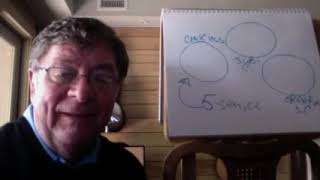
So we're gonna, we got my day. I've got the data that I, that I took in. I screened out some, got some in. I say, okay, where have I seen this before? But perceive, interpret, conclude, act. Scooting up the ladder, I'm going to tell you a ladder story and then each of you is going to be invited to find a ladder story of your own. I'll probably tell you two. So here's my first one. First one again is a brand new junior high school, middle school principal. And as I'm wandering through the preschool, my superintendent said to me, you need to do two things. Ben with the wind. You know who this is? Ben with the wind. And I didn't know what that meant, and control the school. Okay. Ben with the wind, I learned later, really had some import, but I didn't get it back then. But he said, control the school. So I started making up handbooks. I made up custodial handbooks, teacher handbooks, student handbooks, parent handbooks. I thought a handbook, I could control everybody, right? Let them read the handbooks. So I'm running around doing this stuff, all these handbooks. So school starts and it's the second week of school. It's a Monday morning. I remember this like it happened yesterday. And I get there to be on the bus ramp because I spent 20 odd years on the bus ramp. That's what you do. You learn about your community out there on the bus ramp in the morning. So I'm out there on the bus ramp, I see all the kids getting off the bus. They tell me everything going on. Then I do the parent drop off and walkers and I get to the back of the school. Second bell rings, school's in session, I start looking down the hallways, I can't see any kids. This is a what good thing? Okay, they're in the boxes with the teachers. This is good. Okay, So I wander now down towards my office. I hit a few bathrooms on the way, make some noise, let them know I'm checking, get down to my office, go in there, sit down, put my feet up on my desk, light a cigarette and get a cup of coffee. I didn't look anything like I look right now, anything. And so I'm sitting there thinking, oh, what a good boy am I. Out in the hallway I hear boom. Well, I leap from my desk with my cape flowing. I race out into the corridor and there's a kid at the end of the corridor punching and kicking and swearing at a water cooler. Now where have I seen this before? I've Seen kids act dopey before. Okay, here I come. He actually looked like you, Jack. So I'm going to pick on Jack. So there's this kid kicking, kneeing and swearing at the water cooler. So I'm going down the hallway. I mean, what else could you do? There he is. I've seen it before. What does it mean to me? Interpretation? Nothing. Good. Conclusion, kill the kid. Okay, so I'm going after him. Action. Here I go running down to get him. I get all the way down there and I go, I got a cup of mic. Hey, I had that voice. You probably have heard that voice before if you've been in schools, haven't you? Someone has that voice in all high schools in America. Hey, school board property, what would your parents think? So I gave them 30 seconds of my best. Teachers are opening doors and they're looking out the door. I'm teaching an object lesson for the entire junior high school. Right at the end of 30 seconds, this kid is just holding the water cooler and staring at it while I'm giving him what for. Well, he rips his face up at me at the end, he stares me in the eye and he says, my granddaddy just died. What was I missing? A little piece of data. If I'd let it get through the screen, I still would have gone down and done something about what he was doing, but I would have behaved differently. See what I mean? Ladder story. Ladder story two is from Connecticut. I'm working with a group of. These were county employees and it was about 40 of them and they were trying to learn about learning conversation, which is where you are. You're in the midst of that right now. What's a learning conversation? What's it look like? This woman says, I got a ladder story for you, Ray. So she stands up and talks to the whole group. She says, I'm checking out at the supermarket and as I'm checking out, I'm online and I got my groceries and I have twin girls, five years old, beautiful little girls, okay? Kind of holding on side of her pants or skirt or she had arms. She's checking out. They're with her now. She's checking out and online to check out. In front of her is a woman also with a basket. But the woman, if she weighed a pound, she weighed 400. She was an enormous woman, a big woman. One of the twins goes in a five year old voice, which you all know, mommy, mommy, look at the big cow. So she immediately starts to apologize to the woman in front of her. Oh, I'm so sorry, I don't know why. And the woman's kind of looking over her shoulder at her, right? The other twins pulling on her. And she go. And she points up in the ceiling and guess what's up there? A big cow drinking a glass of milk. Which is what this five year old was trying to point out in the first place. Okay, what was mom missing? A little piece of data. Okay, so here's your job. And again, this is an invitation for a stand up conversation. I'd like you to now talk in pairs if you could please. Standing. Each of you please find a lattice story of your own where you came to a conclusion but you were missing a little piece of what data. Ready, set, go. Stand up conversation with somebody right in your tabletop. Come up with a latter story. Most people get up to come to work every day and they say, I'm going to go there and try and have a good day. I'm going to try and get something valuable out of this day. I'm going to try and contribute somewhat to what's going on. Or they might just drive to work and listen to the radio, but they're not showing up, trying to hurt it. Therefore, this is a big systems edge for us to play with. When we come back, 95% of the people working in the system do the best they can given what they know and the condition of the system. The ladder of inference helps us understand that very often people will come to dramatically different conclusions with exactly the same data set. It doesn't make them bad. It's an opportunity for you to build common understanding. What we actually have learned, ladies and gentlemen, in this work is, is if we can't build common understanding, we can't have alignment and we can't have engagement. As a young leader, I would stand in front of those 200 teachers and talk to them for 45 minutes once a week. That was the standard. It was expected. You held a faculty meeting. I gave them my best. I did big agendas, I planned them, I worked on them like crazy and I sent them on out. After my 45 minutes. I would always say, are there any questions? And always one person and always the same person, right? Would ask you this insane little question right? Then they would leave, go out into the campus and do 200 different things. And I would start to think, judgment up the ladder. Something's wrong with them. What I actually learned, gang, is something was wrong with the way I was constructing those meetings and the way I was pulling feedback to myself. Once I understand the ladder and I accept the fact that people are going to do the best they can. Whatever understanding they go out the door with is what they're going to work with. If I don't provide opportunity to build that common understanding, there's no way I can have alignment. Engagement is slipping too, but there's no way I can have alignment. Sam.