Dr Steve Greene and Joe Apfelbaum Chat about Success
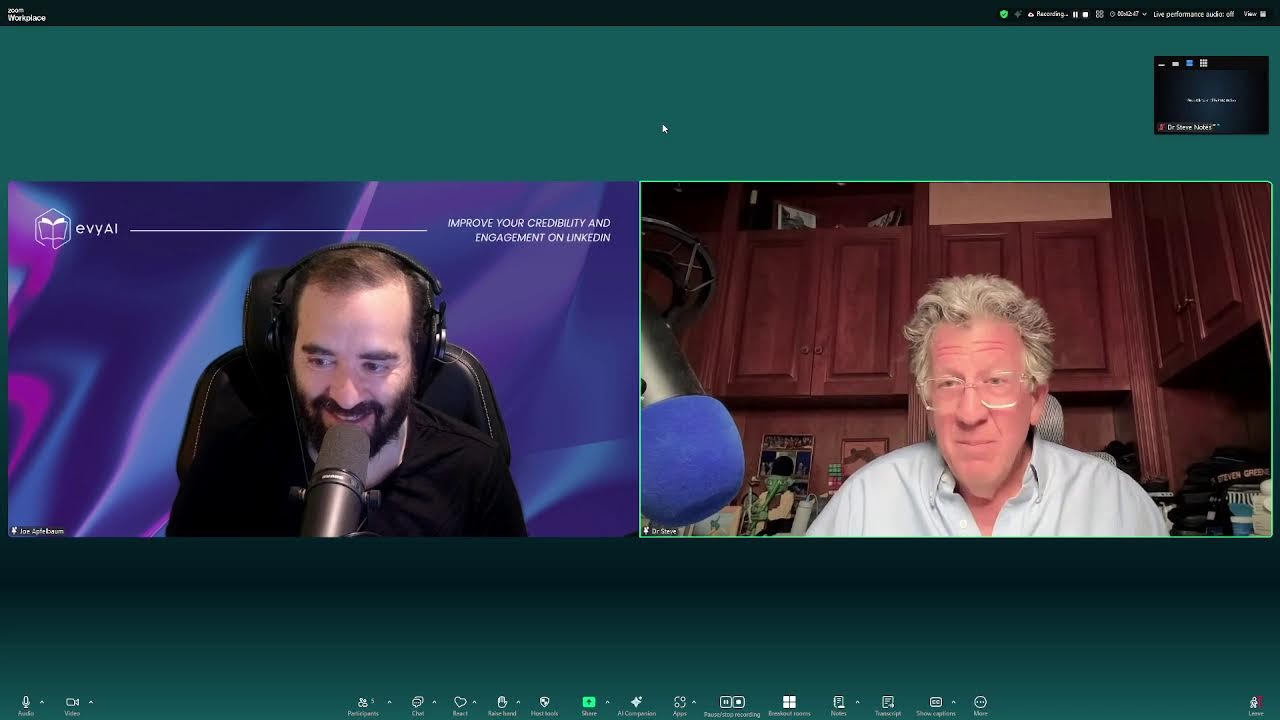
LinkedIn marketing expert Joe Apfelbaum shares his framework for business success: Plan, People, and Promise. He built an AI Assistant that clones his voice to generate LinkedIn content and outreach, and stresses that most users fail because they don't have real conversations. His advice: five daily conversations, relentless self-investment, and treating success as a repeatable process.
Chapters
Hey, Dr. Steve here to Make the Great Experience Podcast, talking about success journeys. We're talking about better mousetraps. We're talking about ways that you can uplevel your game. I have a fantastic guest today. I get a lot of guests. I always say nice things about them, but honestly, the guy I'm going to introduce you to in about a minute, he is playing at a high level. This guy is fantastic. You're going to learn a lot from him in a short amount of time. I am proud to tell you I've been associated with him about 6 months here and I have learned a lot and I am putting it into action. That's the key. This is about taking action. You can know everything in the book, but if you don't actually get going and do stuff and plug in, where's it going to get you? So let me introduce Joe Apfelbaum. Joe, welcome to the podcast. Let me tell the world a little bit about you. Joe has trained over 1,000 companies on how to leverage LinkedIn over the past 3 years. Most recently, How to Use AI for Business Development and Marketing. He's a digital marketing expert and CEO of a marketing agency that's been ranked in the Inc. 5000 as one of the fastest growing private companies in the United States. He's the author of 5 books.
Love that.
Including his most recent book, High Energy Networking. He's the founder of AI Assistant for LinkedIn, the software he developed with his team to help LinkedIn users maximize the platform And save time using AI that learns your voice and can craft comments and content. In a world of duplication, this is a beautiful thing, right? When he's not on stages all over the world inspiring and educating professionals, he spends time with his 5 children rollerblading and rapping in Hillside, New Jersey. You got one book per child. How about that, Joe? So Joe, welcome.
I—
this is a very busy guy. I am lucky to have him here to spend some time with me. I appreciate it. I wanna get right into it. Okay. So what, what, tell us a little bit about your journey. You know, I, I know your, I know your story a little bit. You can share what you want, but how did you become, how did you go from wherever you were, Joe from Brooklyn, right? Or Joe from wherever to, you know, a, a really a, a, a nationally, internationally status level LinkedIn trainer and, and AI developer. So.
They say you can only grow your business as much as you grow yourself. Have you ever heard that before? You can only grow your business as much as you grow yourself. And when I started off about, let's call it 25 years ago or so, um, I really didn't have a lot of skills. But more importantly is I didn't really know who I was. I was really stuck in my identity as kind of like, I'm trying to make it. I want to build a family. I want to make money. I want to make a difference. I always thought it was all about the skills. What skills do I need to learn in order for me to be able to make more money? And the more you have skills, the more money you could make. And it's important to have skills, but I really think now looking back at the past 25 years, I think it has to do more with the beliefs that you have rather than the skills that you have, like on a, on a core level.
Mm-hmm.
And I wrote about this in a book that I never published. I actually wrote several books that I didn't even publish. One of them is called From Average Joe to CEO: The 7 Stages to 7 Figures. And I've spoken about this book, but I've never published it yet because although I was able to successfully make multiple 7 figures on the top line, getting 7 figures on the bottom line is a whole nother story. It's a whole nother ballgame.
Yeah.
And it really takes a lot of being evolved as a CEO, being evolved as a thought leader, as an entrepreneur, as a community servant leader, like making a difference for people. You can get anything you want in life if you enough— if you help enough people get what they want. That's a famous saying by Zig Ziglar. He said it many times.
Ziglar.
So I always tell people, it's like, okay, yes, skills are important. You gotta uplevel your skills. But if your beliefs are not there, no matter what your skills are gonna be, you can have— you can be the best lawyer in the world and know how to litigate really well. But if you believe that you're a horse in a hospital, then you're going to be a horse in a hospital. That's what's going to happen. That's literally, you're not going to be able to get the clients that you need to get if you don't have the beliefs. And part of having the beliefs is me going back down to like, okay, so what is your strategy? Like, what does your foundation look like? And for me, I didn't really understand strategy. I saw my mother fail. you know, growing up as a teenager in the Lower East Side, you know, I grew up in Brooklyn, but my mother had a store on the Lower East Side of Manhattan on Orchard Street. I don't know if you know the Lower East Side of Manhattan, Orchard Street, Delancey, very popular place for immigrants to have a store. You know, some people had wagons. My mother actually rented a store. She took all her credit cards, maxed them out, bought clothing, sold them, paid back her credit cards, maxed out more credit cards, bought more clothing, sold it. tried to figure out how to make it happen. She generated revenue, but she never generated enough money for her to be financially free. And she never really had a strategy. Her whole idea was like, let me go there, let me sell stuff, and let's hope for the best. Hope is a good thing. It's a great thing to have hope, but it's not a strategy. And so having the right strategy is key. And that kind of was like a little bit of my like wound that I have as a, as a teenager watching my mother trying to make it. And then her eventually going out of business after a decade of trying to make it. And so that kind of like stayed with me as like the thing of like, oh my God, I gotta make it. And once I make it, I gotta teach people how to make it as well. And that's kind of like, that stuck with me and it became like almost like my life mission. It was like, okay, I figured it out. I got the 7 figures. I got my business to do millions of dollars in revenue. We were featured number 178 on the Inc. 500 as one of the fastest growing companies in America. Wow. I remember not having a network of any CEOs at all. Like, my network was like the Jewish community. I grew up in the Jewish community, and that was my network. You know, my neighbors, my the people that went to shul. A lot of them were blue-collar people. You know, they weren't. They didn't have. They weren't like necessarily successful. Some of them worked at supermarkets. You know, like some of them just kind of sold a Luluvan Esrig or a Sukkah, or they were they worked at the bakery or whatever.
And they they weren't like they were hustling. They were hustling.
They were hustling. They were they were moving and shaking and hustling and trying. make it happen. And if Hashem sent you a blessing, if God sent you a blessing, you'd do really well. And yes, it's nice to get blessings from God. And I believe all the blessings that I've had come from God. Everything came from God.
Mm-hmm.
At the same time, I believe that God wants us to create a strategy. He wants us to improve ourselves. He wants us to make a difference for other people. And part of that is having a plan. So when I teach people how to be able to be successful on LinkedIn, It starts, you know, they say there's 2 Ps in the pod. I think there's 3 Ps in the profit. There's 3 Ps in the profit. There's the plan, the people, and the promise. So what's the plan? The plan is, what is your business plan, marketing plan, and LinkedIn plan? And we walk you through this process step by step. We have a $10,000 program that we're now giving away for free with the bundle that we essentially just walk you through. Okay, how do you make a business plan? And by the way, AI writes the whole plan for you. How do you make a marketing plan? AI will write the whole plan for you. I just need to know a little bit more about your business. What is your offer and that type of stuff? Like, what do you offer? And then we'll write your business plan, marketing plan, and LinkedIn plan for you in a matter of seconds. Then we move on to like, okay, now you have your plan. You know what you're selling. You have a good offer. You have an offer that's so good people would feel stupid saying no, right? You have a good offer. You know what you're offering. You know what your price point is. You know what your revenue is. You know how many clients you need to get to your goal. All that's done. Now it's about the people. Who are you? Who is your ideal client? Who is your ideal target market? Who is your center of influence? Who needs to refer you? All that type of stuff. Once that's done, once you know who your ideal client is, and most people say, oh, decision makers. I'm like, that's not a client. That's not an ideal client.
No.
A decision maker is just a word. Okay, I want people. I want people. I want to speak to people. Get me on the phone with people. I'm like, okay, I have someone in India that wants to talk to you right now. I have someone in New Zealand. I have someone in Saudi Arabia that wants to talk to you. Do you speak Arabic? تحدي عربي شوي أنا جوعان أمك. And they're like, what are you talking about? I don't even speak Arabic. Why are you just shoving me some Arabic? I was like, my grandparents spoke fluent Arabic. Like, oh my God, that's a whole nother conversation. And my first language is not Arabic. My parents are from South America. So Um, I speak Spanish as my first language. And so people are like, okay, so you want to speak to Spanish people? I'm like, I, I don't speak any Spanish. They tell me, I'm like, so who are the people? Tell me who the people are. They're like, I don't know who the people are. I was like, so come take our course and we'll, we'll show you the 6 different ways to pick your target market. You answer 6 separate questions. AI will suggest your target market and tell you where they are and tell you exactly everything about them. He's like, why do I need to know everything about my target market? It's because you need the 3rd P. Now that you have the plan and you have the people, you need the 3rd P. And they're like, what's the 3rd P?
Promise.
It's like the 3rd eye. It's like the why. It's like your promise, your purpose. Like, why would somebody want to buy from you? Like, why? What's your promise? Why do they trust you? And so it's like, how do I develop a promise? Well, you fill out a couple, answer a couple questions in our system, and we just tell you why people should buy from you. It has to do with their pains, goals, dreams, and fears. It has to do with how people think, both emotions and ration. People make decisions based on emotion. They back it up with logic. And so how do we frame our promise in a way where people will be like, they trust you just based on your messaging? Like, wow, really? Really? People will trust you based on messaging, based on perception? Yeah, they will. A promise is about perception. It's not even about you doing anything. Oh, if I do a good job, then they'll trust me. No. If you promise You'll do a good job. They'll trust you. Because if you do a good job, that means they already trusted you to do the job. So they have to trust you before you even did the job. And that's why the promise is so important. That's like such a big differentiator. And that's why having good lead magnets, landing pages, and building out your promise properly through what you teach is really important. But that's, you know, one component of what like your strategy has to do with the 3 Ps in the pod, which is your plan. your people and your promise. And if you have a good strategy, then you move on to the next step. The next step is about making sure that you're building the right assets. That's why the bottom we call it branding. The second thing we call it building. And the third thing we call it booming. Those are the 3 steps: branding, building, and booming in the Evergreen Networking System.
A lot of alliteration, a lot of alliteration in your world.
Yo, yo, yo, my name is Joe and I'm the B2B to B2B sales pro. Let me show you how to grow. Let me show you how to flow. Let me show you how to Yeah. So that's the idea.
Well, listen, first of all, we could probably stop now because there's a ton— we won't, but there's a ton to unpack here. Didn't I promise you we're gonna get some serious value today? Unbelievable. Again, this is the Make It Great Podcast. Steve Green, your host. My guest, Joe Apfelbaum, uh, a, a, just an encyclopedic knowledge of, of marketing and wisdom. I wanna just, I wanna address a couple things specifically. Okay. Clearly, you have a plan. I mean, I'm just gonna sort of summarize what you've been talking about the last 8 or 10 minutes as a plan, right? It's a marketing plan slash business plan slash social media plan, kind of all bundled together, right? You, you must use the term AI 5 or 6 times. So for the people who maybe just don't get AI or skeptical about AI or think it's some, like, I don't know, plot from some Big Brother. to control us or whatever. Can you break down why, just on a fundamental level, AI is helping us here or helping you to help people here?
I would say, if somebody wants to be able to use artificial intelligence to grow their business, AI has to know who you are. Yeah.
Prompting. Good.
Okay. Um, and no, not just prompting, but like training the artificial intelligence to know exactly who you are. And most people, they themselves, they don't know who they are. Like, who is Steve Green? That's, that's a major foundation for like training the AI because the AI knows your ideal client and everything about them, but does it know you? Does it know your voice? Does it know how you speak? Does it know how you stand out? Does it know your competitive advantage? Does it know your experience? Does it know your story? And that's where the second component of building— the 3 parts of building is building your story, building your presence, and then building your technology tools and automations and so on.
So you view AI like I think, uh, a lot of people do, perhaps, as a— if it's trained properly. If, in other words, it— good input is going to equal good output, bad input is going to equal bad output, right? If it isn't set up right, if it isn't prompted right, if it isn't given the right information going in, what do they say? Garbage in, garbage out, right?
Yeah.
So part of the challenge is understanding these things yourself In order to give the right information or the proper and most beneficial information into the system. Um, does the— I'm gonna ask you sort of a yes/no question. Does the average person really have to understand AI to take advantage of it? Like, do we have to understand how it—
No, I, I don't think you need to understand AI. I think you need to work with someone that understands AI. I think so. This is, this is a major, major thing, a roadblock for a lot of people. Is that, oh, I don't understand technology. I don't know how technology works. Well, you don't have to know, understand technology. You don't have to understand AI. You don't have to understand business. You just have to find someone that can guide you and support you and sit with you. Find a mentor, find a coach, invest in yourself. Don't try to figure it all out yourself. You don't need to become a surgeon to get a surgery. You don't need to become a dog walker to get your dog walked. This is a massive— this is a massive thing that I learned, I would say, a good 15 years ago from a CTO, because I thought I had to do everything myself. And the CTO was sitting in his office, $10 million business on 415 Madison Avenue, 25th floor overlooking Manhattan. And he's like, Joe, let me tell you something. And I said, what? He's from Hungary. He's like, let me tell you something. I was like, what? What? He's like, first get me a Diet Coke. And so I went, I got him a Diet Coke. I brought it back. I'm like, tell me, tell me what? Tell me, tell me what you want to tell me. He's like, you don't have to do anything. Even if you want a Diet Coke, you just have to say, get me a Diet Coke, and somehow a Diet Coke will appear. He's like, I want solutions. This is what he said. I want solutions. I don't want you to do anything. I don't want you to do anything. I just want solutions. And that really hit home for me. So I was like, do you mind if I hire 2 people under me right now? He's like, do it. Here's the budget. Here's $100,000. Go do it. So he gave me $100,000. I hired 2 people for $50K each, and that freed up all of my time. Now I asked him, what can I do? What should I do with my time? He's like, start a business. Do whatever you want. He's like, I don't care what you do with your time. He's like, I don't want anyone complaining. So make sure that as a director of marketing for this, director of IT for this company, that the servers are up, help desk is working, that nobody comes to me with any issues. You're my first line of defense. If anybody complains about anything to me, you did a terrible job. So he's like, let me do the big thinking about how the organization needs to grow from $10 million to $100 million. You, Joe, Make sure that the 200 employees are taken care of. And I don't want to hear from you unless there's something that you need me to approve, like a budget. If it's under $10,000, deal with it. I was like, I'm good. See you never. Let me know when you need anything from me. Goodbye.
Wow.
And I hired 2 amazing people under me. I trained them. And then I just spent time making sure the organization was solid, had all the latest technology, everything was backed up, everything was working. There were some days that I had Had to spend 2 full 24-hour sessions making sure everything was transferred and backed up. But then I was basically free. I was able to do whatever I wanted and I'm getting paid a beautiful 6-figure salary. So I ended up starting a marketing agency, which became one of the fastest growing companies in America. And through that company, I ended up finding my business partner because I had all the free time in the world to do whatever I wanted to do. So it was just like, if you think about the concept of like, Find people to help you. Like, there's someone making cold calls right now for me. I'm not doing it. There's someone that I hired that's sending out connection requests and building relationships with my own clients right now. It's happening right now as I'm on a podcast right now. Someone's doing the work that I could be doing, which I enjoy doing thoroughly, but I know I'm not going to do it because no one else is going to do this podcast. No one else is going to go on LinkedIn Live. No one else is going to do that for me. Eventually, there will be other people doing this, which I'm training into doing that. But there's somebody else creating the 99 Hacks course with my clone. Did you know, Steve, that I cloned myself?
I didn't. I actually heard a rumor that you did, but I didn't know it actually happened yet.
I have a clone of myself that's gonna— that is currently presenting the 99 Hacks course, the crash course called 99 Hacks, which teaches 99 hacks. on how to leverage LinkedIn. We're selling it at 99, 90% off or whatever. So it's gonna, it's a $1,000 program. We're selling it for under $100 and it gives you 99, 99, um, 99 hacks on how to leverage LinkedIn for under $100. You get 99 hacks. They're each 1 minute. And I put up a LinkedIn poll asking people if they were interested in the 99 hacks and 171 people said they wanted to buy it. Literally first. And so I already have 100 people that paid for it. So that pays for the, the, the almost 100 people. We're like, we have a couple spots left. So if you guys are interested, let me know. But, but, you know, the, that pays for the, the designer and the whatever, the, the video editor to take my clone, pay for the clone software, to take my voice clone, pay for the voice cloning software. And that initial amount, I didn't pay a penny for it. My clients already prepaid so that the person that's the video editor goes into the clone and takes my clone with all my ideas and then just goes off and builds out the course. And the course is coming out in a couple weeks and whoever prepaid for it gets it at 90% off. But the idea is like, I put up a poll on LinkedIn, people said they wanted to buy it. I made a checkout page on— Paying for it. I made a checkout page on Stripe.
Okay.
I sent it to those people as kind of preorder. They preordered it and paid for it. I took the money that they paid, I sent it to the video editor, and then I sent it to the software company that have cloned me. And I said, build the course because the people paid already and I'm going to have to refund all of them if you guys don't build the course. And now they're off building 100 1-minute videos or 99 1-minute videos that go through the entire crash course that I wrote down while I was on an airplane one day.
So let me, let me ask you this, because I'm, I'm sure there's people out there listening to this saying, well, this is awesome. I love— this just all makes sense when Joe's doing it, but he's been in this 15, 20 years. He's a professional. He's at the top of his game. I'm a newcomer. I've been struggling with this. I, I don't have the same kind of success. What would you say to the I don't want to say this. I want to pick my words a little carefully. To more of a novice newcomer into the space.
When I was brand new, when I was brand new, Steve, you know what I did? You know what I did to learn how to launch a course? I hired a guy named Aaron and Aaron taught me. Now, I couldn't afford Aaron, $5,000 an hour. That's what he charges. I couldn't afford Aaron. So what did I do? I bought his course. It cost me $1,000. That's what I did. I bought his course. It cost me $1,000. But just spending—
You invested in yourself.
I just paid $1,000 for the course. I didn't have the $1,000, but I borrowed the $1,000 from my credit card. I paid the $1,000, but then I found an accountability partner to watch the course with me. I kid you not, 30 times.
30 times?
30 times I watched the course. The first time I watched it, I didn't understand anything. And I basically just said, this is bullshit. I can't understand it. But then I said to myself, you know what? Let me just watch it again. And I watched it again and watched it again and watched it again and watched it again and watched it again and watched it again. And then at the fifth or sixth time, I started understanding it. And I started thinking to myself, hang on, this is good. I just don't get it yet. I just, I'm starting to get it, but I don't get it. I didn't have that epiphany. You know that moment where you're like, shit, I got it? So then I started taking notes and watching it. And it was in my basement in Brooklyn. And I was kind of like watching it. And I was like watching it again. And I was like, I think something I don't get about this. And then I reviewed it with somebody else and I watched it again. And then I reviewed— and it was a short thing. It wasn't like a 2-hour course or whatever. It was like a 5-minute video that I watched. And I watched it and watched it and watched it. And then finally I applied it and watched it again and fixed what I applied and watched it again. And then all of a sudden, at one point it just cracked. And then I got it. And once I got it, I didn't need to watch it ever again. I was like, I got it. I get it. I get it now. Like, I understand what he's talking about. I understand how to build my ladder of success. I understand how to build my signature thing. I understand how to, you know, everything that I talk about now is all based on that course. For all the businesses in the future that I'll ever have is based on me having a fundamental knowledge of how to be able to communicate my products and services in a way that people actually want to buy it. And it's because I hired someone's expertise. There are so many different times that I had to make breakthroughs. It was because I read the book 4 times. I read Getting Things Done 4 times, and then I highlighted it a 5th time, and then I reviewed it with my team a 6th time, and then I made them all read it 4 times. And that's how we get shit done. You get what I'm saying? It's like, there's a book called Getting Things Done. People read the first couple of pages of it and they're like, this is too technical for me. It's not too technical. It's a system and a process for getting things done. So if you're not going to get anything done, you either have reasons— oh, there's a bunch of reasons and excuses— or you have results. Results come from action. I saw this in a fortune cookie. I posted it on LinkedIn. Results come from action.
It's a lot of wisdom in the fortune cookies. Basically what you're saying is this, and I'm going to— correct me if I'm summarizing this incorrectly or inaccurately. One, don't be afraid to invest in yourself. 2, it's worthwhile to invest in another expert, somebody who knows more than you. And 3, you have to commit to the process almost indefatigably and tirelessly until you master it.
And number 5 is hire someone to help you do the things that you're not interested in doing.
Or when you can afford it, just offload it.
Yeah, but everyone can afford, everyone can afford $5. There's a website called Fiverr, right? So like you don't have $5, borrow $5. Okay, you could afford $5. There are plenty of people that are willing to work for $5. There are people willing to work for commission only. There's plenty of people that are willing to work to learn. I've hired many interns in my life that have helped me so much. There's so many people. You don't need more resources. You're like, "Oh, I can't afford it." That's bullshit. That's that's an excuse. That's more of a reason that you don't have results. Either have reasons or results. You don't need more resources. You need to learn to be more resourceful with what you already have. You got credit? Use it. Use your resources. You got friends? You got investors? You got Oh, I don't have a network. I don't have people. You have LinkedIn? It's free. Go use it. Go, go have conversations with people. Well, I don't know how to log in. Find someone that will help you. Well, I can't afford to hire the guy. Borrow money. I don't have any credit. Get credit. Figure it out. Get someone to do it for free. Like, you know, whatever you need. Become an affiliate. Like, figure out how to make it happen in a way.
Mm-hmm.
Like, there's a guy who told me, I don't have any money. I said, Pay the $1,000 for the program. And I promise you, you'll make double within the next 30 days if you follow everything that I tell you to do. The guy made double back. He spent $1,000, made $2,000. He's like thrilled. He's like, oh my God, this is crazy. Because I just walked him through the path and he took the actions. If you take the actions, if I walk you through the path and you take the actions, you are guaranteed to make the money because action equals results every single time. If you know what the offer— a woman, we met on a cruise. I met another woman on the cruise. She came over to me, she's like, Joe, I'm not making any money. I was like, I'm gonna give you some free advice. As a single mom, I'm gonna sit down and give you some free advice. And if you take action based on this advice, you'll make money. And if not, if you're not willing to do it, it's probably because you didn't invest in the advice. So then you could pay me for the advice and then you'll probably end up taking action because people that pay, pay attention. But I'm gonna give you the free advice anyway, 'cause this is what I do for people. So I sit down with her, I gave her some free advice. She took action on the free advice and she made money off it. And she's like, wow, this is incredible. I made money off this free advice that you gave me. I said, could you imagine how much more money you'd make if you actually paid me some money?
Let's get into one last thing here. It is LinkedIn just broadly. Okay. 1. 3 billion people on it, something like that, right? A big giant, giant world to investigate. But what percentage of people do it wrong? What percentage of people—
Almost everyone is doing something wrong. Almost everyone is doing something wrong. Most people are not showing up. 60% of people never even log in often. Like they're not really doing it properly. They're not even present. A lot of people are not networking at all. They're not, I call it not working.
Not okay.
There's networking and there's not working.
Well, it's easy, easier to not work for most people.
Yes.
So people are— so without, without giving away the shop, because you are a professional LinkedIn trainer with a course and all such.
I'll give away the shop. I'm happy to give away the shop.
So let's, let's do it this way. What's the number one thing people need to do they're not doing besides logging in?
Get on conversations with people like me and you are having. That's the number one thing people are not doing. Perfect. Just basic meetings. Book meetings.
Yeah.
get, get on the phone, book meetings, and talk to people and, and have them and learn about them. You know, think about it. The average CEO has 930 connections on LinkedIn. But when I ask people, I say, how many of your LinkedIn connections have you had a conversation with in the past 60 days? They tell me zero. You're connected to 1,000 people and you had zero conversations with your connections? Zero? That's an embarrassment to society. I teach my clients how to have 5 conversations a day. Every single day, 20 a week, 80 a month, 1,000 a year. If you don't have 5 conversations a day, you're not part of any of my programs because everyone that joins our programs has more conversations. How many people did you speak to? How many people attended your event today that was in our system? How many people? A dozen, right? Let's just say a dozen, 15 people, whatever.
15.
Yeah. You had, you had, you had enough more conversations than most people have in a month. You had it today. And all those people you could follow up with and they'll take your call because you're their leader. Every one of them will be happy to have an hour call with you or a 30-minute call or a 15-minute call with you. And that's just one conversation that you had for an hour today where you had 15 people show up to your thing. You know how many people would pay $1,000, $2,000, $3,000 to have 15 people show up to something with Facebook ads?
Mm-hmm.
You know, think about that. How much money people spend on ads to get people to show up to an event and you had 15 qualified people that all paid money To be part of your thing. They're all qualified. They're already investing in stuff. And you have them in front of you just like that. And every single one of your friends, connections, and everyone listening can have this if you have the right strategy. So you need to have conversations. Here are 3 things that most people don't have that they need.
Go ahead.
Exposure. You need exposure. So you need people to know you. You ever heard the term, people do business with other people that they know? You ever heard that before? They know what they're getting into. The second thing— yeah, the second thing is they need to trust you. So how do you get credibility? So you need exposure, you need credibility. Those are 2 really key ingredients. And then they need to like you. So if they know you, they like you, and they trust you, they'll do business with you. Think about it. Anyone that you're throwing money at, it's because you know them, like them, and trust them. That's why it's so important to have the plan, the people, and the promise. That's why it's so important to have your stories, your presence, and your technologies. And that's why it's so important to have exposure, credibility, and meetings. And if you don't have exposure, credibility, and meetings, then you're not attending any of my free sessions that I have, and certainly not the paid ones. And you don't have the right technology and you don't have the right presence. So let me teach you and walk you through step by step how to do it with a checklist. We meet all of our clients every single day. We have office hours every day. We have events every month, every week.
I can vouch for all this.
And, and, and, and by the way, we don't charge anything extra. You pay a few hundred dollars, you're in the door, and you get unlimited access, unfettered access to my whole team. We have a community. We have a community of 1,000 people that are all engaged on LinkedIn. They're all highly qualified people. They all have invested. And so that's, that's the idea. The idea is get into the right community. You know, most people, they're in the wrong community. You're the average of the 5 people you're spending the most time with. So you want to be more active on LinkedIn? You want to network? Come to our community. We have dozens and dozens and dozens and dozens and dozens and dozens and dozens of people would be thrilled to get on the phone with you right now and refer business to you. Would be thrilled. You would have unlimited conversations just by entering our ecosystem. So that's what I tell people. It's like, just start having conversations. That's the bottom line. Get off LinkedIn, get on the phone, get on Zoom, get on face-to-face. I mean, me and you were what? We're both in New Jersey. We're both not far from each other. So you can easily, you could take my address, come to my house. I'll sit down with you and we'll have some shawarma.
I'm gonna take you up on that. So, all right, let's do this. Is there anything you want to get into that we have not had a chance to get into briefly? And then I want to get into my wrap-up here.
Yeah. So if you want to wrap up, you need to make sure that the words rhyme. That's the most important thing. You got to make sure the words— that's how you wrap up. J-O-E, with the right strategy, let me show you how to be The last thing I want to tell everybody, the secret to living is giving. If you want to get, you got to give. You got to invest. Investing in yourself, investing in your network, investing in other people, having the right people around you is key. Don't try to do everything yourself. Find someone that has already done it that will help you get there because success leaves clues.
Yes.
Success is a repeatable process of getting from where you are right now to your goal. It's called from point A to point B. You don't need a Range Rover to get from point A to point B. You can use a Honda Civic, you can use a bicycle, or you could use bus number 11, which is your 2 feet. You could figure out how to make it happen. It's much easier to take a bus or a train.
Yeah.
It's much easier to take a plane. It's much easier to take a broomstick that flies. But we don't have that magical broomstick, even though someone on Instagram sold you the magical broomstick that flies. The broomstick doesn't fly, it sweeps. And most of us are weeping instead of sweeping. So let me tell you what you need to do. What you need to do is find someone that can help you. Use your— be resourceful. Stop worrying about not having enough money and start living in abundance and start attracting what you want. Rub some elbows with some grease with some other people around you that are doing the work and watch what happens.
Yeah.
When you do the work consistently with the right strategy, magic happens. And for me, magic is the very simple art of planting a seed, putting some water and sunlight in it, adding some fertilizer, and watching the tomato seed blossom into a seedling and eventually into a forest of tomatoes. And then you harvest your tomatoes, you get rid of the aphids, you have a great time. And trust me, I do this often. I live in New Jersey now. And when I lived in Brooklyn, the only grass I had is grass you can smoke. Now I'm planting tomatoes.
You've made it. You've made it. Hey, let me, let me ask you this, and I want to get into something real, real quick with you. You feel like your work is done? Do you feel like you're just getting started? I mean, you have so many projects. I'm lucky to be in a few of them with you, but you feel like you're just scratching the surface? I mean, where do you sort of see your positioning? I mean, in terms of— what you can ultimately accomplish? Because you've accomplished a lot. I mean, you're a humble person, but in general, you've accomplished— I can tell you, Joe's accomplished a ton of stuff. He's impacted very positively a lot of people. Most people speak very highly of him in the professional world. But, you know, do you have any goals or anything you just haven't feel like you've gotten to yet or you need to maybe move on to? Or I'm not sure if I'm even asking the question as concisely as I want, but— What do you think?
I, I'm— right now it's about being present. Wherever I am right now is exactly where I need to be. I have 5 beautiful children. I got to be present for them. I have 1,000 amazing clients. I have to be present for them. Just being present with what the universe is giving me as gifts and just being there for other people, making a difference for people one day at a time, one moment at a time. Wherever I am is exactly where I need to be and just be fully in on wherever I am right now. That's kind of like where I am in life right now. In terms of my like goals, I want to impact people on a deeper basis. I want to make a difference for organizations, companies. I'm speaking to IBM. I'm speaking to large organizations that have, you know, thousands of sales teams, salespeople, hundreds of sales teams and thousands of salespeople that I can impact in a very deep way. So right now I'm on a mission to build an amazing AI assistant that also has agentic capabilities. And I'm working with my team diligently to build this sales assistant for people and for organizations. So having an incredible sales assistant will write your content, that will help you with comments, that will help you with doing AI research on people, organizing and segmenting all your connections, and then eventually doing all the outreach for you. That's really where we're headed. We're headed to a place of agentic capabilities where— Instead of hiring a sales rep, you hire our assistant that will do sales together with you and book your meetings for you. That's kind of like where we're headed. And so like, imagine you can have someone book all your calls for you. That's just an agent that does it for you. That's kind of like where we're headed. And that's kind of like what I'd love to build right now. Um, I built a beautiful piece of software that really saves a lot of people time and can help scale up.
Some of it's already done.
Yeah. And so the other end of it is like waiting for the technology to catch up and being ready for it when it does. And it's almost there. I see it there. It's like we're at the edge of it. We're at the cutting edge of it. We already have all the clients and we already have the basic of the basis of the technology. We're just going to add some more, some more things to it that just make it more useful and more useful and more useful. Like for example, right now you can use our technology to scour the web for any of your LinkedIn connections or anyone on LinkedIn, period. Like you just push a button and then you see the agent go off and crawl the web.
Yeah. Mm-hmm.
And bring back to you their contact information, bring back to you their personality, bring back to you what they do for a living and how you could help them and what you should say when you get on the phone. I want the agent to bring that not to you, but to another agent that that agent can then reach out to that person via phone, via text, via whatever, and then schedule the meeting on the calendar for another agent that that agent goes and has an initial conversation with the person. And then that agent passes it off to another one and then gets them on the phone with you if you're even interested in being part of the process, or that agent just closes the deal for you and then you can do the customer service, or we have another agent doing the customer service. We can build a whole ecosystem around sales and that's kind of where we're headed to. So we have the first part, which is assisting you. Eventually, it'll kind of do it all for you, but that's neither here nor there, but that's the idea. Beautiful. And we would do that in terms of just like taking commission. Like if I got you a deal, you don't have to pay me anything. If I believed in your offer, I would just do it for you commission only because I already have everything. So like I don't— I just— I'll get you the client. You just pay me a commission. You pay me 50% of whatever you're making. I'm good. You know, like I'm happy. You know, like you do the work, I get 50%. I'll bring you the clients. Everyone's happy. Let's be partners. Now all of a sudden, if I have the capabilities of doing that for any company, That would really make an impact for a lot of people.
Yeah. Well, there you go.
Whew.
Whew. I got, I got, I got to take a deep breath. This was a lot of stuff. Steve Green, the Make the Grade Experience Podcast. My guest, Joe Apfelbaum. Uh, we've been, we've been just blowing through this for about 40 minutes, and I'm sure we could probably go another 3 hours. Huge amount of value, everybody. I hope you might, like Joe read that class 46 times, whatever. I suggest you listen to this 3 or 4 because there is a lot to unpack. And, and I can tell you, because I work with Joe, I use some of his software, I'm in his community, everything he's saying is true and more. So let, you know, let's, let's close. I always close out with this. I call it my fave 5. Okay? So I'm just gonna ask you 5 things. You tell me your favorite of them. Okay? So simple. This is sort of, this is so the world gets to know you a little bit better. What is your favorite color?
Green.
Oh, that's a good start.
There we go.
Favorite food? Favorite food?
Tomatoes.
Look at you growing your own too. Favorite song? Favorite kind of music?
I love rap, like hip-hop, R&B.
Okay.
Like, really clever rap. What?
Okay, like not old school, not like Run-DMC.
I like it. I like Biggie's I like Biggie. I don't really like the, the, the, this, the Kendrick Lamar stuff. I can't really understand. It's like, so it's like he takes it to a level of like depth of that. Just like, I want it to be like not too old school, but also not too like new age where it's like you have to be—
Like, is there a term yet? Classic rap? Has that happened yet?
Maybe. I don't know.
I got classic rock. Do they have classic rap?
I don't know. I don't know. Interesting.
Okay. Favorite activity, hobby?
I like—
you got any free time?
I like rollerblading. I like running. I love being in nature. I love plant medicine. You know, like nutrition, health, that type of stuff, personal development. Those are the things that I really enjoy.
This is the bonus 6th one.
You ready?
Favorite podcast host?
Steve Green.
It's incredible how many people get that question right. It's like 97%.
I really do like, I really do like Tony Robbins a lot. I love listening to him interview people.
Plenty of good ones out there. Plenty of really smart ones.
I really, I really like him a lot. I don't know if you ever heard Tony Robbins or watched any of his programs.
I'm not sure if I ever heard him host a pod. I have, I've heard him like as part of his programs.
Yeah, he's interviewed a lot of people and he's—
A lot of very high-level people.
Yeah, he's amazing. He's amazing at presenting and also interviewing. So I learned a lot from him.
Interesting. You know, he's still out there. He's still he's still hitting the pavement.
Totally hitting it. Yeah.
Good for him, Joe. I I cannot thank you enough. As they say in the old country, toda raba gadol.
Toda raba gadol meod. Yeah. Muchas gracias.
I thought I said it right. I gotta. It's been a long time. Hey, if you liked what you heard today, everybody, and you aren't already, please subscribe. Please share this. I really believe. This is a public service. I believe the more people that can get this information, the more people this helps, the better. And I don't care how it gets in their hands. I just want people to have information they can use to level up, take it to the next level, and accelerate their journey to success. So, we have some cool stuff coming up. I got about 5 or 6 guests in the queue all over the map. You're going to see, you're going to be surprised some of the things I got coming on here. I got a person who is a professional athlete coming on. I got a— A couple other really interesting ones, some academics, some business people, a globetrotter kind of person who actually Joe has crossed paths with, but I won't mention names yet. No spoiler alerts, but you know him from the cruise. Anyhow, that's what we got. Joe, thanks again. I'm looking forward to what we can do together down the road, and I want to congratulate you and thank you at the same time for everything you've done.
Thank you.
for your community. And, and it's a lot of people, and I know that they appreciate you. So thanks everybody. We will see you in the next episode. Dr. Steve, the Make3 podcast, signing off.
More from Joe


How to Beat the Algorithm: Remove Hidden Watermarks & Scale Content with evyAI









AEO & GEO: SEO's Future Explained! Master Answer & Generative Engines! #shorts