Jay Samit Talks about The Second Act Advantage with Joe Apfelbaum
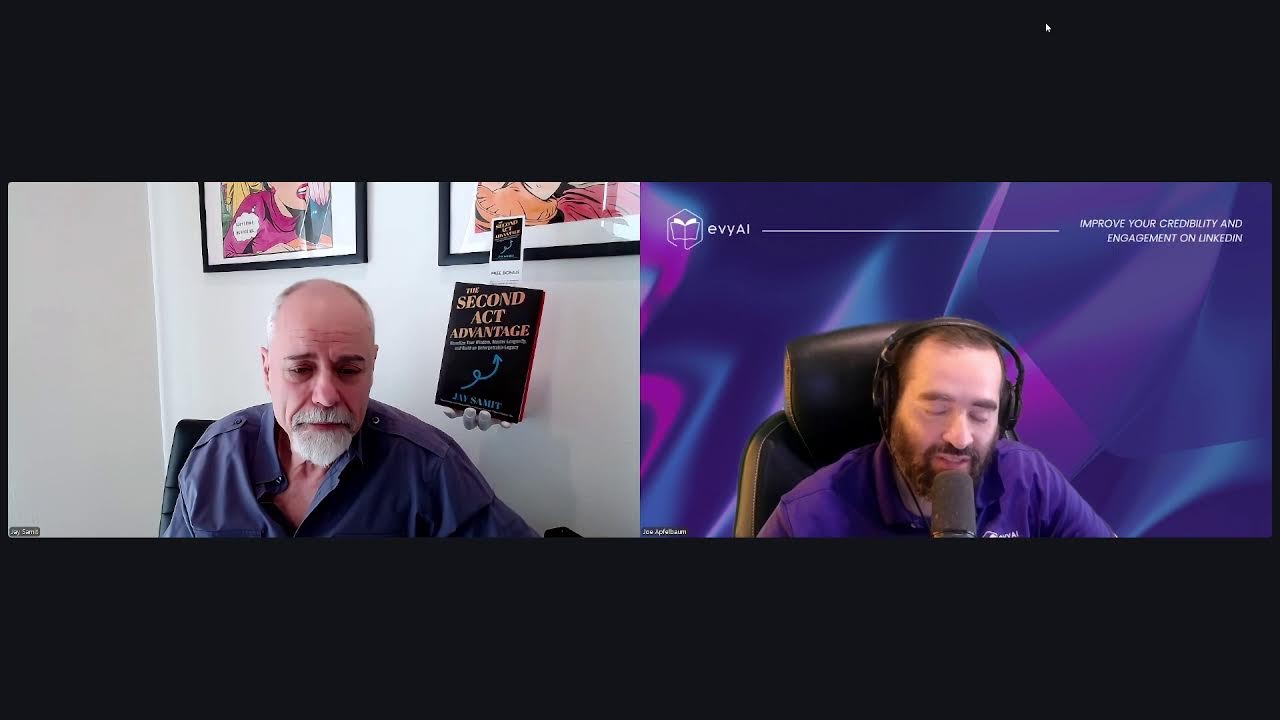
Jay Samit, a serial entrepreneur, warns that AI will eliminate a third of jobs in the next decade. He shares how he sold an ad unit for $200 million and built multiple companies using other people's money and problem-finding. His advice: write down three problems daily, adopt a growth mindset, and act now before AI competitors take over.
Chapters
someone amazing. So I was introduced to Jay by one of my former employees and a dear friend of mine, Philip. And he told me that this guy's doing pretty amazing things. So we just had a little conversation and I was like, wow, he wants to save society. That's what he's out to do. And he's done some pretty impressive, incredible things in his life. And now he's coming out with another book, um, called The Second Act Advantage. And he's here to discuss this with you guys. Jay, welcome to the program.
Thanks for having me. Appreciate it.
So Jay, what's behind this book? Like, what's the reason that you decided to come out with this book? You've had so many amazing accomplishments in your life. You've done so many incredible things. You don't need to come out with another book. You already made it. You already had a, a best, uh, New York Times bestseller book without even gaming the system like some people do. But tell us, tell us what makes you want to come back out and put yourself out there like this.
I've been very blessed. I love life. Okay? Our world is about to be disrupted in ways people cannot imagine. And I've been chairman of one of the AI companies that, that, you know, and AI will make a third of the jobs disappear. Now, 10 years ago when I wrote that in Disrupt You, I'm a lunatic predicting the future. By the way, people that don't know me, The way to predict the future is I hang out with the people that are coding it. You know my backgrounds. You know I've worked with you know Gates and Jobs and da da da da. So I'm not the genius making that stuff. I'm the guy saying what's going to happen. And when I spoke at Davos, the speaker before me was the head of the International Monetary Fund. And when she said thirty percent of all jobs are disappearing in the next three years, you take that seriously. So what does that mean? 100 million people in the States lose their jobs. Imagine what happens to society. Okay, that's not a pretty picture. I can't solve what the government's doing. I've tried. I've worked for the White House. I've worked internationally, and I still work for, for countries that are trying to do something good for people. But what I can do is help the individual that wants to help themselves, and whether by choice or circumstance, Every career is going to be disrupted. So disruption isn't about what happens to you. It's about how you respond. So here we have an aging population. We have more baby boomers retiring these years than any time in history. And this is the last non-natively digital generation on earth. How can I show them how they can launch a business with no capital to supplement their retirement income? Or to start a legacy foundation or a nonprofit? Or do they move to Costa Rica? Is it really cheaper? What are the legal— and how do you do all that? You know, what's the minimum you can do to make yourself live another 30 years? Because if you make it to 60, you most likely make it to 90. AI will cure most cancers this decade. So most of what kills you is you, and we can go into that. So I felt there was a need to help people because I want civilization to continue to advance. Um, I've seen Terminator. I don't like the sequels. Um, so that's basically what's driving me. I— believe me, I— my, my, my peer group thinks I'm crazy. They're, they're all, you know, living on their private islands.
So tell me, tell me about your— what you've seen when LinkedIn was created. You mentioned you were like behind LinkedIn, you were behind eBay.
Yeah, with Reid Hoffman. So I have worked with most of the big names that, you know, Reid's a genius off the charts. I don't say that about anybody else. Reid needed help in how to get a dual-sided marketplace into existence. I'd done the first auction that became eBay. That's also dual-sided. You're not going to look there to buy anything if there's nothing for sale and nobody's going to try to sell anything. if there's no buyers. So why would I put up my resume on LinkedIn if there's no jobs? And why would I look for resumes? So, you know, you do clever things that get attention and springboard markets into place. So getting Bill Gates to join LinkedIn, like he's looking for a job. Why is he on here? That got people, you know, getting Barack Obama before he was president when he's running to go on to Fill out his thing on LinkedIn that gets people to notice. So those types of things. I learned a pattern. It's very easy in a world where you're one click away from 6 billion people to launch a digital business and, you know, be an overnight sensation, so to be. What is more difficult is the speed at which governments change policy. to change the course of a slow-moving dinosaur. And that takes, you know, some really impressive small countries are doing amazing things. And I worked with Singapore on their 5-year plan and, you know, they took a swamp and turned it into the Garden of Eden. Like we could learn from that.
So in 2015, you came out with Disrupt You and you mentioned that you helped somebody Go— a migrant go from being completely homeless, couch surfing, to being able to have a 7-figure business in a year just from meeting you once a week. What's the— what advice do you have for people that just got fired or that know they're going to get fired? Because you said 30% of all jobs are going to be replaced in the next year. What do you think people can do if AI is basically doing everything? If AI is doing all the knowledge work, it's doing all the legwork. Um, and people don't have money for VC. I don't know if you know this, but 90, 80% of people are living paycheck to paycheck. Uh, most people don't even have $1,000 in savings. So you said no need for VC money, big emphasis on individuals that can achieve lasting prosperity and success using methods without raising capital that you wrote about in Disruptive— in your other book. But what, what advice do you have to people that are kind of like leaving now?
Sure, your, your stats are even worse than you imagine. 30,000 Americans own 90% of all stock, land, businesses, everything. Okay? The system is stacked. Okay? So you can sit there and go, I've lost my job. It's hopeless. Give me some opioids and I'll die. That's what's making our population die younger. The other alternative is in the next 2, 3 years during this transition, you're not going to lose your business to AI. You're going to lose your business to somebody using AI. So learn those tools, grab your piece. What I've taught people in Disrupt You and what I taught the young immigrant in Future Proofing You is there's always gaps. New technology can do something somebody hasn't applied it somewhere yet. So if you can identify those, you don't have to be a technologist. I've been in technology, been on the internet since '78. Okay. I still have not written a line of code. I'm not an engineer. And now all of a sudden there's no jobs for engineers. They're getting rid of them.
So, yeah, 'cause you, you just, you, with Agent 4 on Replit, you just talk to it. It does the front end, the back end, the authentication. It does the database, it hosts everything for you. It launches it, it QAs it, it tests it.
So here's what it doesn't do. It doesn't recognize a gap in the market. It doesn't see a problem. I'll give you a concrete example from my life. Everybody stopped watching linear TV.
Right.
Okay. And they started fast forwarding through commercials. Everybody, maybe not on live sporting events, but everything else. That meant for the big broadcasters, their model was screwed. I invented a new ad unit on the internet. It was called Value Exchange. Watch this ad. Here's some cash to play FarmVille. Watch this ad at an airport, you get access to the internet free. Value exchange. It had a phenomenal stickiness. You had to watch the whole ad. Change the model. 18 months later, the company sold to News Corp for $200 million.
Wow.
Did we have $200 million in revenue? No. Do we have $100 million revenue? No. Do we have $10 million revenue? No. We found a gap and then you find somebody that needs that. I had a startup that had to compete, a music store up against iTunes. Their marketing budget was $100 million a year. Mine was $0.00. So what do you do? Here's the 3 letters you're gonna learn today, Jay's favorite 3 letters for business, OPM, other people's money. So I had to look at who in the world has a problem And how can I make what I want done a solution? So there's a movie a few, a couple of years, 20 years it's now been, but called Super Size Me by Spurlock.
Right.
Guy eats McDonald's every day for a month. Cholesterol goes up, heart attack. He's almost going to die.
Yeah.
McDonald's stock goes and sales go for the first time plummeting.
Wow.
So I go to McDonald's. I can make you hip and cool again. Like, what are you talking about? Buy a Big Mac, get a free track. You get a free digital song with each burger. They know how to do the TV commercials and pay for it. They do the signage in every window, the tray liners, the side of the bag and everything. First week of launching my music store, 20 million paying customers. Cost of advertising, zero. And I repeated that model with airlines, with Coors, with BIC pens, You know, I think we stopped at tampons.
Yeah.
So, there's always somebody that wants the same audience that you do, but that they are selling a product that's not competitive.
Right.
Right? I'm taking this book, which is aimed towards a certain demographic, and going to life insurance companies saying, this is something you should be using for prospecting. You know, you pay all this money and get people to come to these big seminars and And they're gonna get a, you know, a free ride on the pontoon boat or something.
Exactly. Give them something, give them something of value that comes along with your digital, with your AI agent called Digital Jay. Can I ask you a question? Like, what's the single biggest mindset shift people need to make to turn their second act into their most prosperous and most purposeful years?
Ooh, great question. So you need to have what's called a growth mindset. And so I'll explain. I'll go back to Vin. That was the name of the immigrant. He grew up in public housing, a lot of drug crime, you know, no success, no, like, you know, somebody to look after. Wasn't an athlete, so you can't look at somebody got out that way, you know. So how do I— my goal was to see if I could turn him into a millionaire in a year. How do you switch that mindset of I can't, the man's against me, everything's against me, da da da. And I'll tell you the secret. I lied to them. There's a psychological principle called the Pygmalion effect. A professor goes to school, tests all the kids, and looks at the results and tells the stu— the teachers, 7 kids will be super learners this year. 7 kids will outperform the whole class. The end of the year, they test all the kids, and those 7 kids did better than everything. The professor lied. He tested the kids at the beginning, but he never looked at the results. Picked 7 names out of a hat. If you tell people they're special and you treat them special, they become special.
That's beautiful. It's like, it's like, that's why having a happy mother that tells their kids how amazing they are makes a big difference in how successful the kids will be.
100%. Or the opposite. Ignore them and—
Right, right. Exactly. Okay. So what you're, what you're saying is have a growth mindset, figure out a way to lie to yourself and tell yourself how amazing you are because you'll believe it.
And here's how to do it. So, in Vin's case, I told him I interviewed 200 people and he was the only one that checked all the boxes to be a self-made millionaire.
Okay?
Wow. He wrote in his diary, this guy's full of it, but I'll go along with it.
Okay?
At the end of the first month when he did like $50,000, $70,000, he could have flown to Europe without a plane.
Wow.
Here's how you lie to yourself. Your brain doesn't know that you're lying.
Yeah.
It sounds silly. Every morning when I get up and shave, I look in the mirror and say 2 things. Today can be better than yesterday. That's a true statement. And I have the power to make it so. That's also a true statement.
Right. So you're saying your affirmations need to have truth in them?
Yep.
And they need to be powerful in that way.
But here's what happens biologically. It lights up your synaptic nerves, releases the serotonin and oxytocin, all the things that make you feel high and positive. And because you're in that mood, you are more likable at work.
More charismatic.
You are more sexy.
Yeah.
You are, are more happy and you will see opportunities.
You'll find opportunities. Yeah. Yeah.
We've all worked with that person that has a cloud over their head that no matter what was in front of them, they wouldn't see it.
Okay. So let's talk about the other end. Let's talk about the, um, the longevity world. Many fear retirement that, that they, they think it means like, okay, retirement's fading away, but you frame longevity as an opportunity. How should someone in their 40s or someone in their 60s or someone now in their 80s start monetizing their accumulated knowledge through consulting, personal branding, online courses, or whatever it is that you talk about in your book, The Second Act Advantage. What, how should someone actually do that? Like there's like what they need to know and then like how to do it. 'Cause you know what? I have a technology called Evvy AI. It's an artificial intelligence technology specifically designed to help people make an extra $100,000 a year in profit and through their relationships that they already accumulated. And most of our clients are in their 50s, 60s, 70s. 70s, and 80s. And we provide them with tech support every day to learn how to leverage LinkedIn and to learn how to build relationships. And then we give them an AI that will write their posts or comments or messages, all that stuff. But a lot of the questions that people have is like, how? It's like, okay, I know what I need to do. I need a growth mindset. I'll say all the mantras every morning. I'll wake up.
Right.
I'll buy your book. I'll buy The Second Act Advantage. I'll talk to Digital Jay. But at the end of the day, It's like, how should someone start monetizing their knowledge today?
So the book is a step-by-step to give you all the practical details. Okay. What I don't know is what path you particularly wanna go on. Do you wanna be speaking? Do you wanna be consulting? Do you wanna, you know, write books? So that's why the Digital Jay can customize everything to the individual. But it, it's a very simple thing. Once you get 40, In today's corporate world, you're too expensive.
You expired. You expired.
All right. In the beginning of the internet, in the '80s, we used to say on the internet, no one knows you're a dog because you don't know who you're communicating with. Now, no one knows you have gray hair. Okay? Those that aren't seeing this—
Yeah, because my 15-year-old is like, oh, they're going to think I'm a child. I was like, nobody knows you're a child. You could be a woman.
Yeah. So the whole point is, I didn't call it a second act book. I called it Second Act Advantage. Here's the advantages you're bringing to it. You have years of contacts and relationships. When you were starting out at 20 and you had a good idea, you didn't know anybody. Number 2, you've had ups and downs and learned. The gray hair came from learning lessons and learning how to, how to solve stuff and get further into a problem. So you've got that to bring to it. The missing pieces, You may not have been in marketing, you may not have been in tech, you may not have understand, you know, that this type of business would work best on TikTok, this would work there, and how to do it. So there's tons of examples of people that are in their 80s and 90s that are, you know, killing it, you know, making, you know, a million plus.
Okay. So you meet somebody in their 50s and they only have a minute to speak to you. What would you tell them that are the practical steps in under a minute that they can take to disrupt themselves right now?
Find a problem that isn't being addressed. Look at the problems in your life, and I give an exercise for this that's a little bit longer than a minute, and just focus that because you have life and experience and may have seen a problem. It's probably not that original, but it may be a different problem than an 18-year-old kid going to Stanford that's going to go and be a VC. ever thinks about. So I'll give you an example of a big tough problem for a regular person to jump into. An engineer that worked for me when I was at Sony, his dad got Parkinson's. He was a farmer from handling pesticides. Grandfather, you know, Kansas farmers for generations. There's got to be a better way to grow food than slathering it in poison. They put enough not to kill you, but to kill everything else.
Yeah.
This is like 100 years of stupidity. Simple idea. Can you make a little robot like an ice chest that goes up and down the corn and the soy and just chops off the weeds?
Yeah.
Well, the answer was yes. It's called Greenfield Robotics. And, but here's the business model. The farmer now makes 40% more per acre. He doesn't have to buy the poisons and he's selling organic. He's making more. We don't die from cancer. He doesn't have to handle carcinogens and the excess runoff doesn't go down the Mississippi and kill all the fish in the Gulf of Mexico. Love that.
I love that. So find a problem. That's the key. The key message is find a problem and you'll work—
So let me give you a simple one. So the exercise is write down 3 problems a day and do it for a month. By the end of the month, I guarantee you have a billion-dollar idea.
Love that. Write down, write down 3 problems a day. Guys, this is so important. Even if you just literally, that's the only thing you take away from this interview, write down 3 problems a day, every day for the next 30 days. And by the end, you will have a billion-dollar idea.
And here's the why, because people aren't believing. The first day, it's easy. I was in traffic. I did it. By day 3 or 4, you go, I don't have any more problems because we live most of our life on autopilot, meaning this is the way it's always been done. This is the way I always do it. So a buddy of mine was getting up in the morning, taking his medicine. Phone rings, missed phone call, gets off the phone and goes, oh, did I take my pills? If I did, I take more. That's an overdose. If I don't, I die.
Wow.
Oh, that's a problem. So he writes it down. Long story short, take a 25-cent Happy Meal watch, you know, put it on the cap so that it ticks every time you open it. Oh, I opened it 3 minutes ago. Yes, I took my pill. Oh, I didn't open it for 8 hours. No, I didn't. Oh, add Bluetooth to that. I now know Grandma hasn't taken her pills. I can call Grandma. If she figures out how I know that, she'll stop taking her pills. So I call more often. So anyway, that became TimerCap, made him millions and millions of dollars. It is that easy.
Wow.
It's not about— I used to think that you had to invent, you know, anti-gravity boots, right?
I mean, I'm thinking to myself, I'm thinking to myself to create an app right now called the Problem Finder app that gives people a prompt every day of how they can think about, you know, ask them questions that helps them find their 3 problems a day. Like, I'm thinking to myself, And then combines them, organizes them, and then rates them in terms of monetization level.
In Disrupt You, I show people that many of the great things were taking something that somebody invented somewhere else and repurposing them.
Yeah. Google wasn't the first search engine. Facebook wasn't the first social media. Airbnb wasn't the first hotel. So like, yeah, it's a twist on it.
I was the first social media. First social media to get a million. It was called Animal House.
Wow.
Yeah, but it's even funnier than that. During World War II, for Navy ships, they needed something that would hold sensitive dials with the bouncing of the ship, so a special type of spring. They couldn't get it to work, but they got it to a certain point. A guy took it after the war and you know the Slinky, Slinky. People used to smoke in their houses and their wallpaper would be covered with ash. Somebody made a compound out of dough that you could roll on and takes it all off.
Wow.
Turns out, put food coloring in it, kids like to play with that. It's called Play-Doh.
Yeah. I mean, yeah.
Guys that I worked with years ago when broadband came, they took a dating site. Dating used to be, for those that swipe with their thumb, for us old timers, it was, here's a photo and you can read about the person. No video. They said, we're gonna do it with video.
Yeah.
It's called Tune In Hook Up. First video was a guy in front of an elephant cage at the zoo.
Yeah.
Like nobody wanted to date this loser. So the site was a disaster.
Wow.
But lesson number 2, look at your data because that's where you'll get the insights.
Look at your data.
Data never lies. It's your best friend. Bring it, everything. What the insight was, women saw this guy and said, I'm not dating him, but I'm gonna show this video to all my friends, show how bad the dating pool is. So they changed the name of it at the end of the first year to YouTube and sold it for $2 billion.
Wow. Really powerful. I love that story. If somebody wants to buy your book, I know it's in preorder. It's coming out May 5th. Where do they go to buy it?
Go to Amazon, Second Act Advantage, Jay Samit, S-A-M-I-T. If you get it, and I believe you, just reach out to me on social media or on my website, jaysamit.com, and tell me that you bought it. You don't need to send me receipts or anything, and I'll give you the link so you can start working with Digital Jay now ahead of time.
And, uh, yeah, I'm definitely, I'm definitely committed to buying it. I'd love to support your journey. Thank you very much. And I'll see you very, very soon.
Thank you. And thanks everybody for tuning in.
All right.
Bye.
More from Joe


How to Beat the Algorithm: Remove Hidden Watermarks & Scale Content with evyAI









AEO & GEO: SEO's Future Explained! Master Answer & Generative Engines! #shorts