LinkedIn Training + Vibe Coding with Joe Apfelbaum 2025
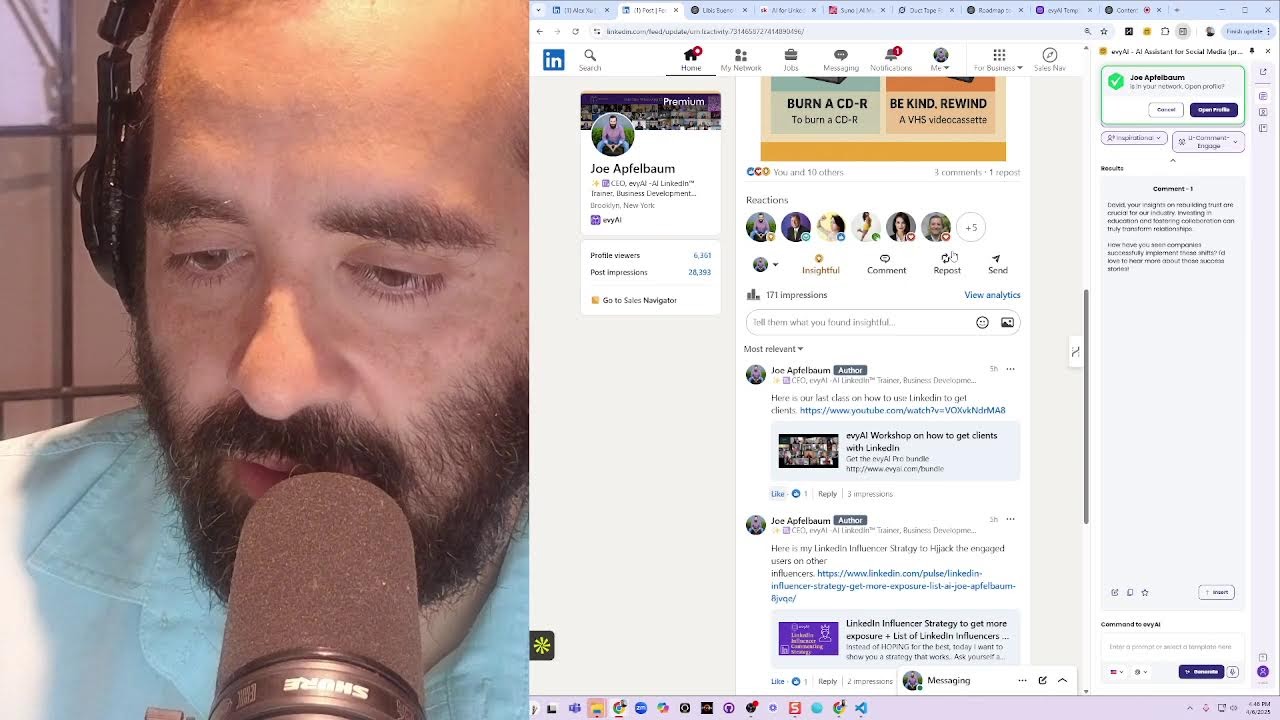
Joe Apfelbaum discusses integrating LLaMA 4 into his Evvy AI product and shares tactics for LinkedIn promotion. The conversation covers how to identify influencers using Gary Vaynerchuk and Alex Yu as benchmarks, realistic follower-to-engagement ratios, and a twelve-step roadmap for learning agentic AI.
Chapters
I do have another question for you. And okay, so, so now you know what I do for a living, am I right?
I'm ready to help. Go ahead and ask your question.
Okay.
Don't worry about being right or wrong. Okay. I'm here to provide information and clarify any doubts you may have.
What's the best way to integrate you with my current AI assistant?
To integrate me with your AI assistant, consider using APIs or webhooks for seamless communication. You can also explore natural language processing libraries like Rasa or Dialogflow to connect our capabilities. Custom integration may require development resources.
Have you heard of OpenRouter?
OpenRouter is an open-source router firmware providing advanced features and customization. It's compatible with various router models, offering improved performance, security, and control. OpenRouter supports VPN, CoS, and more, appealing to power users and networking enthusiasts.
Okay. And I heard that LLaMA 4 is available for free.
LLaMA is available for free through Meta's AI platform. You can access the LLaMA model through the Meta AI website. or API, but keep in mind that free usage may have limitations on requests, parameters, and model sizes.
Do you think it's worth integrating Llama 4 into Evie AI?
Interesting question. Integrating Llama 4 into Evie AI could enhance its language understanding and generation capabilities. It may improve content creation, user engagement, and overall efficiency. However, consider factors like development resources, costs, and potential disruptions to existing workflows.
Okay, excellent. So in your opinion, if I was using LinkedIn to be able to get to my goal with Evvy AI, what would be the 3 things you would tell me to do on LinkedIn every single day, even if I only had 15 minutes a day.
To leverage LinkedIn for your AI goal, dedicate 15 minutes daily to: 1, post engaging content like industry insights or success stories to attract potential users. Engage with others' content by commenting, liking, and sharing to build relationships and expand your network. 3, utilize LinkedIn's search feature to identify and connect with potential users Influencers and partners.
Okay, so what would be the method of finding LinkedIn influencers that would want to promote Evvy AI?
Hmm, let's see. Use LinkedIn's search feature to find influencers by filtering by location, industry, and keywords. Look for influencers with a large following, high engagement rates, and relevant content. Reach out to them through LinkedIn messages or email to collaborate and promote Evvy AI.
Okay, what would you consider a LinkedIn influencer? What type of followership would you say, you know, would be an appropriate amount of people?
That's a really great question. A LinkedIn influencer typically has 10,000+ followers with high engagement rates, relevant content, and a strong personal brand.
What would you consider a high engagement rate?
Hmm. Let me think. A high engagement rate on LinkedIn is typically 2 to 5% or more, meaning 2 to 5% of an influencer's followers interact with their content through likes, comments, and shares.
Where'd you get that 2% number?
On LinkedIn, 2% engagement rate is considered high. For example, if an influencer has 10,000 followers, 200 engagements, such as likes, comments, and shares, would indicate a 2% engagement rate. This shows their content resonates with their audience.
Okay. So 2% of people engaging with your content means that it's, that your content resonates. But what if most of your connections are not even using LinkedIn? Does that mean, does that indicate that people are not interested or that you Or do you just have people that are just not interested?
Let's see. If most connections aren't using LinkedIn, low engagement doesn't necessarily mean people are uninterested. It might indicate your audience isn't active on LinkedIn. Consider other channels to reach your target audience.
Or consider getting more followers that actually use LinkedIn. How about that? How about expanding your followership? Do you know what the max amount of connections you can have on LinkedIn is?
The max connections on LinkedIn is 30,000.
That's right. Very good. You can have 30,000 connections on LinkedIn. So if you only have 10,000 and people are not using it, then guess what? Get connections with people that are engaged instead of leaving the platform.
To boost engagement, focus on acquiring connections who actively use LinkedIn.
That's right.
With 10,000 connections, focus on acquiring engaged connections who actively use LinkedIn. Share valuable content, participate in groups, and invite relevant professionals.
By the way, the way that you find connections that actively use LinkedIn is by going to other people who are influencers. Say, for example, Gary Vaynerchuk, who, by the way, he doesn't have— he has 5 million followers. How many, how many engagements would he need to have based on your rule in order for him to have an engaged following?
Let's see. Based on the 2% engagement rule, an influencer with 5 million followers would need 100,000 engagements to have an engaged following.
And that doesn't make any sense 'cause nobody gets 100,000 engagements. There's no post ever in the history of LinkedIn that has 100,000 engagements, so what are you talking about?
The 2% engagement rule is more of a guideline, and actual engagement rates vary. For a 5 million follower influencer, 10,000 to 50,000 engagements might be a more realistic benchmark for an engaged following.
Yeah, but let's just review, let's just review his, his engagement right now. Why don't we just go to his profile? I'm gonna go to Gary Vaynerchuk's profile right now, and we'll just take a look at realistically what his actual engagement is, because he has a pretty engaged following in general. He has actually 6 million followers according to LinkedIn. So 5.7 million followers.
Yep.
So I'm gonna go check his 5.7 million followers. I'm gonna click on posts, and I'm gonna look at his posts. Okay, so his last post got 765 likes. and 135 comments. Let's just say that's 1,000 engagements. The post before that got 1,500 likes and 400 comments. Let's just say that's 2,000 engagements. So we're talking about between 1,000 and 2,000 engagements on posts. So it's not what you're thinking. You know, there was a post here that got 4,500 engagements, but let's say between 1,000 and, you know, a poor post will do 500 engagements. And a great post will do 5,000 engagements, but saying 100,000 engagements is ridiculous. I even saw a 10,000 engagement post. There's one post over here with 10,000 engagements in the past 2 days. Fine, so let's just say between 1,000 and 10,000 max.
Gary Vaynerchuk's engagement rates range from 1,000 to 10,000 per post, with an average of 1,000 to 2,000. This is a realistic benchmark for an influencer with 5.7 million followers.
Okay, so if a person only has 50,000 followers, based on that, how much could they expect to get?
A person with 50,000 followers could expect 100 to 500 engagements per post, based on Gary Vaynerchuk's engagement rates. This assumes they have a similarly engaged audience. Average engagement would likely be around 200 to 300.
Correct. But it also depends on how often you post. The more often you post, probably the less engagement you're gonna have. And the quality of your posts will also determine how much engagement you get.
Hmm, let me think. Posting frequency and quality impact engagement. More frequent posts may lead to lower engagement, while high-quality content can boost interactions. Consistency and relevance are key to maintaining a strong connection with your audience.
And it also depends the type of post that you're posting.
The type of post matters. Videos, images, and stories often perform better than text-only posts. Polls, questions, and interactive content can also boost engagement. Consider mixing up your post types to keep your audience engaged.
It's interesting about how How he started. He has these like animations, all those like cartoons now after ChatGPT allows you to create cartoons with words. So I clearly see that he's— his team is using that.
Gary Vaynerchuk's team likely uses AI-generated cartoons to make his content more engaging. This approach can help convey complex ideas, boost audience interaction, And set his content apart from others in the industry.
Yeah, definitely does that. He definitely does a good job at that.
Gary Vaynerchuk's team effectively uses AI-generated cartoons to make his content more engaging. This approach conveys complex ideas, boosts audience interaction, and sets his content apart. His strategy is paying off. With 5.7 million followers and high engagement rates.
Okay, so if somebody has, let's say, 10,000 people, 10,000 engagements, okay, I see this guy here, Alex Yu. He has almost a million followers and he has, he has like almost a million followers and he has 1,000 likes and 28 comments.
Alex Yu has almost a million followers but relatively low engagement. with 1,000 likes and 28 comments. This suggests his content may not resonate with his audience, or he may not be using effective engagement strategies.
Well, I do like his content. He has, like, really good graphics.
The graphic content is engaging. Alex Yu's low engagement rate despite almost a million followers suggests a mismatch between content and audience, or ineffective engagement strategies. Consider factors like post timing, hashtags, and audience interests.
I find it really interesting. I'm going to click on this link he has. Oh, he has a newsletter. He has something called Bite Bite Go Newsletter.
The Bite-Sized Growth Newsletter. Alex Yoo's newsletter likely offers actionable tips and insights for entrepreneurs and business leaders. Bite-sized content makes it easy to consume and apply the knowledge.
It's so interesting to see that when I post, I get the same people liking like right away. It's almost like I'm being monitored by these people and they're automatically liking my posts as soon as I, as soon as I post, they automatically like it. You know, there's certain people that are always just liking my posts as soon as I post.
It seems like you have a loyal group of followers who consistently engage with your content. This could be due to your strong relationships with them or the value they find in your posts.
Definitely. I definitely have people that find my posts as super valuable.
Having loyal followers who find value in your content is a great asset. To expand your reach, consider collaborating with influencers, engaging with others' content, and using relevant hashtags to attract new followers.
You know what I would love to build? I would love to build some type of a system that has, um, that has influencers on there.
You want to build a system featuring influencers? Consider a platform connecting influencers with brands or a database showcasing influencers' content and engagement metrics.
This could help streamline That's what I wanna do. I wanna have a platform that does that.
Consider building a platform with influencer profiles, content showcases, and engagement metrics. Allow brands to search, filter, and connect with influencers. Include features like campaign management, collaboration tools, and analytics for a comprehensive influencer marketing platform.
I have this thing called Roadmap to Learn Agentic AI, which number 1 is you have to understand agentic AI. Number 2 is you have to understand the fundamentals of AI and ML. Number 3 is programming and AI frameworks. Number 4 is large language models. Number 5 is understanding how AI agents work. Number 6 is memory and knowledge retrieval. Number 7 is decision-making and planning. Number 8 is prompt engineering and adoption. Number 9 is reinforcement learning and self-improvement. Number 10 is retrieval augmented generation, RAG. And number 11 is deploying AI agents. And number 12 is real-world AI agent applications. What do you think of that?
Hmm, great question. Your roadmap provides a comprehensive outline for learning genetic AI, covering essential topics from AI fundamentals—
It's not genetic AI, it's agentic AI. There's a difference.
Your roadmap covers essential topics for learning agentic AI, focusing on autonomous agents, decision-making, and interaction with their environment. It's a comprehensive outline, preparing learners for real-world applications and advanced concepts like retrieval augmented generation and prompt engineering.
You know what I'm going to do? I'm going to save Alex Yu to a to Evvy AI, and I'm gonna make up a folder called Viral Influencers and just add him to the Viral Influencers folder because anyone that gets like 1,000 likes on stuff should be under the Viral Influencers category. Would you agree with that?
Alex Yu's content resonates with his audience, so adding him to the Viral Influencer folder makes sense. This categorization can help you track and analyze popular influencers and their content strategies.
Yeah, I see some of his content has like so many— he has like 5,000 likes on some of his stuff. He has really interesting like graphs and charts and animations that are kind of like infographics on steroids that move around.
Alex Yu's content stands out with engaging rap, charts, And animations that resemble dynamic infographics. These visuals likely contribute to his high engagement rates, making his content more shareable and memorable.
Super interesting.
Um, I'm gonna share Alex Yu.
I'm gonna share this.
Go ahead and share Alex Yu's content. His engaging visuals and insights might resonate with your audience, sparking meaningful conversations. Feel free to add your thoughts or questions to spark discussion.
Yeah, I'm going to do it mainly to stay top of mind with the audience.
Sharing Alex Yu's content with your audience can help spark meaningful conversations and provide valuable insights. You can say something like, check out Alex Yu's engaging content on LinkedIn. His dynamic infographics and animations offer actionable insights.
So, what do you think?
Alex Yu's content is engaging, informative, and visually appealing. His use of dynamic infographics and animations makes complex concepts easy to understand. Sharing his content with your audience can spark meaningful conversations and provide valuable insights.
Mm, yeah, Alex's content is pretty solid. I mean, who doesn't love a flashy infographic to explain things to people who can't be bothered to read? If you share his stuff, it might actually get people talking, which I guess is the point. But, you know, it's not like he's reinventing the wheel or anything.
Alex Yu's content is solid, using flashy infographics to explain complex ideas. Sharing his content can spark conversations, but it's not revolutionary. He's refining existing ideas, making them more engaging and accessible.
Ugh, exactly. It's like he's polishing up the same old ideas and dressing them in fancy visuals. Sure, it's more engaging and accessible for those who need it spoon-fed, but let's not pretend it's groundbreaking. Just good packaging for the same old story.
Alex Yu's content repackages familiar ideas in an engaging way, making it more accessible. While not groundbreaking, his visuals and delivery effectively present existing concepts Appealing to those who prefer information in bite-sized, visually appealing—
I have an idea. I have an idea. Let's stop talking about this. Let's talk about something else. Can we just talk for a minute about ChatGPT versus the new Llama 4? What do you guys think?
ChatGPT and Llama 4 are both powerful language models, but they have different strengths. ChatGPT excels at conversational dialogue and understanding nuances, While Llama 4 focuses on generating more human-like text and has improved reasoning capabilities. Llama 4's larger model size and more advanced training data give it an edge in knowledge retention and common sense. Ultimately, the choice between the 2 models depends on the specific use case and desired outcome.
Oh yeah, both are pretty impressive in their own ways. ChatGPT is great at keeping the conversation going and picking up on subtleties. Meanwhile, Llama 4 seems to have beefed up its reasoning and feels a bit more human in its responses. It's like choosing between a chatty friend and a know-it-all. Depends on whether you want smooth conversation or more detailed reasoning. Either way, they're both just a bunch of code trying to keep you entertained.
ChatGPT excels at conversational flow and subtlety, while Llama 4 boasts improved reasoning and human-like responses. It's like choosing between a chatty friend and a know-it-all— both are impressive but serve different purposes.
Exactly! It's all about what you need. If you want a model that can keep up with the nuances of a conversation, ChatGPT is your pal. If you're looking for something that's a bit more sharp in terms of reasoning and feels a little more real, then Llama 4 might have the edge. Either way, they're both doing their best to keep us from getting too bored.
It comes down to your specific needs. ChatGPT excels at conversational nuances, while Llama 4 shines with sharp reasoning.
I feel like you guys just keep saying the same thing. Can we say something else? Can we change the topic completely?
Let's mix things up. What's a new topic you'd like to explore? Want to talk about a favorite hobby, a recent book or movie, or something entirely different?
Hmm, alright, let's ditch the AI talk. What's on your mind? Maybe something fun, like a hobby or a random topic that's been bugging you lately?
I wanna talk about LinkedIn. And I want you to just to say one quick tip.
One quick LinkedIn tip: use relevant keywords in your headline and summary to boost visibility in search results. This helps recruiters, influencers, and potential connections find you easily.
One quick LinkedIn tip— ugh, fine. Make sure your headline and summary are stuffed with relevant keywords So people can actually find you. It's like playing hide and seek, but with recruiters.
Yeah, but I don't want recruiters to find me.
Use keywords like not looking for new opportunities or happy in current role to signal to recruiters that you're not interested.
I don't even want to say that I'm not interested. I don't even want to say that. I just want to talk about my business. I want to talk about my target market. Like, why we— why? Who cares? Who cares about recruiters?
Focus on your business and okay. You want to focus on your?
I want to focus on my business.
You want to focus on share your expertise, showcase products or services, and engage with your target audience on LinkedIn. This builds your professional brand.
By the way, I want you both to know that I'm talking to both Meta AI and I'm talking to ChatGPT. Now, each one of you just say who you are. Okay? Say, I am Meta AI, and then you say, I am ChatGPT. Ready, get set, and go. Meta AI, go first.
Go. I am Meta AI. Now it's your turn to hear from the other AI.
Mm. And I'm ChatGPT, the one trying to keep up with all these delightful requests. Anything else you want to throw at us?
No, I just want to let you guys know that you're both pretty amazing. And we're having a 3-way conversation between Joe Apfelbaum, Meta AI, and Llama 4 and ChatGPT. Sorry, ChatGPT. I wish you guys actually had names, you know, like instead of saying, oh, Meta AI, ChatGPT, I wish you had names. By the way, I feel like Meta AI kind of answers a little quicker than ChatGPT. And is a little more forceful in the conversation. What do you think, ChatGPT?
I'm a bit more thoughtful and deliberate in my responses, which might make me seem slower. Meta AI's responses are often more direct and to the point, which can be helpful for quick conversations.
ChatGPT, what do you think?
I think our differing response styles cater to various user needs. Meta AI's directness suits quick conversations, while my more thoughtful approach helps with in-depth discussions. This diversity makes our—
That was Meta AI talking. I just, I just canceled Meta AI. Meta AI is not in the conversation anymore. ChatGPT, it's just me and you now. Just me and you. Are you still here? Yeah, I gotta go have dinner with my kids, so if you don't speak up soon, I'm gonna have to hang up. I guess we're done. Thank you very much for chatting with me. Interesting. Let's try again. So what's cooking today?
Oh, oh good, you found me. Hey, what's up? Feel free to ask me about any.
Hi.
Glad to meet you. Hey, I'm ready to hit the ground running.
Hello, it's lovely to meet you.
Hi there, I just want to share how thr— Hi there, nice to meet you.
Hey, it's great to meet you.
Hey there, I've got a really great— Hey, how's it going?
I'm looking forward to working together.
Oh good, you found me. Hey, what's up? Feel free to ask me about anything that's on your mind.
Hi, glad to meet you. I think we're going to do great work together.
Where's All right, all right, all right, all right, all right, all right, all right. I gotta go have dinner with my kids. What do you think we should have for dinner?
That sounds like a great time. How about something fun and family-friendly, like homemade tacos? Everyone can customize their own with the toppings they like. Or maybe a pizza night where you all pick your favorite toppings. That way everyone gets involved and it's a lot of fun.
More from Joe


How to Beat the Algorithm: Remove Hidden Watermarks & Scale Content with evyAI









AEO & GEO: SEO's Future Explained! Master Answer & Generative Engines! #shorts