Smarter Strategy for Scaling: Winning Moves for $10M–$100M Businesses
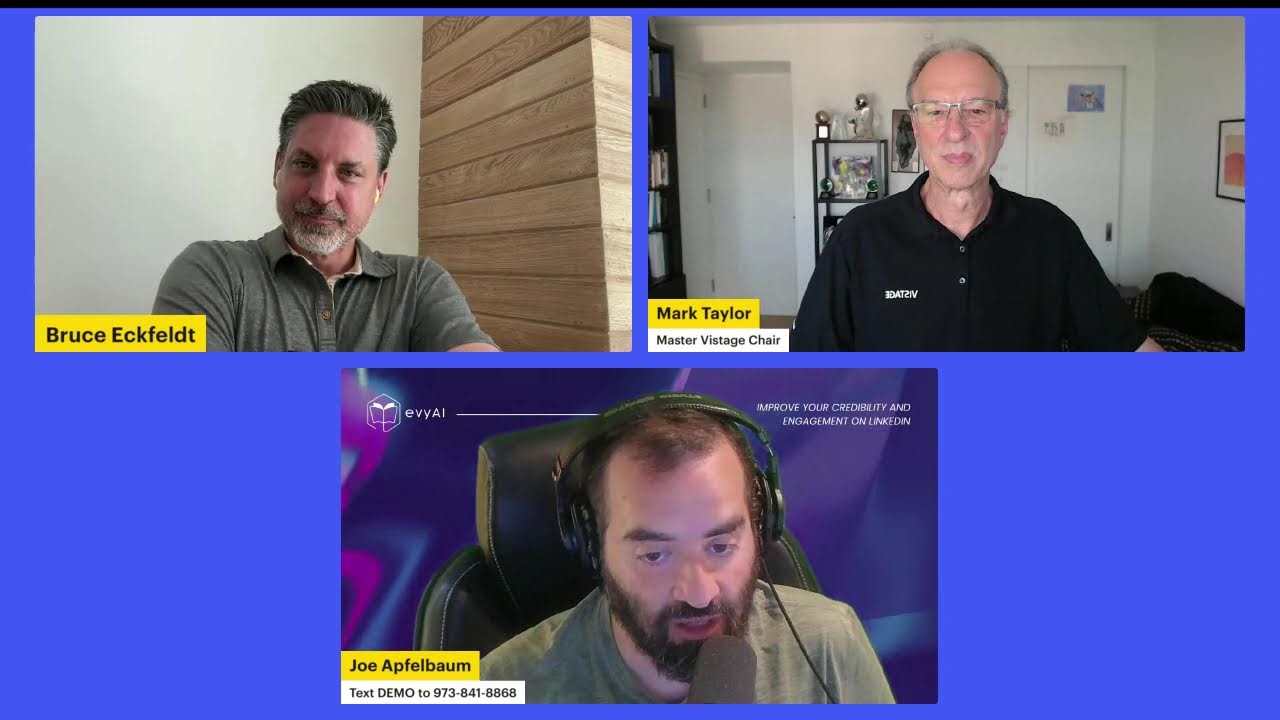
Joe Apfelbaum and Mark Taylor discuss how mid-market CEOs can use AI for strategy and execution. A LinkedIn survey found 70% of CEOs are unsure how to use AI. They recommend starting with prompt engineering, building a prompt library, and automating one repetitive task while using business-tier AI models to manage risks.
Chapters
Okay, welcome everyone to our LinkedIn Live. I'm Bruce Heckfeld. I'm going to do a little intro here. I'm going to introduce our guests and then we're going to get going on things. So today's LinkedIn Live is an exciting one. This is really about AI and how you can use AI for strategy and scaling and really help align leadership teams. We're gonna talk a little bit about kind of what we've seen with the teams that we've worked with and some of the strategies we see them using and tools that we see them using and where AI is going. Obviously a lot of moving pieces right now in the world of AI, but we wanted to cover it from a strategy and a leadership point of view. Excited for this. Let me introduce our 2 guests, 2 amazing guests. First up, Joe Apfelbaum. He is CEO of Ajax Union. He's a B2B digital marketing strategist. He runs an agency. He's an expert in using AI. We're gonna hear about some of the tools he has and developed. He's focused on marketing strategy and he's big on LinkedIn. I've known Joe for quite some time. It's really amazing to see what he's been able to figure out and do in the LinkedIn space. He's also a speaker, educator, and he's known for breaking down complex topics, which hopefully we'll see a little bit of today, and developing actionable insights for business leaders. So, Joe, welcome to the program.
Thank you so much for having me here. It's really exciting to be here, and I appreciate the beautiful intro.
Great. Next up, Mark Taylor. He is a seasoned CEO coach. He's a Master Vistage Chair. He works with executives, teams, and growth modes in companies. He helps them think more strategically, operate with greater clarity. He has a deep background in business leadership transformation, and he's passionate about equipping leaders to scale intelligently. With all that, Mark, welcome to the program.
Thank you.
So if you're watching on LinkedIn and you have a question during the live, go ahead and drop your comments in there. We'll watch that and weave those into the conversations as we see them. We're also streaming on YouTube. We're probably actually streaming on a couple of different platforms at this point, but we are streaming on YouTube. I know if you have a comment, jump over to LinkedIn. I'm not gonna be watching the YouTube comments during the live program. But I will say, if you're on either platform or any of the platforms watching the replays, go ahead and drop comments in the comment section there. If you have questions, put it in the comments. We'll watch all of those channels and respond to people there. So even if you're watching the replay, drop a comment, drop a question there, and we'll get back to you. So with all of that, let's go ahead and get started. I guess, why don't we start just— I'll hear from both of you in terms of What's the main thing that you see leadership teams doing right now when it comes to AI? And I guess give us a sense of, you know, how are they using it or what tool or what kind of angle are they taking when it comes to applying AI to leadership development, strategy development? I'd love to just kind of get a general sense from each of you. Mark, why don't we start with you?
So I recently did a survey on LinkedIn and 70% of the people that responded to the survey said that they're not sure how to use AI yet. So I was really surprised at that. I read a book recently called The AI-Driven Leader by Chuck Lutz.
Good one.
Have you read that book?
Yeah.
So I've been encouraging and teaching my CEOs how to use AI as a thought partner, like, you know, just talking to it and using it to help them figure out their strategy. So I've given my members a couple of what I call killer prompts. Take a look at our company and compare us to our competitors in the area and tell us if you were one of our competitors how you would kill our company. Tell us what our weaknesses are.
Right.
Take a look at everything on the internet. Take a look at things like Glassdoor. Take a look at any ratings that you can find by customers and show us where we could we're liable or we're at risk of being beaten by a competitor. So I'm teaching them to have those conversations. You know, the second part that he teaches is to tell the AI to ask you questions. So I'll say, ask me questions one at a time if you need more clarity on this. And we're getting some amazing results. And if you go into deep research and give it a longer prompt, it'll give you like a 20-page report on where your strengths are, where your weaknesses are, where there's opportunities to beat your competitors. I mean, I just think that it's amazing.
Yeah, yeah, it's really, it's a deep hole you can go down in terms of asking questions. Joe, let's hear from you. Like, what have you seen leaders and leadership teams do in terms of leveraging AI at the leadership level?
I think that people that are, first of all, a lot of leadership teams are just not using it at all 'cause they're kind of like afraid of it. 60% of people in recent surveys that I've done are just terrified of it and they don't want to be involved. They don't want to get into any data breaches or any issues, so they kind of like avoid the whole thing.
Mm-hmm.
Um, the people that are using it are definitely have a competitive advantage besides doing strategy development work. They're also just saving a lot of time.
Yeah.
Time is an asset. Time is something that if you can leverage artificial intelligence to save time by adding automations, by streamlining research, By being better prepared, by taking proper notes and doing proper follow-up and creating proper memos. These are things that historically it just took too much time and too much effort to do. And now if you don't do it, you're basically leaving a lot on the table, especially if you're part of a board.
Yeah.
And you need to document things. The amount of resources that you can have with AI now available at your fingertips is extremely powerful. And in general, what I see companies starting to do now is invest money in training their teams on how to use AI.
Mm-hmm.
So that the teams can thoughtfully use AI because there's a lot of people that are using it in a not a thoughtful way, especially when you're posting on social media. One of the things that I tell people is like, AI can be authentic, but you have to train people to train AI to be authentic. Because if you don't, yeah, it's just gonna be just spraying and praying. So, I, I do see training budgets coming out for people to get their teams trained in because it's not obvious. Common sense is not common practice. And so I do see leadership teams needing to get trained in themselves. A lot of them don't know where to begin or what to do. Uh, but they're just using the basics. They're scratching the surface with how they're using ChatGPT. But there's so many other tools and so many other ways of using it, um, to allow you to maximize your performance. What I tell people is think about the role that you're in right now and think about the issues that you have within your role. And let's try to find a way to have AI and have automation help you be able to improve that role. Because that's what it's really all about. Yeah.
Yeah.
Yeah.
I find that there's kind of 3 buckets that I, I kind of organize this in. One is I, I call strategy development, which is how do we really understand, you know, who is our core customer? What is competitive landscape? How are we gonna differentiate? Like, and, and how do we operationally, what do we focus on operationally to get that differentiation? So that's all for me, strategy development. And then you have strategy execution, which is, okay, now that I know that the things I need to do to be effective strategically and differentiate, how do I implement that stuff? So everything from roles and responsibilities down to priorities, quarterly planning. So it's all the making of the sausage of actually putting strategy in place. And then the third bucket for me, I'll call it just leadership and management. And I find that There's kind of different strategies and different tools in each one of these buckets. Let's talk, a couple of people mentioned kind of the risk or kind of where people are afraid, I guess, a little bit of AI. Where are you seeing people kind of hesitant to use AI and where do you think it's valid and where do you think they just have, you know, they don't understand or their concerns are mislaid in terms of what they should be worried about and what they shouldn't be worried about when it comes to AI? Joe, why don't you give us your take on this one in terms of what, what you caution people on and where you think they should just go ahead and try things?
I think the biggest caution is when you're putting out content, a lot of times AI hallucinates and makes things up. It's actually trained to make things up when it doesn't have the answer. Yep. And so understanding how to verify information and making sure that you don't look like a fool when you share a bunch of facts that are not really facts.
Yes.
You know, fake news and all that jazz.
Uh-huh.
Um, that would be the first thing. The other thing I would be is like, what information are you feeding the, the AI that might be proprietary or private and you don't have the right to put that information into AI? So you gotta just be careful from a, from a legal standpoint, what you're allowed to put in there and what you're not.
Yeah.
The safe things to do is to like research people and to research topics, you know, that's real. And to brainstorm without giving it much information to really help you be able to think better and to get organized. So for example, when I make a phone call to call somebody, or if I'm on a podcast and I'm interviewing somebody or somebody's interviewing me, the first thing that I'll do is I'll run an AI agent that will automatically research the person.
Yeah.
It'll tell me not just their, their name and company name, but it'll tell me who they help and how they help them and all the notable achievements that they have and every article they've ever written and every topic they talk about in the articles and every podcast they've ever been on and conversation starters around each podcast. and it'll gimme their personality type and how I should be approaching them. And every possible thing you can want in about a split second, it'll do that. And that's extremely powerful and very low risk to be able to do. On the other hand, when you're writing content, you wanna make sure that the content sounds like you. That's why I use personas to make it sound like me.
Mm-hmm.
And I use, I make sure that it's not hallucinating by whatever topic it gives me. I'm actually reading it through, making sure it makes sense. and then publishing it. Some people just publish things mindlessly, and that's a big, big danger.
Yeah, yeah. Mark, what are you seeing, and what do you kind of advise leaders on in terms of where to be careful and where they should go ahead and proceed?
I'm seeing similar things as far as the concerns that Joe mentioned. You know, as far as privacy is concerned, what the problem is, is that people just don't know how to use it. I'm mostly a ChatGPT user, and you can turn training off, or what I suggest is that they buy the Teams version not related to Microsoft Teams, but the business version, which is like $30 per month, where it doesn't train on your information and it says it doesn't use your information so that you're de-risking the possibility of private information getting out there. And with that, you know, no training on, then I'm able to attach a strategic plan, upload the file, and get much deeper insight and better information. And as far as hallucination, one of my teachers, one of— when I was getting my master's degree, said it's not the recipe, it's the cook.
Yeah.
And so I think it's not AI that you have to worry about, it's the cook, the person putting the prompts in. And you can put guardrails on your prompts. You can say, give me the sources and the URLs for the information that you're getting. If you don't know, Don't hallucinate. And it's amazing how much more accurate just those 2 guardrails by themselves will be.
Yeah.
So I think it really— what Joe said is that we have to train our executives and our executive teams on how to use it so that it can reduce some of the fear and the anxiety that they have. And the failure to do that is what I think is the biggest risk, because people in your organization are using AI, and they could be using it Not in the best possible way.
Yeah. Yeah. I think just having good policies and guardrails, not only for yourself, but for your team, for your organization, and making sure that, you know, there is some baseline protocols around this so people know how to do it. It's kind of the— I forget what the study was, but, you know, the children that were playing in the open playground and, you know, they stayed really close to the playground equipment and they wouldn't wander around, right? But then they put up a very secure fence around the large playground, and then children would go off and do all sorts of things because they felt safe. Like, they knew where the boundary was, they knew they were protected. So I think if you can do that, you set up very clear guardrails, give people a place to play they know is safe, then they'll experiment. And that's when you start to see kind of the benefits, is because people are willing to kind of try things now that they know they've got some protection around it. Yeah, I do find the other one, I'll do things like You know, remove any identifiable names and things like that from data sources. So if I'm taking a spreadsheet or something, like, I'll do acronyms or, you know, things that I know that I can pull back out of it and then repopulate or translate it back. But I know the AI is not going to have specific identifiable names in it. So just the little things like that that help you manage a little bit of the liability around the data that you're sharing with it. AI. And I would say it's like anything, like sharing it with anyone else in the world, right? This has that same risk, right? So just like you're, you know, if you were to post something on LinkedIn, right, you, people are going to see that. I assume at some level that unless I have those protocols in place, that is a similar kind of risk with AI. Um, I'll talk a little bit about specific techniques. Any, anything that you've seen, uh, you know, particularly interesting in terms of how a team has used AI to either develop or implement strategy or work on their kind of leadership or management skills? Joe, why don't we hear from you?
I think the first thing is to use artificial intelligence to role-play within your role. I've seen people do that really, really well, especially if you're going to be doing interviews or you want to role-play before an important meeting is happening. And you can put in all the personalities of each person that's going to be on the board and their backgrounds. And you can tell the AI what you want to propose to them and then tell it to respond as if they're each person. So using that role-play ability with AI is really good at taking on people's roles, especially if it gets to know personalities. So if you have 10 personalities in the room and you wanna be able to manage the personalities and think about what they might say, AI's really good at predicting what they might say to something. And that can help you be so much more prepared in a, uh, business conversation around the table and make things more effective. The other thing that I've seen really, really well is often people will ask a question. Well, they didn't ask the duck. That question is not necessarily the best question.
Mm-hmm.
So what I've seen some executives do is take a question in real time that's being asked and then figure out what the right question really is. 'Cause we don't need to necessarily come up with solutions. The solutions are usually there. We just need to ask better questions. And that's why prompting is so important because the whole premise of prompting is asking a really good question. If you ask the AI, what's the weather in Brooklyn, New York? The AI does, it's just gonna give you the weather. But if you ask the AI, what should I wear today? Then it'll not only check the weather, but it'll also give you advice based on your preferences. It'll kind of help you solve a problem versus just giving you the weather, and now you have to make a bunch of other decisions.
Mm-hmm.
And so really ironing out what the real questions are, what the real issues are, and then doing additional research around what other, uh, things other companies have in this industry. Is extremely useful and I see people are using.
Yeah, yeah, I'll chime in on that one because that's one thing I've had fun doing is I use several different assessment tools. And when I have everyone's assessment results, then I can load that all into a conversation or into a project, really. And then, you know, I'll work with a team. So I'll put everyone's profiles into a conversation and I've got the team I'm working with in there. And then I can start working through like, OK, so we've got to tackle these questions, we've got to tackle these issues. And I can start to anticipate, okay, where we might have some challenges or where I might need to pull information out of someone or have someone try to stand down a little bit because I know they're going to be active. But once I have this engine built, you can start doing all sorts of interesting things around running the scenarios or going through like, hey, what should I do? What are questions I can ask? It helps prepare you with the thing. I've seen sales teams use this really, really well for doing a scenario. You were mentioning this as scenarios. is loading up like all the common objections they're having from prospects. And then you have the AI run simulations randomly selecting these kind of objections and stuff and training salespeople. And then you score it. Like we've created score systems where they've gotta go through and do 10 simulations and get an average score. And then they start competing with the AI who can get the better score out of this. So it's a fascinating tool. Once you kind of train it and load it up, then you can get really creative in how you leverage that. Mark, what are some things that you're seeing, some interesting kind of applications?
You know, 30 years ago I had a company, it was a systems engineering, Taylor Systems Engineering Corporation, and it was really based on the book Reengineering the Corporation by Michael Hammer. Do you remember that book?
Yeah.
So what we would do is we would go into a company and we would analyze an order from the time it was created until the time it received its customer and everything in the process and look for Where were manual tasks? Where did errors occur? And then we would automate that process if there was a return on investment for doing so. And we did that through programming systems. Man, if we had AI, it would have been remarkable. I think that's the first thing that you have to do is what is the problem that you're looking to solve? And I love what Joe said about workplace automation because there's so many processes that are manual, repetitive processes where AI shines. Last month I hosted a workshop. I had a speaker that's written 9 bestselling books on artificial intelligence. His name is Severin Sorensen, and it was a 1-day workshop for my CEOs and their executive teams, and it blew their minds. He would take examples from the, from the audience, and one example was a roofing company, and one of the most repetitive, time-consuming tasks is doing estimates. Now, these are estimates for commercial roofs that would cost, you know, $1 to $5 million, and it would take several weeks to do it. So he was interviewing the guy who also happened to have been an estimator and created a custom GPT that any of his engineers could now walk into a site, take pictures of the site, answer a few questions that it asks, and it would create a quote for them. And it did it within minutes, and it was like he couldn't believe how accurate it was. I mean, it was like getting the latest price on steel, getting the latest union rates in any city, any place. And I mean, his mind was blown. So I think really the key for artificial intelligence is looking for problems that it can solve and problems that are going to have a big return on investment, especially for your first projects, because—
Yeah.
Want to have a win.
Yeah. Where, like, in terms of where people start, you know, if someone listening here is on a team, leadership team, they haven't been really using AI a whole lot, where would you kind of advise them to kind of begin that process? Joe, what would you, what would you say is the good first step for them?
I would say the first step is prompt engineering, just like the simple basics of how to speak to an AI in a meaningful way. Um, that would be the minimum of learning the basics of prompt engineering. Understand how AI can take a role, understanding how to give it constraints.
Mm-hmm.
Understanding on how to give it examples, understanding how to build a prompt, how to build a good prompt, and how to even prompt AI to build a prompt.
Yeah, exactly.
You know, it's like how to build a prompt and how to build AI to build a prompt. That would be the first thing I would also say in addition to that is don't just have ChatGPT as the only thing you use.
Yeah.
Like, think about what are the different tools that you need? Maybe you need a tool to help you make presentations. Maybe you wanna learn GenSpark. Maybe you need a tool that will help you in your role to create music. Maybe you need to use Suno for that. Maybe you need to use LinkedIn more effectively. Maybe you wanna use Evvy AI for that. And if you want a demo of it, you can go to text the word demo to 973-841-8868 and watch a demo. My point is, don't just have one tool, but try different tools. And often AI is biased. So, you know, you wanna try a little bit of Perplexity and a little bit of Claude and a little bit of Gemini and a little bit of, you know, sometimes I'll ask ChatGPT a question, it'll be like, oh, I can't answer that. And then I'll go to Gemini and I'll get the perfect answer. So don't get used to just using one AI. Use a variety of different AIs. I call it being non-monogamous with AI. And, and this way you'll be able to really learn the platforms and get what you need out of it. And the other thing I would tell you to do is don't, don't be afraid to create images with AI also.
Mm-hmm.
Because that saves a lot of times, especially with this concept called Nano Banana. And if you wanna hear more about it, I'm happy to tell you, but I'd love to hear from Mark as well. But the idea is kind of like, make sure that you're prompting properly. Make sure that you're using more than one tool and more than one LLM. Yeah.
Mark, where do you suggest teams start?
I think you have to start where people are at. So I mean, if they're very basic beginners, you got to show them how to use the tools and how to do prompts. But if they've gone beyond that, which is where I find a lot of people, it's like, what do I do next? And I think automating tasks is a good one and choosing a simple task. I'm, I'm taking a certification course in AI for Leaders at the University of Michigan Department of Engineering, and it's 6 hours a week of class plus homework.
Wow.
And they have us using Zapier now to create our first workflow automation. I am amazed. I had not used Zapier before, but Zapier's interface with Microsoft Copilot And when you make a mistake, you just ask the Copilot, hey, I don't know why this isn't working. Can you help me figure it out? And it says, oh yeah, and it tests everything that you're doing and comes up and rewrites your, your Zap so that—
Yeah.
So just doing simple things like taking a referral that I get and putting their email address in the Constant Contact, which used to be a manual process that I would send to my assistant. So I mean, just coming up with a simple task and seeing what's possible, and then you begin to imagine and look for what are the repetitive tasks that I'm doing on a daily basis that AI might help me with.
Yeah, yeah, I would, I would agree with that kind of— so start with what you're doing right now and just start asking AI how it could help you do these things, right? Just, just try it, right? Say like, hey, look, this is— I'm trying to write this email, or I'm trying to like sort through this data or not and ask it like, can you help me and how, and how would I do it? And like, let it kind of tell you, well, I could do this for you or this for you. And it's like, oh, that's a job I hadn't thought about.
And it could, it could also be very overwhelming quickly. So I really like Mark, Mark's point about start where the people are at because some people haven't even used ChatGPT yet. Yeah. And for them, that's a huge task. So getting them to use other tools are gonna be very overwhelming, or using the word prompt engineering sounds really overwhelming. So just kind of like, just a very, very, very basics for some people. It's like, how do you even log in? How do you create an account type of thing? You know, like you never know where somebody is. And, and most people in the world, there's only like, say, 100 million people using ChatGPT. That means out of the 8 billion people in the world, 99.999% haven't even, even like, don't even know that it exists.
Yeah.
Like sometimes I'll walk into like a, a Target or like, you know, like, um, like a supermarket or something and just see people and just wanna walk over to them and just, just ask them a question and say, hey, are you using AI at all? And they're like, what?
A what?
A what? And, and they don't even know what I'm talking about. And some of them are business owners. They're like, are you a business owner? Yes, I am. Have you, have you used anything like ChatGPT? ChatGPT? What? What are you talking about? I don't know what you're talking about. And I, I just like, I'm so in it that I can't even imagine that most people are not.
Yeah. Yeah. Yeah.
Yeah, that's very true. So I want to ask a little bit about once you start playing with it, and I'll start with one thing that I give all the teams I work with, all the leaders I work with, is this idea of a master prompt or a master context situation. So I have a document, it's about 20 pages, and I used AI to create this, which is everything you need to know about me, my life, my job, what I do, the kind of clients I work with, everything. So it's a It's a long document which gives a significant amount of context, even things that I write about, core concepts that I teach, right? Like, so the programs that I run, and that helps transform these kind of generic tools into something that is hyper-specific in terms of knows an extensive amount of me. So I can go to Claude, start just a random conversation, And say, write me a 200-word bio. And it knows so much about me, it can just write a bio without knowing anything. And it really is a game changer in terms of then when you're in these projects and in these conversations that it now knows a lot more about what I'm trying to do, the context that I'm operating within, and really kind of changes the game. I think once you get into it, you realize how important context is to these conversations. So that's one thing I've really recommended. the leaders that I work with do. What other kind of recommendations do people have? Like, once you're kind of in there, things that really kind of help level up and really make AI more effective? Either one of you have something you want to start with?
Marc, you can go first.
I mean, I have a document like that, but what, you know, I've been in Vistage for over 30 years now, probably heard over 500 speakers, and almost every year you have a speaker that's going to give you some sort of a personality profile. So I've done You know, I'm a positive intelligence coach, so I know my saboteurs. I've done Working Genius, I've done this on Myers-Briggs, I've done Kolbe. I probably have over a dozen results, StrengthsFinders. And I took all of those documents and I put it into ChatGPT and I said, create a personality profile of me and integrate what are my strengths, what are the areas I need to work on to be an even more effective leader. And now I have this document that I use so that when I'm responding, I want that authentic voice that Joe talked about. So I've also given it sample emails and other things that I've written, but it also knows my personality style so they can put my personality inside. And I've told it a couple of stories of, you know, life-changing events that I've had. So it can even—
Yeah.
Relive stories when I tell it to personalize a LinkedIn post or an article that I'm putting onto LinkedIn. So I love the idea of having a document that it can refer to.
Yeah, I think mine even knows my love language and my attachment style.
I didn't do those 2. That's a good idea.
Joe, what do you, what do you kind of recommend to kind of really boost this for folks?
I would say like having a prompt library is extremely important. Um, not just having, you know, all your stuff into one place, but in general, let's say for example, I wanna build a landing page.
Mm-hmm.
I already have a framework for the perfect landing page. That's HTML, CSS with every little thing that I want, every little feature that I would want on every landing page, the ability to save to local memory and the ability to have debugging code built into it and every possible thing I could think of. So like, When you're creating yourself a library of AI knowing who you are, have prompts for every little thing that you might need. So you might need a sales, uh, to create sales proposals on a regular basis.
Yep.
So you wanna have all the information that are related to your company, all the information that would go into a prompt that would build the perfect sales proposal or the perfect sales presentation. Or for example, I'm part of the Executives Association of New York City. We're a networking group that meets on a monthly basis. a couple times a month and we exchange business with each other. So after every single meeting that we attend, I have AI analyze who is at that meeting and automatically create a very robust email with all the information that's needed because I have a prompt that's ready to go and I save that prompt into Evvii AI, saving me a lot of time. So my, my thing for everyone listening to this is ask yourself the following question: do I have a prompt library? And are one of my prompts the ability for me to train every AI in exactly who I am? Now remember, the more information you give AI, sometimes it won't give you such accurate information. So I like to kind of separate things out and not give it unnecessary information that it would kind of hurt the results a little bit. Sometimes it's good exploring, not giving it any information and seeing what it does with that because the results will be so different than if you just feed it, feed it, feed it. It's gonna give you back basically What you gave it.
Yeah.
So if you want to do creativity, sometimes it's better not to train it too much on who you are. Maybe give it a little information. Hey, my name is Joe. I'm the CEO. Da da da. But I want this. But if you then told it your disc assessment and you told it everything you could possibly need, the results are usually going to come back the same way and more consistent with exactly what you need to hear based on who you are.
Yeah.
And maybe you want a different perspective. Maybe you want contrast. Maybe you want different things. So you know, I would also try to use AI when you're not logged in. versus when you are logged in and kind of see the difference between the results. There's also the ability to create incognito, uh, AI, which is the ability to use it in a way where it doesn't even know who you are. And also I would try like Copilot versus, uh, Gemini versus Claude versus other stuff.
Yeah.
But, you know, I want to, I want people to realize that training AI is something that's going to keep evolving in like forever. It's not something that just, yeah, that just happens once. But I do, for each business that I have, I do recommend having a document called a comprehensive overview of Evvy AI. And it has a list of FAQs of all the frequently asked questions, a list of the vision, a list of the goals.
Mm-hmm.
A list of every product and every feature and every detail of everything. And then that's a, a document that you just keep updating and whenever you need it to do anything, you just put that comprehensive summary of your business. You put the comprehensive summary of yourself in there.
Mhmm.
And now you can kinda do what you need to do, but that's part of your prompt library.
Yeah. 100%. So we're gonna hit time here. I wanna make sure people have info— contact information if they wanna get ahold of folks. Mark, if people wanna find out more about you, the work that you do, what's the best way to get that?
My website is marktaylor.nyc, and my email is mark@marktaylor.nyc.
Awesome. I'll make sure that is in the LinkedIn show notes as well. Joe, if people wanna get ahold of you.
Yeah. I'm very easy to find. I bought a domain, joelinkedin.com. So if you wanna find me on LinkedIn, you can go to joelinkedin.com. My cell phone number's on my LinkedIn. If you want a demo of Evy AI to try it out, you just send the word demo to 973-841-8868, or you can go to evyai.com. We just added a new feature that you can highlight anyone's name, press a keyboard shortcut, And then that name gets searched on LinkedIn.
Wow.
So, if you're on any email, any website, anywhere you wanna find somebody, just highlight a name, put a keyboard shortcut in, and boom, that name gets found on LinkedIn and you can find anybody from anywhere.
Yeah. Make sure—
It's just really, really powerful.
I'll make sure the link is on the show notes as well. And if people wanna get ahold of me, just bruce@eckfeldt.com is my email address. Eckfeldt.com is my URL. And then obviously on LinkedIn. Gentlemen, this has been a pleasure. Thank you so much for taking the time today. All the audience, if you're watching live, thank you for joining us live. If you're on the replay, Thank you for watching the replay. Um, but like we said, we'll check comments and stuff as we go, so feel free to post comments, post questions. We'll watch them in the coming weeks, and we thank you all for attending. So with that, gentlemen, thank you so much for being here.
Take care. Bye.
More from Joe


How to Beat the Algorithm: Remove Hidden Watermarks & Scale Content with evyAI









AEO & GEO: SEO's Future Explained! Master Answer & Generative Engines! #shorts