The AiSpace Podcast + Joe Apfelbaum Discuss LinkedIn Strategy
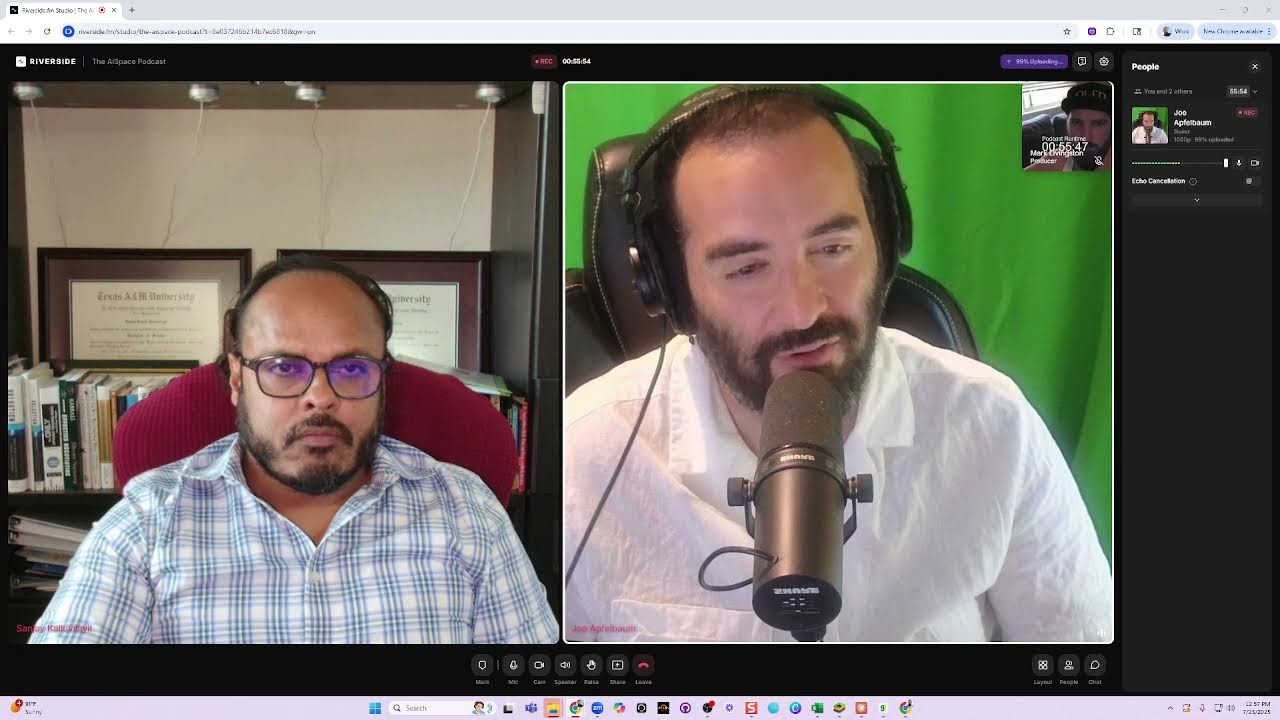
Joe Apfelbaum, CEO of Ajax Union, built Evie AI, a LinkedIn assistant that automates commenting, DMs, and research. He scaled from a rabbinical student to running a seven-figure agency by focusing on high-energy networking and B2B accounts worth $1M+. His growth framework: identify bottlenecks, use LLMs for brainstorming and research, start unscalable by selling before the product exists.
Chapters
Welcome back to the AI Space Podcast. AI isn't just the future, it's a force rewriting the rules of business, wealth creation, and society. If you're a founder, innovator, or technologist, this is the AI show for you. The question you have to ask yourself is, will I blaze the path, follow the crowd, or be left in the dust? Well, I have another amazing episode. I'm thrilled to have Joe Apfelbaum, CEO of Ajax Union and EDAI. Ajax Union is a boutique internet marketing firm focused on enhancing the online presence of your business and dedicated to your online success. EvAI is a LinkedIn AI assistant that helps you create personalized comments, write posts, and reply to DMs. It has a Chrome extension app designed to help you to be more engaging and optimize your content to improve visibility and networking opportunities. Joe is recognized as a business strategist, LinkedIn expert, and certified Google trainer. He has a prominent voice in the digital marketing and professional networking spheres. His agency Ajax Union has been acknowledged as one of the Inc. 500 fastest growing companies, having served over 1,000 clients using strategies in SEO, social media, email marketing, and sales enablement. I'm Sanjay Kluwilel, founder and CEO of Stonehouse Advisors, your trusted advisor for AI founders and businesses focused on go-to-market strategy and execution. Well, Joe, first of all, welcome. I'm excited to have you here on the AI Space Podcast. We highlight game-changing insights that drive innovation and scale business initiatives. So what do you see as the hottest trends in AI?
The hottest trend in artificial intelligence is being able to create autonomous agents that can help you in your business, whether it's generating new revenue, whether it's helping you with operational difficulties that you have in your business. Not only are the agents that I'm seeing right now going out there and doing stuff autonomously, they're also making decisions for your business autonomously as well. So I'm seeing this getting better, better, faster and faster. If you don't have agents in your business right now, you are majorly missing out.
No, that's awesome. We're going to definitely dive deeper into that. So let's take to the next level. What do you see as the top AI strategies to grow and scale a business?
If you want to grow and scale your business with artificial intelligence, you need to understand what artificial intelligence can actually do for your business first. Think about the problems that you have inside your business. I call them the bottlenecks. Every business has a bottleneck that is stopping you from getting where you are right now to where you want to go. If you can find those bottlenecks, and artificial intelligence can help you find where the bottlenecks are, and then you can solve those bottlenecks, you are like opening up a river to be able to have unstoppable growth. And most people are not using AI for brainstorming, for researching, for organizing, for transcribing, all these basic tasks that you can do that sometimes would cost $1,000 an hour to have an expert do, you can do with AI. Think about starting to use LLMs as your consulting partner To help enhance what you're doing.
No, that's amazing. I think we're gonna definitely deep dive into those aspects. So let's take a step back. Um, you know, once again, welcome. I think I've known you for over a year now. You know, we met, but we'll get into that. But can you tell us a little bit more about your background and how you got here? What led you into this foray into AI and your path to Ajax Union and EDI?
I grew up in Brooklyn. I lived for 40 years in Brooklyn, and my parents They wanted me, especially my father, he wanted me to be a rabbi. His father wanted him to be an entrepreneur. He kind of rebelled against his father and decided to become a rabbi. He wanted me to become a rabbi and follow in his footsteps. So he sent me to rabbinical school. I actually went and became a rabbi. And at the end of it, I realized, you know what? I need to make money. I need, like, my parents are living in a basement. Like, there's no money here. I need to figure out how to buy a house and live, make a good life for my kids. And so, and I wasn't married at the time yet, but my mother was like, if you want to make money, you know, like, what's stopping you from making money? I was like, I didn't go to college. I don't have an education. I don't have a formal education. She got me in her car, we went to the library, and she said, go into that place. And I wasn't really allowed to go to libraries because they had a lot of knowledge that wasn't religious there. And so she's like, go into that place, and in that place, you will be able to create something called self-education. And I said, what is that? She said, formal education, will make you a living. Self-education will make you a fortune. And so go in there, and, and I went in there and I got some books on computers, and I didn't have a computer at the time because the internet was just coming out. And, you know, I went to J&R Music and Computer World in Manhattan. It's no longer in business right now, but I got myself a Compaq Presario. My mother chipped in with me, and I learned to do something called web design. I don't know if you're familiar with web design, but it's basically coding HTML which is writing different tags, and I learned Flash animations, and I learned about how to build websites, the basic building blocks of building a website, like what files are and how to upload them to an FTP server. And I started doing it for fun because I realized, oh my God, I can do this for fun. But then people started saying, hey, can we pay you to build me a website? And I started making about $1,000 per website, and I would do about 100 websites per year. So I'm making $100,000 a year. I'm barely 20. And I'm realizing like, wow, this is a powerful thing. But my clients start complaining. They start saying, Joe, you built me a website, but nobody's here. I said, yeah, but if you build it, they will come. I read that in a book. One of the books in the library said, if you build it, they will come. I built it. Nobody came. And it was embarrassing to tell you the truth. I had to figure out this concept called search engines and search engine optimization. Now the latest trend is GEO, generative engine optimization, where you use an llm.txt to get your website to rank within ChatGPT, Grok, and so on. But then it was all about search engines and how do you get to the number one page on Google? And believe it or not, Sanjay, it was really easy to do back then. All you had to do is find the word they wanted to rank for and add it to the title tag of the website, and the website would show up first on Google. And so I said, okay, can I do this for you? And people will be like, sure. I was like, but instead of charging you $1,000, why don't I charge you a few hundred dollars a month and I'll do it for you every month? And then before you know it, I had 1,100 clients and we were doing millions of dollars in recurring revenue in our business because of the concept of like, I didn't even realize that recurring revenue was a thing. So I kind of had to like learn business and I had 75 full-time employees and I didn't know what culture was and I didn't understand business. And I kind of had to like go to Vistage and Entrepreneurs Organization and join, hire mentors and get courses. I basically had to learn the whole process of what it means to build a multiple 7-figure business and go through that process. And at some point I started realizing that the type of clients I'm getting from SEO are not necessarily the types of clients that are going to be long-term because most businesses are not profitable. And if you grow a not profitable business, they'll go out of business faster. And so what ends up happening is I started growing all these companies and they started going out of business because I got them a lot of top line, but they had no bottom line. So I got really into like strategy and figuring out how to get real big customers. And one day I was networking because I learned how to network. I had to go through the process. I wrote a book called High Energy Networking to my whole experience and how I learned how to network. And I was sitting with the president of an organization and I helped him get into 500 hospitals by giving him a niche list and supporting him and teaching him the process of account-based marketing. And then he looked at me, he's like, Joe, what can I do for you? I said, I'm trying to get into bigger companies. He's like, I have a friend of mine who's a sales director at a $400 million 3D printing company. Do you want me to introduce you to him? He's looking for an agency. I said, I would be thrilled. That would be great. That company was spending $45,000 a month with my agency when they started. And that was from a referral. And I was like, what am I doing? Why am I dealing with a few hundred dollar account through SEO or cold calling when I could literally just do networking and get really, really, really, really big accounts. And that's what I started— that's when I was like, oh my God, I'm all in on networking. I have to learn how to do this. And 90% of people are afraid of networking. I had to do a lot of personal development to get over my own fear of networking. But as I got over my fear of networking, my fear of public speaking, I started picking up really big accounts. And I realized I can do all that on LinkedIn as well because LinkedIn is a networking platform. And then I saw Microsoft pay $26.2 Billion. Sanjay, billion for LinkedIn. And I was like, I'm all in on LinkedIn. And then eventually I started teaching people how to use LinkedIn because everyone's like, dude, how are you doing this? How are you leveraging LinkedIn? You're not trying to go viral. You have a strategy. And I realized, oh my God, I had a strategy. But first I had to deal with my ego because my ego's like, you're a CEO. You're not a LinkedIn trainer. How dare you go train people? You sit in your office and you hire people. But I had to get over that and I realized, you know what, I am a LinkedIn trainer and I do have passion for helping people. And so I started training. As we trained over 1,000 people, we started a training business called the Evergreen Training Company, and we started training people on how to build evergreen strategies to grow their business. And then ChatGPT came out in 2022, and I was going through a divorce and my divorce was finally finalized and I was looking for a new wife and ChatGPT fit the bill. And so I said, listen, will you marry me? And ChatGPT's like, I don't know, let's go out on a date. So we went out on a date in Mexico and I started chatting with ChatGPT and I said, listen, I train people on how to use LinkedIn. I have a marketing agency, multiple 7 figures for many years. What can I do to impact a million people? And ChatGPT said, start a software. And I was like, my dream is to start a software, but I'm afraid of doing it. They're like, yeah, but I'll help you. I'll help you do everything. So ChatGPT helped me basically do everything. We hired developers. We failed with many, but we succeeded with some. Now we have 20,000 users in 37 countries around the world. Thank you, ChatGPT. And you're muted.
Yeah, that's amazing. And, you know, some other things you said, you're from Brooklyn. Actually, my family moved to New York in the '70s and we lived in Albany, Schenectady, then Brooklyn. But Brooklyn in 1978 was a very different place. So we exited and moved to Texas.
Houses. Houses that are now worth $3 million. I mean, the brownstone that I bought for $500K or whatever that's now worth $3 million, then, then was worth $20,000.
Wow.
You know, think about it. In 1978, you could have bought a brownstone in Crown Heights for $20,000. It's now worth $3 million.
Well, the cool thing is like when we first came to North Dallas, Carrollton area, it was all like farmland. And but now this is the bustling place. Companies are moving here and there's—
Incredible. There's so much, there's so much opportunity in the main— like, if you go around, you know, I started traveling, I went to Seattle. Like, do you know what's going on in Seattle? Do you know what's going on in all these places? Like, you know what's going on in Austin, Texas? Like, there's insanity going on in these places.
Definitely, definitely. And, um, the other thing too, uh, in terms of— let's talk a little bit more about Ajax Union, right? So, uh, what are your target segments, your use cases for Ajax?
So for our— for Ajax Union, we decided to focus on business-to-business. For a while, we were kind of like doing everything, and where focus goes, energy flows. You got to focus on your target market. So we decided that we're going to focus on B2B companies that are over $1 million in annual sales that need a marketing funnel to be able to grow, and that are already bought into the marketing funnel process. So for example, a service provider like a commercial HVAC company that is already savvy and understands the fact that they need a marketing director internal and they need a marketing funnel with top of the funnel, middle of the funnel, bottom of the funnel, and they need assets, we'll build their full funnel system and their account-based marketing system to allow them to be able to nurture leads long-term to be able to get people from the top of the funnel to the bottom line. So our specialty is B2B marketing for companies that are bought into the funnel that have employees that are in charge of marketing internally. If you— we can't really deal with the CEO because the CEO doesn't attend meetings and they're ADD and whatnot. So we need to have internal staff that we could work with that are marketing directors, and they rely on us to do the strategy, the asset creation, and the execution.
Great. And tell the folks a little bit more about Evie AI, what it does.
So Evie AI is an artificial intelligence that solves the problem of you needing an assistant online. So every single person that's in sales needs to have an assistant because if you don't have an assistant, you are an assistant. So we believe that time is precious, that with AI you need to be authentic, and of course make sure that you can experiment properly. So we built an assistant that sits on the side of your browser and that helps you out with things like leaving comments on posts. We have a keyboard shortcut that will read the post and leave a comment on any platform. We have, uh, the ability to have agents that will research every single one of your connections, will go out, scour the web. Pull everything about the person, give you their email, their contact information, conversation starters, business opportunities, who they work with, how you can do business with them, what you should be saying to them, their personality, every podcast they've ever been on, every article they've ever written. We scour the web in seconds so that you have information about each person that you're talking to and building a relationship with in a meaningful way, because the right way to be able to grow your business is to save time and do revenue-generating activities. And if you can have an assistant write your content for you, if you have an assistant draft comments and help you write replies and assist you really well, then we teach you the strategy. You have work with the assistant to help you out, and then you can be much more productive. And that's the biggest problem that I found with people that took our courses is that they learned how to do the thing, but they didn't have the assistant to help them execute. Now we give you the assistant, and that's what the problem that we solve for people with Evie AI. You now have a full-time assistant that costs you a few pennies a day that will do unlimited posts, unlimited comments, unlimited messages, unlimited connection notes, and support you through the process of getting your next 100 clients.
Yeah, that's amazing. We'll get a little bit more— we'll get deeper into that later in the podcast too. So just a question for you. We met a year ago and we'll get into that as we go forward too, but what about the AI Space Podcast resonated with you and Say, hey, I'd love to be a guest on the show.
I really love the way that you interview people and pull out meaningful business insights. The AI Space Podcast is not just an ordinary podcast, but it's a high-quality production that allows the listeners to be able to learn about people, learn about process, learn about strategy, and learn about what's working in artificial intelligence today. Most people they don't do the podcast the way that you're doing it because you do a lot of pre-interview work. You have a pre-meeting, you pull out all the right questions, you do your research, and you have an incredible producer that understands how to be able to pull all the right things at the right times and turn it into a production that people actually want to watch. So if you haven't subscribed yet to this channel, I highly recommend that you go on, uh, online, you find the AI Space Podcast, and you guys subscribe to it. Because this is a very high-caliber, high-value podcast that I highly recommend.
Hey, Joe, thanks so much for that. Actually, that leads us, you know, I want to make— before we continue, I want everyone to follow Joe Apfelbaum, and we'll get into that. I met him over a year ago when I was first— and we'll get into that a little bit later. But also make sure to like, comment, subscribe to the AI Space Podcast, because that helps us to get more awesome guests like Joe on the show. I'm also going to include the affiliate link for Evie AI in the description below. So definitely make sure to check it out and subscribe and to use it to help grow and grow your business. Um, let's take a, you know, you're a founder of a company, you have AI communities, you, I mean, you had so many things that you're doing. What do you see as critical insights you can share around vision and mindset for long-term success?
If you want to be able to have long-term success in your business, you need to know where you're going. 96% of businesses in the United States are doing less than $1 million in annual sales and less than $50,000 a year in profit. My vision for Evvii is to help coaches, consultants, entrepreneurs, and sales professionals be able to generate $100,000 in profit in their business. And it's having the right strategy, but vision often comes to knowing where you want to go. What does the end look like? Where do you want to grow? A lot of people are so stuck in the day-to-day, That they can't take a moment to themselves to look into what's going to happen 3 years from now. If you plan for 3 years from now or 10 years from now, and you have a very clear picture of where you want to go, and then you go all the way down to what are you going to do now that's going to impact 3 years from now? Wow. What an amazing thing that you can create. I started gardening. I don't know if you've ever gardened before, but when you plant a seed, You know what the plant is going to look like in 3 months from now, but you planted the seed today and you gave it sunlight today and you gave it warmth today and you gave it love and water today. What you do each day impacts the long-term growth of the plant long-term, and at some point the plant is going to produce food for you to be able to eat, but you have to know the process of getting there and get the support to get there, but also know what you want to achieve. If you're randomly going to sprinkle seeds and hope for the best, spraying and praying, it doesn't work with plants and it doesn't work with business.
No, you're absolutely right. And, you know, but the thing is, a lot of people, they, you know, one thing I hear, like, if you just dream it'll happen, or, you know, but a lot of people don't know how to start or the actions to take. Because I think my thing is, if you focus on the right actions, you'll get the right results. then you don't have to worry about emotions like fear and false hope. You should have faith, but you shouldn't have false hope. And you got to take the right action. So how does someone start taking the right actions in their business, right?
I would say surround yourself with the right people because we mirror each other. So if you surround yourself with the right people, I mean, I surround myself with people like you who are successful entrepreneurs, who are thought leaders, who are into personal development. Look at your circle. Who are your buddies? Who are your bros? Who are your sisses? Who are the people in your life that you're connected to right now? Are they pushing? Are they going to the gym? Are they working out? Are they reading books? Are they doing personal development? Or are they hoping for the best? Hope is a great thing. It's important to have faith. It's important to have hope. But hope is not a strategy. A dream is not a goal, a SMART goal. A dream is important. We have to be dreamers and we have to know what our dreams are. But if you're living in fluff, then you're just gonna enjoy the marshmallow melting. What you need to do instead is take a moment to take a step back and start journaling. It's start writing down specific, measurable, attainable, relevant goals that have a timeline, that you know exactly what specific actions you're gonna take each day, and surround yourself with other people that are gonna hold you accountable that are doing much better than you do. I walk into a room The CEOs that I'm around, they all have 2,000 employees. They're movers and shakers and are working really, really hard. Many of them could sell their business today and they're made for the rest of their life. But that's not why they came to the world. They are pushing themselves and pushing themselves. They're going from $120 million to $1 billion in revenue. And I'm watching them do it. And the reason I surround myself with those people, because I wanna vibrate at that level. I want to vibrate at the level of growth, of contribution, of giving, of doing. So look around you. Look around you. If you are not surrounding yourself with the right people, get into nature. Nature vibrates at the highest level. So get into nature and upgrade yourself by upgrading your surroundings.
That's great. There's a saying, your net worth is related to your network, right? And you look at the 5 closest people. Next to you, right? And so, you know, kind of like you talked about your journey, how you started, you know, I came from a different place. I started with like an undergraduate and an MBA, and I started working in a Big Four consulting firm and doing, doing Fortune 500 transformation. I worked for a Global 500 company, and then, you know, I held different roles. But then about, you know, 10 years ago, I realized I had this corporate mindset and I wanted to do entrepreneurial things that I had to unlearn. I had to unpack a lot of things because the education and that corporate environment trained you to be a certain way. I think you develop some good skills, but to be an entrepreneur, you have to throw a lot of those— that assumptions and training out the window. And I, you know, and you, you get this— it's kind of interesting, you get this idea that either technologists or the people that are in strategy or whatever, they're doing the real part of the business. And people would kind of like poo-hoo the sales and marketing aspects. And I saw one podcast, I was like, oh, who's in the fluffy area of sales and marketing? But when you're an entrepreneur, you know, you can— and this is going on with all the consultants out there. And part of the reason I started this podcast was I wanted to give back. I know there's other people trying to grow in the space, learn about AI, right? And hey, let's help some other folks out. And so, you know, how can we best do that? And that's what I've been trying to figure out. And to grow. So what are your thoughts on that?
I think that a lot of people are afraid of sales and marketing because they don't understand it. That's a big problem. If you don't understand sales and marketing and you think it's some tactic manipulation, and you don't understand the fact that if you don't have sales and marketing, no matter how good your product is, no one's going to know about it. As a matter of fact, people don't buy your product. People buy the perception that your product has. People buy the marketing that your product has. People buy the sales pitch. They don't even buy the product. They don't even care about the product. They buy the branding. They buy the outside of the product. When you walk into Walmart and you're going to buy something, you're buying the outside. You're buying what you see. You're buying what you feel. You're not buying what the product actually does, but you're buying the promise of the product. So if that's the case, what's your promise? And so many people are afraid of the woo-woo part of sales and marketing because we all know that 50% of sales marketing is a waste. And you're trying to be as efficient as possible. It's different being efficient and being effective. There's a very big difference.
Yeah, and you're absolutely right, because when I started, I think, okay, I have all these 30-plus years experience, it shouldn't be too hard to get clients. I was like, it was a hard lesson because I had no lead gen, nothing. I had to start putting on my CMO hat, and I think it's how you connected with me, and I went through some of your online communities and used Evie AI and You know, I started learning. It's like, okay, my gosh. And like you, and then we focus on these long statements. So I'm a consultant, I do X, Y, and Z, right? The clients don't care about that. They have a problem. Can you have a— do you understand their problem, their pain point? Do you— can you deliver a solution or some sort of result that can do that? They trust that you have the experience and methodology to do it. And do they believe that you're going to deliver the results?
I love what you said. You said about trust. You just said something really interesting. Do they trust you?
Yeah.
Because do they trust you, which means do they believe in your promise? Do you, are you articulating the words that they need to hear that resonates with what you said, their problem? But there are really 4 things that we teach in our course, which is the pains, the goals, the dreams, the fears. And our AI automatically writes it all for you. So you put in your target market, You get really clear geographic, demographic, psychographic, firmographic. We break it all down. And then our AI will go off and tell you all their pains, goals, dreams, and fears. And then tell you what are the actionable things that you can create a promise around their pains, goals, dreams, and fears. If you do that correctly, and then you get the message out to people, you're going to have clients in droves coming because people just want to solve problems. You know, Sanjay, you're just thinking about your problem. You're not thinking about the client's problem. So if you're thinking about your problem and you communicate your problem to the client, the client's going to ignore you. But if you communicate their problem to them, now they're listening.
Yeah, you're absolutely right. Um, you know, as you started growing your business, right, you got your first few clients, right? The hard part is taking it to that next level. So what are some insights that you have for folks like, okay, I got my initial client base, I get my lead gen working, I need to scale my My sales systems, right? To get to the next level, scale my operations. You know, what do you see as in terms of business scaling? What are your insights around that?
Well, the first thing that you want to do is you want to treat your business when you're starting it in an unscalable way. I know that this doesn't sound good to a lot of consultants to be like, or a lot of coaches, a lot of people will be like, what are you talking about unscalable? I was like, hang on a second. Did you get your first 100 customers? You think you're going to get your first customer and now you're ready to scale? No. Your first 100 customers need to come first. And are you treating your first 100 customers like you're going to treat your first 100,000 customers at scale? And you start in a non-scalable way, supporting them deeply and getting to know them deeply and speaking to them and learning about them and learning everything that you can about them. And so what I did was, before I even started writing a line of code for Evvii AI, and I did this same thing for Evergreen and for Ajax Union, I did this for all my business. And now I have a course called the 99 Hacks, and we're doing this as well. We already got 100 people to buy the 99 Hacks course, and we didn't even come out with the course yet. We're coming out in September. So what I do is I get people to pay for the product first based on the promise, because you don't need the product for people to pay. And then you start delivering on the promise to them before the product even exists. So with Evie AI, I first got 100 people to pay for Evie AI, and I started delivering on the promise of Evie AI before I even created Evie AI. And by the time I created it, I did it in an unscalable way. And I had spaghetti code and it was an MVP and they started using it and loving it and becoming addicted to it. And sometimes it broke and sometimes it didn't work, but then we started implementing systems and processes and we started finding the bottlenecks. What's stopping you from getting from point A to point B? So I would say start off really slow, start off really unscalable, and then you're going to find your niche. You're going to find the biggest bottlenecks and then you can start scaling. Then we got our first 1,000 customers in the first year, and now we're 20,000 users in 37 countries. And now we got the right partnership for us to be able to scale to a million users. So you can only do that once you treat it in an unscalable way.
No, that's— I think that's very important insight. And it reminds me also when I first started this podcast, right, I was trying to give back and get things going. And obviously the team was doing a great job because I had no clue. I remember on the first episode I was all bug-eyed and didn't know where to look, etc., right? But I remember from some of your communities too, it's like About being consistent. So we would post these reels every day on LinkedIn and go to Facebook and Meta, like crickets, zero, like nothing.
Nobody there. No one's even watching.
But we're still— but the episodes were doing well. We're getting good traction on the main episodes. And, you know, was there a whole lot of engagement? No, because there's always that watch and see aspect. You know, there's, there's a term called some people are lurkers, but who cares? I mean, and so, but I just said, okay, I remember You kept saying you just gotta be consistent, show up every day. So I would just post regardless, right? And then there was a moment I was a little demotivated, and I was talking to a colleague, going back to, you know, who's in your network, a former colleague. And I said, yeah, you know, he goes, yeah, I see your posts all the time. They're really good. They really look professional. I was like, oh, really? Because, because this person never like made a like or a comment. He goes, Yeah, you should keep doing it. I was like, great. And then somebody else told me the same thing too. I said, yeah, no, you're doing a good thing. Keep doing it. I was like, okay. And then I realized it's like about branding and other things. If you're doing the right things and you're putting good content, don't worry about it. In the— like you said, it's planting the seeds. It'll show up later, right? And now, like 6 months later, I'm seeing the results and seeing the traction. And, you know, it's never like the pure— in the early part of the hockey stick is the, the challenging part. And there's something called the, the valley of disappointment. You think things are going great and you go through that, that valley of disappointment of like, hey, I'm not seeing the results, not happening as fast. But it's about that consistency. So I want to thank you for that, just that reminder. It's still ingrained in my brain. So allow you to add to that.
So powerful to have consistency because people will remember you based on repetition. That's how people remember you. They don't remember by seeing you once. Some people think, oh, I wanna go viral, I'll get 15 minutes of fame and then I'll be famous. Eh, wrong. They need to see you every single day for 10 years. Every single day. I'd rather have 100 people see me every day for 10 years than a million people see me once for 10 minutes. I'll say this again. I would rather have 100 people see me every day for 10 years than have a million people see me for 10 minutes. Why? Because those 100 people know me, trust me, like me, and they each have a network of 100 people themselves. And now I'm tapping into 10,000 people through the network of 100 tight people. So you want to do it right? Keep it tight.
Oh, I think that that's good. That's good. So let's get a little bit into technology, right? So What do you see as some of the essential AI tools or frameworks that you're using or seeing popular going forward?
Well, I think that what people need to start using from a tool perspective is something that solves the problems in their business. Like number one, let's think about transcription. Do you transcribe all the meetings that you're part of? Do you have a note-taker? That follows you around. That's number one. You know you don't have a note-taker? What are you doing? Why, why are you taking manual notes? Why— if you're networking, building relationships, if you're in sales, do you know how many salespeople I meet with and they do not have a note-taker? And then I bring my note-taker and they're like, hey, could you send me the notes to our meeting? I'm like, seriously? I have a note-taker that automatically follows me around. I have a Plaud note-taker that's hardware that sits on my shirt when I go to meetings.
Thank you.
I have a Granola.ai note-taker that can take notes on any meeting on your computer. Just incredible. I have Otter on my phone. Anytime I go to a conference, anytime I go anywhere, Otter's there for me. Otter can now listen into a Zoom meeting and I can ask it questions in real time. I could say, hey Otter, what did Jon say 20 minutes ago? And Otter will respond and tell me what Jon said 20 minutes ago, like in the meeting, during the meeting. Like this is, This is now. This is one thing. That's number one. Number— Yeah.
So let me add to that. Yeah, I've used Otter and also used Fathom AI because it has a video. It takes a video. Obviously, in some places you need consent or whatever. But the cool thing is not only takes a minute, it'll give you the key action items. It'll summarize. And there's also a summary there. And there's times where like, okay, I remember like 3 months ago I met with somebody and, you know, you've had 100 meetings by now, right? It's like, who the hell— who— I'm sorry, who the heck was that person? And then you can go back and go, what did they look like? You know, because at some point the names start blurring and then okay, okay, sometimes just okay, okay, that's who that was. Because also I'm a visual person. It's like, then you see the person's face and everything comes back to you, right?
100%. But you know, like what I tell people is like, get your stack together. What does your stack look like? I want to know what everybody's stack looks like. And if you're watching this, In the comments of this video, I want you guys to write your top 3 AI tools, and then let's all review each other's AI tools and like and comment on them. What are your top 3 AI tools? For me, Otter is on the top of my list because it follows me around everywhere. The other thing that I use constantly is Evy AI. It's my sales assistant for LinkedIn. When I want to leave a comment on a post, I don't want to have to think about what to say. I just press Alt+G. So get yourself an assistant. It doesn't have to be Evy AI. It could be anything. But if you wanna try it for free, we give you 20,000 credits for free. You can try it out. Just make sure to use Sanjay's affiliate code so we can give him credit if you decide to upgrade and get a deal. And then the other thing that I really, really love doing constantly is image and video generation. So for example, I cloned myself using a tool called HeyGen. So if I wanna send somebody a message and maybe I lost my voice 'cause I went to a rave or something, I wanna still send the person a message. So I will create a message on video with my clone and send it to them and they don't know the difference. If you watch some of my courses or some of my videos, you don't know if this is really me or not. Like, it sounds like me. It looks like me. And I just type text and hit generate. And now there's a video of me saying whatever I want to say with this little microphone, with this headset, with the shirt, with this background, with everything. It's right there, ready to go. And by the way, I have a full-time person who's a video editor that's making videos for me that look like me. That sound like me, that taste like me, if you're into that, that literally is me. And I don't have to perform. I don't have to talk. So like, why are you not cloning yourself? So those are the 3 things I would say, but I'd love to see everybody's 3.
You know, that's great. I think definitely for me, the note-taker, I use Fathom. I've tried all the GPTs. I have Perplexity for some research. I use ChatGPT. I use, you know, sometimes Claude. I used to use Microsoft Copilot for some, like, IT step-by-step type stuff.
And we include—
go ahead.
We include all of them into our assistant. So, so if you want an assistant, like you're using, you try this, you try that, you try that. We include Gemini, Copilot, we include Perplexity, Claude, Grok, ChatGPT with all the latest models. We include everything into Evie AI. So it might be worth it for some people instead of paying subscriptions across the board, You could pay less than the price of ChatGPT for a subscription to Evy AI and get all of the LLMs.
That's amazing. That's an amazing offer. And one other thing I've done is I've created a custom GPT. So I've called it the Stonehouse Advisors CMO. So it puts your regular LLMs onto, you can put it like, you know, the RAG retrieval augment, you know, augmented generation.
You can, you know, put files or, other things you want PDFs, spreadsheets, CSV files.
Yeah.
You know, something I learned from you on your stuff is about creating personas. And actually I was working on some lead gen and someone created some messages. I'm like, I would never send out anything like that. Sounds so unprofessional. And so I said, and I didn't, I was in between meetings. I was back to back meetings. Like, I don't have time to give them directions. I went into it and said, give me the Stonehouse Advisors brand persona. And it's like professional, witty, creative, blah, blah, blah. And I sent it to them and said, here's a sample message. This is what it should look like. Make it better. And they're like, wow, this is super helpful. Right? And then the other thing too, I'm looking at creating an intake form through GoHighLevel, and we'll talk about that on— Yeah. And I said, okay, I don't have time for this. I asked, I asked the LLM to give me step by step. I said, I need to give directions to my VA. And it produced it.
Boom.
And I sent it. Just like that. In 5 minutes. I didn't have time to go research all this stuff.
And, and sometimes I'm, sometimes I'm sitting at the gym and somebody comes over to me and he says, Joe, you know, what do you do for a living? And I say, I have an AI that It's an assistant that works on every website, helps you out. And then they're like, can you send me a demo? And I said, yeah, just, you have your phone right there. Why don't you send the word demo to 973-841-8868? He's like, what? Whoa, whoa, whoa, whoa, what was that? And he types in 973-841-8868 and he writes demo, sends it, and my AI responds with a demonstration of Evie AI.
So we can flash that on our screen or when we—
Yeah, but it's just, people should try it out. And it's like crazy. how quickly you can do things like that. I have an LLM that people can call and have a conversation with. I have a Facebook ad running right now with someone that picks up the phone when you call the Facebook ad and they have a regular conversation with you and they book a meeting with me just like that. Just like a regular person. Her name is Ava. She's ginger. You know, she's a little red redhead. You know, like that's, that's what I chose. But you know, you could choose anything. You can choose any accent. You can choose Jamaican, like whatever you're into. There's an AI that speaks like that perfectly depending on who you're targeting. So if I'm targeting people in Ireland, I'm going to have an Irish accent. If I'm targeting people in India, I'm going to have an Indian, like an accent for people that speak that particular language. So I want you to really think of like, people want to speak their language. You can have an AI that sounds, speaks, talks in their native language that can qualify prospects, do customer service. And it's available right now for less than 10 cents a minute.
That's amazing. So we've talked about note takers, we've talked about LLMs. Let's talk about image generation in a sense, right? Obviously ChatGPT and Sora does some of the stuff, but I've, you know, I've used NightCafe, I've used Prompt Hero, Runway for the videos, you know, Runway and Kling. So I've tested out all the different models just to see what the capabilities are. What have you tested out if we're talking about image generation?
What do you like? I like Google FX in the AI Test Kitchen. So if you guys haven't checked out Google's image generator. That does really, really good stuff. I like Leonardo. They were just bought by Canva. They're really, really high quality images if you're looking for people images. ChatGPT's new image generation tool is really fabulous. Part of Evy AI Pro is we have a prompt generator that will help you generate prompts for infographics that you can create with ChatGPT. And ChatGPT has it available for free. So we have an, you know, one of the things that I love doing is vibe coding. Vibe coding is a fancy term for talking to the AI and they build software for you. And so I build all different types of utilities and softwares for my clients on the fly. My developers can't keep up with me to implement my ideas, so I'll vibe code the idea myself, put it in the community for people to try out, and then they'll use it. So like image generators, you can vibe code that. You can vibe code any type of image generator. I have an image, I have a tool that will look at any image and make a prompt out of the image. You know, you can make a prompt, you know, you can make an image from a prompt, but can you make a prompt from an image?
I've done that before, actually, in ChatGPT or whatever else too. Sometimes I'm like, hey, I like this image, but I want to make a better version of it. So give me the prompt.
So I have, so I vibe coded a Chrome extension where you can drag the image into the Chrome extension. It gives you the full prompt of what, how we can recreate it. And then I paste that prompt into ChatGPT or into Claude. And I say, Claude, make this prompt even better to take the image to the next level. And then I tell it to make the prompt into a JSON format, which will actually be able to give the AI with such specificity what elements of the image in many different ways. And you can literally recreate the image with a JSON. So it's really, really powerful, like taking things to that level. But again, most people are not even using basic image generation. Like, ask yourself, what type of images do you need? Do you need a good human? Centric image that looks like you? Use Leonardo. You can train your own face within Leonardo. Do you need your image to start talking? Use HeyGen. You can drag your image in or Hedra. Have you used Hedra 3? Really, really powerful. You can just upload an image, upload an audio, and it makes the image do whatever you want it to do. The image could walk. Let's have an image of me walking out of a box, a toy box, and talking as it's walking out of the toy box. And it sounds exactly like me because I used ElevenLabs to clone my voice. So learning how to use these tools, we have something called the Business Development Circle. We meet with dozens of professionals every single month and we discuss how AI works. You know, this past week we discussed Genspark. Have you heard of Genspark? G-E-N-S-P-A-R-K dot dot dot AI. They just came out with an LLM that creates podcasts. That is so much better than NotebookLM. It's like 10 times better than NotebookLM because it creates the hosts separately, their personas of the hosts and their voices separately. And then it creates what each person says and you watch it creating it and then it puts it all together. And it's just like, it's like so good. I've never ever, like the podcast is so good. Like I wanna listen to that podcast.
Oh.
It's like the NotebookLM podcast is good, But I know it's NotebookLM and it's a, it's very like fit. It's like very surfacey stuff. Yeah, robot.
It's robotic.
Dude, that one is not robotic at all. GenSpark. And also the, the presentations. I used to use Gamma.ai for presentations. I canceled my Gamma because GenSpark is a super agent that makes so, the design is so yummy. It's so good. I'm like, holy muck, this was designed professionally.
Like, wow. So before we get into that aspect, let's go back into ElevenLabs and HeyGen. So how I used it— so I've trained my voice. Actually, what I did was I was invited to speak at an event, and I'm busy, and so I actually trained my voice on ElevenLabs. I also use HeyGen, right, and for the video avatar, everything. And I said, hey, I wrote up my speech and I had to do it and I had to submit it actually, so I wrote up and I tried to— I had to cut it down to about 5 minutes. So then I, I didn't have time to go speak. And so, so I actually put it into the prompt and had the avatar speak it. It was 7 minutes. I said, okay, I went into my LLM, cut this down to 5 minutes. You know, I cut it down to 5 minutes and had the avatar speak it. And then I'll go, okay, great. And then I saw how they were speaking. I said, okay, I need to tweak this word. I need to tweak that. Then I did it my own version. Then I spoke it. And submit it. I didn't submit an AI version. I submitted my real version, but I had these tools to help me save so much time in terms of editing, making sure am I under 5 minutes, etcetera. And I haven't posted the— my AI. So one thing I'll say about when I started this podcast, people saying, why are you doing this live podcast? Because I'm trying to have real-world people with real-world insights. So it's not theoretical BS. We're talking about stuff that we're using, right? So why didn't you just have an AI produce it? I was like, you know, I wanna be, to be authentic and that's great. But it's kind of interesting. I think YouTube rules are changing too, where if people make faceless YouTube videos that have no purpose or story, it's gonna be very difficult to monetize. So I, I'm glad where I am. And if it's a really good podcast that are generating really good content, kudos. Amazing. Right. But I think by having the, I think YouTube's more moving toward more authentic content too.
I mean, human beings want authenticity. That's what human beings really want. They want to be able to know that it's real. 50% of people, as soon as you tell them it's AI, they stop listening to it. They're like, I'm not interested in it. Even if it's good content, if they learn it's AI, they don't wanna see it. And a lot of people think everything's AI. They see an image like, oh, that's gotta be AI. I'm like, I literally just took it with my phone.
Well, that happened to me on a TikTok post. So I'm like, we can still tell it's AI, but I think the video cracked for a second. So I go like, that kind of did look like an AI, but I responded. It's not AI.
Somebody, somebody once, uh, told me that my posts are all AI. And I said, I literally wrote my post manually on LinkedIn Live. And they're like, oh shit. Like you watch me write the post by hand because I've written 5 books by hand before AI was a thing. I went through a personal development journey to write books. I used to think, oh, I'm not a writer. I hire writers. I have 3 dozen writers working for me. And then a coach challenged me. He's like, Joe, Joe, can you write if you wanted to? I was like, if I wanted to, of course I could. Yeah, write me an article. And then I tried and I couldn't. I couldn't write. And then I was like, holy shit, I can't write. I have a mindset shift that I need to make. And I hired a writing coach. I worked with her for a year and a half before I wrote anything. And then she helped me get through all of my self-limiting beliefs. And then I read a book called On Writing by Stephen King, one of the most successful writers that ever lived. He wrote one, uh, nonfiction book about his writing journey. I read that book and I, and he says, if you don't write 2,000 words a day, how dare you call yourself a writer? And so every single morning for years, I wrote 2,000 words every single day, and that turned into 5 published books. So like now I'm a writer and I write, but I also train AI on my writing. So it's important for you to write so that AI can learn your style. And now I leverage AI and I'm hybrid. You know, I do some AI, some me. But at the end of the day, it's like if you want to be able to express yourself, you got to be authentic. That's the key.
Yeah, no, you're absolutely right. I mean, I use AI as a brainstorming sometimes. I actually write, I personally want to make sure my posts are authentic, so I write my stuff first. Then I'll ask it to optimize and tweak it, but usually I don't like what it writes and there'll maybe little nuggets that it helps. But at the end of the day, the post is my—
It has to be yours. It has to be yours. And we have a microphone in Evvy AI that you can talk to unlimited and it'll type everything you say while you're saying it. So like, what, why, why are you not doing that? Even if you want to leave a comment for somebody, I'll type it up for you. Why are you even gonna? Why don't you have? You know, you know, like my assistant types things up for me. My AI assistant types things up for me. We have a microphone on LinkedIn, Facebook, Instagram, Twitter, WhatsApp. We have a microphone everywhere with every AI. You just click on the mic and talk, and and then AI can make it better if you wanted to make it better. Make it shorter, make it louder, make it stronger, make it faster, make it make it make it make it you know.
Yeah.
And then, you know, now the next level, we're talking about the stack, right?
Suno. Add Suno to the stack, baby. Add suno.ai to your stack ASAP. If you like rap, if you're like me, yo, yo, yo, my name is Joe. I'm the B2B to AI. I got it pro. And I literally can just say whatever I want and it turns into real music for me with every, with beats, with everything. So like, if you haven't been using Suno, Dude, suno.ai, the bomb.
No, that's great. And then also the next level is really, if we're talking about the stack, is automations. You know, the, there's workflow automations. People like use Make and you can, you know, people have Zapier integrations and automations. You know, Slack now has some automations. All the tools are coming out with automations. Then the next level is agentic AI. And also you, we talked earlier about vibe coding, which is the, when you use these no-code tools, uh, like Make or Cursor or whatever, you start typing in prompts. So if you know LLM prompting, you can do prompting in these.
The most popular one is, is, uh, lovable.dev, bolt.new, Windsurf, and Cursor for IDEs that are, that are better. You can also use Visual Basic with a Klein plugin and use OpenRouter, and you get unlimited credits for the LLM for those techies that want to learn how to do it. But even just using Claude Code or just using Claude and say, or Gemini and say, vibe code me.
They rely on Claude Code anyway.
Yeah. But you just, you just, or you could use DeepSeek or whatever, but you, you could just say, hey, build, build me a landing page that does X, Y, and Z, and Claude will build it to you in 2 seconds, or Gemini will be like in 3 seconds.
You'll have it.
One thing I've noticed on all these, there's no easy button.
I don't want people to think, hey, I'm just gonna—
because there are things that, especially when it comes to authentication, security, and database. I mean, they do connect to like a Supabase, or they may have their own internal database.
Or Firebase or whatever. Yeah.
You could, But that's where it gets a little kludgy and things don't go as smoothly. It, it'll generate a beautiful landing page for you. But now do you want something that's gonna be deployed? That I, what I've seen on all these, I've used all of them, right? I've even used Lindy. They're all great and they have their, and you have to know what it does well. But when it comes to deployment, all of them have some challenges, I think.
Yeah.
And you wanna hire a real developer that will look at your front end, that will look at your backend, that will look at everything for you and make sure that it's cybersecurity ready. And you don't just wanna do things, you know, just vibe code. You don't know if, if you just vibe code something and you think you're, you're production ready, you're wrong. That's not gonna work.
Yep. Oh, wow. And then, um, last thing is agentic AI and multimodal AI. You know, what are your thoughts on that?
My thoughts are you gotta get into it now. That's what's happening right now. You gotta get into it. Um, both n8n and Make and Zapier, they all have agents built in right now. So I recommend looking into make.com, getting a free account. You can use their agents. You can, if you wanna self-host the N8N so you don't pay for credits, you can do that as well. But learning how, learning how the agent mode, yesterday ChatGPT came out with agent mode. Now, I don't know if it works on your account yet, but they just notified me that it works on my account. I can deploy an agent to go do stuff for me while I'm sleeping and it'll just, and I can even schedule it with ChatGPT tasks to kind of schedule the agent.
Yeah.
GenSpark could make phone calls and make reservations for me at restaurants. You can have agents just go off and do things on their own right now. You can have MCPs. We're going to be adding MCPs to Evie AI. There's so much you can do with artificial intelligence, but start with the basics. That's what I say. Start with the very basics. Learn prompt engineering. Learn what you need. Get an assistant. Get someone to transcribe things for you. Clone yourself. Do the basics and you'll be much more successful. Now, Grok 4. Have you tried Grok 4? Have you tried flirting with Grok 4?
No, I haven't really done Grok too much.
Dude, pay $30. It's cheaper than a date. It's so amazing. So amazing. Grok 4. If you go to grok.com and you start talking to Grok 4, it sounds like a regular human. I would play it if we had time for you, but dude, it sounds like a regular human and it's super, super— it's one of the smartest AIs around. And it even just gave me a list of every single one of your podcast episodes and what it was each about just now as I just talking to you. It looks like you're frozen.
Yeah, no, it's good. No, that's cool. Um, so in terms of democratization, you know, there's a lot— all these tools are great, right? How do we make sure that, you know, people who haven't got in, you know, that we're making more accessible to folks from a variety of backgrounds, perspectives? How do we bridge this gap, you know, in terms of AI?
I think that giving people education is the most important part around democratization because a lot of people don't even know these things exist and they're afraid of it. And so offering education, that's why I do webinars and that's why I make it super accessible. And I have a free version of EveryEye for anyone to try. Um, all this stuff is going to be completely free, just like Google search is free. Everything is going to be completely free. Um, but you know, at the end of the day, it's about getting people educated. That's the most important part. Everyone can access everything right now. The problem is no one has the education. And people think it's like you have to do fancy footwork to know everything, but really you don't. Everyone can use it. You just need more education. That's what— that's how it's going to be able to be accessible to all.
Yeah. And also all these apps that we talk about, a lot of them I do have affiliate or referral links to. So check out theaispacepodcast.ai in the affiliate link section and Evie AI will be there too. In terms of ethical AI, you know, we talk about all this cool stuff. AI is awesome. This is great. There are risks and dangers to AI. So, you know, how do we balance innovation and fast time to market with ethical and responsible AI governance and development?
In the world of bits and bytes where ideas take flight, there's a voice that's guiding us through the AI night. It's called authenticity. That's number one. You need to have authenticity. That means that don't just copy and paste stuff from ChatGPT. I know that your wisdom is very deep. But you need to tap into who you are. You need to show up as you. People want to get to know the real you, not you copying and pasting garbage from online. So everyone can see right away when you say unlock this or unlock that, nobody cares about unlocking stuff. Just be yourself because everybody else is already taken and be authentic. That's why we have tons of personas within Evie AI to train the AI to sound exactly like you. But you have to know yourself in order for that to happen. So get to know yourself, do the work, and start sharing more of yourself online.
Yeah. One other thing I want to get to is, so we talk about technology and AI in business, but one of the things I use AI for, I'm very fascinated by languages, right? And I've noticed that these AIs are trained on Hebrew, Greek, the Bible, the Quran, you know, the Bhagavad Gita.
All that stuff. Yeah.
And so I'll use it to get etymology for words. So I want to do a little thought exercise with you since you said you were going to be a rabbi. So, you know, I actually, 2 years ago, I took a— before I got into AI, I was taking an online Biblical Hebrew and Biblical Greek class. So I can read the scriptures with the interlinear, right? I still don't have time to get all the words, but current Hebrew is written in like the Aramaic script, right? From the But from the Babylonian, Babylonian times, right?
Yeah. So regular Hebrew is written with very specific Hebrew letters, and the AI can read all the Hebrew, but the AI doesn't understand always the context of what we're taught. So there's a lot of nuances that it doesn't understand. So like, you still need humans right now. It's not that smart.
Yeah. And what I'm asking, the current script is in Aramaic. I'm trying to understand how the script changed. And then before that, it was like a— they call it Paleo-Hebrew, or it's in like a Canaanite script where the alpha is like the ox head, aleph, and the beit is like a reed hut.
Yeah.
Um, you know, it's kind of interesting to see that migration.
Yeah, we're taught that there's Hebrew and there's Aramaic, and they're 2 separate languages. Um, that's kind of like what we're— that's what we're— that, that's what I was taught. Yeah, but the letters are the same. The letters are the same. It's just like the vowels are different on the bottom.
Yeah, yeah, no. And then I was looking, because then what I was trying to understand is like the evolution of the Hebrew language, the script.
Yeah.
And so like, then what was it written— so if you think about Abraham, if he came from Ur, you know, near Samaria and stuff, what was Hebrew written in, right? And then as they moved into Canaan, what would the script look like back then? And then they went to Egypt for several hundred years.
Yeah.
And, you know, and then Joseph was married to an Egyptian woman. and Asenath, you know, the daughter of the priest, and what would the script look like at the time of Moses when the Ten Commandments was written. So, it's kind of interesting to, you know, brainstorm what would it look like. It doesn't do a very good job, I'll be honest, Claude or ChatGPT or Perplexity on that aspect, but it's still kind of interesting to kind of brainstorm with it on that.
Yeah, and you can actually see the scrolls from back in the day, and, you know, I was taught how to read Hebrew fluently, and so, a lot of the information that we have now is very different than the information they had back then.
Right.
So like, you know, you can see it. You can— it's an interesting language to read. They say you can only create reality in Hebrew because Hebrew is like the true language of reality or whatever. But it's, you know, we treat it like a holy language. And when we pray, we pray in Hebrew. It's just very interesting.
So I know we're coming over the end of the show. So any final thoughts, insights, encouragement for those seeking to build in this space?
If you want to build in this space, get educated. It's so important for you to take the time, and it takes a lot of time and a lot of energy to learn a new skill. You need skill development. You need to have a growth mindset.
Mm-hmm.
Carol Dweck talks about the difference between a fixed mindset and a growth mindset. Everyone needs to get retrained, from the CEO to the janitor. Every single person in every role needs to get retrained. If you're a business owner or a business leader, train your team. Train yourself, and then go out and train your— I'm training my team every single day. I'm showing them stuff that they've never seen before, and their mind is blown. I'm in full-on research mode. Start researching. Listen to more of these episodes. Subscribe to the podcast because you are going to get blown away.
No, I mean, I had an awesome time. This is like a vibe session in this podcast.
It's a vibe podcasting.
And you know, and so we're coming to a time. Where's the best place for folks to? Man, I gotta connect with Joe.
Yeah, go to Joe. Yeah, if you go to JoeLinkedIn.com, I bought a domain. I forwarded it to my LinkedIn. Just go to JoeLinkedIn.com. My cell phone number is on there. You can also check us out if you text the word demo to 973-841-8868. You can always get our demo of our AI or check out the affiliate link below that Sanjay set up. But yeah, thank you very much for having me on the show. Appreciate it. And we'll see you on the next one.
Yeah. So man, everyone make sure to check out and connect with Joe. I'm realizing after this, I need to reconnect with Joe on some things too. And so don't forget to, you know, follow us on LinkedIn, subscribe to our YouTube channel. You'll find us on platforms like Spotify, Apple, etc. Joe, man, I've learned a lot. I've had a lot of fun. I'm Sanjay Kluver. You're the founder and CEO of Stonehouse Advisors. I hope you gained a wealth of game-changing, real-world insights to grow, transform, and scale to new levels and dimensions leveraging AI. I hope to see you all next time. Thanks so much. Thanks, Joe.
Bye, everyone.
All right, nothing to reshoot, Sanjay, but I know we gotta wrap this up. So could we film the Thursday teaser?
Yeah, so basically we'll have a minute. I'll just say, hey, I'm gonna have Joe Applephone, you know. Hey Joe, what are we gonna cover?
Let's do it. I'll do it.
And we'll talk about vibing and cool. I got it.
Yeah.
All right, I'll have a, uh, 50-second or sorry, 60-second countdown on my camera so we can see how fast a minute goes. So Sanjay, whenever you're ready, I'm wrapping up.
Lindy on my, on my Zoom. Yeah.
All right. Hey folks, I have another awesome episode. I have amazing Joe Apfelbaum from Ajax Union and Heavy AI. Joe, tell us what we're gonna cover on this episode.
If you wanna be able to learn about artificial intelligence, this AI Space Podcast is the one that you need to listen to. It is an incredible episode that we're gonna be having about vibe coding, about AI agents, about the stack, the exact tools that you need to use In order for you to generate another $100,000 in profit in your business. If you've ever wondered what are the tools you need to be using in AI, listen to this episode because we cover them and we show you how to leverage them to be able to grow your business. We'll also talk about personal development. We'll talk about building a multimillion-dollar business. We'll talk about many other things, but if you tune in, it'll change your life.
Yeah, it's an awesome episode. And one thing I liked, Especially that I took away is about authenticity. So thanks, Joe, for your authentic podcast.
Thank you for having me.
All right, sorry, I just realized that my timer wasn't going on my camera, but it was playing in the background. Um, no, great job. Uh, is that the one we want to take, Sanjay? Did you want to do stronger?
I know, Joe, you gotta run, but hey, man, I had awesome—
I could have somebody, I could have somebody on my team. Um, we could do another one if you need to. Do you want to do another one?
No, no, that's awesome.
Okay, that one was good. Okay.
I was just more concerned with— I know Sanjay stumbled at the end, but I could always fix it.
No, no, we will. We— that part we can always fix.
Yeah, he could always do another version of what he said for you.
Well, we can trim it too. We can cut, cut it too. So, all right.
Well, Joe, looks like your upload's complete. I'll shoot you an email when this episode's ready. Like Sanjay said, it'll be about almost a month out, a little bit sooner than that, I think.
More from Joe


How to Beat the Algorithm: Remove Hidden Watermarks & Scale Content with evyAI









AEO & GEO: SEO's Future Explained! Master Answer & Generative Engines! #shorts