The Right Strategy Will Save You a Decade
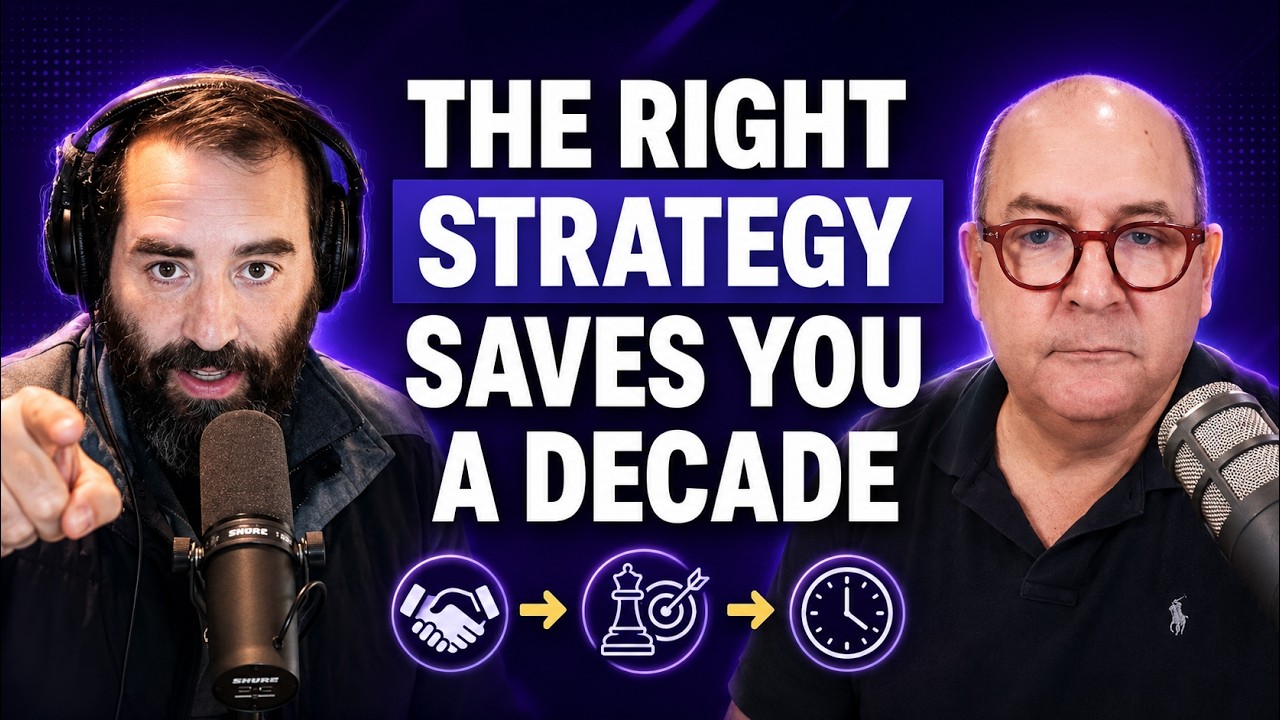
Joe Apfelbaum built Ajax Union to 1,100 clients by treating LinkedIn as a networking event, not a cold-calling platform. Introductions convert at 80% versus 3% for cold calls because they borrow the introducer's trust. His "Evergreen Networking System" focuses on building relationships with active networkers who can unlock warm intros to decision-makers.
Chapters
3% of cold calls get you on the phone with people, but 80% of introductions turn into meetings. I would rather get an introduction any day of the night than to try to do a cold call to try to get in the door, because as soon as I come in, I already borrowed the trust of the person that made the intro to me.
Well, my friends, we're here talking about leads. We're talking about leads. We're talking about LinkedIn. We're talking about prospecting. We're talking about doing this smartly in the year 2026 and beyond. And I could not have a more appropriate guest, Mr. Joe Apfelbaum. Welcome to the show.
Thank you for having me on the show. I'm excited to be here. I'm excited to do it.
Well, thank you. Yes, do it with the trademarked exclamation point. That's what we're here to do. Before we get into all of that, though, for the few people who do not know the Joe Apfelbaum story, could you please share with us a little bit about your professional journey that brought you to the work that you're doing today and some fun pit stops along the way?
They say if you build it, they will come. I built it. Nobody came. I built many websites for people because when I was a teenager, I decided I'm going to start getting into building websites for people. My father wanted me to be a rabbi. I didn't really want to be a rabbi. So I just decided I'm gonna get into computers and I got into it. Um, and you know what? I built a lot of websites and I really enjoyed building them, but you know, it didn't end up getting me— it didn't end up getting my clients the traffic that they needed to be successful. And so I had to learn, I had to learn how to market. That's what I had to do. And marketing is a very powerful thing when you do it correctly. And so I had over 1,100 clients they became clients of Ajax Union. We were featured as one of the fastest growing companies in America, servicing many, many customers. People were loving what we were doing for them, and we were doing a really great job. You know, the, the— what I realized is at some point that I needed to start getting much bigger customers because I was limited to my growth and servicing a lot of small businesses. In our business, we have 3 core values. One of the core values is Uh, time is precious. You gotta save time when you're doing things still. But at the same time, the second core value is be authentic.
Yeah.
Which means that you wanna be authentic whenever you're doing networking and relationship building. You don't wanna have a robot do everything for you. There are certain things that you hire an assistant to do, and there are certain things that you would not hire an assistant to do, even if it was a human assistant.
Yeah.
So a robot is just a replacement for a human assistant. It's not there to replace you. It's there to help you. So I'll give you an example. One of the things that I use my robot for is I have it research people for me. So you've seen me do this. I push a button and all of a sudden the robot goes off on the internet and tells me what you do, who your target market is, what your message is, how you help clients. It gives me conversation starters. It tells me all your notable achievements. It tells me the business opportunities that we can do together. That's a really nice thing to have front and center when I'm having an authentic conversation with somebody. I would say the majority of your target market, if you're targeting the Inc. 500 or Fortune 500 companies, the majority of them are going to be muggles. That's the reality of it. The majority of them are not going to be engaged on LinkedIn. As a matter of fact, the majority of LinkedIn users are muggles.
Yeah.
The majority of the people on LinkedIn, 60% of LinkedIn users have never really posted anything on LinkedIn and they're not really active. A very few percentage of people are actually posting on LinkedIn and engaging on LinkedIn. But if you can find, let's say, 100, 200, 300 people that work with your target market, these are networkers, they work with your target market currently, and those people are very active on LinkedIn. They're the wizards.
Yes.
And they're networkers. And if you can find those people and build a relationship with them, they're going to introduce you to the people that have a LinkedIn account but are not active on LinkedIn. And that's the fastest way to get a meeting with those people anyway. If I hit you up directly on LinkedIn, you're not gonna wanna talk to me. But if you come introduced to me by one of your friends, you're gonna, 80% of the time, you're gonna get on the phone with me because you don't wanna look like a jackass when someone makes an intro, you're gonna get on the phone just because I told you to get on the phone with them. It's just not nice if you don't.
Right.
And you don't wanna be the person that's not nice. And so that's the approach anyway. I look at LinkedIn as a 24/7 networking event. I don't look at it as a prospecting platform, although a lot of people look at— they don't understand the value of networking. And that's why we call it the Evergreen Networking System, where we teach people how to network and build relationships. So for example, let's say you're talking to the CEO of a $100 million business called Acme Incorporated. I made up the name. Okay.
Sure.
So I reached out, I'm trying to reach out to the CEO. I see he's not active on LinkedIn. He's not posting. He's not engaging. He has an account and he has 700 people he's connected to. By the way, the average CEO has 930 connections on LinkedIn. But let's say this person's below average. They have 700 people. And I see that we have 3 mutual connections, Alice, Sam, and Dave. I contact Alice, Sam, and David, and I say, Alice, Sam, and David, each one individually, obviously. I say, how well do you know this guy from Acme Inc.? And 2 of them say they don't really know him well. They just connected to him a while ago. And one of them—
Wow.
David, he says, what do you mean? He's literally my, my father-in-law. Or he's my, my brother or whatever. And then I said, do you mind making a warm intro between me and him via email? And then Dave was like, of course, I'm happy to do it. What do you want me to say? I tell him what to say. He makes the warm intro. Now I'm on this phone with the CEO of this $100 million business that no one else has access to because I use the unlock, which is the mutual connections on LinkedIn to get in the door. And it's my preference that he's not active on LinkedIn because once I'm in the door with him, I don't want anyone else to get in the door.
Right.
The biggest problem that people face is that they don't have a strategy. I always say the right strategy will save you a decade. Not knowing who your target market is, not knowing who your target market is means you lack a very important part of your strategy. So my 3-step process for creating a strategy is the 3 Ps: the plan, the people, and the promise.
Now, the centers of influence, I go back and forth on this, and I think our audience has gone back and forth on this. They say, okay, it could be a trusted advisor, it could be a consultant, maybe it's their accountant, maybe it's their financial planner. All of these people who are in these professions that are the typical centers of influence, after 40 years of terrible networking where people have tried to take advantage, they've tried to barge in, they've tried to steal their clients, whatever they've done, These poor people that have these trusted advisor relationships, I think they're burned out, they're jaded, and they're scared. So now we come across, even doing our amazing research with every AI and having all of this, you know, coming in very smart, very, very sophisticated in our profiling. What's going to get these trusted advisors to open up to us where they've been burned and screwed over before?
I would say the number one thing that's going to get people to open up to you is the know, like, and trust factor. People don't care how much you know until they know how much you care. So you got to get people to know you, like you, and trust you. How do you get people to know you is by you sharing of yourself online. That's the number one factor that people will get to know you, that you'll know that you're different because they know your story and they know who you are. That's number one. Number 2, How do you get people to like you is they are like you, they will like you. So the more you share of yourself, the more they could identify similar stories to the problems that you had, the vulnerabilities that you have, and so on. And the third component, trust. When, when you get to know somebody else, they automatically trust you. That's just what happens. When, if, if I don't know anything about you, then you don't trust me so much. But when I start Doing AI research on you, and now I know every podcast you've been on. Suddenly you're like, this guy knows me.
Yeah.
So I feel like I need to trust him more because he knows me. We want to be known by people. Like, think about your whole life, you're trying to get known by your lovers, known by your friends, known by your clients, known by your prospects. So if I get the time, if I take the time to know you, then you'll trust me more, especially if you know how much I care about you.
For the people listening, that might be because, again, this might set off people's radar. I'm just channeling our listeners here. That's my job here at the show.
Channel away. As long as you're not channeling aliens, we're good.
No, no, we're not channeling aliens. We're not channeling evil spirits. People hear what we're talking about, Joe, and as smart as it is and as necessary as it is essential, they say, well, that sounds— that sounds a little bit manipulative. That sounds like we're just sort of, you know, putting out the honey trap and we're trying to snare people. I— the way I reframe this, I call this intentionally befriending the people that you want to be friends with. And you just said it a moment ago, you know, if people are married, right, how'd you find your spouse? How'd you close that deal? Just by randomly sitting around going, oh, I hope something happens? No. You wanted to intentionally befriend this person in a romantic way. How'd you get the job that you've had or your first job, right? Oh, I just sat around and I hoped some employer would come around. No, you intentionally befriended people that are in that company or that know that company. This concept of intentionally setting your sights on a genuine relationship that you want to enter with a value mindset, a giving mindset, a generosity mindset, a mutual benefit mindset, there's nothing skeevy or schemey or weird about intentionally befriending people that you know you can help and similarly that you know might be able to help you. So all that mindset around, boy, this whole intentionality and zeroing in and targeting, it feels kind of skeevy. It's like, this is how humans have been doing it for 3,000 years.
And here's the other thing I want to add to that. I think you're right. Humans have been doing this intentionally, connecting and building relationships. I think when people hear that you have a strategy to build a relationship and it doesn't sound organic, they don't feel like that is a friendship. They feel like it's more of a game or like a sport. And that's kind of like, that makes them feel uncomfortable with, with them making friends as a game or a sport. But realize networking and life is a game. Life is a game, and you can decide to be strategic and make friends strategically, or you can wait for friends to come to you. That's your choice. If you believe that making friends strategically is unethical or manipulative, or you're uncomfortable with it, I would tell you to reinspect your beliefs that are disempowering Because something bad happened to you in your life that you took as bad, and that's controlling your ability to strategically build relationships, and it's stopping you from you being able to meet your potential. And right away, you might have pushback to that because most people will be like, well, nothing bad happened to me. I was like, let me tell you something. If you're a human, you have trauma. Some people have trauma 'cause they had too much money. Some people have trauma 'cause they had too little money. Some people have trauma 'cause they didn't have trauma, so they have a trauma about not having trauma. Everybody has trauma, and that's how we grow. A butterfly doesn't just become a butterfly. It has to suffer through the cocoon. Otherwise it has crooked wings. And so what I would tell you to do is just look through your beliefs and ask yourself, is this an empowering belief? Because it's just a belief. Beliefs are neutral, just like nature is neutral. The wind blows on everything. It doesn't just blow on you. The wind literally blows on everything. And so if you're taking it personal, If you're saying, oh, I don't like this, it's not that you don't like this, it's that you have a belief that this is manipulative because somebody hurt you in some way so that you think that this is the same as that. But it's not true. This is just a way for you to get where you're going. And often because of my outreach, because of my befriending, because of my strategy, people will thank me to the endless of the world saying, oh my God, thank you for befriending me. I would've never reached out to you 'cause I have my trauma. And the fact that you overcame yours to be able to be open enough to connect with people and be a conduit of blessing, and that's what I wanna be. I believe that the right strategy will save you a decade, and most people are using energy without strategy. So if you could take one thing today, is inspect your strategy for the upcoming year. Make sure that you work with someone to help you craft a strategy that will help you be able to meet your goals faster, more productively, and more profitably. If you would like a demo of Evy AI, you could simply send the word demo to 973-841-8868. That's 973-841-8868, and an AI will respond with a demo. And if you'd like to meet with me, you could always let me know through that number that you want to meet, or you could always email hello@evyai.com, and my team will be more than happy to help you out and get you up and running and support you. We love helping people and love making a difference for people. And of course, if you want to check my LinkedIn, you can go to joelinkedin.com. That's joelinkedin.com. It forwards to my LinkedIn. It's really easy for podcasts. It's one of my 99 LinkedIn hacks. I have 99 hacks and a pitch ain't one of them. And so if you go to 99hacks.club, you can join the 99 Hacks Club. We actually have a discount right now for all the listeners here. To get $900 off the 99 Hacks. It's usually $1,000, but you can get it for $99 if you go to— if you go to 99hacks.club. But I just want you to take away the concept of strategy, because if you do things methodically, if you do things strategically, you're going to get where you want to go and make your impact much faster. So Stephen Covey talks about this in The 7 Habits of Highly Effective People. At the end, he says you got to sharpen the saw, because if you have 8 hours to cut down a tree, You can spend all 8 hours with a dull saw. You can spend 15 minutes sharpening the saw. So spend some time being strategic and you're going to be able to have a bigger impact.
Totally amazing.
Wanna make networking easier and more effective? Try Evvy AI, your AI-powered sidekick that helps you connect, engage, and grow your network faster than ever. Click the link and start building smarter relationships today.
More from Joe


How to Beat the Algorithm: Remove Hidden Watermarks & Scale Content with evyAI









AEO & GEO: SEO's Future Explained! Master Answer & Generative Engines! #shorts