
Episode 13 - Lisa Padden on UDL, diversity & inclusion - Plus One podcast
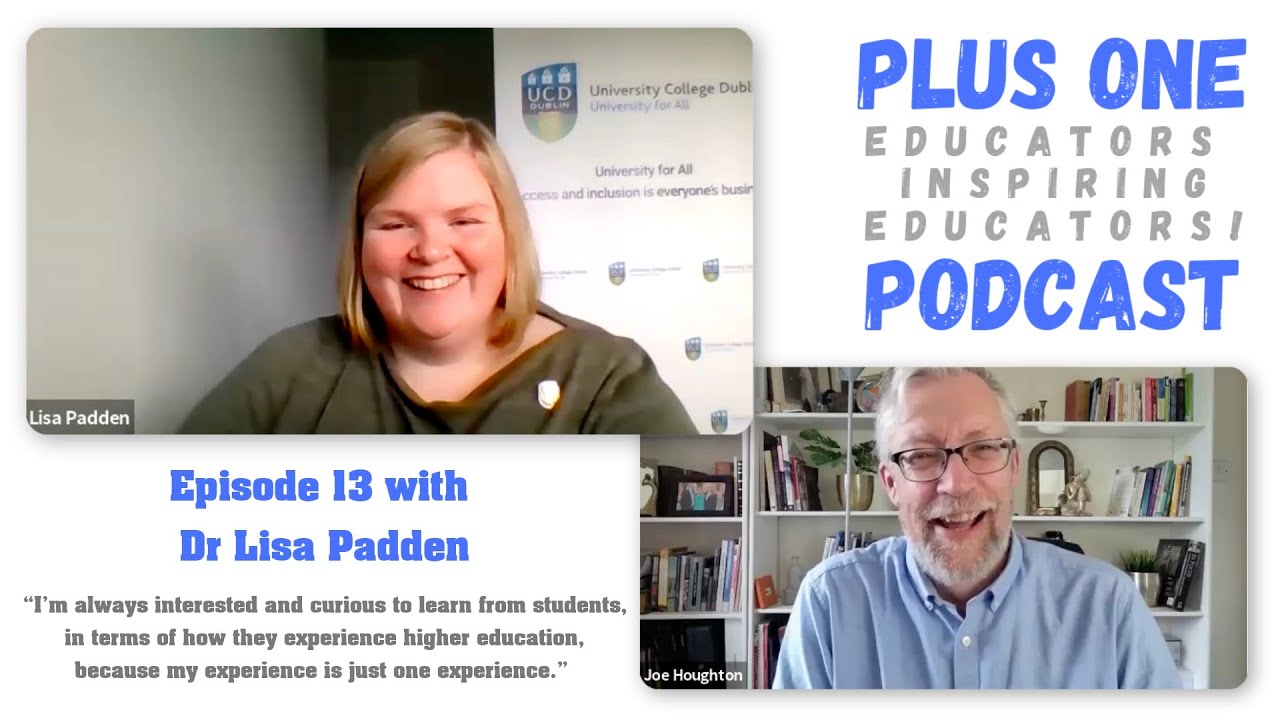
In this hour‑long Plus One Podcast episode, host Joe Houghton interviews Dr Lisa Padden, Project Lead University for All at University College Dublin (UCD). The conversation weaves together Padden’s personal background as a first‑generation student, her academic trajectory (English, Psychology, a medieval liturgy PhD), and her professional focus on inclusion and diversity in higher education. Padden recounts how early experiences in a supportive secondary school sparked her commitment to access, and how her family’s dyslexia shaped her sensitivity to learning differences. She describes the development and national rollout of Universal Design for Learning (UDL) in Ireland, beginning with AHEAD’s 2018 initiative, the creation of a 20‑25‑hour digital badge and facilitator pack, and the subsequent expansion to a 2,000‑person national programme. The dialogue explores practical UDL implementation: embedding multiple means of engagement, offering choice of assessment, and designing resources such as videos and rubrics. Padden critiques traditional timed exams, advocates authentic, diverse assessment formats, and highlights the need for staff CPD, including the National Forum’s open courses and the free Toolkit for Inclusive Higher Education. The episode ends with concrete calls to action – using the toolkit, accessing open courses, and joining the UDL facilitator community – providing listeners with actionable resources to advance inclusive practice in their own institutions.
Chapters
Hi, my name is Joe Houghton and this is the Plus One Podcast. Today I'm thrilled to be joined by Dr. Lisa Padden, who is a colleague of mine at University College Dublin in Ireland, although we work on different campuses. Although it's a long time since I've seen the campus, I don't know about you, Lisa, but—
Yeah, it's been nearly a year.
Indeed. On LinkedIn, Lisa describes herself as Project Lead University for All at UCD, and further down she describes herself as an inclusion and diversity professional working in the higher education sector with students, university leaders, staff and faculty, and in the sector to implement systemic change processes for access, inclusion, diversity, and widening participation. Lisa has degrees covering English, psychology, literature, and publishing, so drawing on a kind of wide educational diversity of skills. And I mean, certainly when I first became aware of Lisa and have started, you know, having the chance to do a little bit of work with Lisa, has been a champion of UDL, Universal Design for Learning, for a good number of years now. as well as the diversity and inclusion. So we'll touch on both of those over the next hour or so. Lisa helped set up the highly successful UDL national programme in Ireland working with AHEAD.ie. I think that was 2018, wasn't it, Lisa, when you set that up?
Yes.
And the rollout last year in 2020, which I took part in as a student for the digital badge, Incorporated, I think, more than 600 people. She's not one to sit on her laurels, is Lisa? So, this year, Lisa's heading up, certainly in UCD, the kind of rollout to most of UCD. We've got a big push in UCD to get all the staff up to date on UDL. I'll be working as the facilitator on that program. So, I'm really looking forward to being part of, you know, this next rollout. And only 2 weeks ago, you gained a Professional Diploma in Leadership and Management. So you really walk the walk when it comes to continuous professional development. Amazing. So your 2-word description, you chose inclusive and curious. So let's start with that. Let's start with inclusive and curious. So in particular, why inclusive? What's so important about inclusivity for you, Lis?
Wow, that's a big question. I think, I suppose, for me, access and inclusion has been a big part of my educational journey from the beginning. So I know—
And that was my next question, so those two might riff into each other. Yeah, yeah.
So I'm a first-generation college student, so I'm one of 5 siblings. So neither of my parents went to college. My dad finished primary school and that was it. And my mother had to leave school when she was 15 because she got pregnant with my brothers who were twins. So I suppose inclusion is really important to me in terms of acknowledging the barriers that people face to education. I mean, my mother in particular always wanted to go to higher education. She was passionate about education. And for me, as I grew up, I didn't see the barriers, I guess, that were there because my mother was so, like, such an advocate for inclusion and education and making sure, like, there was never a question I was always going to university. university, there was no doubt about it. Even though we lived 3 and a half hours from the closest university, there was never any question that that's where I'd be going. And I have to say, in my secondary school as well, there was no doubt. I mean, we have the— actually, the progression rate to higher education from the school where I went in Ballymullet in County Mayo, which is a tiny, tiny place, is almost 100%. So there's— they do a lot of work and they work really hard to make sure that people get the opportunities and take those opportunities. So, and I'm really proud of that. in terms of my own background. So I suppose when it comes to inclusion, I describe myself as inclusive because it's really the entire bedrock of my work is around inclusion and removing barriers for students. And I'm always interested and curious to learn from students as well in terms of how they experience higher education, because my experience is just one experience. And I think one of the big lessons for me when I moved to work in UCD from NUIG where I was previously was the difference in rural and urban disadvantage. So that's just one of the lessons I learned in terms of, you know, I thought I knew what educational disadvantage meant in terms of financial disadvantage and people being distant from higher education, but really I didn't have a clue because when I came to UCD, I met students who were from areas of very concentrated urban disadvantage where there was absolutely no expectation that they would ever go to university. And not only no expectation they would go to university, but also a real judgment of them for having been brave enough to take that step and come to university, which wasn't something that I had experienced previously. So I think I'm always looking to learn from students and understand how they experience education, how they experience the barriers that are there, but still meet students who are overcoming so many barriers, not even aware of those barriers because of the huge amount of support that they get from their families, from their university, and it always brings me back to to my own experience in terms of there never being any question that I was going to come to university because I had that fantastic support.
Wow, and that's a really interesting kind of observation about Bell Mullet. So was it the school and was it the staff and stuff that made that, you know, a reality? Did they all push all the students to kind of excel and to go on and whatever? How did that happen? What was the reality of that? Because that's lovely, isn't it?
It was lovely, and it's— I suppose I probably wasn't even aware of it at the time, but looking back, I can see that all of the teachers pushed everybody to get the absolute maximum out of them in terms of their potential. Nobody was allowed to rest on their laurels. It was, you know, if you got a B, well, why didn't you get an A? You know, you could have done this, you could have done that. You know, you should work harder, you need to spend more time. And the teachers really did invest in us so much. So I went to a Convent of Mercy and there was another school next door and I think there was a good healthy competition as well and that always helps. Like, there are only 2 secondary schools in Ballymalish, so one of them was a convent and one of them wasn't.
Right.
So I think, yeah, the sense of competition and the sense of self in terms of who the teachers told us we were in terms of students and what we could achieve. And I remember every time my mother would come home from a parent-teacher meeting and tell me, well, they said you're doing great but you could do better, So you need to spend more time studying, more time on this subject or that subject. So for me, sciences, for example, I really didn't like science, but I took my lab science for my Leaving Cert because I knew, because of the, the really good guidance that we've gotten, if I didn't, then I was already putting barriers in place for myself. So if I didn't take a lab science, there'd be some courses I wouldn't be able to take in university. So I had really good quality guidance when I was in school, but again, there's loads of students who don't have that. So they already, when they get to 5th year in secondary school, there's already barriers there for them. There's already courses they can't take, they're not doing enough higher-level subjects so they can't matriculate to university, they're not doing a language, they're not doing a lab science, and you have to say to those students, okay, so there are other pathways for you. So you can come in through a further education pathway, you can do a different type of course, you can go to a different college. But, you know, they shouldn't— there shouldn't be those barriers at that stage of somebody's education.
Right. And I mean, when you did finish school and went to the first college, I can't— I'm not sure where that was. NUIG. Yeah, NUIG was it. Yeah, so your undergrad was psychology and something else, wasn't it? So again, you could— all those doors were open to you.
Yeah, psychology and English. So I came in as an arts student. I loved university, I have to say. I loved NUIG. My happy place is absolutely in the library in NUIG. I can smell it.
Yeah.
I just loved it. I loved to just sit there all day and read and study, and really I thrived at university. I felt like I had found, you know, my place. So I did English and Psychology. I had always liked English at school, but I had certainly challenged my teacher, and I had the same English teacher for 6 years in secondary school, and I made it my business to basically disagree with everything that she said and have different opinions on the texts. And yeah, I think I was probably a bit of a challenge, but I went on to do it in university and loved it. And, you know, we were encouraged then to have different opinions and things like that, which was great. But yeah, the psychology on the other side, and it was interesting doing a 2-subject degree where the 2 subjects are so completely different.
Yeah.
And even the way they were assessed was completely different. So it's interesting, you know, I can look back now and go, okay, so in English we did a lot of essays, as you can imagine. I avoided doing presentations at all costs, so I would look at the modules and go, well, there's a presentation, I'm not doing that, I'm going to do something completely different. But I still ended up having to do some presentations, and it's interesting now because I basically present all day long every day.
Yeah, I mean, you're just a natural now, aren't you, in front of the camera or kind of in front of a class?
Yeah.
Yeah, no choice, I guess. But then in psychology, it was very much exams, MCQs, learning off things and regurgitating it back in the exam. Nothing against the psychology department at NUIG, but it was very much just a completely different assessment strategy. And actually, towards the end of my degree in my master's, I had no exams at all, which was fantastic. So it was all continuous assessment, and to see the benefit of that was I mean, it was just very clear that it wasn't appropriate to give an exam to a literature and publishing student. Why would you examine somebody in literature? Doesn't make any sense at all. And I have to say, obviously I loved the English department there because then I stayed on and did my PhD with them and taught with them for a number of years, and still in touch with lots of the staff from there as well, which is great.
Yeah, so you kind of stuck with the English strand through, through the master's and the PhD, but the publishing is interesting, isn't it? Because that's quite a practical bent. And then what did you end up doing the PhD on? It was some kind of medieval thing, wasn't it?
Medieval liturgy. So I always out myself actually as having quite an irrelevant PhD to what I do now. I definitely learned a lot during it. Yeah, so I did my PhD on the Book of Margery Kempe. So some of these— some say it's the first autobiography written in English, so it's in Middle English obviously, but I looked at a lot of areas around you know, the portrayal of women and women's bodies, and I suppose in some ways the equity or inclusion or otherwise of women in the church at that time, and, you know, public perceptions of Marjorie Kemp. So no, it was really, I have to say, my PhD experience taught me a massive amount about resilience and, you know, working. I worked 9 to 5 on my PhD, I refused to work weekends or evenings, which is the best decision I ever made, and I finished in 4 years. and I had a pretty full teaching load as well. But I think seeing some of my other colleagues— and I was very lucky when I started my PhD, I started with 9 others, so 10 of us started in the English department at the same time. It was just before the crash, so we were all funded, we all got teaching fellowships, so that was my first foray into teaching. But to see others who, you know, burned the candles at both ends is what I'll say, in terms of their research process and how difficult that was and unfortunately not all 10 of us finished, but again, we're all in touch as well. But the PhD taught me a lot about resilience and a lot about teaching and learning and the process. So while I was in NUIG, I worked a lot with the department. I would have done a lot of work with Dervla Mooney, who was the administrator, and she's still the administrator, and she absolutely was a fantastic colleague. So she would have made me aware of different jobs that were available. So I was— I got the SUSI grant all the way through college, including my PhD, so never paid any fees, which was great.
Amazing.
And I had a bursary as well. So without that financial support, there's absolutely no way I would have done a PhD, which is important to say. So I went straight through from undergrad to master's to PhD because that was the easiest way to keep my grant. but because my dad is a farmer, we got evaluated every single year, so it was not an easy process. But I would have done a lot of work with the department to kind of add to my finances and to fund myself as I went through, along with the bursary. But I worked with a lot of the lecturers, so I would have done assistant examining with them. I would have worked with a couple of them around teaching them how to use Excel, so when it came to using Gradebook, so they could figure out how to actually input the marks with the formula to get the grade at the end. And I said that was my first— the first time I taught somebody who was much more senior to me.
Yes.
Yeah, so I mean, that in itself I think was a great experience, and I have to say taught me a lot about how to approach the teaching and learning process with different types of learners. And I taught undergraduates, so I taught first years primarily, so we had a really large first-year module which was a brilliant module. It was year-long, so not just one semester, and gave all students the grounding that they needed to be a good student in English. So I've absolutely— I brought loads of those skills with me into UCD. So we covered things like presentations and essay writing and critical thinking and analysis and all of those core academic skills that every single student should have. And the fact that we were able to teach it across a full year meant we were able to develop really good relationships with the students, and we had a great team of teachers assistant, so we had relatively small groups of students as well. But I also taught on the evening degree in English, so I had— I did 3-hour lectures every Tuesday evening, I think it was, on the history of English literature. So I brought the students all the way through from the Middle Ages to current literature. So that was again a big challenge. So I had no materials, to use, so I had to design everything from scratch. And just like every other teaching experience, I found out about it a couple of weeks before it actually started.
As it always— yeah, that always happens, doesn't it?
Yeah, that's it. So, so that was a great experience in terms of looking at, well, how am I going to make this engaging? Because I'm definitely not going to talk for 3 hours at these students who've been at work all day and are now coming into university. Actually, it was such an interesting group. There were a number of GPs in it who had decided to do this English degree together. So they were interesting as an audience, and like, I was 23 at the time.
And you're teaching GPs English, English literature. Oh my goodness, this is real diverse stuff, isn't it?
Yeah, yeah, absolutely. It was such, such an interesting course, but, and so exhausting. I mean, so exhausting. 6 till 9, um, at night it was, and it was the autumn, uh, semester as well, so it was dark.
Oh yeah, but I suppose at least they wanted to be there.
Yeah, absolutely. But trying to keep them engaged and everything, so, you know, designing exercises around the different types of literature, the different eras, looking at historical context in different ways. So that was a great experience. It was a massive challenge, but I learned a huge amount from it. So that teaching, and then I also taught seminars. So I taught Shakespearean comedy for a few years, which was great, and it was an interesting seminar because it was a mix of students who were absolutely passionate about Shakespeare and wanted to learn about Shakespeare Shakespearean comedy, and students who had missed the deadline to sign up for a module, maybe weren't as motivated as their colleagues. And lots of international students as well, so lots of students who have come from the US used to take those seminars. So I mean, that was an interesting experience teaching a group with really different motivational levels and engagement, and I definitely learned a lot from that as well. I learned a lot about Shakespearean comedy. which again I didn't really know that much about until I taught the modules.
But it's very rich, isn't it? Yeah, it's a wonderful kind of area. Wow, you just threw yourself into the whole education space, didn't you? Right from— was that— did you always know? When did it click that this was going to be your thing? That education, rather than perhaps English specifically, was going to be your your happy place, or is that just still an evolving story, I suppose, isn't it?
Oh no, I think I've left the medieval literature behind now. I can say that with confidence. I think about probably about 2 years into my PhD, I realized that I was far more passionate about the teaching and learning than I was about the medieval literature side of what I was doing. That along with the the stark reality that there weren't very many jobs in terms of lecturing medieval literature. They were actually reducing because students just weren't interested in medieval literature. So you'd always have some students who are really, really interested in it and really passionate about it, but most students wanted to avoid it. I mean, they hated Chaucer, they didn't want to do anything, they thought everything— they thought Middle English was Old English and that they shouldn't have to read it. So I knew the writing was on the wall, really, that that wasn't going to be— I good place to go. But I did a great module with CELT in NUIG, so that's the Centre for Learning and Teaching down in NUIG, on small group teaching, which really sparked my interest again in terms of the educational side of things and the diversity of the students that I was teaching. So I would have taught a lot of students with dyslexia.
Okay.
Which I was always really interested in because my dad and both of my brothers have quite severe dyslexia. So both my brothers would have had— they used tape recorders for their Leaving Cert exams, things like that. So those kind of what I would see now as very archaic reasonable accommodations that really are not great.
And for those— for somebody in the audience who's heard the word but doesn't know what dyslexia is, just tell everybody kind of what dyslexia encompasses from a learner's perspective.
Sure, so dyslexia is just one of the specific learning difficulties, and essentially a student with dyslexia One student with dyslexia is not exactly the same as another student with dyslexia.
It's a spectrum, kind of, isn't it?
Yeah, so some of the common difficulties that students might have would be around reading speed and reading comprehension, certainly around written composition. So you might find a student with dyslexia is really good verbally, but actually when it comes to writing an essay, they just can't get their thoughts down on paper in a very organized way. So it's very much— we call it a print disability because it's around reading and writing, and also things like left and right right. So you might have a student who doesn't automatically know the difference between left and right, like I don't. So I have— there are certain aspects where I can see that I have dyslexic-like tendencies, which is also a reason that I was very interested in it, especially as I ended up doing a PhD in English. But yeah, I had a lot of students with dyslexia who would have been absolutely fantastic in class, did brilliant presentations, and then it came to their essays and there just was a big disconnect between the student I saw in front of me and what they had written down on paper. So I mean, I was very privileged. I was able to spend the time and work with students individually to get them to a point where they were able to express themselves on paper in a way that I suppose was much more effective than they had done previously. And again, I suppose that's a testament to that module that we taught for those first-year students that was year-long, being able to develop a very trusting relationship with the student. And quite often it was mature students, So students who had left school and then returned later to higher education, and we see that a lot. We see it in UCD as well, that students get a late diagnosis of dyslexia, and the reason that they didn't continue on into higher education was because they had a really negative experience at school, that maybe a student was told they were lazy, that they weren't working hard enough, but actually it was the fact that they had dyslexia and it wasn't diagnosed and they didn't get any support.
Yeah.
So that's quite common. So So yeah, I suppose the realization that I really did love the teaching aspect, I loved the students, and that where I wanted to be was education rather than the Middle Ages.
Yeah, yeah, wow. One thing that struck me over the last few years as I've started to become aware of teaching and learning as a an area, and particularly, you know, the diversity and the UDL stuff over the last couple of years perhaps. If you go and be a— if you want to go and be a teacher in a secondary school or in a primary school, you've got to go and do an HDIP, and they don't let you in, do they? And you've got to sign up with the teaching council, and you've got to be registered and all the rest of it. But to teach at university, you just got to get a master's and then you're in, you know, if you can get on a course to teach it and whatever. And I mean, you know, I did the diploma in university teaching and learning with Dave Jennings up at the centre there, I think 2015, 2016, and I put myself on that because I realised I've been here 10 years and I've never learned how to teach.
Yeah.
And the more I get into the T&L stuff, and, you know, even just now you're just talking through Dyslexia. I've never done a seminar on dyslexia or dyspraxia or any of the learning challenges, if you like. But that's awful, isn't it? That I'm 15 years into a teaching career, if you like, and I've never actually sat through anybody saying, well, to teach people with these challenges, here's accommodations you should make, or here's ways that you could assess them differently, or whatever. And that's one of the reasons I'm doing this podcast, because I keep getting exposed to all this amazing stuff, and it's kind of pointing out the holes in my practice. And maybe it's pointing out holes in other people's practice as well, that then now we're aware of them, we can go and fill them. Yeah, but that's where you are. You're a hole filler, aren't you? You can—
That's a beautiful description.
So, I mean, you're not unusual in that you have never done any training around supports for students with disabilities or learning difficulties. One of the first things I did when I came to work in UCD, I worked with Julie Tong, who's a disability officer, and we developed training sessions around disability awareness So we teamed up with HR Learning and Development and we offered lots of sessions that way, which was great. I will say that it was far more support and professional staff who attended those sessions rather than faculty or academic staff.
So, you know, I think most people haven't been exposed to actually, you know, have to think about how do I adjust my teaching to make sure that I'm including students with dyslexia, students with ADHD, students with dyspraxia. I think those sorts of invisible disabilities that lots of our students have, so there are lots of barriers there for those students, but actually, you know, they're not necessarily getting a huge amount of support in the classroom. They might get their extra time for an exam, but I mean, that is just trying to plug a massive gap with something very, very small.
Mm-hmm.
It's not going to make up for the 12 weeks of the learning experience that the student has had if they haven't felt they were included in the classroom. And I think really that's where universal design for learning comes in. So if you're, you know, embedding Universal Design for Learning in your teaching and your assessment, then you don't necessarily need to know about every single challenge that a student has, whether it's dyslexia or ADHD or the fact that they have caring commitments outside of college or that they're working nearly full-time hours, whatever it might be, that actually your universally designed program accommodates that student because you've built in multiple means of engagement, there are choices of assessment, You're very open in your communication, students will come and talk to you, so if you've got all of that nailed, then you don't necessarily have to know about every student's individual circumstance. So I think that's where we're coming in, as you said, really pushing Universal Design for Learning and trying to get as many of our colleagues trained as possible, and for the next national rollout, we're hoping to have 2,000 participants on the course.
Wow.
No. But I mean, you've built the infrastructure, haven't you? And I mean, so that was a lovely segue into UDL. So take us back to 2018, and then bring us through the UDL journey, you know, in terms of, you know, your engagement with CAST and then ahead.ie and designing that program, and then the huge expansion in 2020, and then, and now into UCEDD. Take us through that journey. For someone who hasn't come to the podcast previously or whatever, what's all this UDL stuff anyway? I mean, why does it matter?
So I suppose it all started really with AHEAD and AHEAD's passion for UDL. And they— so when I started in UCD in 2012, one of the first conferences I went to was the AHEAD conference, and it was all around Universal Design for Learning. And I had never heard of Universal Design for Learning before. So, AHEAD did a huge amount of work in terms of building awareness of UDL and what it is and how important it is. And obviously, AHEAD are coming from the disability perspective because they're the Association for Higher Education Disability. So, for them, it was really about how do we get our academic colleagues on board with UDL? Because so much work had happened in the previous 10 years around disability services and reasonable accommodations and making sure that supports were there for students when they came to college and that there was consistency across the entire country in terms of, if I come to UCD, I'm going to get the same supports as I got when I went to NUIG, so all I need to worry about is which course I'm doing, not who's going to actually support me, because everybody's going to support me. But it was very clear that the gap was in the classroom, and there was— there's very little that the disability service could do about a module that was just taught in trying to phrase this delicately in a way that maybe— Don't be delicate.
The kind of sage on stage, death by PowerPoint type delivery. Exactly.
I mean, maybe sometimes not even PowerPoint, maybe just somebody standing at a podium talking for 50 minutes and then leaving with absolutely no materials provided, and then one exam at the end. I mean, that's the ultimate nightmare module. for any student, I think, to be honest.
Yeah.
I'm not sure that there's any students that that didactic type of teaching and assessment actually suits. So that's where the, I suppose, UDL came from. And then in 2017, the National Forum put out a call where they were developing, or had wanted to develop, a series or constellation of digital badges for CPD for all those who teach. In higher and further education. And one of the categories that we put forward was around Universal Design for Learning. And I should say it was actually Áine Galvin in Teaching and Learning in UCD who sent me on that call when the National Forum sent it out. So ultimately I have Áine to thank for everything around the UDL Digital Badge. So I put in an expression of interest, as did a head, and then we ended up working together then on the actual development of the digital badge, and it was definitely a collaborative process with the National Forum. You know, they brought in everybody who had put in that expression of interest, and we worked together around, you know, what should this actually look like, you know, the entire process around the digital badge. We had a lot of freedom when it came to the design and development of the materials, so the National Forum kind of said, you know, whatever you think will work. for your badge. They gave us some criteria that, you know, it should be around 20 to 25 hours of learner effort and that there should be a way for you to verify the badge. So people will need to, you know, submit something or verify— you'll have to be able to verify in some way before the badge is awarded. And from the very beginning, they said, along with your badge materials, you also need a facilitator pack. So the idea ultimately with these badges is that somebody in another institution in Ireland can pick up the facilitator pack and roll out the badge in their own context. So that was the idea from the beginning with the National Forum. They really wanted this to have a high impact, but something that wasn't, you know, an entire module, an entire 5 credits, something that people could do in a very self-paced type of way.
So that design for osmotic kind of like growth is fundamental to it, isn't it? You do another, what, 5 hours, I think, of reflection effectively to get the facilitator badge on top of the digital badge. But that wasn't a kind of like a big ask. It was just like, it was another couple of steps. And it just built on everything that you'd done in the digital badge in a very It wasn't a bolt-on, it was just a natural extension.
Yeah, exactly. It's, it's like, well, you've learned about UDL now and you've embedded in your practice. How can we get everybody else to do that in your institution as well? So, you know, who are your partners going to be if you're going to roll this out? Getting you to think about what are some of the challenges that you might face and how will you overcome those challenges. It's a really practical exercise, and I think that probably sums up everything about the badge is that we tried to keep it all very practical, that, you know, people could actually implement UDL in a really practical way. There was a lot of material, and I suppose when we sat down to develop the materials initially, we knew that there was a lot of material around why UDL was a good idea and a lot of theory.
Yes.
Here's why you should do it, but there wasn't a lot of here's how you do it. Here's how you take a module and actually embed UDL. And I think to some extent that's still the case in some, in some places that you hear a lot. A lot of the sessions are on here's why it's a good idea, rather than—
But you use video very, very effectively in the module, for instance. So part of your creation process was going and recording the videos with the different talking heads who, you know, the educators who shared their experience of doing it, which was, for me, that was one of the most powerful pieces of the whole thing. It was amazing how, you know, that you just got it.
Well, they didn't exist in the first iteration of the badge. That's what I should say. So for the first year, we didn't have those videos, but that was very much something that we wanted to do. So after the first year, we— the forum actually, I think, gave us some additional funding and we were able to enhance the badge further, and we did that through those videos, through going out to actual practitioners in Irish higher and further education. So in UCD, for example, we have videos with Dr. Geraldine O'Neill talking about choice of assessment, which is brilliant, and they really enhanced it. And it's great to hear that they did what we wanted them to do in terms of actually engaging participants and you being able to see how you actually embed UDL in your practice on a day-to-day basis.
Yeah, yeah. I mean, and talking about kind of different ways of representation, both from a teaching perspective but also from a learner's perspective in terms of assessed work and putting work back, how are you seeing that change? You know, I mean, it used to be we did exams and we'd sit down in a big drafty hall and we'd write for 3 hours on a you know, piece of paper, you know, little booklet and stuff. Some people still use that stuff, but there are other ways of doing things, are there not? And are our students today equipped, trained, capable of doing anything other than writing on a piece of paper?
Yeah, I mean, the whole assessment piece really, I think, is where we can make the biggest impact. Like, we know students are so busy. The first thing a student does when they go into a module is go, okay, how am I going to be assessed? They want to know straight away because there's so many demands on their time. And this is, I mean, in terms of our academic skills, this is what we teach students as well. I mean, I would have given students a template that they could use for their assessment schedule, and I'd say, go away and figure out how you're going to get assessed, what percentage it's worth, and then you figure out how much time you should spend on it. Because we knew students were doing things like spending weeks on something that was worth 5%. So you need them to actually pull that way back. But, you know, there's a lot of people still relying on that traditional exam method, and we hear quite frequently, you know, if it's a really large module, people really feel that an exam is the most efficient way, or sometimes they feel it's the only way for them to be able to examine or assess such a large group of students. But I mean, the dreaded exam booklet— I can still remember piles and piles of exam booklets because I was a I was the assistant examiner for, I would think, probably most of the lecturers in the English department at NUIG at one point or other. I spent my Christmases grading, literally on Christmas Day.
I've been there, yeah.
Such a torture. I was so happy that when I left NUIG, I've never had to grade another exam since, and I hope I never have to grade another exam again. It was really the worst part of teaching. And I see some of my friends as well, I mean, who are lecturing, and when it gets into that grading period that they just really struggle to do anything other than grade and grade and grade. So I think we have to eliminate exams. And I think if COVID's taught us anything, we can eliminate exams. It's entirely possible when you're forced to do it. Then there's no reason to have 2,500 students in a drafty event hall 3 times a day, 6 days a week. There's just no need. We don't have to do it, so why are we doing it? I mean, if you want to be really cynical about it, why would we pay an event hall for 2 weeks to do those exams? Surely we could use that funding for something else. You know, and I've said this again and again, particularly over the past couple of months, I've been on a couple of panels where I've said again and again My post-COVID wish is that we never ever again go back to those mass timed exams. And I think we also need to be wary of people who want to switch the mass timed exams just for mass online timed exams.
Yes.
With the dreaded proctoring software.
Which is very iffy anyway, isn't it? But from everything I've—
That is putting it mildly. It is inherently discriminatory in its very existence. So absolutely, we shouldn't be looking at proctoring software. We shouldn't be looking at timed exams really in the vast majority of cases. The only exception to that that I would give would be things like very real-life exams for medicine students and vet medicine students and nursing students who do those very practical exams. That absolutely makes sense, or for language exams, you know, discussion exams, things like that.
Yes.
The only exam I've done anytime recently was an Irish Sign Language exam, which was the most stressful experience I think I've ever had. I did a fantastic module, it's an elective in UCD in Irish Sign Language, which completely went against any way that I've learned before because I couldn't take notes because I was watching the tutor all the time. So our tutor was deaf and she brought an interpreter to the first class and then never again, so we all signed all through class It was the only way we could.
From nothing?
From nothing, yeah.
Wow.
The exam at the end was a presentation through ISL, and then the tutor asked us questions, obviously through ISL as well, and we had to answer them, which was, as I said, completely stressful. Also on, I think, Wednesday evenings of an autumn term. So yeah, back to that kind of dark—
And was it all done online through Zoom as well, was it? You weren't in the room?
Thankfully, it was before Yeah, right. Because I think trying to do it online would have been even more difficult to try to stay focused because you just had to focus constantly for 2 hours. But I mean, it was a great experience. So exams like that, I think, you know, that's okay, that makes sense as an exam. What doesn't make sense is anybody doing arts or social sciences or lots of other subjects being given questions, not being able to look at any of their materials, and then having to just produce something in 2 hours. And lots of students who'd have a bad day for loads of different reasons, or that just doesn't suit, or students who have to use reasonable accommodations. Like, just eliminate that altogether. Why do we need that? We don't need it. We should be looking at what we're teaching and looking at authentic means of assessment, and where possible, having your choice of assessment, but at a very minimum, having diversity of assessment. So even things like, okay, well, if you've got an essay as a midterm and then an exam It's like, well, what kind of an exam is it? Okay, you're still asking students to produce written answers, so really you're assessing somebody in the same way all the way through your module. So if you've got a student that that's not really their strength, maybe their strength would be doing a presentation or creating a video or doing a project, then they're really excluded from doing their best in your module. They might have met the learning outcomes, but because of the mode of assessment, they can't show you that they've met the learning outcomes in the same way as another student who maybe that is their strength, to write essays. So we really have to see that diversity coming into play much more, I think, when it comes to assessment strategies, not just for modules but also on a program level, and seeing people working together to see, you know, how are we assessing students at level 1 and level 2 and level 3. And, you know, I think it's interesting you said, can students actually do the other types of assessment? And I think we can't make an assumption that they can. I mean, I meet lots of UDL practitioners who've tried choice of assessment they get really disappointed because the students stick with the very traditional mode of assessment, but it's because the student doesn't have the skills or experience or the confidence to create a video or, you know, whatever the other means of assessment are. It's usually a video or an essay, that's a very popular choice. So if you want somebody to create a video, you need to teach them how to create a video, and if they've only ever written essays, you better believe they're going to continue to just write an essay when it comes to this module because they're really busy and they feel like they don't have the time to invest to learn to do something else. So you have to embed it in the module. You have to—
So let's talk to that then, because, you know, part of the idea of the podcast is, if you like, to help other educators embed this change, whatever change they're going to make. So let's just take our an essay and we want to give people choice. So we say, well, either you can give me a 3,000-word essay or you can give me a video which covers 3,000 words of delivery.
Okay.
Is that all you need to do as a UDL practitioner? Or so have I got to build in now a lecture on video creation? At the start of term, I mean one thing I have done in the past, and I don't know whether it's right or it's wrong, is is I've made non graded submissions early on in the semester, typically short, non graded. You know maybe right as a team you've got to produce a five minute video in two weeks' time. You've got to show show us a five minute video on this subject. Okay, and I point them to some. resources and things to read about video creation, and here's some free tools, and all the rest of it. But I haven't kind of done a 2 or 3-hour session on, here's how you cut a video, and here's how you edit it, and here's why audio is important, and all the rest of it. I kind of, I just throw them in at the deep end, see what they come up with. But then we play the videos, and I crit them, and I say, okay, this was good, But this could have been improved. And can you hear that the audio is choppy or, you know, whatever it was? And that's been quite successful. I don't know whether it's right or it's wrong, but it's been reasonably successful in a way that, you know, they get to try it and then they see it crit. They see it crit in real time. It's ungraded, so it's low stakes, doesn't matter too much, but then they've had that experience so that that they now know, right, that 15-minute video we've got to produce for a grade, we've had that experience.
Yeah, I think that sounds great. And I think you don't have to do the 2 or 3-hour workshop. And I think that puts people off as well. They think, I already have all my content for all my classes, I can't squeeze in another class. But it is about providing the resources to the students. So pointing them towards, well, here's some really good instructions about how to create a video with this software, or you can use that software, and just having those available. And as you say, giving them a chance to practice where the stakes are not high. But like, if you get to it towards the end of the semester, it's worth 60%, and you go, okay, you can make a video or you can write an essay, they're not going to make the video. Like, most of them are not going to have done it before, so they're not going to choose to do it then. So I think that sounds like a really good strategy to try to get them on board to making videos. It's also a great skill to have.
Yeah, well, this is it, isn't it? You've got to kind of contextualize it, haven't you? But you've got to contextualize Well, I try and contextualize all the outcomes from a course in terms of this is a skill for, you know, getting into this job that you want, or this is a skill that's going to serve you in the future. Yeah, yeah.
I mean, I think back to myself and trying to avoid presentations as an undergraduate student, right? And I think lots of students probably still do that, but it's a skill that you need. You're going to have to be able to present in one way or another. I mean, when you go to a job interview, the first thing you're probably going to be asked to do is present, but I mean, you can contextualize presentation skills in lots of different ways. It's not just about standing up for 15 minutes with a PowerPoint. It's— there's lots of other ways that we present all the time, and I think trusting students as partners and saying to them very explicitly, this is why you're being assessed in this way, it's because this is a skill that you need to gain, and here are the resources we're going to give you. I mean, I mean, even with essay writing, I think it's quite funny as arts students we're asking students— they write essays all the time— social science students, lots of other students, when are they taught how to write an essay?
Yes.
So it happens sometimes but not all the time, and it should be happening all the time. It should be built in. I mean, we have the Writing Support Centre in UCD, which is absolutely fantastic, but nothing will compare to a built-in session about how to write an essay in this context for this module coordinator. So, I mean, a lot of the work I've done in UCD has been around the kind of academic skills piece. So when I came in, I was Academic Skills Coordinator with Access and Lifelong Learning for quite a number of years, and we developed lots of resources and workshops and sessions for students around things like essay writing and presentations and all those skills. But in an ideal world, they'd be embedded in the program, they wouldn't be separate. I mean, essay writing should be contextualized because an arts and humanities essay is very different to a social sciences essay, it's very different to a law essay.
So it would be a business report or something.
Yeah, exactly, it has to be contextualized. So I think as a +1, I think the assessment is key, but also the skills building around it.
Right, yeah. And I'll Well, I suppose this is where the UDL training perhaps comes in, because perhaps the teachers feel challenged. You know, I can't ask my students to create videos because I don't know how to create videos. I mean, that must be a common kind of block to this stuff.
It is, yeah.
I've done essays for years. I can grade an essay. And I know what to look for, I know how to grade it, but this UDL stuff, it's asking me to ask them to submit audio files and video files and, you know, pictures and stuff. I don't know how to grade a picture. How do we get past that?
I think it's definitely CPD, and we all have to not just be teachers but be learners as well. Yeah, so I think what's really important is looking at the the skills that we're expecting students to have, the skills that we're expected to have as educators, and feeling confident in that. I think things like video creation, we do need to have those skills now.
Yeah.
I mean, it's going back to what you said earlier about secondary school teachers need to have a qualification but not university teachers, and I think we all need to be focused on, you know, that continuing professional development and understanding who our students are as well in the classroom. So, and what their needs are, so not making any assumptions, just like we wouldn't want our students to make assumptions about us, we shouldn't be making assumptions about them either. So lots of the students probably do have video creation skills.
Yeah.
So maybe it's about exploring that with the student group and making that educational process two ways instead of just one way. So I think I do hear that all the time where people are stressed out and nervous because they go, how can I do this when I don't know how to do it myself, but, you know, things like rubric development so that you've absolutely nailed exactly how you're going to grade something before you set it for students, before the students submit. Co-creation of rubrics with the students again can help them to really understand what's expected, whether it's an essay or a video or a picture. That's something that Geraldine O'Neill recommends in terms of having those rubrics and having she has a really good template that you can fill in if you're going to do choice of assessment, so the students can look and make a choice based on all of the information, which includes the rubric, so they know how they're going to be graded, you know, what you will be looking for. And peer assessment as well, I think, can be very helpful with that, so allowing students to practice use of that rubric in a low or no-stakes environment. But I think Yeah, the rubric development as a process, I think, can help people to get over the fear of a new type of assessment because you've thought it all through completely before it gets to that assessment point.
You mentioned Geraldine's template. Is that something we could put a link to in the show notes? Is it an open one, or is it just for UCD, or is it—
No, it's an open resource. So she's published quite a bit on choice of assessment, but her teaching and learning guide on choice of assessment has that template, and that's an open resource that anybody can use.
Fantastic. Well, maybe if you send me a link to that, then I'll link it in the show notes so everybody can see that. That's fantastic. So we're almost up to our hour. I just want to ask you a couple of other kind of questions that I kind of made a note of as well. You mentioned National Forum earlier on and CPD and open courses and stuff like that. And the digital badge isn't the only one of those. So you were talking about this around your own CPD, but just tell us a little bit about the National Forum open courses and what those are and why you mentioned them.
Well, I think they're—
so the National Forum's open courses are a fantastic resource really for anybody who's involved in teaching.
And what's great about the National Forum is that they're very explicit that, you know, really their courses, their resources are for absolutely anybody in the sector who's involved in the teaching process. So they've developed with colleagues in the sector lots of different courses. So there's ones on online teaching, on active teaching, on CPD. There's actually a digital badge you can do on continuing professional development, which is great. And what's good about them is that the majority of them, they're self-paced. You get to meet other colleagues and engage in that kind of peer learning as well. And they're, they're all very manageable in terms of the workload. So I think if I was to recommend a CPD course for anyone, obviously I'd recommend the Digital Badge in Universal Design for Teaching.
As I would, because I've been through it. And yeah, and it is, it is, it's low impact, isn't it? It's what, 25 hours over 4 weeks?
Over 10 weeks.
Yeah, 10 weeks. Yeah, yeah.
And I think all of the badges are similar So all of those open courses, those digital badges, so I'd say go and have a look. The National Forum have actually developed a new website now for the open courses as well, so it's really good, it's really easy to navigate, all of the information is there that you need and you can see when the different rollouts of the badges are going to come up and you can fill in an expression of interest if there isn't one coming up that you can register for at that time. So I think have a look at those and there's such a breadth there, and there are so many colleagues now who are trained as facilitators as well. So obviously in the national rollout, myself and colleagues in AHEAD are coordinating, but we have almost 90 facilitators now on board for the next national rollout. So, and that's just, that's 90 out of 250 who are trained to be facilitators, and that's just one badge. So have a look at the other badges, get your facilitator badges as well, so it's not just your own CPD, it's also for your colleagues and being able to share all of that good practice as well.
Yeah, no, I'm really looking forward to being part of that rollout as a facilitator because that'll be a new challenge, you know, to kind of be involved in that side of it now. Now I've been on the other side last year, so that was— that's great. Okay, so you've given us your plus one because your plus one was kind of diversifying and setting assessment strategies, and particularly looking at Geraldine O'Neill's stuff, which we'll put the link to. So your call to action then, your call to action was something about a toolkit for inclusive higher education. Tell me about this.
So a couple of years ago, when we started the University for All initiative, which you mentioned at the start, we were looking for resources. So everybody said to us they thought University for All was a really good idea, Yeah, access and inclusion is great, but what do you actually want us to do?
Yes.
And there wasn't anything that we could give people, so our response to that— so myself and Dr. Anna Kelly, we wrote the Toolkit for Inclusive Higher Education Institutions. So my call to action really would be for you to have a look at that. It's a free open resource. It's essentially a self-assessment tool that you can use to start the conversation with your colleagues around access and inclusion. So we've been using it in our University for All workshops, and we've actually developed an online version of it so people can record their answers on it in the workshops.
But really, it's a really good way to start that conversation and to get you to reflect. And I think, isn't that the core of all good educational practice, is self-reflection?
Yes.
So get you to think about things like very simple things around your communication materials. So do your course communication materials reflect the diversity of your student population? So can your students see themselves in your communication materials? And that's feedback we get from students all the time, that they can't see themselves. So there's a particular type of student who appears in communications.
I see. So what you mean, are you talking about kind of just featuring kind of white affluent students and never, you know, yes, young white affluent. So maybe an older student or a student of color Or a disabled student or whatever.
Yeah, yeah, reflect the diversity that's there. We know that a third of our students in UCD are from diverse backgrounds and another third of them are international students, so that should be reflected in your communication materials. But that's just one of the areas. It's also lots in there around teaching and learning and diversity of assessment and your materials that you use for teaching, your classroom practices. So each statement— so there's hundreds of statements in the toolkit We find that in a workshop of— if we give about an hour, we can get through maybe 5 statements.
Yes.
Because there's just lots of discussion, and it isn't so much about the score. So, there's a whole scoring rubric. It's really about that discussion and deciding, you know, what action am I going to take now? So, I can see that there's a gap here. What am I going to do about it? And actually having an action plan. And similarly, if you have areas where you're doing really well, And everybody does. So it's important to say nobody is starting at zero. Everybody's on the journey to inclusion at one stage or another. And if you're doing something really well, then you should be sharing that. So things like the case studies that we've produced around UDL, so that somebody else can pick that up and use it in their own practice. So it's, it's really good in terms of a conversation starter and identifying where you're doing well and where you need to actually take a bit of action.
Brilliant. I love it. And it seems to build plus ones in because, you know, just do one new thing based on that discussion or whatever.
Exactly, yeah.
Fantastic. That has been fantastic, Lisa. The hour has just disappeared, hasn't it?
That's lovely.
Thank you so much. You've given us loads of really valuable nuggets there. And I can already kind of see that the show notes are going to be pretty solid with links to external resources and stuff like that. Yeah, really, really insightful and very practical tips that educators who are listening, you know, will be able to go off and look at and find out more about. And yeah, I'm really looking forward to the UDL rollout coming out over the next few months. And thanks for letting me be part of that as well.
Well, thanks for being part of it. We'll get you lots of participants, Joe, So you'll be very, very busy.
Okay, well, we'll draw it to a close there. So, so, Dr. Lisa Padden, thank you, thank you for coming on.
Thanks very much.
More from Joe




2026-01-31 RPS Under the bonnet 5 - Masking in Lightroom Classic with Joe Houghton

Joe Houghton on creating a Google GEM based on a NotebookLM notebook optimised


RPS Let's Edit - Composition - Depth & perspective - Joe Houghton 2025-12-06



