
Video Episode 10 - Dr Linda Yang on intercultural development
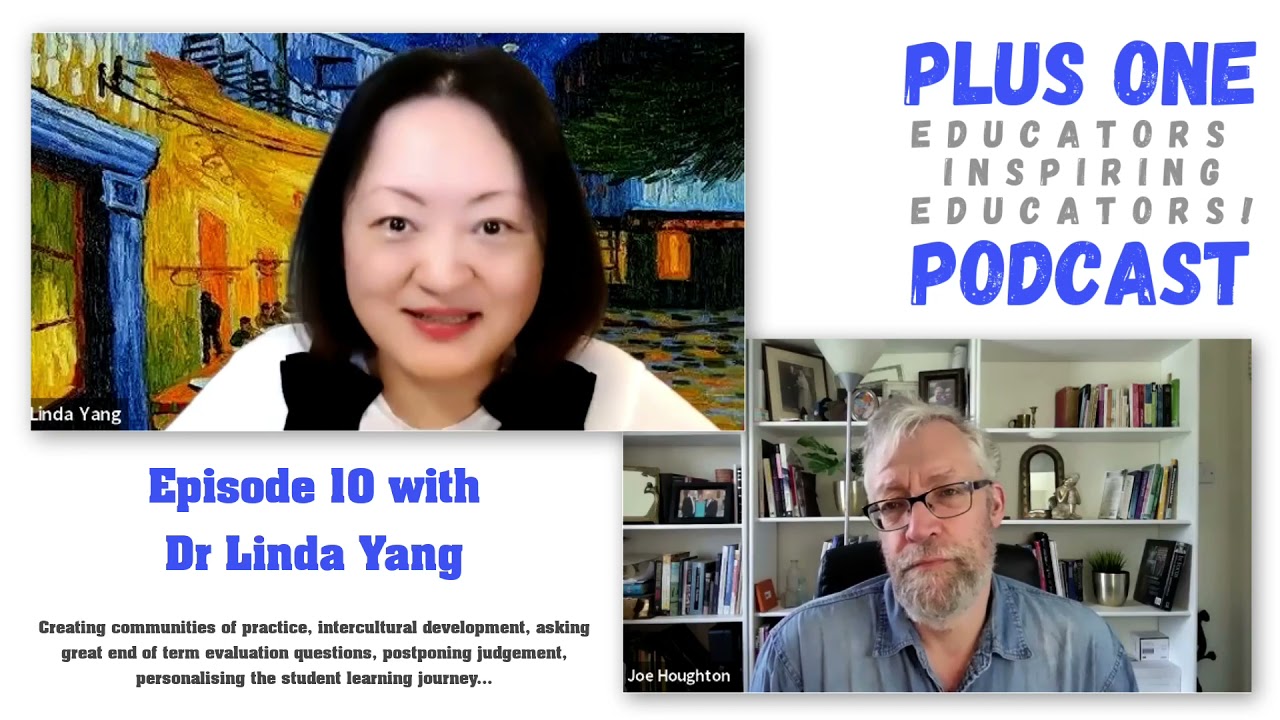
In this hour‑long Plus One Podcast episode, host Joe Houghton interviews Dr Linda Yang, an intercultural development specialist at UCD Smurfit Business School. Linda recounts her personal journey from Harbin and Beijing (China) through graduate studies in London and Durham to a post‑doctoral role and then a faculty position in Dublin. She explains the research‑driven Intercultural Development (ICD) programme she created, its two‑tier structure (fundamentals online and advanced in‑person), and how it supports students, staff and faculty in developing intercultural and global competencies. The conversation explores the meaning of internationalisation of higher education, the three layers of curriculum (formal, hidden, pedagogical), cultural dimensions such as Hofstede’s power distance, and practical teaching tools like Universal Design for Learning (UDL) and breakout‑room strategies. Linda shares insights on stereotypes, empathy, the role of evaluation, and the importance of a community of practice (College of Business Intercultural Forum). The episode ends with reflections on empathy, postponing judgment, and the inspirational example of Temple Grandin as a model for personalised learning.
Chapters
Hi, my name's Joe Houghton and this is the Plus One Podcast. Dr. Linda Yang is someone I've had the absolute pleasure to work with over the last year, 18 months, something like that, and her programmes around intercultural awareness have been so successful at UCD Smurfit, the graduate school where we both work, that I I found out this morning that in the next academic year, the intercultural module will be available to every student in the school, which is quite some testament to the success and the importance of that programme. So it's going to be really interesting to hear in the next hour some of that story and that journey. Smurfit prides itself on being, you know, one of the top international business schools in the world. And Linda has been absolutely instrumental in kind of leading the way into kind of making that a reality, not just for the staff but also for the students. So I'm really looking forward to the next hour. Welcome to the podcast, Linda.
Thank you so much, Joe, for inviting me to your really, really fantastic podcast series, which I've been really enjoying, thoroughly enjoying myself. So I was— I've been looking, really looking forward to this opportunity to have this chat with you.
Fantastic. Yeah, well, I mean, I think, you know, with your educational story and what you're doing, I think it's going to be a good episode. So let's kick off. Can you— I mean, how does a girl from Beijing, or China anyway, I don't know whether you were from Beijing or whether that was just your first kind of, you know, listed bit of study, but how do you get from Beijing to Dublin with stops in London and Durham and maybe other places along the way. Describe your journey to where we are today.
Oh, wow. That's such a good question. I mean, okay. So yes, I'm originally from China, culturally originally from China. And I was actually born in Harbin. That is a really beautiful city in the northeast of China, has 5 million population. And then actually, when I was quite young, we moved to Beijing. So I actually grew up in Beijing, you know. But if, yeah, if you think about cultural identity, I identify myself with China, first of all, and also most importantly with these 2 cities, you know what I mean? So that is my identity now. So yeah, I mean, like, I actually grew up in Beijing and finished my undergraduate study in English studies. I actually always wanted to be an English teacher, you know, like teach English.
Yeah, I saw that on your profile, and that was a question for later, kind of, you know, why— where did English go and how did it morph into what you're doing now? Yeah.
I know.
Yeah.
So, yeah, I always wanted to become an English language teacher, which, you know, we will touch upon this later on why the path changed, right? And then I actually went to King's College London to get my master's degree. So that I spent a fantastic year, one year in London, you know. I must admit that London is a fantastic place to work and shop and study, you know, which means that I was— I really needed to be strict with myself in terms of not being distracted.
Yeah.
So many wonderful options over there. And then I got scholarships from Durham University, School of Education, Durham University, which is such a beautiful little university town in the northeast.
Wonderful. The cathedral is just awesome, isn't it? Yeah, it's beautiful. Yeah.
Oh my goodness. Speaking of cathedral, that was when my graduation ceremony happened. And on that day, I was the only PhD student graduated. So it was huge, you know, like so, so beautiful. And Such a beautiful memory, you know, I still have the DVD with me. So yeah, I basically went to Durham School of Education, finished my PhD over there, and after that actually stayed in Durham University, worked there, and have a couple of jobs focused on, let's say, researcher development, and I was involved in a couple of European kind of research projects, you know, working with universities across Europe. you know, maybe 8 or 9 partners in one of the projects. And then, yeah, and then I moved to Dublin, you know, because of the job as well. And actually, I was the postdoctoral researcher in our School of Education in UCD, actually. That's right.
So this is very research so far, isn't it? This isn't kind of necessarily practical, hands-on like you're doing now. You were more on the academic end of things.
Exactly, that's a good observation, Joe, so because that's what I always wanted, that's what I believed that my career path should be, you know what I mean, so just follow the, you know, like standard academic career ladder, you know, okay, PhD, postdoc, keep going, you know, so after postdoc and then there was this post in College of Business came up because up to my postdoc my research area has always been in intercultural studies, internationalization of higher education, so I actually worked with a fantastic colleague, you know, I was her postdoc. She's Marie Clark, she's the Dean for Undergraduate Studies in UCD actually, and we actually— I was involved in this kind of national study in Ireland looking at internationalization of all the Irish higher education institutions.
Wow.
So that was really, really nice experience. And then this post, you know, which is advertised as Intercultural Development and Support Officer, but the role is quite vast, kind of in College of Business, in UCD College of Business, which is to provide intercultural support for all faculty, staff, and students. So for me, it was really exciting because it's like mothership calling, you know what I mean? So it's basically, you know, oh my goodness, this is my research area and involves teaching and research. So I was thinking, oh, this is cool.
And I don't think, I don't think I mean, maybe I'm wrong, but I don't think anybody was doing this before you arrived, were they? Or if they were, it was very quiet and under the radar. So you could kind of make the job your own in a way, I suppose. The post was kind of a greenfield site almost, and you could, yeah.
Joe, you are absolutely right. So I feel that I'm the entrepreneur kind of in the higher education context, because like everything, you know, everything is evolving and changing. And because of globalization, higher education, is globalized, you know, it's internationalizing, whether you want to use the word globalization or internationalization, they are very, very similar. So, you know, higher education has been changing and it needs to change to actually provide, you know, really the best possible education for our students, you know. So then I think jobs like this with focus on intercultural element, let's say intercultural support, whether it's teaching, you know, helping with intercultural development, for students, staff, and faculty is badly needed. It is really, really needed. And in fact, it's one of the key findings from our research that I did with Marie Clark, with Professor Marie Clark, you know.
So what did— what, just go back to that research a minute, because that seems to kind of situate where you've come from, doesn't it? I mean, so tell me, what, what, what does internationalization mean in terms of, you know, educational institutions and things? Is it just bringing in students from China, or is there more to it than that?
Oh, Joe, it's such a good question. Oh my goodness. I mean, obviously, you know, like, I can write a paper about it, but—
Yeah, and you probably will now.
Yeah. If you ask me to answer it in a couple of sentences, it's a real challenge. And so, yeah, so in a nutshell, I think internationalization of higher education is basically— look what you said, is a really good question that you ask. It's not about, let's say, the representation, you know, the representation of students' cohort, student community, and also representation. What I mean by representation is whether our student community, faculty community, staff community, whether it's diversified enough or not. It's not just about gender, it's about, let's say, countries, cultural representations, all of that.
Okay.
So that is one thing that is on the surface level, okay, that's statistics. So from a statistical point of view, okay, these are how many nationalities in UCD We have more than 143 nationalities represented in the student population, right?
Yeah.
So that's one thing. But on the other hand, there is a much more in-depth, you know, in terms of the internationalization of higher education. It's basically, what about the content what you're teaching? Is your curriculum internationalized in a sense that, is your curriculum, let's say, culturally inclusive? Is your curriculum just dominant, you know, like dominated by one, let's say, one thought? one school of thought, you know, is it European culturally focused, or is it kind of diversified, has a global perspective even, right?
Okay.
So that is the curriculum, and then that is the content. On the other hand is the pedagogy, meaning it's teaching and learning. Do you— are you able to, let's say, for our— all the faculty and staff who have teaching responsibilities, are you able to actually manage and teach effectively to diverse cohort of students? So these are the big areas over here. And a third element would be, you know, the hidden curriculum, right? So you have formal curriculum and then you have hidden curriculum, or the informal curriculum, which is extracurricular activities. Are they tailored for the diverse student cohort as well? Because if you think about it, this comes down to the fundamental question of what education is, you know. I mean, what is the purpose of the education? Obviously, you know, we want students to really achieve what they can, you know, to utilize their strength and to improve the areas they find challenging or still need to be improved and provide the opportunities for that. Basically, it's to tailor education for the diverse student cohort.
Okay. Yeah, I mean, that sounds lovely. Yeah, and I'm, you know, I'm being provocative here, okay?
There's a long way to go to achieve that.
That sounds lovely, but You know, if you've got a teacher with 50 or 100 students in the class and they're already busy and they're preparing lesson plans and they're grading and all this kind of stuff, you know, is it reasonable to expect them to tailor material and delivery to, you know, Indian students or Chinese students or Vietnamese students or Australian students or wherever they come from. I mean, is that even possible for one teacher to do? Because, you know, you've only got your own set of experiences, and so there must be somewhere in the middle that we meet, mustn't there, on that kind of question?
Oh, absolutely, Joe. It's such a good question. I think for any teacher, you know, if you ask any teacher, including myself, it's really overwhelming, you know what I mean?
Yeah, the more you look into this, the more it becomes kind of like, oh my goodness, I mean, there's so much.
I know.
When you look at diversity, when you look at accessibility, and we'll come on to those later on as well, but yeah, it's terrifying, isn't it, when you first dip your toe into this?
So I think that, you know, it's a good question. I think, you know, I feel that whether you like it or not, whether you want to do or not, you have to do it if you want to make sure that you are teaching the education that we provide for our diverse student cohort is really the top quality, as we, you know, tell the students. Right? So we need to do this. This is what's needed, you know. However, here comes down to the question is that whether we have the knowledge skills to do that. Most fundamentally is the attitudes. I mean, do you see— do we see, you know, diverse classroom as a good or as a burden? You know, I think that's a very, very good question to start with. And also, I think it's unrealistic to expect, you know, the faculty and staff members, let's say, because We are, let's say, like everyone is expert in their own, let's say, academic discipline. Okay, so for example, you are teaching, Joe, project management, right? And then we have, let's say, faculty members teach finance, all of that. So all of you guys are trained to be an expert in your own discipline. However, teaching is a different discipline.
Isn't it?
Exactly, exactly. So obviously in UCD, we have teaching and learning, the UCD teaching and learning who has been doing a fantastic job. You know, which is why, you know, like there should be sufficient support for faculty and staff development, because I believe that learning never ends. I mean, you know, you really need to improve yourself, keep learning, so that you can really kind of keep refining your teaching to keep up with the changes and also the needs that students have, right? So which is why I think the faculty and staff development is a very important piece. Which luckily, I think that, you know, like in terms of the structure-wise, in UCD we have good structure. We have teaching and learning, you know, in UCD we have a teaching and learning committee. And also, Joe, you and I, we work on the College of Business Intercultural Forum, haven't we?
Oh, we're coming on to that later on, definitely.
Yeah. Oh, yes, yes.
So there are structural supports in place now, but they didn't used to be as much. I mean, they've developed hugely in the last 5 years or so, haven't they? I mean, I remember when I came into Smurfit back in 2005, and I got my MBA, and then I got to teach a module or a couple of modules, and I was mentored in by Ken Meats back in the day, and eventually took over the program and co-wrote the program with Ken and created the new program and stuff. Having a master's degree was the door opener, and the assumption was if you've got a master's and you've got your experience, you can teach.
Yeah.
And I look at kind of friends of mine that are primary school teachers and secondary school teachers, and some of those, you know, may be listening, and they have to go off and they have to do, you know, an HDIP or whatever in Learning about teaching.
That's right.
But it wasn't for 10 years before I suddenly thought to myself, I should actually go and learn how to teach, and I put myself on the Postgrad Diploma in Teaching and Learning with T&L, and it was an eye-opener.
Yeah.
It was an absolute eye-opener. Now, fortunately, I found that most of what I was doing was about right, but, you know, there were definite areas of improvement, and the more I look into this whole teaching and learning space. And that's why I'm doing the podcast and I'm putting the book together, is because I think there's so much going on and there's so many possibilities for us as educators that kind of sense it— just sensitizing yourself to what's out there and available to develop your educational delivery, presentation, approach, inclusivity, diversity, all this. And that this is really where you've, you've come and you've just lit a fire, haven't you? And you really have. So, so I mean, that's, that's why I wanted you to come and talk to us today, because it's just such a, it's such a vast area, and I think a lot of people are probably a bit scared of it.
Hmm, well, you know, it's always scary to face the unknown. Yeah, yeah. Yeah, I think, I think, I think, I think it is overwhelming, to be honest. I think for— because this is, you know, this is my research area. That is why let's take just CBIF as an example, the College of Business Intercultural Forum, right? So the purpose of that really is to really have this kind of collegiate community of practice, you know, like learning from, you know, the existing knowledge and practice, that really good practice within our community, like what you said, Joe. teaching, you know, teaching practice is not a myth, you know, a lot of it is common sense because all of us have been learners, you know, but the thing is that this is the unconscious bias. We teach based on how we learn, how we were taught.
Yeah.
That doesn't make sense, right? So the key thing is that, the key thing is that, you know, like to see, okay, what are other approaches out there and what else I can do to actually improve my teaching, you know, so I think that, you know, for And for adult learner, for adult learner, obviously there is a formal structured learning. We can go on, you know, training workshops and all of that. And there's another side which is equally important, sometimes it's more important, which is informal learning, because we learn a lot really well from our colleagues. It's like you and me, Joe. I mean, we haven't met yet, but—
We haven't physically met still. Yeah, I know, it's crazy.
I know, but we've been learning so much from each other. You see, right? So you have your strength, which is really, really, really impressive. You know, you're, you're very creative and a very innovative educator, and I, I keep being impressed by you, you know what I mean? But then I have this expertise in the, you know, like in the diversity, how to deliver culturally inclusive teaching and everything.
Oh, yeah.
This is how the community of learning works. That is why we actually, you know, organize all of this really kind of very popular, actually, you know, bite-sized webinar. You know, our brilliant— our colleague Cathy O'Reilly, you know, she's been the host of the webinar. I acknowledge her here because she's earned it.
The audience of this podcast, I mean, it's aimed at educators to give them ideas and inspiration to up their game, up their teaching game. So if there's somebody out there feeling challenged about this whole idea of intercultural diversity and how do I tailor my teaching to better serve a diverse set of cultural, you know, background students and stuff, what can they do? Give me 2 or 3 things that they can do, and maybe they're not at Smurfit, yeah, you know, maybe they haven't got access to you.
They could.
So, you know, what other stuff is out there perhaps? that they could look at or do?
For example, I think that if you want to make your teaching inclusive, you need to have a framework, right? So recently, you know, I actually followed your footsteps, Joe. I finished the UDL, Universal Design for Teaching and Learning, right?
Yes.
So that is really— I personally found it— I mean, even though this is my expertise, let's say, right? But I personally found that UDL approach is very useful. For example, for me, it gives me a good framework, okay, to put all my theories, all my understanding I can put them, kind of categorize them in this framework, which is really useful. But I think for someone, let's say, who is a new teacher, who is very new in this area, yes, very new in this area, and then I think that I suggest, you know, kind of actually to complete or buy a book or something. There are so many books about UDL, you know, understand what it is because, you know, there are 3 elements in there, isn't it?
And we can go back to episode 1. Jen Lynch was talking about UDL in the first episode as well. So we've got, we've got a few Strands of UDL running through the podcast. So that's great.
Yeah, yeah. So then I think that, you know, basically, you know, UDL will give you a good framework to reflect on your own practice, you know, in terms of, okay, so what am I doing is right? Is there anything that I need to improve? So I think that there are 2 elements over here. One is the knowledge. You need to understand how people from, let's say, different cultural backgrounds, you know, if you're talking about the cultural differences, how people from different cultural backgrounds learn, right? Um, especially—
And do they learn differently? Because I mean, you know, I'm an English lad and, and you're, you're a girl from China.
Yeah.
Now we've come up in very different societies, very different political systems, very different educational systems. Now, now we're connected and we're learning from each other and working together and, you know, Fast becoming quite good friends, which is wonderful. But does your learning— is your learning experience so radically different from mine that if I have you or people from China coming into my class and I just try and teach them as an English person teaches and was taught, am I going to reach them effectively?
Okay, that's a— yeah.
And how do I find out whether I am reaching them effectively? Because there are cultural differences in communication, aren't there? I mean, I'm being awfully stereotypical now. I'm going back to original Hofstede power distance and stuff, but I mean, you know, very often Chinese students don't tend to be as vocal in class. They don't tend to challenge or argue with the teacher because perhaps there's that power distance thing and the, you know, the reverence for authority or whatever you call it.
Yeah.
I mean, I have one session on the introduction course that I do to project management where I do an ethics session. The ethics session is primarily grounded in Western philosophy. But I brought in some slides from— I think it was Sibyllus who gave me the idea, but I brought in Guanxi, I brought in Lian, and a few of the concepts of reciprocity and networking and trust from Chinese culture. And I put the ideograms up and stuff, and year after year after year, I get such a huge positive reaction from the Chinese students that they— and they say, nobody's ever drawn on Chinese culture before in any of my classes. And it was lovely to hear you talking about our culture and China and that we can bring positive things to business and all the rest of it, which of course you can. You're one of the world's major superpowers, but we teach, like you said, from our background, don't we?
Yeah.
And I very often feel that I'm teaching from a very narrow viewpoint. And there must be so much more that I could do.
You know what, Joe? I think what you're doing is a really good example in terms of internationalization of a curriculum.
Okay.
You know, because what you're doing is your content. Basically, you know, if you think about it, Joe, like, you know, there is— the world is so vast, people are so different, so many cultures. I mean, we will never, you know, grasp all the knowledge, all the cultural traditions. So there's no way of doing that, right? But I think as a teacher, here is the thing. It's like, do we see ourselves, you know, what role do we see ourselves in it? For example, in our teaching context, we're the facilitators, right? We're the ones who guide students, you know, study and everything. Now, so what you have done was, right, to actually add the diversity into the content of your teaching. For example, it's not just, let's say, European-focused, you know.
Right.
It's not just like Western philosophy-focused. But then you bring in the curriculum. But what is very interesting, Joe, is that this is— that is the beauty bit. There's the beauty of teaching young adult learners because they love sharing, you know, because they have a lot of their own life experience. So I feel that— I mean, and I'm not— I'm not surprised by the positive feedback from your students because I feel that, first of all, when you include the diverse, let's say, the diverse content in your curriculum, students feel like they can resonate with it. They feel that they're included, you know what I mean, and they have something to contribute, you see. So then I think that I believe the discussion must be really rich in your class so that, let's say, the other non-Irish students, and including ourselves, we can learn from our students, you know, from their own cultural expertise. So like what I always say, that in my class I always say to other students, all of you, each one of you, you are your own cultural expertise. So I think, I think the key thing is that as, as teachers, how do we bring that out so that students can learn from each other? Does it make sense?
It does.
Yeah.
So maybe that, maybe that's a good segue then into the program that you have put together over the last couple of years and, and which has just exponentially grown, hasn't it? This intercultural program. So, so tell me about that. Tell me about how it's started and what the ideas were that kind of got it going, and describe the journey through from where it started to where you are now and where you're going with it.
Well, first of all, do you have a day?
No, we've got half an hour, so—
I'll try to be brief. Yeah, so you know what, I mean, so basically, as I said, that part of my role is to provide intercultural support. to students, right? So that includes both postgraduate students and undergraduate students. I can tell you that the Intercultural Development Programme, in short we call it ICD, yeah? So ICD is completely research-driven in a sense that it was developed based on the research in internationalization of higher education. So as I mentioned early on in this podcast that based on research, for example, in the higher education context, it's not just Ireland, everywhere. all the popular study destinations for international students. For example, America, Australia, you know, Ireland, UK, you name it, right? New Zealand, Canada. So like, when you have international students and domestic students together, diversity doesn't guarantee integration.
No.
Right, exactly. So if, you know, and even if you have diverse students in one class, it doesn't mean that they're gonna talk to each other very well, and it doesn't mean that they're gonna work in groups very smoothly, right? So Research shows that especially, you know, there are a lot of problems, issues, which is common even for adults now, you know. It's like people have team, you know, conflicts. This happens all the time. However, students working in teams, you know, having conflicts in the university, that is slightly different because their group work, many of them are graded, you know, it's connected with their learning. So if you look at, you know, UCD strategy, you know, we talk about, okay, we want to empower a human being, all of that, right? So then the purpose of the ICD really is to really— how, what can we do to actually enhance, to help students, to give them the knowledge and skills to be able to work well together and develop, and at the same time have this overall development as a person to be an intercultural, let's say, person, citizen, however you want to call it. So the purpose— so that is the original idea of the ICD. ICD comes in as an intervention, as a problem-solving approach.
So the pain point from a university perspective is diverse sets of students are not working well all the time in groups. They're not teams at the time, are they? They're groups. And how do we ameliorate that, or how do we bring them through the forming, storming, norming, performing kind of roles? into cohesive teams?
Absolutely. All right. Absolutely. So what you need, right, overall, there are a set of skills that you need, but the core is intercultural and global competencies. The reason why I say it's intercultural and global competencies is because, you know, the concept itself keeps evolving, and, you know, there are different models out there. So people sometimes call it global competency, some people sometimes call it intercultural competency, but in SMARTFIT, for the ICD, I use intercultural because—
What does global competency mean? I mean, does that mean you know where things are on a map?
Well, that is part of it. So, I mean, this is such a good question. From my understanding, global competency and intercultural competency, they are the same. They are the same. But if there's any difference you can tell is, so maybe there's one element in terms of global competency is your responsibility as a human being for the planet, you know, the system, the sustainability, all of that, that will come in. Yeah, so the intercultural competency really emphasizes a lot on people's interaction. For example, you and I, when, when we are interacting, how do we communicate? So then going back to why ICD is in place, is to really design systematically to help students have the knowledge and skills for them to be able to work effectively together in a diverse learning context in and outside of the classroom. Because hopefully, you know, by developing these set of competencies, they will be able to, you know, form, you know, intercultural friendships as well.
Yes, yeah, and I mean, I suppose developing skills for communication and teamwork outside of the classroom, I mean, certainly in the Smurfit environment where a 200-credit module, they may have 24 or 36 hours in class, but then they've got the other 160, 170 hours self-directed learning, so You're teaching them how to do that, are you? You're teaching them how to connect better and interact better outside of the formal— I don't call them lectures because I don't do lectures anymore. I run sessions now. But yeah.
Basically, you know, like for the students, I think the fundamental issue is whether they see the value of interacting with someone who is different or not. different, you know, like could be anything, gender, anything, you know, because culture is everywhere, you know, culture is not just about national culture, you know, there's a— it's about, for example, even within Ireland you have cultural differences as well. So I think the fundamental thing is the attitude, you know, so if the student sees this as a value, then they will put more effort to it, and the ICD is helping them first of all with the attitude and then give them the knowledge and skills and competencies to be able to do that effectively.
Right, and you bring, I mean, an energy. I mean, you're just a force of nature. I mean, every time I interact with you, you know, you're smiling, you're energetic, you're enthusiastic, and you seem to put everything of yourself into this, into what you do. So I mean, that must be infectious, that must kind of communicate to the students. And it does, because I get the feedback from them, you know, and they all come raving about Linda's classes and Linda's course and all the rest of it.
Oh, thank you so much, Joe. Thank you. You see, you see, the thing is that this comes down to, uh, why, you know, why, why I choose to teach, isn't it? I mean, including yourself, we can choose other professions if they want, uh, if we want. I think I can, I can be a good marketing person, you know, if you think about it, you know. So But the thing is that, you know, I feel that this is what students like, because I do annual students' experience survey for the ICD program because I want to learn, I want to, you know, keep improving my teaching under the program. So the keywords came up is that students say that I'm very energetic, you know, they feel that my energy is infectious. I think that's the word you used, did you?
Yeah.
And then they enjoy it. So I think that The key thing is really, it's because I love what I do. I think I love teaching and I keep on and I get energized from it. And also I love the discipline, you know. I am a true believer of, you know, intercultural competency, you know, inclusive teaching, you know, and education should be inclusive, you know. All the opportunities should be available to the students, and then it's up to the students in terms of how much they can achieve. So maybe know, and I remember at one point some of my students told me that, you know, because you're so passionate about it and you made me want to learn about it.
Yeah.
And I said, oh, that's great, I didn't realize that, but it's such great feedback from them, you know what I mean? So yeah, so I think because of the demand, as you mentioned at the beginning, so I'm really excited about the next step for the ICD because this will make Smurfit School the first school in Ireland offering intercultural learning opportunities that is available to all students, all students of postgraduate students. So this is quite exciting stuff.
That's amazing. But I mean, that's 1,300, 1,400 students, I think, based on current numbers, isn't it? I mean, are they cloning you?
Well, hopefully they're not. I mean, well, the thing is that, you know, like, the thing is that because there are 2 levels of the intercultural— of the ICD program, I think the really tailored for students' needs and in order to scale, right? So there is a fundamental level, you know, for the fundamentals, and there's advanced level. So the difference between fundamentals and advanced is basically advanced, right? So you learn from, let's say, action, you know what I mean? So they will come in and do the sessions with me, you know, so there are only limited places for advanced because like what you said, I mean, there's only one me, you know what I mean?
Yeah.
Uh, not all the students, uh, not, uh, not all the students actually have the time, let's say, time to actually devote it into the advanced level, which is— which just makes sense. I mean, because all the students have their own priorities, right? So which is why there's fundamental level, uh, it's completely online self-study, but, but it's kind of interactive online, you know.
Ah, so you've recorded— you've recorded sessions and, and done quizzes. So this is like a Coursera course or a Thinkific course or whatever it is.
That's right.
And then the in-person one is what, 100 people or so, I think, is it? Or it's probably more now, but yeah.
Yeah. So basically, you know, for example, for the fundamentals, right, like students, I think it suits some of the students, especially if they prefer to study on their own, you know what I mean? And also, you know, fit their study schedule. For example, if they're very busy and then, hey, now I have 30 minutes, so I'm gonna do ICD, you know what I mean? So this is really based on my experience in the past 3 years. So there are a small group of students who are so committed, you know, who are able to commit fully to the program, and they will be the ones who get advanced, right? But the fundamentals, the difference is that, you know, they didn't have the kind of face-to-face interaction experience, but all the theories, all other stuff is the same. Okay.
Yeah, I want to do this fundamentals course. Is it available to staff as well? Because if it's online, it should be.
Oh, it's such a good question, Joe, and thank you for adding more things into my to-do list. I think, you know, that's a good question, you know, that's a good question because that is one of the things that I plan to do, but I think I need to tailor it for the faculty and staff because in terms of the faculty and staff, your role is more like teaching, you know, how do you handle the diverse classroom. I think support around that area, how to achieve, let's say, culturally inclusive teaching. That's my next thing to do. Absolutely.
Because, I mean, that's so needed. And I mean, that talks to, you know, why we're here, doesn't it? You know, so, I mean, how do I improve my classroom for my students? How do I— I mean, again, broad brush stereotype here, okay? Horrible. But in general, perhaps in the classroom, Chinese students tend to be quieter. and less kind of— they don't contribute as much verbally. And I don't know whether that's because they're shy or whether that's because of the cultural conditioning of not speaking up in class or challenging or having, you know, opinions. But yet, you know, they're as bright, if not brighter, than everybody else.
Mm-hmm.
Now, how do I bring them out? How do I involve the Chinese and the other students who are more reticent to come forward? They have the knowledge, they have this amazing experience, otherwise they wouldn't be sitting in the class there, but how do I bring them into the discussion? Because we kind of almost predicate our teaching, I think, on discussion, don't we? On involvement, on engagement and, you know, argument and stuff like that. Is that a Is that an assumption that we should make as educators? Should we ground our teaching in the expectation that people are going to discuss and going to have an opinion and going to argue, or is that a cultural assumption that I'm making that I shouldn't be making?
You see, Joe, I mean, you ask such a good question and it's a very big question, you know what I mean? And it's debatable, but if you ask me my own personal opinion, Is that I feel that because we have this diverse classroom, and first of all, let's talk about stereotype. I think stereotype is helpful. Okay. Really?
Okay, so it's not a dirty word then.
Well, you know, stereotype is helpful because it gives you a general direction in terms of— it helps you to have an expectation, you know what I mean? But as long as you don't think stereotype is absolutely a universal truth, it's never going to change, then that's not good. You know what I mean? So if you don't fix onto your— onto the stereotype and keep an open mind, then that's fine, you see? So yes, I mean, research do shows that students, let's say, from East Asian cultural background, including Chinese, you know, like Koreans, Japan, Japanese, you know. So in the class, depends on who you compare to. If you compare to Americans who have no problem to speak up— Here we're talking about stereotypes. Yes, very much.
Yeah, the other end of the spectrum.
Exactly. So we, in practice, you know, we have stereotypes, but we treat each student as individuals because they are all different. Yeah. Now, so there are cultural differences in terms of classroom behaviors on the surface level. How do they behave in the class? And you mentioned about Hofstede cultural dimension, and the most relevant one obviously is power distance. For example, China, India, you know, um, all the Asian countries, most of the Asian countries are high power distance.
Yes.
And the low power distance would be, you know, uh, the lowest power distance would be America, you know, um, and then Ireland is very similar to UK, probably slightly higher than the UK, you know, all of that. So then, which I, I felt that it's a good piece of research. I think the Hofstede dimension actually is pretty accurate in terms of looking at a national trend, right?
And I know it's quite old now, but it's been updated, hasn't it? And you, you know, even when you look at the current kind of scales for this. There is still a difference.
Yeah, yeah, absolutely. But I think that the general trend is still the same, you know. So then, looking at the classroom behavior, I think you have a really good observation, right? So the Chinese students, if you compare Chinese with the Irish and Americans, so the Americans are very talkative and the Irish less, you know, but there are still students who are willing to speak up. But the Chinese students would be quiet. Now, so as a teacher, depends on what you're teaching, what do you believe effective learning and teaching should be? For example, in the Western context, you know, we need to talk, talk, speak, debate. Oh yes, yes, that is, you know, active participation. You are great. You know, you must have been a great learner. But that is according to your specific culturally believed—
Exactly.
In terms of what is a good learning, right?
Yeah.
But that is a low-power distance. Low-power distance meaning that, you know, like, okay, everybody is equal. You can challenge your teacher. But this is such a difficult concept. concept for the, let's say, students, you know, from the high power distance society to adjust to. It's not that they don't want to, because if you look at the research, all the international students, okay, who decided to study abroad, they already mentally prepared. You know what, I'm going to study abroad, I'm going to learn, you know, that's what I'm paid for. They want to learn. However, if you think about it, they've been practicing this for over 20 years, and you expect them to immediately change this within the first week? Right.
Yes.
Arriving in the UCD, there's no way they can do that, you know what I mean? So obviously, even if they want to, then it kind of takes time for them. So which means that we should give them the support, which is why the ICD is there, you know. ICD is for everyone, you know, so that, for example, for our students and American students understand why some students don't speak. It's not because they're freeloaders. It's not because, you know, they are free riders. It's because there's a cultural difference. For example, the Chinese students— let's just take Chinese students as an example. When they're not speaking, it's not that they're passive, you know. In the literature, there's a word talking about, you know, like, okay, Asian students can be passive, you know, passive. But the thing is that that is according to your own cultural lens, okay.
And that's just a perception, isn't it?
Exactly.
They're sitting in the class, but they're not saying anything, they're not interacting. Therefore, they're passive.
Exactly. So you need to look at, you know, what is deep down. Deep down is that they are active listeners. They're active. They keep reflecting on it. So if you ask me, okay, Linda, just use one sentence to summarize the key difference between, let's say, high-power distance and low-power distance societies in terms of teaching and learning, is whether it's teacher-centered or student-centered, right? So in a teacher-centered, which means that, Joe, let's say I'm Chinese and I come to your class, and what I expect is I want to learn from you. You know what I mean? Because you are the teacher, you are the guru, you are the master of the subject.
The sage on stage model.
Yeah, exactly.
But that's a model I'm trying to get away from now. I mean, I think when I started teaching, that's where it was, you know, and I was sage on stage and I was handing down the knowledge, if you like. But the more I get into teaching and learning and learning, you know, about current trends, certainly in teaching and learning, the more this sage on stage thing seems to be like, throw that away, bring the class in, make it inclusive, make it, make it discussive and all the rest of it. But I recognize that that's difficult for some of my students, and I don't know how to bridge that gap at the moment.
You know, you see, the thing is that I think, I think, which is, this is one of the purposes actually the ICD is trying to achieve, you know what I mean? So which is why, I mean, as a You know, as a member in kind of in the Smithfield School, I think you probably observe that ICD has kept changing.
Yes, it's evolving. It's different every time I look at it. It's amazing.
Yeah, I know. So I always think about, you know, kind of what can ICD do to actually sort of— because like what you mentioned, faculties, you know, I mean, you guys basically, you know, like, first of all, not everyone has the expertise to deal with that.
No.
But at the same time, I think people should improve themselves, learn anyway, right? And then at the same time, actually, you might— you probably don't have the time to deal with that. For example, what I mean is that, you know, can you really solve all the group problems, you know, all of that? But I think that this works two ways. So, you know, faculties make an effort. For example, whatever you can do to make your teaching as inclusive as possible, You know, so if we look at the UDL, you know, principle is that you need to have options for choice for different students, isn't it?
Yes.
Choice. I think choice, that is the keyword. And also, I think, you know, from the ICD point of view, you know, like in terms of the program, how can the ICD help students to equip their awareness and the skills to be able to actually appreciate the diversity, you know, do not judge other students, okay, your language is not good, you must be a bad learner. So language competency is not equivalent to academic achievement.
No, but it's a blocker if there's an immediate perception that this person can't speak English very well or can't communicate with us very well, you know, in business English or whatever, therefore they must be, you know, they're not as good as us, they're not—
So the question, Joe, the question I have towards you As a teacher, right? I mean, you are an amazing teacher. I've heard super feedback, you know, from my ICT students, which are from your class as well, you know what I mean? So I have students from across 22 programs. I have all the gossips of different faculties. It's only a joke. So my question to you, Joe, right, is that, is discussion really that essential? I mean, what I mean is that, you know, kind of in terms of the— let's say, use a stereotype, right? the Western concept of teaching, okay, is that like how much time do you actually, you know, how much emphasis, how much do you emphasize on the value of discussion and how that discussion takes place? Does it have to be verbal? Oh, I think that's a, you know, a cracking question.
I think if I went back 2 or 3 years, I would say relatively little discussion in class.
Yeah.
Mostly me with my PowerPoint deck droning on, pushing information at them, expecting them to soak it up and whatever, but interspersed with practical and experiential application of, you know, right, I've talked about the theory for an hour, now go and do this exercise and put the theory into some kind of a practice, whether that's on an in-class exercise or whether that's on a wider assignment, you know, going and working with a charity or writing a business plan for a real company or whatever it is. So there's all that built in. Now, since COVID and since I had an actual seminal interaction with one of our colleagues, Alessio—
Hello.
Yeah, and Alessio asked whether he could come and audit one of my online classes because he was about to teach an online class and he was still getting, you know, getting situated with the online stuff.
Mm-hmm.
And so I love people coming and auditing my classes because I get another educator's view on what I'm doing. And he made a comment and he said, you know, the class was fine and all the rest of it, but you spend too much time expounding a point. They got it in the first minute. You don't need to spend 10 minutes on it. Maybe give them some time then to talk about the point. And it was a light bulb going on in my head when he'd said that. I'll never forget it. It was such a really good, inspiring insight. That's a really good comment. So what I'm trying to do now, and it's difficult, It's difficult because I think a lot of us as educators like talking, and to actually build in stops where I stop talking and I let them talk now, and I throw them into breakout— and this is where Zoom has actually been really, really useful because the breakout rooms function is fantastic. You know, you can just mix and match them randomly.
Mm-hmm.
I mean, if they're in a classroom, you've got them sitting at a table and the 4 of them sitting at the table, and unless you actually say, right, everybody move to a different table now, and that takes 5, 10 minutes to happen. So Zoom has facilitated this, but I think building in conversation time and discussion time, and then having time after the conversation where you come back into forum, share some of the insights from each group, and then riff that into the next discussion or whatever. I mean, that's It's quite a powerful model that I'm now increasingly using. There was also a post by a teacher, a high school teacher in the States, Rob MacIntaffer. I'll put the link in the show notes. 6, 9 months ago, and he said when he went online, how he got over this problem of talking too long was every third slide in all his PowerPoint slide decks, he just inserted a blank slide.
Oh, that's really clever.
And it was just, when you get to the blank slide, stop talking. And I thought that was such a simple but easy intervention.
Oh, that's really clever, isn't it? Remind us, hey, time to take a break, you know.
Yes, blank slide, talk time.
Yeah, yeah, I like that, I like that actually, I like that.
Yeah, so I don't know, I don't know whether discussion as a study tool. I mean, so much of the teaching and learning work that's going on at the moment and the conferences I'm going to and the Innovation Academy and all the rest of it, they say this is the way to do it, this is the way to do it. Have your students talk, co-created learning, that's a big thing at the moment, isn't it, and all the rest of it. Is it right? Is it not right? I don't know. It certainly adds some value, but does it add value to the diverse students who perhaps are not as comfortable talking?
Well, if you ask me, you know, I always wear the inclusive teaching, culturally inclusive teaching hat, and I'm always careful not to go extreme, you know, with any method. Because, you know, I know it's very popular, people talk about, you know, co-curriculum and everything. So maybe that's the area we need to look on, we need to work on, we need to look into. But I think every one of us, we need to make a conscious decision. in terms of based on our own student cohort, you know, what would be a good mix, for example, in terms of teaching techniques, teaching activities for my students? Does it make sense?
Well, I don't know whether we've got time to do it today because we're almost on 1 o'clock now. I mean, maybe we'll have another session, but I think one thing that might be really interesting that you could bring from your background to that discussion would be Some ways to inform teachers and, you know, professors and whatever on, well, how do I measure this? How do I turn my teaching into research? And what questions do I ask my cohorts each year to elicit, if you like, the right changes? Because you've done that, obviously, for years and years and years, but I've not. And I probably should be doing, but I don't know how to.
I think, well, first of all, right, so this is a big question, Joe, okay?
I know, I know, and I know we've only got 3 minutes left, so I know it's the wrong time to have asked it, but—
You see, the thing is that I don't— what I do, right, is that at the end of my teaching, I mean every class, I actually ask the students to give me evaluation. Simply because, like what I said, because I love teaching, I want to improve my teaching all the time. And that is a primary reason why I ask them to do that. But then, for example, how I improve the program, for example, you know, I would ask them to fill in the end-of-the-year survey, you know, things like that. Key questions, you know, key questions is really sort of— I would want to reflect based on self— is what worked, you know, what worked for you, right? And what didn't work? Is there any room for improvement?
Yeah.
And why? I think, I think that's it. And what hasn't been covered, for example, right? In your case, in your case, for example, if you want to improve, if you want to develop the content of your teaching, because you included actually the Chinese students' case, you know, so what else needs to be included? I think, I think that would be a good angle to look at it if you want to do a piece of research, because you need to be very focused. Do you want to research on your curriculum? You know, do you want to research on your syllabus, you know, or do you want to look at your teaching method, you know what I mean? Whether any method is effective or not. So I think as a—
I can feel a collaborative paper coming on, Linda.
Oh, oh, absolutely. We should always collaborate. We already collaborated on a paper, haven't we?
We've already done one. Yeah, yeah. And again, I'll put a link in the show notes on that. Yeah, how we communicate, how we set up kind of the CBIF community of practice and how well that worked. Listen, I probably promised we wouldn't go too much over time, so I'm going to kind of wrap up this talk, but I think we're going to have another one at some point. But just a couple of final kind of points to talk about. I noticed in your survey before the podcast you mentioned Temple Grandin.
Oh yeah.
Talk to me about Temple Grandin because I hadn't come across Temple Grandin, but—
Oh my goodness.
She inspires you.
So who is Temple Grandin and why should we know By the way, probably you can do another session with Jacob as well because Jacob met her in person.
Oh wow!
So basically, tempo, right? I mean, she was diagnosed as autistic when she was little. I actually didn't know her until I listened to her TED Talk. You know what I mean? I was so inspired. I actually listened to it again, again, again because she spoke so fast, so well. And then she was kind of diagnosed as autistic when she was a child. And basically most of her teachers, okay, in a nutshell, and now she's really famous, you know, like, like, like she's really, um, uh, she's an expert in horse development or something. So anyway, so yeah, she's been invited to give talks and everything. So what inspired me was that, um, you know, um, like most of her teachers didn't know what to do with her because she's, you know, autistic, you know. So most of teachers don't know how to do it. But then she, one of her teachers who actually Managed to discover the way to help her, to help her discover herself how to learn, how to pursue what's your strength, how to pursue it and everything. And that's how she became rich where where she is now. So I find that that is so inspiring. In fact, I actually shared that post on my LinkedIn because I mean for me because I'm so inspired by that because I was so impressed by that teacher because gave gave us her you know the the teacher name. the teacher who was able to actually personalize the learning journey for this child, which is what we should do for every learner, you know. I was like, oh my goodness, that's so impressive. So I remember when I was listening to that TED Talk, it was late in the afternoon. I was like, oh, such a good day to, you know, such a good way to actually to end the day, you know what I mean? So it's really, really inspiring. So I feel that for an educator, you know, I call myself educator, I think that's really inspiring because that's what I believe, you know, how can we help every of ours, not the majority, not a standard student, every student to achieve their potential. It's a lot of work for us, but I think that is a very important goal for us to, for me at least, for me to pursue.
And I mean, that riffs us beautifully into my last kind of question for you, which is your plus one. Yeah. And your plus one was to have empathy towards your students. And I mean, that's really what you're talking about, I guess. But I mean, what do you mean by empathy? And how does— how do we as educators empathize? Because I mean, that's a term that, you know, it could be a woolly term. It could— so what can we do to empathize with our students?
Don't judge them, basically, you know, postpone your judgment. Because I think that, you know, we always have our unconscious bias, bias against everything, you know. But then I think it's that we have unconscious bias towards our students as well. This is, this is, you know, directly relevant to stereotype. When you see a student, your brain will immediately make some judgment. That's fine. That is normal, you know. But then postpone your judgment and really observe that student. See how he or she learns and what can you do to help her, him learn better. You know, that is what I mean by empathy. Rather than judging the students, you know, see them as a problem or see them as Why? You know what I mean? So always postpone judgment. Okay, is there anything, you know, I can do to help that student in any way to learn better? So that's what I meant by empathy. I think, I think postpone judgment is just so important.
So that's a lovely point, and I'd never really conceptualized that in such a cogent way. That's, that's a wonderful way of summarizing, summarizing it, Linda. I'm, I'm so glad you came on.
Thank you.
We are, I think, over the hour now, so we'll draw a close here. But I mean, what a super discussion, you know. Thanks for sharing your passion. And I mean, you know, that's what comes over with you, Linda, as an educator and as a person. You're just so passionate, and it is infectious, and it clearly resonates with all the students and the faculty. I hear about what you've been doing and see what you've been doing, and I'm constantly inspired. So it's been great to have you on the show today, and thank you so much for coming.
Thank you so much for inviting me, Joe. It's been a fantastic talk, and you keep inspiring me as well, you know. So really thoroughly enjoyed it, thoroughly enjoyed it.
Fantastic. Okay.
More from Joe




2026-01-31 RPS Under the bonnet 5 - Masking in Lightroom Classic with Joe Houghton

Joe Houghton on creating a Google GEM based on a NotebookLM notebook optimised


RPS Let's Edit - Composition - Depth & perspective - Joe Houghton 2025-12-06



