
Day 10: Why Self Storage Has Survived Every Recession Since 1970 (The Data Explained)
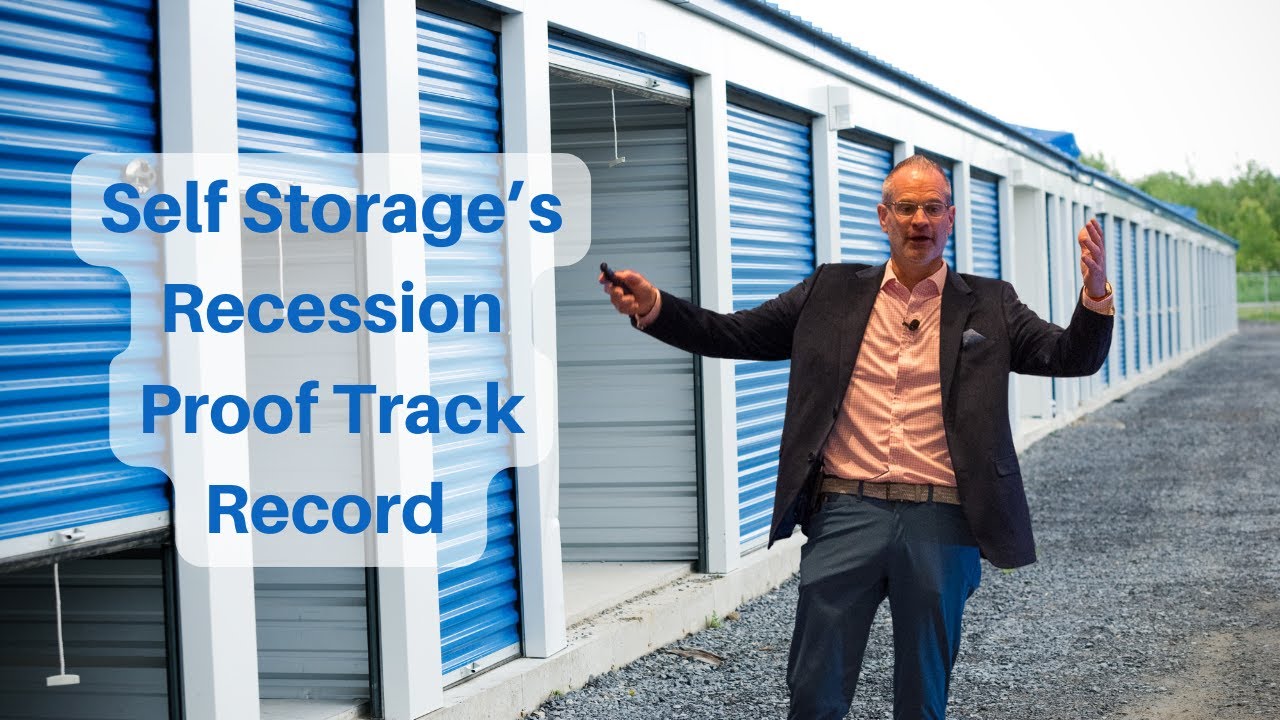
Joe Downs explains why self-storage survived every recession since 1970. Low operating costs (25-35% expense ratios) and month-to-month contracts let operators adjust instantly. REITs invested $8 billion in storage from 2008-2010 and $15 billion in 2020, with distress rates staying near 0.1%.
Chapters
All right. Welcome back to day 10 of the Storage 100 series. I am Joe Downs with the Storage Mastermind. Today, as promised, we're going to talk about a question I get asked a lot and one that you're astute for asking. Why has self-storage survived every single recession since 1970? This isn't just a claim. It's a proven 50-year track record. To do that, I'm going to break down for you the core mechanics that make this asset class uniquely resilient. You need to understand that self-storage is not a cyclical business. It's a countercyclical business. That is a tongue twister, by the way, and I nailed it. That means it often performs best when the rest of the economy is struggling. All right. We're going to look at the demand drivers as to why, the cost structure, and the secret weapon of the month-to-month lease. And it's really not a lease. It's a contract. I know we think of it historically as a lease, but technically it's a contract. All right. Let's dive into the historical proof right now. And I'm not talking theory here, folks. We're talking history. So look at this track record. Over 50 years, self-storage has proven its resilience through every major economic downturn. You had the oil crisis in the '70s to the Great Recession, and then even the COVID-19 pandemic. The industry held strong during the '73 recession. It's a great year, 1973, by the way. Might or might not have been born that year. Families downsizing still needed a place for their stuff during that recession. So expansion continued. And then even with the 10% unemployment rate in the '80s, demand stayed steady. During the Great Recession we lived through, institutional money actually poured into the sector, recognizing its stability. The institution recognized its stability. This asset class doesn't just survive recession, it thrives in them. All right, let's look at why. The reason storage is so resilient is that demand, as I stated, is countercyclical. What does that mean? It means factors that drive demand often increase when the economy slows down. So when people lose their jobs or face foreclosure, they might downsize from a house to an apartment. And if so, they need storage for the excess belongings they can't fit in the new living arrangement. Job loss often means relocation. People store their items while they move or look for a new place. Small businesses also downsize their offices and store inventory to cut costs. And sadly, life transitions like divorce or death can increase during economic stress, and they are huge drivers of storage demand. These are life events that happen regardless of the stock market. So that's why it's countercyclical. Demand is one half of the equation though. What's the other half? It's cost structure. So we have strong demand, But we also have an incredible recession buffer built into the operating model. This is all about low operating costs. Just look at the numbers. Self-storage operates with an expense ratio of, you know, if it's really humming, 25%. If you just bought a brand, you know, not brand new, but a value-add, you know, facility, mom-and-pop run, you might be up to, you know, and you got to get revenue, you might start out 35% to 40%. costs on your revenue. So compare that to apartments or retail though, which are often 40 to 55%. This low cost structure gives you a massive cushion when revenue dips during recession. You don't have to have expensive tenant improvements or complex maintenance like you do with other property types. We can temporarily cut marketing, defer some maintenance without losing tenants. This financial flexibility is key to weathering any storm. But the real secret weapon is how we handle our leases. We don't have them. We have contracts. And the single biggest advantage self-storage has over other traditional real estate investments like apartments, multifamily— we use month-to-month contracts. Apartment owners are locked in 12-month agreements, meaning they can't raise the rent on an existing tenant mid-lease. We get to adjust our rates in real time based on demand. So if occupancy dips, We can lower rates to fill up units. If occupancy hits 90%, we can raise rates right away. This flexibility allows us to test pricing strategies every single month. We can respond to competitor move-ins within days, not months or years. This results in revenue optimization in any market condition, which is critical when the economy's uncertain. Now that you understand the power of month-to-month leases, let's dive into why storage is truly an essential service. This is the core reason self-storage has proven so resilient over the last 50 years. People prioritize storage payments, believe it or not, even when money's tight. If you think about what people store— furniture, family heirlooms, business inventory— losing access to these items means losing thousands of dollars in purchased or inherited possessions. It's just cheaper to keep paying the $100 or $150 a month than to move everything out. Moving costs. I don't know, what's a truck cost? $100-some. Then you got labor, or you're doing it yourself. And then where's it going? What are you doing with this stuff? Storage becomes a recurring bill people don't question, much like their utilities. I often refer to it as the Planet Fitness model, or I shouldn't name a gym because I don't know what their model is, but let's just say a gym membership model where it's easy to sign up, but it's hard to cancel your membership, right? Storage is hard for different reasons. There's never a good weekend to go move everything out and you just paid the bill, right? So you'll move next week. Well, next weekend it's raining and next weekend little Johnny has a game. We'll do it the weekend after that. And before you know it, it's the next month already and you've kind of forgot about it. So it's an essential— it's— this essential nature is why the smart money flows into this sector. All right, so that's what we're gonna look at now. The essential nature of storage is not lost on the big players in real estate. Institutional investors agree that self-storage is a safe harbor during these economic storms. When recessions hit, institutional capital doesn't flee self-storage; it floods in. Look at 2008 to 2010 period REITs, which is a real estate investment trust. They're the publicly traded owners of real estate. Is the best way for me to explain it right now? They acquired over eight billion in facilities between 2008 and 2010. Institutional ownership grew by more than 300% during that downturn. Self-storage NOI outperformed every other commercial real estate sector during that time period. Then the pattern repeated in 2020. $15 billion in capital poured into our sector. Occupancy actually increased to over 95% during the pandemic. The historical proof shows the confidence of the smartest money in the world, but we need to be honest about what happens during a downturn. Self-storage is not immune to economic cycles. It's just far more resilient than other asset classes. So that honest assessment is that we do feel the recessions, excuse me, but we recover faster and fail less often because of our maneuverability with the month-to-month contracts. So occupancy can dip 5 to 10% as some tenants cut expenses. Rent growth slows or even stalls temporarily while the economy finds its footing, but facilities rarely fail because of the countercyclical nature of the demand that offsets those losses. So our operating, our low operating costs create a massive cushion with 65 to 75% NOI margins. The month-to-month leases allow us to make rapid adjustments to pricing and demand. So the distress rate stayed at a tiny 0.1% during the 2024 downturn. This historical track record should give you the confidence to build your own recession-proof strategy. All right, so we've covered the 50-year track record of resilience. Now it's time to put this knowledge into action. So when you're looking at a facility, you need to build a recession resilience directly into your investment strategy. So first, study the historical data in your specific market. Research how self-storage performed in your target area during 2008 and 2020, for instance. Then understand the countercyclical drivers that apply to your location. Identify which recession triggers like downsizing or job loss is going to drive demand for your facility. And then lastly, build recession scenarios into your underwriting model. Model what happens if occupancy drops 10% and rent growth stalls for a year. If the deal still works under that stress, you've got a resilient investment. If you found this series helpful, please like it. This is what I say, day 10. Oh my goodness, 90-something to go. So throw me some likes, subscribe so you get notified of the live recap of this first segment of the Storage 100, which we are getting dangerously close to. And of course, share. I went to a Jesuit high school in Philadelphia, and one of our mottos at that high school was to be a man for others. So here's your chance to share for others. They will thank you later.
More from Joe



The tenant only paid for the first month! #selfstorage #horrorstory #realestateinvesting

What happens when a storage tenant stops paying? #selfstorage #realestateinvesting #storagemoguls





