
Day 14: Square Footage vs Unit Count in Self Storage: What Actually Drives Your Revenue
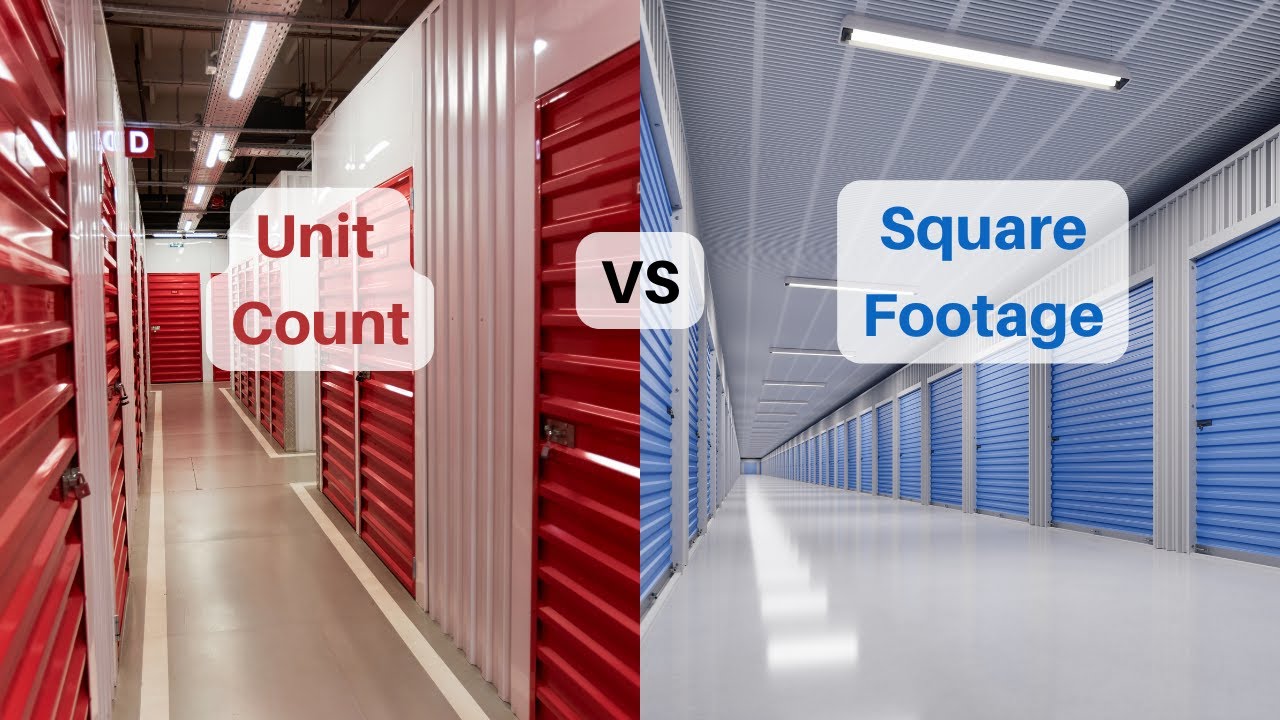
Joe Downs explains why unit count matters more than raw square footage in self-storage. Revenue per square foot drives valuation and lender decisions. Five tactics to boost ROI: subdivide units, add climate control, create parking pads, reclaim dead space, or combine units.
Chapters
All right. Welcome back to the Storage 100 series. This is day 14. I'm your host, Joe Downs, with the Storage Mastermind. And today we are tackling a fundamental question that divides the storage world: square footage versus unit count. Which one actually matters? Well, here's the thing. Most people focus on total square footage of a facility. They think bigger is automatically better, but that number is often misleading when you're trying to figure out a property's true value and revenue potential. The real money in self-storage isn't just about how much space you have. It's about how you divide that space up. So we have to shift our focus from the size of the box to the number of the revenue streams inside of it. So let's break that down, or let's break down the difference between the 2 metrics and see who cares about which one. So we have these 2 core metrics, square footage and unit count, and they tell completely different stories about a property. Square footage is the easier number. Right? It's just the total rentable area. So let's just say 50,000 square feet. And this number is crucial for developers and lenders because it dictates the construction costs and the property tax assessments. It's more about the physical structure. Unit count is the number that matters to operators and investors. This is the total number of doors that you can rent out. So unit count tells you the revenue potential and the operational complexity It's more about the customer base. So, but let me be clear here, both numbers are important, but they serve different masters, right? So the developer cares more about the cost per square foot and the operator cares about the revenue per unit. When it comes to maximizing the profit though, one of these metrics is a stronger indicator. So if you're an investor or an operator, unit count usually wins the debate hands down. The primary reason is revenue generation. More units, more customers, more separate revenue streams. Think about risk diversification too. If you have 400 units, losing one tenant is just a tiny blip on the radar. But if you only have 100, that same loss hurts 4 times as much. And this is important. The vast majority of market demand is for smaller units. Across the country. So think like 5 by 10s and really mostly 10 by 10s. Facilities optimized for these smaller sizes fill up faster. And finally, smaller units command a much higher revenue per square foot than larger units. So you get more money for the same amount of space. So if you think about this way, 50,000 square foot facility with 500 small units, 10 by 10, it's pretty standard, will almost always outperform one with 200 large units. But that doesn't mean square footage is useless. There's certainly specific times when that number is the only one that matters, and that is mostly during the development and construction phase. Building costs are calculated per square foot. Lenders underrate your loan based on the cost per square foot, not the number of units you plan to build. Property taxes is another one. Most jurisdictions assess your annual tax burden based on the total square footage of the building, not the unit count. So adding 10,000 square feet, for instance, increases your tax assessment regardless of how you divide that space up. And if you're in the— in a market that demands more climate control, the square footage is going to drive your operating costs because HVAC and utility expenses are based on the total volume of air you need To heat or cool. So square footage is— think of it as the, the metric cost for taxes and construction, and unit count as the metric for revenue and operations. The real magic happens when you use both to create the perfect unit mix. The unit mix strategy is where we combine the power of unit count with the efficiency of square footage, and this is how you optimize your revenue per square foot. which is the ultimate metric. You need to match your unit mix to your specific market. So some residential areas, for instance, need more small units, whereas maybe more commercial areas need larger ones. Same thing with like urban, suburban versus rural. In fact, the more rural we get, the better we are able to rent larger units. And then vice versa, the more urban, suburban we get, The more smaller units we're going to want in the mix. But generally, you want to prioritize the smaller units, the 5x5s, the 5x10s, the 10x10s, because they generate the highest revenue density as long as there's market demand for them. They're also your fastest turnover units, but you really need to find an operational balance. Too many small units could mean higher turnover and increase your marketing costs. Conversely, too many large units could mean slower fill rates. So the goal is to find that sweet spot that maximizes your revenue per square foot while still meeting the local demand. And this mix is the key to unlocking the highest possible value for your revenue, for your facility. All right. This might be the most important slide in the whole series. We've talked about— that doesn't mean you shouldn't keep watching. We've talked about unit mix, but now we need to talk about the number that actually matters. And that's revenue per square foot. This metric cuts through all the noise about occupancy rates and unit counts. It tells you exactly how efficiently you're monetizing every inch of your facility. And the calculation's simple. You take your annual revenue and divide it by your total rentable square footage. That's it. And here's the thing. Average facilities are hitting $10 to $15 a square foot per year. If you're under $10 dollars a square foot, you might have a problem. Top-tier operators in the space, the ones that are really making money, are pushing, I think, $20 to $25 per square foot. That's the goal, right? What drives this performance? It's the unit mix we talked about combined with high occupancy and your pricing power in the market. This is the number that dictates your facility's true value. So let's look at why that number is so critical to your facility's valuation. This is how the money people look at it. The lenders, the buyers, and the appraisers. They look at your business this way. They don't care about your feelings. They care about this number. Lenders focus on revenue per square foot and net operating income, your NOI, and they are basing your loan amount on the income approach, meaning they are lending against the facility's ability to generate cash. Buyers prioritize unit count and revenue potential. They're going to pay a premium for facilities that have a strong unit mix and high revenue per square foot because they know they can scale and optimize it. And appraisers use the income approach first and foremost as well. They take your NOI and divide it by the market cap— market cap rate, I should say— to determine your value. A higher revenue per square foot directly translates to a higher NOI and a higher valuation. This is important. Operators should always aim for that sweet spot of— I mean, it depends on your size, but let's say 200+ units with a strong mix, strong unit mix generating at least $15 to $20 per square foot annually. Too few, too few units could mean you hit a revenue ceiling pretty quickly. So if this metric is so important, how do we actually move the needle? Well, we know we need to increase our revenue per square foot to maximize our valuation. So here's 5 practical ROI tactics you can implement right now to make that happen if you own a facility. First and easiest is unit subdivision. Take those slow-moving Unrented larger units like a— if you have a 10 by 30 and convert it into 2 10 by 15s, you just increased your unit count and your revenue per square foot without any adding any additional footage, square footage. Next, look at potentially a climate control conversion. If you're in a market that needs more climate control and the building that would support it, adding HVAC to existing drive-up units can increase your revenue per square foot by 30 to 50%. That's a massive bump, especially in extreme climates. And then for someone who has a facility with extra land, maybe you consider parking or parking pad addition or converting unused land into RV or boat parking. That's actually pretty cheap to build or develop, and it generates high revenue per space. It's also a quick way to increase your unit count. And then don't forget about, you know, any dead space you have in your facility, you know, that you could recapture and start to generate revenue from. Walk around your facility, look for wasted hallways if it's on the interior, or oversized aisles on the exterior. You can reconfigure that space to add 5 to 10% more rentable square footage. These are tactics that are all about working smarter, not harder, to squeeze more revenue out of the same footprint. Conversely, if the unit mix does not agree with the market, meaning all of your vacancies in the smaller units, then we're going to do the opposite. We're going to combine units. This will decrease your unit count, but we did it to increase the revenue per square foot, which is more important. Smart operators pay attention to their market and how their facility is behaving in it, and they make those necessary adjustments. All to increase the revenue per square foot. All right, we've covered a lot of ground tonight, but the goal is always action. So if you're watching this and you already own a facility, here's 3 steps you can take right now to put revenue per square foot metric to work for you. First, analyze your market, research your competitors, and calculate the revenue per square foot. This will tell you what's possible with and what winning mix or unit mix is in your area. Second, calculate your own metrics. If you own a facility, you should know your current revenue per square foot. If you're looking at a deal, project what the optimal revenue per square foot could be in your market based on market rates. And then finally, optimize your approach. Stop focusing on raw square footage and start prioritizing unit count and revenue per square foot. Look for opportunities to subdivide or add climate control. Remember, math is only sexy when it makes you money. All right, if this presentation changed how you evaluate facilities, give it a like and subscribe so you don't miss the next episode and all the lives I'm going to do where I'm going to be going deep dive or into deep dives with special guests. And again, I'm going to do them about every 2 weeks, so So subscribe so you get notified. And please share this with anyone who's still bragging about their square footage instead of their revenue. They will thank you later.
More from Joe



The tenant only paid for the first month! #selfstorage #horrorstory #realestateinvesting

What happens when a storage tenant stops paying? #selfstorage #realestateinvesting #storagemoguls





