
Day 42 Drive Aisle Standards Why Your Widths Determine Your Tenant Mix
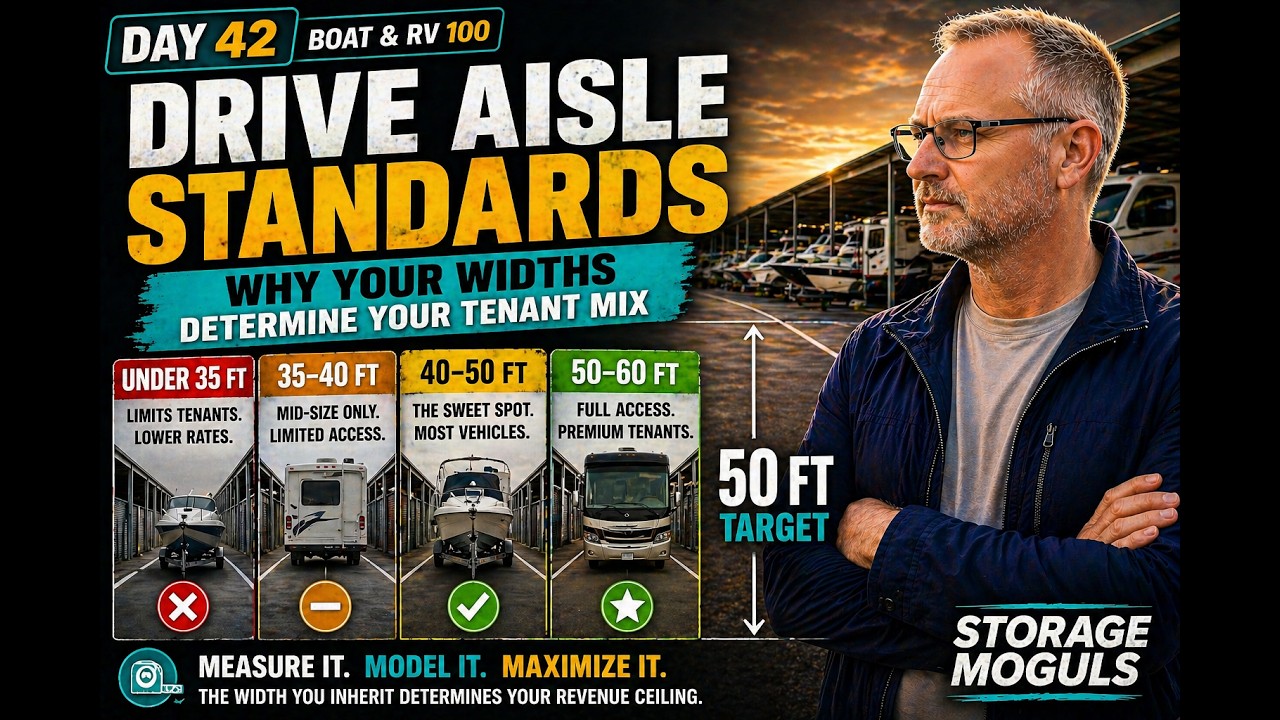
Joe Downs explains why drive aisle width in boat and RV storage facilities determines which vehicles you can rent and how much you'll make. A 30-foot aisle is minimum; 40-45 feet works for most markets, while 50-60 feet attracts premium Class A motorhomes. Narrow aisles force you into low-end segments, depress NOI, and increase liability.
Chapters
Welcome to day 42 of the Boat and RV 100 series. I'm Joe Downs with the Storage Moguls, and today I'm going to show you why the width of the drive aisles you inherit at closing can determine your tenant mix and your revenue ceiling for years. And for more insights like this, you should join storagemoguls.ai. Remember, a mogul isn't just someone who owns real estate. For us, a mogul is defined as a sophisticated operator who knows how to find, evaluate, negotiate, underwrite, and due diligence and then close a storage facility. That's the standard we hold ourselves to, and that's what we're here to teach. And you, if you would like— we don't just buy storage, we acquire and we optimize it. That distinction might sound small, but it tends to show up as tens of thousands of dollars per deal when you get it right. We're made up of real people too, that husband and wife team, solopreneurs, entrepreneurs who are actively doing it. And nobody here graduated to a stage and stopped doing the work. We're evaluating real deals right now, acquisitions between $400,000 and $2 million every day. Why that range? Because you can buy it in that range. That's where the best deals are, and they're financeable. We'll walk you through how to do it at storagemoguls.ai. Members in our community are becoming storage moguls every day, not someday. So if you want to be a part of it, that's where we are. You can start for free, move at your own pace. But let's get into today's episode because most operators never think about drive aisles until the first class, first class A motorhome can't make the turn, and by then the tenant's already leaving. Yes, if you've been following along, we touched on drive aisles in an earlier episode, but we're coming from a different angle this time. All right, drive aisles. Are the least glamorous part of a boat and RV facility. They're also one of the most consequential, and here's why. The width of your drive aisle determines which vehicles can physically use your facility, and the vehicles that can use your facility determine the tenants you're going to attract and what you can charge them. A 30-foot drive aisle can handle most boats and smaller RVs, but the moment someone shows up in a 40-foot Class A Pulling a tow vehicle, they need 60 feet minimum to maneuver safely. And if your drive aisle is only 40 feet, tenant's gone before they can sign a lease. And that tenant, the Class A owner, the serious boater with a large vessel, is your highest value tenant. They pay, pay the most, they stay the longest, and they have the fewest complaints. The aisle width problem isn't fixable after acquisition usually. Without significant capital. And that's why it has to be on your checklist before you close. Let me give you the actual numbers. A minimum functional aisle for any boat and RV facility is 30 feet. That gets you access for most boats on trailers up to 24 feet and a Class B or C RV. Usable but very limiting. Standard you should be targeting is 40, 45 feet. And that width you can accommodate— at that width you can accommodate the majority of boats and RVs in the market, up to about 35-foot vessels and Class A motorhomes in most configurations. That's going to be the sweet spot for most markets. If you want to serve the premium tier, large Class A motorhomes, larger boats, tandem axle trailers, you need 50 feet at least, 50 to 60. When we spec boat and RV facilities, 50 feet minimum for new construction. On acquisition, 40 feet's workable. Under 35 feet could be a problem that needs capital planning before you can compete at a premium price point. When you're walking a facility during due diligence, definitely bring your tape measure. Don't assume, don't estimate, measure. Here's what a narrow drive aisle costs you, and it's more than just one frustrated tenant. First, it limits your space mix. If your aisles can't handle vehicles over 30 feet, you can't rent the larger spaces even if you build them. Those spaces sit vacant or rented at a discount to smaller vehicles that don't need the larger space, and that's a direct hit to your NOI. Second, it forces you into the low end of the market. Tenants with high-value large vehicles will not store at a facility where they're nervous every time they try to maneuver. They'll pay more at a facility where the infrastructure matches the asset. When your aisles are too narrow, you're not competing with premium facilities. You're competing with whatever's cheapest in the market. Third, it creates liability exposure. If a tenant damages their boat or RV maneuvering in a tight aisle or hits another vehicle, you're going to hear about it. Facilities with inadequate aisles generate more incidents than ones with larger aisles. And in a vertical where the stored assets are worth $50,000 to $300,000 or more, incidents are expensive in both dollars and tenant relationships. So what do you do when you acquire a facility with substandard aisles? Well, first of all, if you acquired it, you better know going in. First, before you acquire, assess whether it's fixable. In some cases, open-air facilities with space to spare, you can reconfigure the layout and gain width. You might lose some spaces in the process, but if those spaces were underperforming anyway, The tradeoff can pencil out. So calculate it before you buy. Second, price it into your acquisition. If the aisles are 35 feet and your market needs 50, you either have a capital project or a discount facility. So model both scenarios in your pro forma and see which one makes the deal work or kills it. Third, consider a phased approach. If the facility is generating enough cash flow at its current configuration, maybe a future expansion can include the aisle correction. But go in with eyes wide open. You will not be attracting premium tenants until the infrastructure supports them. What I caution against is buying a narrow aisle facility, charging premium prices, and hoping tenants don't notice. They will, and the reviews will tell you all about it before your occupancy does. When you go walk the facility yourself, every time, don't rely on photos, aerial views, or the seller's description of the aisles. Bring a tape measure and measure the actual usable width, not the space between the fences, the actual clear width, accounting for overhang mirrors and any obstacles. Get the site plan and mark every aisle width. Look for the pinch points, corners, gate approaches, the transition from the entrance to the storage rows. Those are where the narrow spots hide. Talk to the existing tenants if you can during due diligence. Ask them directly, is there anything about the facility that makes it harder To get your vehicle in and out. Tenants will tell you things the seller won't. And look what— and look at what's currently renting. If the facility has 40 spaces with nothing in them while the 20-foot, 24-foot spaces are full, that's a signal. Either the market doesn't demand large vehicle storage or the infrastructure can't support it. Either way, you need to know before you close. Mm-hmm. Let me give you a quick example of how this plays out in practice. We looked at a facility that appeared well, well occupied, decent location, priced reasonably. The numbers looked fine, but when we walked it, the main drive aisle was 38 feet. Secondary aisles, the ones serving the larger covered spaces, were 32 feet. The larger spaces were mostly vacant. Naturally, the seller's explanation was that the demand for large spaces was soft. Well, Maybe, but the real explanation was probably that the aisles couldn't support the vehicles those spaces were built for. A 38-foot aisle with a covered space on each side means a Class A motorhome is not getting in and out without a lot of stress. And we passed on the facility, of course, based on how it was priced. The capital needed to correct that aisle situation, particular or partial reconfiguration, fence relocation on 2 rows, made the economics just not, not work. At the asking price. That's the analysis you need to run before you buy, not after. Here's the frame: the aisle width you inherit determines the tenant mix you're stuck with, and the tenant mix determines your revenue ceiling. It's that simple. Fix it in the underwriting or fix it with capital, but don't ignore it and expect premium results. All right, next up, day 43: gate technology and remote access. More important than you think. The modern boat and RV standard, uh, and we're gonna, we're gonna go into, uh, access control, what today's boat and RV tenants actually expect and, and where operators are falling behind. So like this video if the Drive Isles standards gave you something specific to add to your due diligence checklist. That's exactly why we're here. Subscribe so you don't miss day 43. Gate technology is one of those topics where the gap between the operators are are running, what the operators are running, and what tenants expect is wider than it should be. And share this with someone who's evaluating their first boat and RV acquisition. The dry bowels are the kind of thing that doesn't show up in the listing and can quietly kill the deal's upside. StorageMongols.ai has the full due diligence framework for boat and RV acquisitions, including the site walkthrough checklist. It's free to join. Join Storage Mongols. You should bring your tape measure, know what you're buying. See you tomorrow.
More from Joe



The tenant only paid for the first month! #selfstorage #horrorstory #realestateinvesting

What happens when a storage tenant stops paying? #selfstorage #realestateinvesting #storagemoguls





