
Day 52: Resolving Problems in One Call The Boat and RV Customer Service Standard
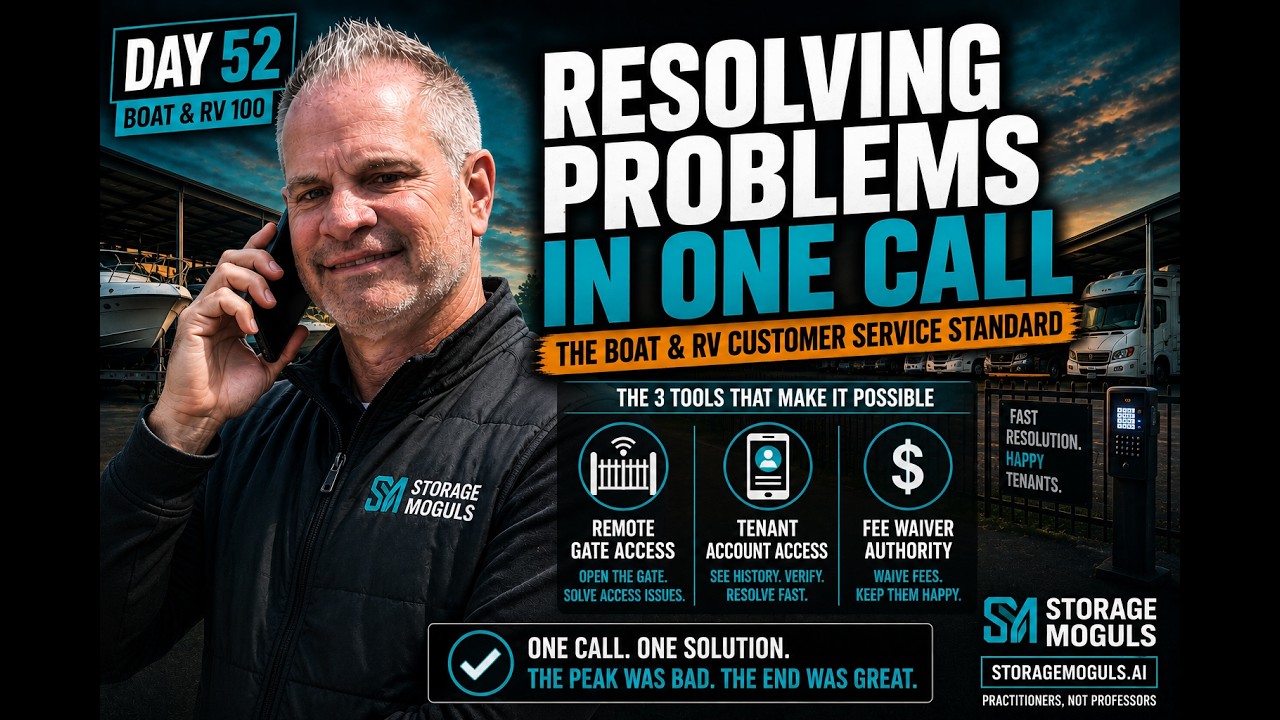
Joe Downs explains how to resolve 90% of tenant calls in one conversation by giving frontline staff three things: remote gate access, account visibility, and fee-waiver authority. Most calls fall into three categories—access, payment, or space—and can be solved in 90 seconds if staff have both the tools and permission to act without escalating.
Chapters
And welcome to day 52 of the Boat and RV 100 series. I'm Joe Downs with Storage Moguls, and today we're making the Peak-End Principle operational. The framework was day 51. Today is the execution, the specific tools, the authority, the structures, and the resolution standard that turns a good concept into something your team actually delivers on every call. Members of this community are becoming Storage Moguls, not someday, right now. And the way we define that word matters. A Mogul is a sophisticated operator, someone who's mastered the full arc from sourcing and a deal to running one well. We don't just buy storage, we acquire and we optimize. And that's not a tagline, it's a discipline, and it tends to be worth tens of thousands of dollars per deal once you understand the difference. We're real people, couplepreneurs, solopreneurs, entrepreneurs. Nobody stepped off a stage years ago and is now selling you a version of success they no longer live. We're actively evaluating deals in our community between $400,000 and $2 million that are financeable. Kind you can actually close. So if you want everything in the series backed by a community doing the same work, you should join storagemoguls.ai. storagemoguls.ai. Start free, you can go at your own pace. But let's get, um, into today's episode because the difference between a facility that retains tenants and one that loses them often comes down to what happens in a single 2-minute phone call. Let's make sure you win that call Every time. Here's Sydney Wilders, a recent guest of mine on Storage Moguls Podcast. She framed the core problem. They're at the facility and they want to get their vehicle out. It's that urgent. They're on their way to pick up their vehicle so they can go have fun with the family. That's always a timed event. And that last phrase is key. A timed event. Your tenant's not calling you from their couch. They're in their truck in your parking lot with a boat. They need to get out on the water before the family's patience runs out. Every minute you take to resolve their problem is a minute of their Saturday you're consuming. That context changes everything about how you train your staff to handle these calls. It's not about being efficient. It's about recognizing what's actually at stake for the person on the other end of the phone and resolving it before that window closes. The one-call resolution standard means exactly what it says. Whoever answers the phone, whether that's you, an onsite manager, or call center, they resolve the issue before hanging up. Not escalated, not called back, resolved. There are 3 categories of problems that account for the overwhelming majority of boat and RV tenant calls. Access issues. The gate won't open, their code is wrong, their Bluetooth isn't triggering. Payment issues, a late fee they weren't expecting, a payment that didn't process correctly, a question about their invoice. And space issues, something is wrong with their space, they need a different space, there's a question about a neighboring tenant's vehicle. Every one of these can be, can be resolved on the first call with the right tools and the right authority. None of them requires a manager callback. None of them requires a ticket system. They require a trained person with access to the right systems and the authority to make a reasonable decision. The tools required, required for one-call call resolution, for a one-call resolution, are not complicated. Remote gate access on every person's phone who might answer a tenant call. This is the single most important tool in the system. If someone can't open the gate remotely, they can't resolve access issues on the first call, full stop. Access to the tenant account, payment history, space assignment, access code, contact info. Your property management software or GHL should have a mobile accessible interface. The person answering the phone call should be able to pull up a tenant record in under 30 seconds. A defined fee waiver authority. A specific dollar amount or specific fee types that any frontline staff member can waive without manager approval. Late fees up to a defined threshold. One-time courtesy adjustments. This doesn't mean unlimited authority. It means enough authority to resolve the most common issues without escalating. These 3 tools together— remote gate, account access, fee authority— Cover 90% of the calls you'll ever receive. If any one of them are missing, your one-call resolution rate drops significantly. Let's be specific about what the resolution conversation sounds like. The tenant calls, their Bluetooth isn't triggering, and they have a late fee they didn't know about. They're frustrated. Here's what the right response looks like. I've got your account right here. I can see the late fee. That's from last month's payment that processed a few days late. I'm going to clear that as a one-time courtesy since this is the first time it's come up, and I'm opening your gate right now. Give it about 10 seconds, you should be good to go. That's it. Under 90 seconds, problem resolved. Tenant back on their way. Compare that to, I need to get my manager to approve the fee waiver. Can I get a callback number? The tenant hangs up, doesn't get called back for 2 hours. misses the launch window. That's the difference between a 5-star review and a 1-star review. The script doesn't need to be memorized. The components need to be present. Acknowledge the problem, resolve it in real time, confirm they're good to go, send them off warmly. The call center question. Many boat and RV operators use a call center for after-hours, uh, overflow Call coverage. The one-call resolution standard applies to call center staff exactly the same as it applies to on-site managers. This is where most operators fall short. They train their on-site manager on resolution authority but don't extend that training and authority to their call center. The call center answers after 5 PM on a Friday. A tenant's trying to get their RV out for a weekend trip. The call center can't open the gate. and doesn't have fee authority, the tenant's weekend starts with a failure. If you're using a call center, they need the same 3 tools: remote gate access, account visibility, and a defined fee authority. Brief them on the boat and RV context specifically, that these calls are timed events, that the person is usually on their way somewhere, and that the standard is resolution before you hang up. A call center that understands The context performs better than one that's just following a generic script. 2 failure modes worth naming explicitly. Failure 1: the operator who trains the manager but not the backup. Everything works when the manager's on. The first time the manager is unavailable, they're on vacation, sick day, weekend, tenant calls, nobody has the tools, the call escalates to voicemail. One bad experience during a coverage gap can undo months of excellent service. Build redundancy into your system. Every person who might answer a tenant call needs the tools and the authority, not just the primary manager. Failure 2: The operator who has the tools but not the culture. The gate app is on every phone, fee authority is defined, but the person answering the call is conflict-averse or overcautious and defaults to escalation even when they have the authority to resolve. This is a training and culture issue, not a tools issue. The message to your team needs to be explicit. When a tenant calls with an access or payment issue, your job is to fix it before you hang up. You have the authority. Use it. Permission given clearly is permission used confidently. Here's the frame. One-call resolution is not a customer service philosophy. It's an operational system with 3 components: tools, authority, and culture. All 3 have to be present. Anyone missing and the system fails exactly when you need it most. Next up, day 53 is the Section 4 live recap. We're covering the full operational playbook from days 41 through 52, the 13 episodes that cover everything from hiring to customer service. So bring your questions about a specific facility. Or operational scenario, that's what the live format is built for. Like this video if the One Call Resolution Standard gave you something specific to implement this week, whether that's extending gate access to your call center or defining your fee waiver authority for frontline staff. Subscribe so you don't miss the live recap. Day 53 is the deepest live session in the series because of the 13 operational episodes to recap and Got the audience Q&A on real facilities. So share this with a boat and RV operator as well. Maybe their call center doesn't have gate access and that gap is costing them tenants every weekend. StorageMoguls.ai has the full customer service training guide for boat and RV facilities, including the one-call resolution script and the call center briefing template. It's free to join. You might as well join. Give your team the tools, give them the authority, set the standard and hold it. See you tomorrow.
More from Joe



The tenant only paid for the first month! #selfstorage #horrorstory #realestateinvesting

What happens when a storage tenant stops paying? #selfstorage #realestateinvesting #storagemoguls





