
Day 59: The Referral Network Why Boat & RV Storage Markets Itself
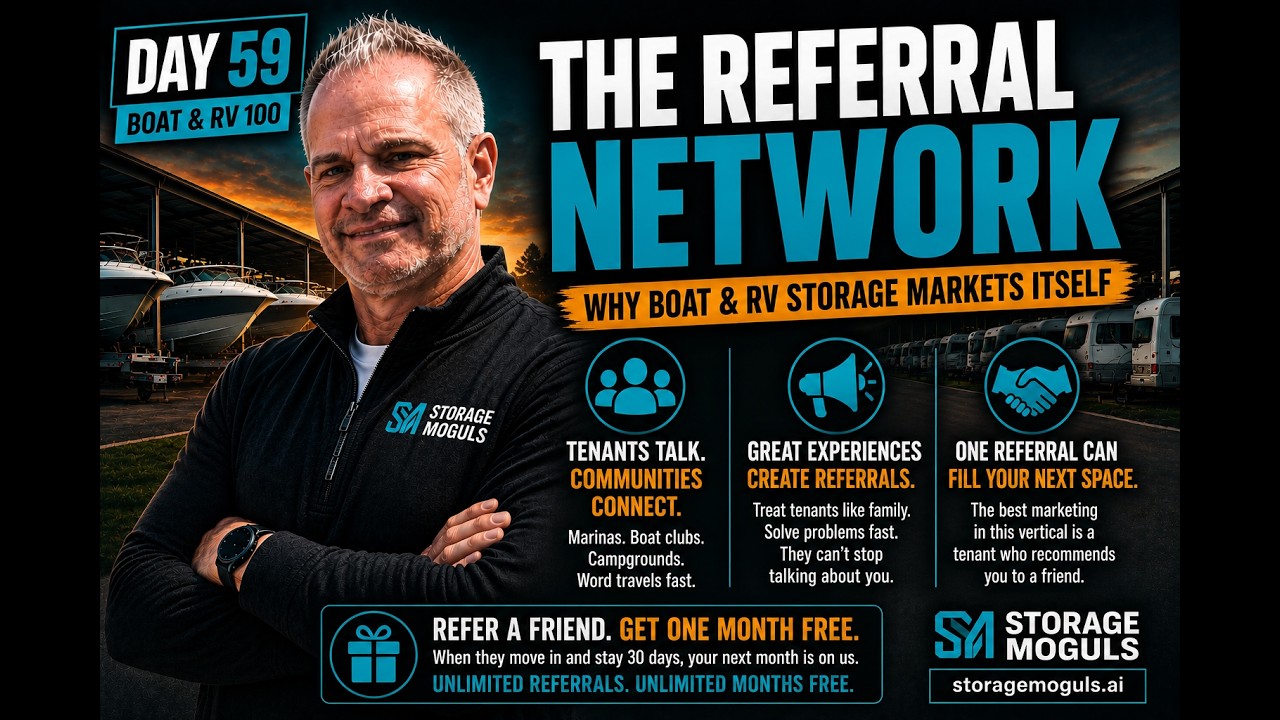
Joe Downs explains how boat and RV storage markets itself through tight recreational communities. Every operational choice shapes the stories tenants tell. Offer one month free to tenants who refer someone who stays 30 days, and ask for Google reviews at the emotional peak of service.
Chapters
And welcome to day 59 of the Boat and RV 100 series. I'm Joe Downs with the Storage Moguls. Folks, self-storage doesn't have what boat and RV has, and that's a tenant community that talks to each other at the marina, the boat club, the campground. Word travels fast in those circles, and a well-run facility earns referrals that never show up in your ad spend. Today we're going to build a system around that because that's what we do at Storage Moguls. Our community runs on deals, $400,000 to $2 million, and we're made up of couplepreneurs, solopreneurs, entrepreneurs, all doing it right now. You can join for free at storagemuggles.ai, storagemuggles.ai, and then level up when you're ready. But back to today, because the best marketing in this vertical is a tenant who can't stop talking about you. And Sydney says it better than I can. People talk about This in a completely different way at campgrounds, RV parks, marinas, gas stations. She says, these guys treat me like family. They've got air for tires. That's the boat and RV referral dynamic in one sentence. These tenants are not isolated individuals who happen to store vehicles in the same location. They're typically members of a recreational community, the marina community, the campground circuit, or the RV club network, and they see each other Regularly, and they talk and they recommend and they warn. The implications are enormous. So a single loyal tenant who talks about your facility at a marina on a Saturday morning is reaching maybe 5, 10, potentially 20 prospects who all have the same need. None of those conversations can be bought. They're all earned through how you run your facility and how you treat the tenants who store there. The flip side is equally true. A bad experience spreads through the community even faster. A tenant who had a frustrating gate problem that nobody resolved is telling that story at the marina to the same people. That's why the operational standards we covered in section 4, the peak-end principle, the one-call resolution, the move-in experience, they're all marketing decisions. Every operational choice either builds or damages the referral network you're sitting on. So let's talk about what this looks like in practice here. So a boat owner who stores at your facility takes his boat out most weekends from May through September. At the launch ramp, at the marina fuel dock, at the campground where he parks his trailer, he interacts with other boat owners who are either storing elsewhere or looking for storage. When the conversation turns to where he stores, which it usually does because Boat owners talk about their boats and everything related to them. He either tells a story about a great facility, a forgettable one, or a bad one. Here's a great story. They've got air for tires at the entrance. The gate opens on my phone as I pull in, my phone app. When I had a billing issue, they— last fall, they fixed it one call while I was in the parking lot. I've been there for 3 years. That story generates inquiries. The forgettable story, they might say something like, it's fine, it's a, it's a lot with a gate. That story generates nothing. Or they— then you get the bad story. They couldn't open the gate when my family was waiting. Nobody called me back, and the aisles are too tight for my trailer anyway. That story generates cancellations. The tenant experience you build is the marketing message you get. Every operational decision either fuels the referral network or it starves it. Okay, so the formal referral program and how to structure it here. You gotta understand, most boat and RV operators have no formal referral program. They benefit from referrals passively when they happen, but they don't actively create the conditions to generate them. A basic referral program is a simple— it's fairly simple to implement. And meaningfully increases the referral rate. Here's the structure that works: existing tenant refers a prospect who moves in and holds the space for at least 30 days. The reward for the tenant who referred: one month free on the next invoice. This structure is clean for several reasons. It's easy to communicate the refer a friend and get a month free program. It's self-policing. The month Discount only applies after the new tenant has been there for at least 30 days, so it doesn't reward fake referrals. It rewards the exact behavior you want to encourage, actually. And it gives you every tenant— it gives every tenant a financial incentive to actively mention your facility rather than passively mentioning it. The communication to existing tenants is simple too. A one-page letter or email. We're always looking for great tenants. If you know someone who needs boat or RV storage, send them our way. When they move in and stay for a full month, you'll get your next month free. That's simple. No limits. That's it. Post it at the facility office. Send it in your August communication with the rate increase notice. It shows up when tenants are already engaged with facility communication. The marina conversation, the Google review, also serve the same function. Both tell other boat and RV owners Where to store. Day 58, we covered the Google My Business side. The operational angle here is the same as the referral program. You have to ask. Every tenant whose problem you resolved on a one-call solution is a candidate for a 5-star review. The ask is simple. It should happen in the moment. You've been real easy to work with, and I really appreciate it. If you have a minute sometime, a Google review would mean a lot to us. Don't wait to ask. Don't email the request 3 days later. The emotional peak of the interaction is when the tenant is standing at the gate with their problem just solved, ready to head out on the water. That's the moment to ask. If you wait, the moment passes. The tenant is happy and grateful in the moment. 3 days later, they moved on. Reviews also reinforce the referral network in a specific way. When a boat and RV marina tenant at the marina searches for confirmation of a recommendation they just received, something like, my buddy Joe— my buddy says Joe's place is the best, let me check Google. What they find on Google either confirms or undercuts the word of mouth. So a facility with 40 reviews averaging 4.7 stars is going to confirm the recommendation and close the inquiry. A facility with 6 reviews averaging 3.9 stars, well, that might create some doubt. The 3 community touchpoints where referrals happen most often and how to be visible in each are marinas, where you have the highest concentration referral environment in this vertical. Boat owners who use marinas for launch, fuel, or slip rental are exactly your target tenant. Some operators post a simple flyer at the marina bulletin boards. Looking for covered boat storage, you know, facility name, phone, website. Others have informational relationships with marina staff who— sorry, informal relationships with marina staff who send overflow inquiries their way. Campgrounds and RV parks, another one. RV owners who campground hop are always talking about their storage situation, especially when their facility has problems. Being known in the RV park community in your market is a legitimate marketing channel. Dealer networks is your third. Day 13 covered the dealer network conversations from a market research standpoint. The same dealers who gave you market intel are, are referral sources for your facility. So a dealer whose customer trusts them for advice on where to store is a channel worth cultivating. So introduce yourself, leave cards, ask if they'd refer overflow inquiries. Most dealers are happy to do it. Makes their customers' lives easier, and it costs the dealer nothing. The community trust dynamic is important here. Why this vertical is different from— and it's why this vertical is different from every— from self-storage and every other storage vertical. In self-storage, a tenant who has a good experience rarely tells anyone. The nature of the product doesn't generate conversation. Nobody talks about their 10 by 10 at the gas station. In boat and RV storage, the product is embedded in an active lifestyle that generates constant conversation. These tenants are talking about their boats and RVs all the time at the launch ramp, at the campground, in online boating and RV communities, and at the dealership. The storage facility is part of that conversation in a way it never is in self-storage. The operator who's— the operators who understand this design every customer interaction to earn a positive story, not because it's good PR. It is, but because the tenant is going to tell the story anyway. The question is only which story they tell. Mm-hmm. Here's the frame. Your tenants are the most powerful marketing channel. They're talking about your facility whether you build the system or not. The operators who build the system, the referral program, the review ask, the community relationships, they capture that word of mouth intentionally. The ones who don't, they leave it to chance. All right, please like this video if the referral network gave you something to build. This is the marketing advantage self-storage doesn't have, and most boat and RV operators aren't using it. Subscribe to so you don't miss day 60. It's going to be about the website. Three questions, one homepage, one element most storage sites are missing. Fast and practical. And know an operator with a referral program? Send them this. One letter, one month discount. That's how it starts. StorageMoguls.ai, folks. That's where you can find the templates, the scripts, the operators with real conversation. Buying real deals. It's free to join. Join Storage Muggles, build the system, earn the conversations. See you tomorrow.
More from Joe



The tenant only paid for the first month! #selfstorage #horrorstory #realestateinvesting

What happens when a storage tenant stops paying? #selfstorage #realestateinvesting #storagemoguls





