
Day 60: Your Website for Boat & RV Storage What Tenants Are Looking For
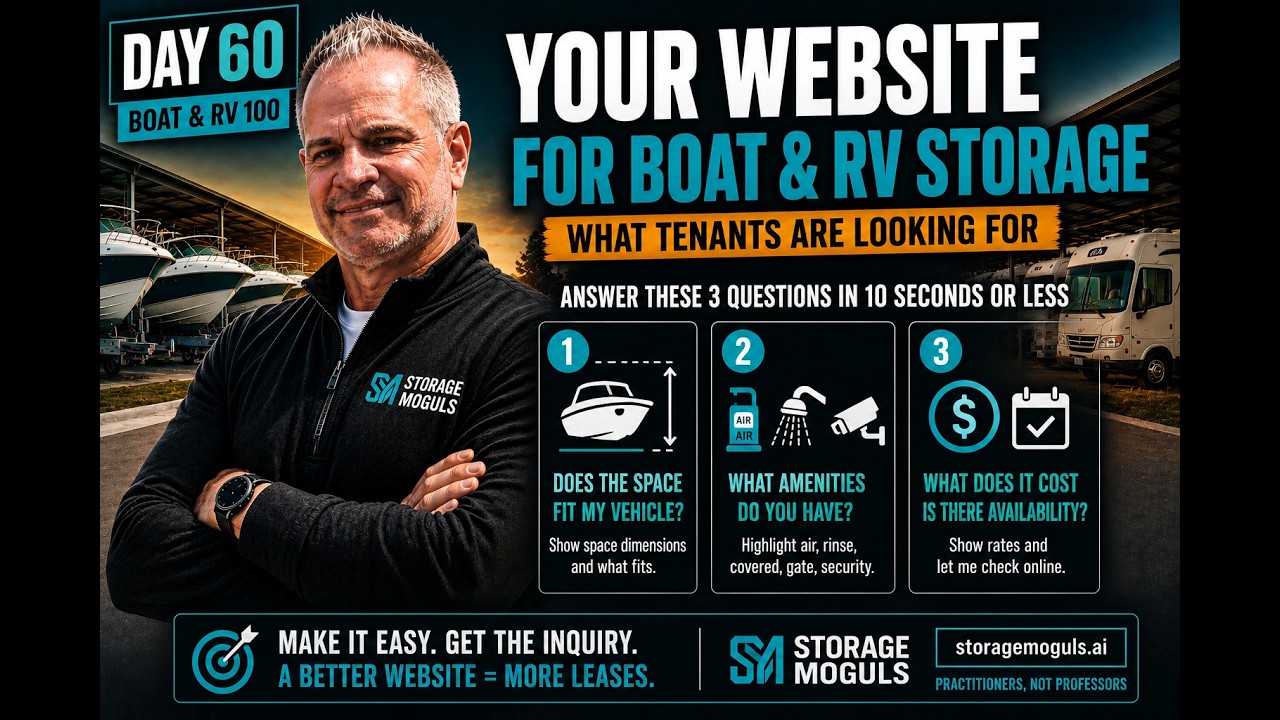
Joe Downs explains how a boat or RV storage website has ten seconds to answer three questions: Does the space fit my vehicle? What amenities are available? What does it cost? He recommends a detailed space chart, visible amenities, and pricing above the fold, plus SEO keywords like "boat storage [city]" timed before July to catch the summer traffic spike.
Chapters
Howdy folks, and welcome to day 60 of the Boat and RV 100 series. I am Joe Downs with the Storage Moguls, and folks, your website has about 10 seconds. That's how long a boat and RV prospect will wait before they decide whether you're the right operator or they go back to Google. And today we'll cover the 3 questions they're asking and why most storage sites in this vertical don't answer any of them, because these are the types of things we do in this community. This is what we talk about in a community of practitioners. Every deal we teach, we've touched. And the sweet spot of these deals, $400,000 to $2 million. And who's buying them? People like you, couplepreneurs, solopreneurs, entrepreneurs, and they're all doing it right now. And how do they get started? Well, they're starting at storage moguls.ai. It's free to start. You can level up at your own pace. Before you know it, you too could have your own facility. But back to today. 10 seconds, 3 questions. So let's make sure your site answers them. Here's the context that makes this episode specific to boat and RV. Self-storage tenants search broadly and often with low urgency. They're looking for a unit near them. They'll comparison shop and they'll take their time. Boat and RV tenants, they search seasonally and specifically. When a boat owner searches Boat storage, insert city, in August. They have a specific vehicle, a specific size requirement, and a timeline. They're not casually browsing. They need 3 pieces of information fast. Does your facility have a space that fits their boat or their RV? What amenities does your facility have? Air, rinse station, covered spaces? What does it cost and is there availability? A storage website that answers all 3 of these questions on the homepage without requiring the visitor to scroll, click, or call has done its job. A website that buries pricing on a separate page, doesn't specify space dimensions, and has one exterior photo from 8 years ago is losing move-in-ready prospects to whoever built a better homepage. The gap between most boat and RV storage websites and what the prospect needs is very large, and that's your opportunity. And this is a fixable problem. Here's the 3-question test. Open your website right now and see if a first-time visitor can answer all 3 of these questions without scrolling and clicking. Question 1. Question 1. Do you have a space that fits my vehicle? Your homepage should have above the fold without scrolling, a space size chart or a simple dimension list. Not, we have spaces for boats and RVs. You actually wanna show the specific dimensions, 12 by 35, 14 by 45, 16 by 60, whatever you have with vehicle types mapped to those dimensions. Jet skis and small boats, midsize boats, travel trailers. Class A motorhomes and large fifth wheels. Tenants with a 28-foot sailboat on a trailer, they need to know immediately whether you can accommodate them. If they have to call to find out, half of them won't. Question 2, what amenities do you have? A simple amenity icon row or a quick bulleted list like air station, rinse station, covered spaces available, Bluetooth gate access, security cameras, all above the fold. Question 3, what does it cost and is there availability? At a minimum, you should have a rate range and a check availability button. Ideally, an online rental or reservation system that lets them reserve without calling. Every additional step between prospect and reservation is a prospect you're losing. The space size chart. This is the single most underrated, underutilized element on boat and RV storage websites. I've seen dozens of storage websites in this vertical. The majority do not have a space size chart. They have a contact form and a photo of the facility. The space size chart is the most specific, highest value piece of content you can put on your website for this vertical because it answers the first and most critical question immediately. What the chart should include, the space dimension. The vehicle types it accommodates and whether it's open air or covered. So for example, you have a 12 by 35 open air or boats up to 26 feet on a trailer, personal watercraft, small travel trailers. That answers that question. Is that, that space size? 14 by 50 covered boats up to 38 feet, Class C motorhomes, large fifth wheels. 16 by 60 covered Class A motorhomes up to 45 feet, large center consoles, tandem axle trailers. This chart eliminates the most common pre-inquiry phone call, do you have space for my boat? And it filters for qualified prospects. A tenant who lands on your site, sees the chart, confirms their vessel fits, and clicks to reserve is a better lead than a tenant who calls to find out and then calls 3 competitors. SEO is all about keywords that matter and when. The search terms that drive boat and RV storage inquiries are highly localized and seasonal. So your primary targets, boat storage, insert city, and RV storage, insert city. Secondary targets, same thing, covered boat storage, city, enclosed RV storage, city, boat storage nearby, name a landmark or a marina. These are high-intent, low-competition keywords in most markets, not because boat storage isn't searched, it is, but because most facilities in this vertical have not optimized for them. A well-structured website with a dedicated page title of boat storage in the city, then name your facility, and relevant content covering your space dimensions, amenities, and rates will rank organically for these terms in most local markets. The timing matters as much as the optimization as well. Search traffic for these terms spikes in August and September, so your website needs to be indexed and optimized before July. A website you're building and optimizing in August is optimizing for next year. Here's 4 additional elements that convert boat and RV website visitors at higher rates. So your amenity photo gallery. Gallery. Actual photos of your air station, rinse bay, covered spaces, and drive aisles, not stock photos. Have ones from your facility. Tenants want to see what they're getting. A photo gallery with 10 to 15 current high-quality facility photos dramatically outperforms a website with one exterior shot. Have a seasonal availability indicator as well. Something as simple as fall move-in specials available. Or limited covered storage, or currently at capacity, join our waiting list. This communicates demand and urgency, and it also gives returning visitors a reason to check back. Online rental and reservation gives the ability to reserve or initiate a lease online without a phone call. In this vertical, when tenants are often searching at 9 PM or later, after they've gotten back from the marina, maybe, the ability to complete the process online captures inquiries that would otherwise go cold by morning. Show your review badges as well by having your Google rating prominently displayed. You know, a 4.8-star rating with 40 reviews is a trust signal that self-storage facilities in your market can't typically match. Put it above the fold. Here's some failure modes on most boat and RV storage websites. A homepage that leads to the stock photo of a generic storage facility and the facility name in large text, or no dimensions, no amenity lists, pricing buried on a separate rates page with no indication of availability, a contact form is the only call to action, or no SEO targeting of boat storage insert city, RV storage this city, uh, the mobile experience that requires zooming and scrolling to read Or the photos last updated when the website was built. Every one of these is fixable without a major rebuild. The space size chart is an afternoon work. The amenities list is 10 minutes. Optimizing the page title for local boat storage keywords, that's a single edit. The online reservation capability may require a platform integration, but many property management systems already have this built in. The operators who address these gaps before August capture the search window. The ones who don't send those prospects to the competitors who did. Here's the frame. Your website's the first 10 seconds of your leasing conversation. If it answers these or those 3 questions— space fit, amenities, cost and availability— your prospect has a reason to call and reserve. If it doesn't, they're back on Google in under a minute. All right. Next up, day 61, managing the seasonal occupancy gap. Filling summer vacancies. We're going to— we're going into the predictable summer dip and the specific targets that will fill it without discounting your rate floor. Like this video if the 3-question test reveals something on your website that needs fixing. That's an afternoon of work with a direct impact on fall-moving conversions. And subscribe so you don't miss day 61. The summer gap episode covers 5 specific tactics. To fill vacancies without dropping your standard rate, and one of them most operators never think to use. And share this with a boat and RV operator whose website still has no space size chart. This is the highest value fix they can make in a single afternoon. Or don't share it. Join Storage Moguls and write an LOI for that facility. StorageMoguls.ai has the website audit checklist for boat and RV facilities, the space size chart template, and seasonal availability copy. that converts. It's free to join. So join Storage Muggles, answer the 3 questions, make the first 10 seconds count. See you tomorrow.
More from Joe



The tenant only paid for the first month! #selfstorage #horrorstory #realestateinvesting

What happens when a storage tenant stops paying? #selfstorage #realestateinvesting #storagemoguls





