
Day 65: Rate Optimization - The Formula That Can Add 15% NOI Without Adding One Space
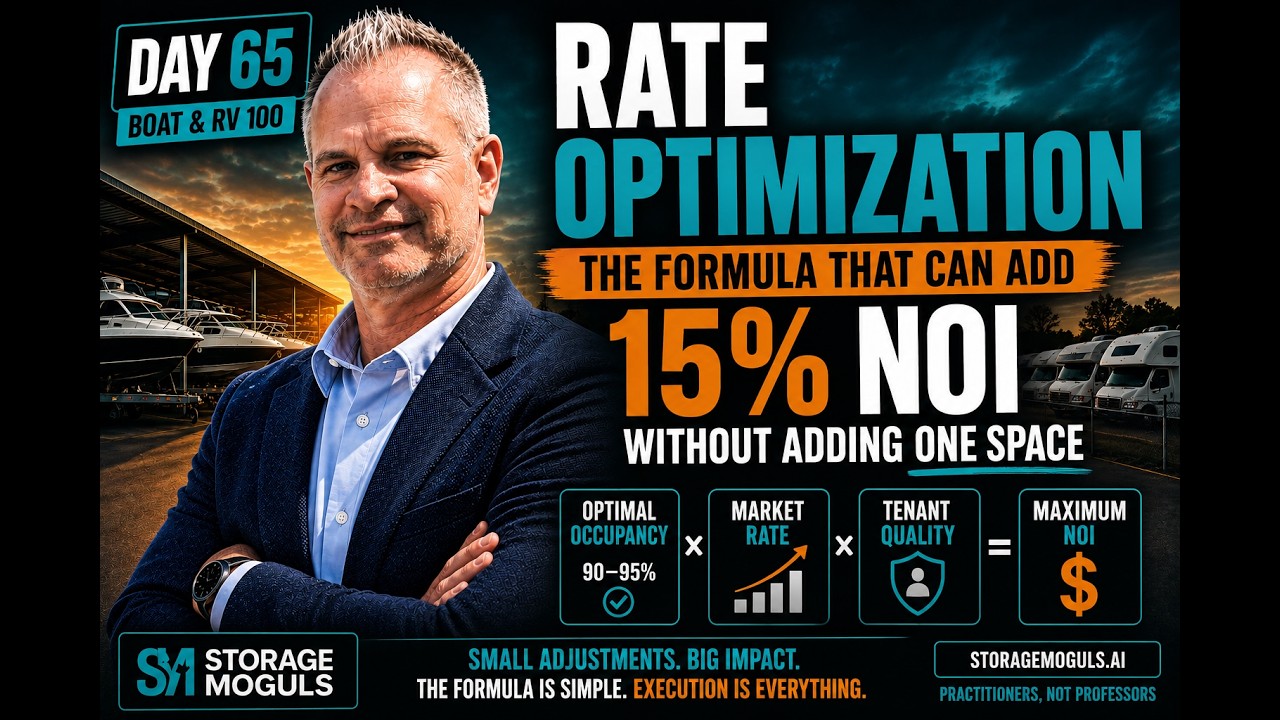
Joe Downs shows boat and RV storage operators how to raise NOI by 15% without adding units. The four levers: charge 40-60% premiums for covered spaces, vary rates seasonally by 10-15%, tier pricing by vehicle size with $20-40 add-ons, and bundle amenities for a $30-60 premium.
Chapters
Welcome to day 65 of the Boat and RV 100 Series. I'm Joe Downs with Storage Moguls. Most boat and RV operators haven't touched their rate structure in 18 months or more. The revenue is already there, the pricing just isn't capturing it. Today we're going to cover the 4 levers that add 15% or more to your NOI without a single new space or a single new tenant. Folks, if you're looking for a room full of real operators doing real deals in the sweet spot range of $400,000 to $2 million, Talking about stuff like this, you're going to want to join storagemobiles.ai. It's free to start and you can level up at your own pace. We've got the full path for you there. But back to today, because the money is already in your facility, I'm going to show you how to go get it. Here's the diagnostic that starts the conversation. When did you last raise your rates? If your answer is more than 18 months ago, you are almost certainly underpriced relatively to your market. In boat and RV storage, the market moves. Arena rates move, campground rates move. Competitive facilities that have been optimizing their pricing are moving their rates annually. If you haven't, the gap between what you're charging and what the market will bear has been growing quietly for 18 months, 2 years, maybe longer. Before we get into the 4 levers, run this simple test. Take your current occupancy. Let's say it's 85 spaces at $180 a month. Model a 5% increase, a rate increase across 80% of your spaces. That's 68 spaces going from $180 to $189 a month. That's an additional $9 per month per space. That has an annual impact of 68 spaces times $9, 12 months, $7,344. At a 7 cap, that additional $7,344 In additional annual income is worth $100,000, almost $105,000 in asset value. That's from a 5% rate increase on 80% of your spaces. The math does the convincing. Most operators who run this exercise understand immediately why rate optimization belongs at the top of the revenue agenda. So here's the rate lever, or here's rate lever 1, I should say. Space type differentiation. Not all spaces in your facility are worth the same rate. And if you're charging the same rate for covered Class A space and an open-air spot in the back row, you're leaving money on the table. The differentiation framework is this: covered versus open-air is the most obvious tier. Covered spaces command a 40 to 60% premium, as we covered in Day 56. Within open-air, additional differentiation is possible. Pull-through spaces where the tenant can drive in and pull out without backing up. They also command a premium over back-in spaces, particularly for large Class A motorhomes. Premium location spaces are typically first row from the entrance, closest to the amenity stations, or have the best gate access, and they command a premium over interior rows. For the pricing architecture, set a base rate for your standard open-air back-in spaces. And add a pull-through premium of 5 to 10%. Add a covered premium of 40 to 60%. Add a location premium of 5 to 10% for the first row or the best access spaces. A facility with this architecture captures the full value of every type of space rather than averaging them across all of them. Rate lever 2 is seasonal variation. We covered the seasonal pricing calendar in day 54. From a rate optimization standpoint, the key point is this: your fall move-in rate and your spring rate should not be the same number. They almost never are in a well-optimized facility. And if yours are, you're not capturing the value of your peak demand window. Fall move-in season is September through November. That's when demand is highest and you have genuine pricing power with new tenants. Remember the standard we've established, a 10 to 15% premium on new move-in rates relative to your spring rate is achievable in most markets. Rate lever 3 is size premium. A Class A motorhome pad, 16 feet by 60 feet deep, requires more land, more drive aisle clearance, and more infrastructure than a travel trailer space at 12 feet by 35 feet. It should command a meaningfully higher rate, not just proportionally to the size difference, but rather reflecting the scarcity premium. Large Class A spaces are the rarest and most sought after in any boat and RV facility. If you have them and you're not charging a distinct premium for them, you're underpricing your most valuable inventory. The differentiation by size looks like this. Jet ski and small boat row. You have a jet ski and small boat row. Small to mid boat and travel trailer. Large boat and Class C or fifth wheel. And Class A motorhome and large vessel. 4 tiers, 4 rates clearly published on your website and in your leasing conversation. Rate lever 4 is the amenity inclusive tier. This is the Platinum tier we covered in day 57. And from a rate optimization standpoint, It's the most powerful lever for capturing the full value of your highest value tenants. The structure is simple. A monthly rate that includes covered storage plus unlimited access to all amenities, air, rinse, vacuum, propane. Tenants who store high-value Class A motorhomes or large center consoles who use the facility frequently are the highest revenue tenants in your portfolio. They're also the ones most likely to value a comprehensive all-inclusive rate that eliminates per-use friction. The Platinum tier captures their full revenue potential in a single rate. Premium is $30 to $60 per month above the covered storage rate. At a facility with 20 Platinum tenants paying average of $45 premium over standard covered storage, 20 times 40 times— or 45 times 12 is $10,800 per year in incremental value. And at a 7-cap, that's about $150 grand in additional asset value from a pricing tier That requires no new construction and no new tenants. Here's the smart calculator exercise, the rate calculator exercise. Run the full 4-lever model on your facility. Take your current rate structure and model the impact of each lever independently, then combined. Lever 1, space type differentiation. Are you covered? Are your covered spaces priced at a 40% premium over open air? If not, What's the incremental annual revenue from closing that gap on your covered inventory? Lever 2, seasonal variation. Does your fall move-in rate reflect a 10 to 15% premium over your spring rate? If not, model the fall move-in volume at the higher rate. Lever 3, size premium. Do you have distinct rates for Class A spaces versus smaller boat or trailer spaces? If not, what's the incremental annual revenue from adding $20 to $40 monthly premium to your largest spaces? Lever 4, the amenity inclusive tier. If you implemented a platinum tier at $45 above your covered rate and converted 15% of your covered tenants to it, what's the annual revenue impact? Run each of these independently, then model them combined. Most operators who run this exercise find 10 to 20% Incremental NOI available within their existing footprint with their existing tenant base at rates the market will absorb. Here's 2 implementation notes. First, rate transparency. Publish your rate schedule or structure, all tiers, all premiums on your website, and have it ready for every inquiry conversation. The operators who are vague about pricing in the leasing conversation leave money on the table because Prospects self-select down to the cheapest option without understanding what the premium tiers include. A clear rate card with the tiers explained converts more tenants to higher tiers than a conversation that leads with the base rate. Second, implement the levers in order of impact and ease. Space type differentiation first. It's the most impactful lever and can often be implemented immediately without Or with your existing inventory. Seasonal variation is second. Implement before your next fall move-in season. Size premium, third. Typically a quick update to your rate structure. And platinum tier is fourth. This requires the most explanation in the leasing conversation but generates the highest per-tenant revenue. You don't need to implement all 4 at once. Just start with the lever that captures the most revenue for your current tenant mix And move on from there. Here's the frame. Rate optimization is not about squeezing tenants. It's about pricing what you've already built to match what the market will actually pay. Most boat and RV operators are underpriced. You got 4 levers already in your facility and already valued by your tenants. Just price them correctly. All right. Please like this video if the 4-lever exercise gave you a number. Run your own facility through it. The gap is almost always bigger than you think. Subscribe to day 66, or subscribe so you don't miss day 66, because we're talking about portfolio building. One facility too many, the sequencing, the capital recycling, and why the first acquisition sets everything else that follows. Know an operator who hasn't touched their rates in 18 months or longer? Do me a favor and send them this video. The math speaks for itself, folks. At storagemuggles.ai, we got the calculator, the pricing template, operators with real NOI results. It's free to join. Join Storage Muggles. Price what you've built. Capture what the market will pay. See you tomorrow.
More from Joe



The tenant only paid for the first month! #selfstorage #horrorstory #realestateinvesting

What happens when a storage tenant stops paying? #selfstorage #realestateinvesting #storagemoguls





