
Day 65: SBA Loans for Self Storage Facilities: The Complete Investor's Guide
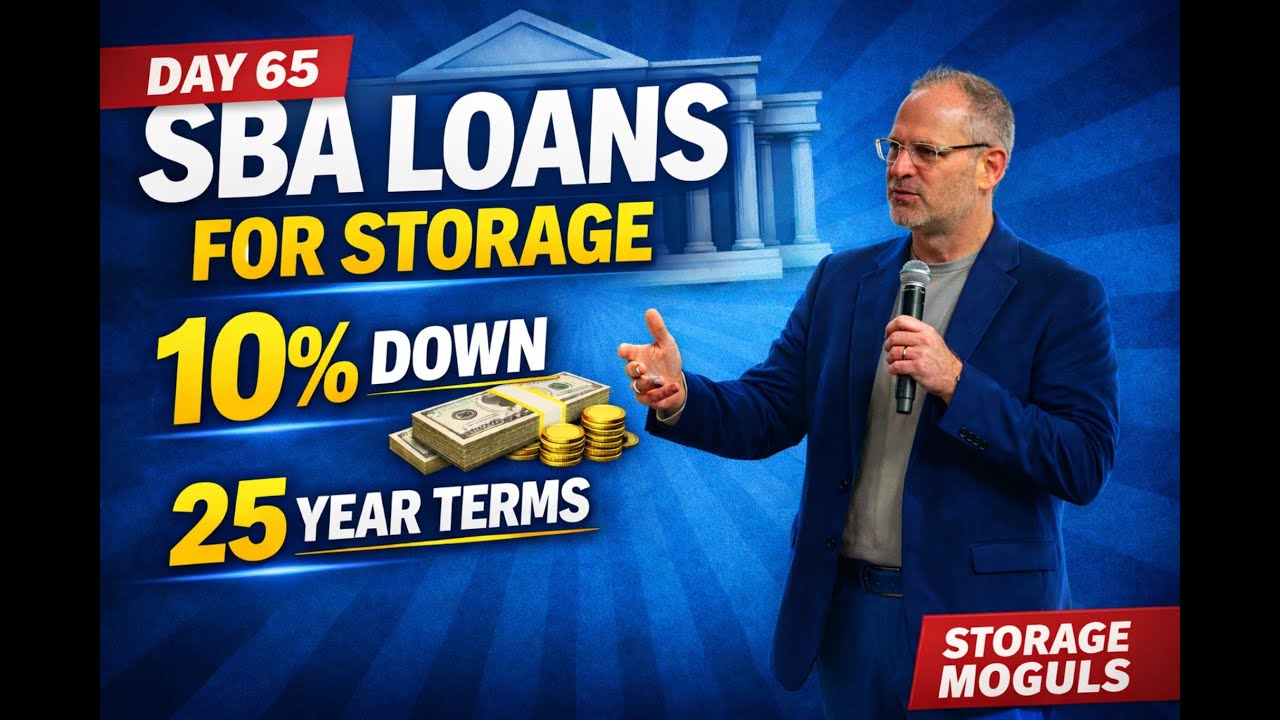
Joe Downs breaks down SBA loans for self-storage, comparing the 7(a) loan (up to 25-year terms, 10% down) and 504 loan (23-year blended term). You need a 650+ credit score and must use at least 51% of the space for business operations. Expect 8-14 weeks for approval.
Chapters
All right. Howdy folks. It is officially day 65 of the Storage 100 series. Of course, I am Joe Downs with the Storage Moguls Mastermind. Today we are diving into one of the most powerful financing tools for self-storage investors, the SBA loan. This isn't just about getting a loan, folks. It's about leveraging government backing to secure what could be better terms than conventional financing. Oftentimes it is, and you'll see why in a minute. We're going to break down how these loans work and why they're a game changer for acquiring or developing self-storage facilities. The SBA program is often overlooked by new investors who assume it's only for small traditional business. For self-storage, the structure of these loans provides significant advantages in terms of down payment and amortization. And understanding the nuances of the SBA financing can be the difference between a deal that pencils and one that doesn't. And today we're going to cover the 2 main types of SBA loans and then address the critical ownership occupancy rule. First though, let's start with a quick definition of what the SBA actually is. An SBA loan is not a direct loan from the government. It's a loan from a bank that is partially guaranteed by the Small Business Administration. This government guarantee is the key though, for making sure that these loans are attractive to lenders because the SBA guarantees 75 to 90% of the loan. So the bank's risk exposure is significantly reduced. The, this lower risk allows the bank to offer much more favorable terms to you, the borrower. You benefit from lower down payments and longer repayment schedules. And this structure is fundamentally different from a conventional commercial loan where the bank carries all the risk. So the government's goal is to stimulate small business growth, and we can use that to our advantage in self-storage. Now that we know what an SBA loan is, let's look at the 2 main flavors, the 7 and the 504. So now that we've defined what the loan structure is, we need to choose the right program for your self-storage acquisition. Again, the 2 primary options are the SBA 7 and the SBA 504, and they serve slightly different purposes. The 7 is the most common and flexible of the 2, covering everything from real estate to working capital. Both programs are going to require a minimum of 10% down, which is a huge advantage over conventional loans. It's kind of funny to say a minimum of 10. You only have to put 10% down. The 7 offers a longer 25-year term for real estate, which dramatically improves your cash flow. While the 504 is specifically for fixed assets like real estate and equipment, the term though is slightly shorter. It's a 2-part loan and 20 years and 25 years gives you kind of a blended term of roughly 23 years. So it's a little bit shorter than the 7. While the 504 offers a fixed rate, it involves more complex paperwork and a second lender, making the 7 often simpler. The 7's 25-year amortization is a really nice benefit, though, and that brings us to why these loans are perfect for self-storage. The most compelling reason is the low down payment, of course, of only 10%. Conventional loans offer 25% to 30% down. A couple of years ago, 35% down, meaning the SBA loan allows you to keep more capital liquid or even do the deal sometimes This preserved capital can be used for other investments or for necessary property improvements and closing costs. So the 25-year amortization period is another critical factor for maximizing cash flow. A longer amortization means lower monthly payments, which directly increases your cash flow. The availability of fixed rate options also provides stability and protection against rising interest rates. Now, While these terms sound incredible, there is one major requirement you must understand, and that's the owner occupancy rule. The SBA requires you as the business owner to occupy at least 51% of the property square footage. This rule is designed to ensure the loan supports an active operating business, not just a passive investment. Good news is that self-storage facilities are generally considered owner occupied under the SBA's definition. Since you're running the business operations, managing tenants, collecting rent, and maintaining the site, you meet the requirement. You don't need to live there. You just need to operate the business from the site. Most self-storage business buyers easily satisfy this requirement, but it must be structured correctly from the start. Now that we know about the occupancy rule, let's look at the specific requirements you need to meet as a borrower to qualify for these powerful loans. The SBA wants to see a strong financial foundation in you before they back your loan. You'll typically need a minimum credit score of 650+. This is going to be non-negotiable for most lenders. The 10% down payment is a major advantage of the SBA 7 program, but you have to have cash in it. Or have to have the cash to close it. This low down payment is what makes self-storage ownership accessible to first-time buyers, but Be prepared to provide a detailed business plan and financial projections to get it. Lenders need confidence that the business will generate enough cash flow to cover the debt. You will also need to provide a personal guarantee because you are personally liable for this debt. Serious commitment, personal guarantee, but it's actually standard in all SBA loans. And guess what? Pretty much every conventional loan is going to require this as well. So it's there. It's part of the deal. If you're borrowing money, you're probably going to be signing for it. So once you meet these requirements, you might wonder, well, how long does the process actually take? There's a lot of horror stories out there and they're usually true, but for all the wrong reasons. So let's set some realistic expectations for the timeline. If you don't use one of the top SBA direct lenders in self-storage, Then this is what it looks like. It will not be that fast, but knowing the stages will help you manage the wait. The total timeline for a non-preferred lender is typically 8 to 14 weeks from start to finish. You, the borrower, actually factor into that a lot as well. Get your docs in, do what the lender asks, do it quickly. The initial prequalification stage is fairly quick, usually 1 to 2 weeks. This is where the lender's gonna check your basic eligibility and credit profile. The longest phase is application and underwriting, which can take up to 8 weeks with these non-preferred lenders. This is when the lender is going to do deep due diligence on the property and your financials. And then the final SBA approval is relatively fast, usually 1 to 1 to, or sorry, 2 to 4 weeks. You need to be patient, but the long-term benefits of the loan structure are worth the wait, even if you don't use a preferred lender. But you can start the clock till you find the right lender. You can't start the clock until you find the right lender. All right, let's talk about the critical step of finding that right lender, that right financial partner. Not all banks offer SBA loans, and even fewer specialize in self-storage. You need to look for SBA preferred lenders. They have delegated authority to speed up the process. A preferred lender can approve the loan internally, which cuts down on the waiting time. Always ask about their specific experience with self-storage facilities as well. You want a lender who understands the unique economics of this asset class. Get quotes from 2 or 3 different lenders, compare terms and service. Good lenders are a partner who can guide you through the complexities of the process. All right. So we covered the requirements, the timeline, and how to find a lender. So let's summarize the big picture. The SBA 7 loan is a powerful tool for acquiring self-storage. It combines a low 10% down payment with a long 25-year amortization period. This combination dramatically improves your initial cash-on-cash return. The lower debt service means more cash flow stays in your pocket from day one, and this makes it the perfect financing vehicle for first-time buyers entering the market. Yes, the process can take time and requires diligence on your part. But the financial structure it provides is worth the effort and worth the wait. Folks, the SBA program could be the key to unlocking your first self-storage investment. All right. Well, that's the end of day 65 and our overview of how powerful SBA loans can be. And I have a surprise for you that I'm going to drop right now. If you join me for our live on, when I go live on day 76, 11 episodes from now, it's on February 17th at 8:00 PM for this, this recap of this section, the financing section. You will get to ask questions directly from my special guest that night, Anne Mino, who is with the top SBA lender for self-storage in the country. Talk about preferred. They're number one. You might not wanna miss that one, folks. If you don't mind, share this video with your network to help them avoid common financing mistakes. Oh, and if you're ready to start raising capital for your first deal, I haven't talked about this yet. Let me know in the comments. Feel free to comment, by the way, on any of the videos. I don't know why I haven't been telling you that all along. All right. Next up, day 66, local banks versus national lenders. Who's better? Do me a favor, by the way, like this video if you found the SBA financing breakdown helpful. Subscribe to the channel so you don't miss the next deep dive tomorrow into self-storage investing and of course the lives. And by the way, if you know someone buying their first facility, you should definitely share this video with them and I'm sure they will thank you later.
More from Joe



The tenant only paid for the first month! #selfstorage #horrorstory #realestateinvesting

What happens when a storage tenant stops paying? #selfstorage #realestateinvesting #storagemoguls





