
Day 66: Building the Portfolio From One Facility to Many
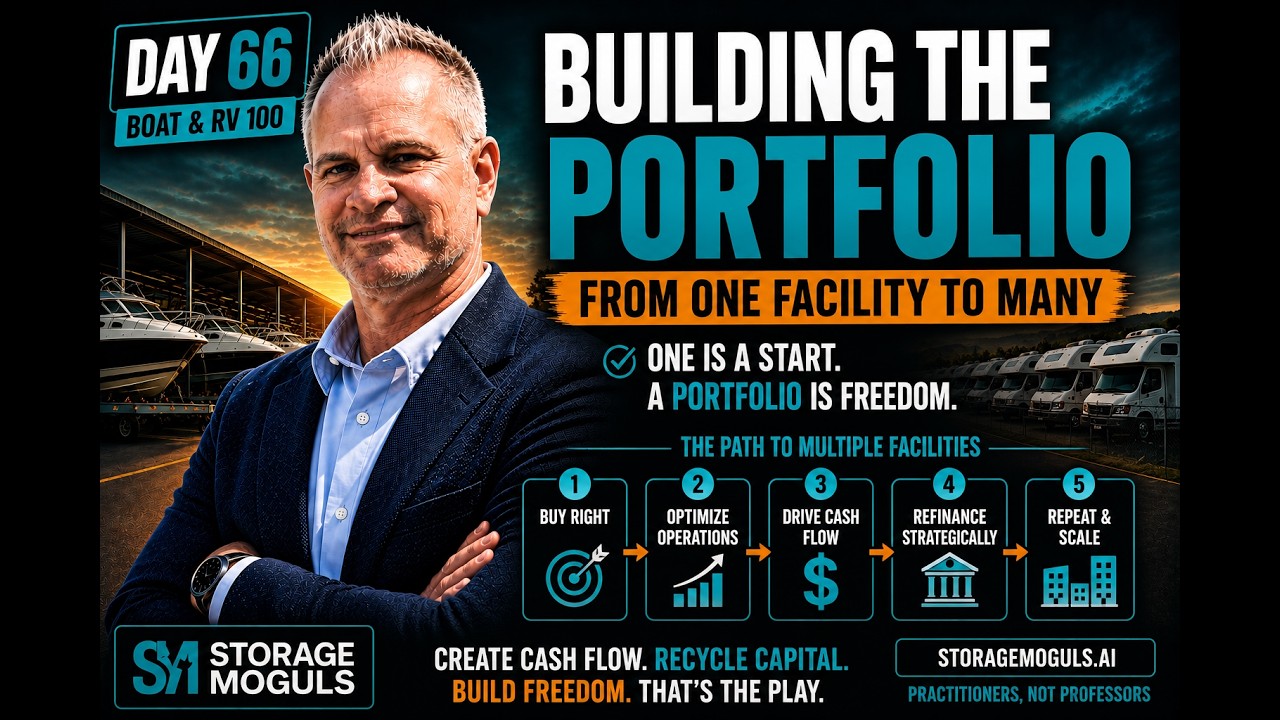
Joe Downs of Storage Moguls walks through scaling a boat and RV storage business from one facility to many. Don't buy a second location until the first runs without you. Document every task, fund growth from cash flow, stay in the same market, and treat your systems as the real asset.
Chapters
Hi folks, and welcome to day 66 of the Boat and RV 100 series. I'm Joe Downs with Storage Moguls. Folks, the operators who build portfolios aren't the ones with the most capital or the most ambition. They're the ones who built the right systems on facility one and then repeated them. And that's the whole playbook. And today I'm going to walk you through it. And that's exactly the kind of thing we dig into at storagemoguls.ai. Real operators working through real growth decisions on real deals. Usually between $400,000 and $2 million. Not theory, not a seminar from 5 years ago. Couplepreneurs, solopreneurs, entrepreneurs who are in it right now, the same as you. You can start for free and you can advance at your own pace. But back to today, because the portfolio doesn't start with facility 2, it starts with building facility 1 the right way. So let's get into it. And let me be direct here about the most common failure mode in the multi-facility expansion. An operator who acquires Facility 1, it performs well. They get excited. They acquire Facility 2 before Facility 1 is operationally stable. Now they're managing 2 facilities in different markets, maybe with different managers, different tenant mixes, different seasonal patterns. And they're doing it with the systems designed for one facility. Facility 2 underperforms because the operator's attention is divided and the systems don't transfer cleanly. Facility 1 regresses because the operational focus that made it work has been diluted. Neither facility performs at its potential, and the operator is overextended. The fix is simple in concept and hard in practice. Don't acquire Facility 2 until Facility 1 is running without you needing to be there every day. That means your manager is trained and trusted, your tenant communication is systematized, your seasonal routines The August renewal calls, the winterization newsletter, the fall marketing push are all in a calendar and executed without prompting. When you can spend 2 weeks focused exclusively on a new deal without FacilityOne showing any degradation, FacilityOne is ready to support a Sequin acquisition. These 5 principles are on the map. Each one gets its own slide with full detail. So let's walk the table briefly and then we'll get into it. You got to nail facility 1 before acquiring facility 2. Systemize before you scale. Document everything so it transfers. Fund facility 2 from facility 1 cash flow. That's the sustainable sequencing. Try to buy your second facility in a same— the same or a similar adjacent market so you can use the local knowledge you already built. And relationships. And principle 5, the operational expertise you build is the compounding asset, not just the real estate. That last one is the one most operators miss. The real estate is important, but the operator who understands this vertical, the seasonal cycle, the tenant psychology, the rate structure, outperforms the one who, who simply holds more properties. Slides 4 through 7 go deep on each principle, so let's get into it. Principle 1, nail the operations on facility 1 first. The operational test is not, is the facility performing? It's, is the facility performing without me? Those are 2 very different questions. A facility where the owner is answering tenant calls, handling billing issues personally, and making every maintenance decision is not a systemized facility. It's a job. The transition from Facility 1 as a job to Facility 1 as a system happens through documentation and delegation. So you got to document every recurring task, your seasonal communication calendar, your manager's weekly walkthrough checklist, your lease signing process, your fall inquiry call script. Every process that currently lives in your head needs to live in a document that someone else can execute. Delegate those documented processes to your manager. Verify they're being executed correctly, then give it one full seasonal cycle, spring through fall, where the facility runs on the system, not on your daily involvement. After that cycle, if the facility is at or above its performance baseline without your constant attention, then you're ready to look at facility 2. Principle 2, systematize everything before you scale. The systems that make a single facility operation work do not automatically scale to a multi-facility portfolio. You have to design them to be repeatable. Here's what that looks like in practice. Tenant communication templates, your August renewal letter, your winterization newsletter, your fall move-in announcement, your rate increase notice, with each one documented, written, and stored where any member of your team can send it. Amenity maintenance checklists, the weekly walkthrough we covered in day 57, applied consistently across every facility, tracked and logged. For the seasonal rate calendar, your fall rate setting process, your spring retention outreach, your summer gap marketing all have to be on a calendar with responsible parties assigned. And the manager onboarding guide, the document a new manager at any of your 4 facilities can read to understand how you operate, what your standards are, and what decisions they're empowered to make without calling you. This documentation investment takes time upfront. But it pays back at every facility you add because each new facility inherits a system instead of starting from scratch. Principle 3, use Facility 1 cash flow to fund Facility 2 equity. The capital sequencing that works for most small portfolio builders in this vertical is straightforward. Acquire Facility 1, stabilize and optimize it. Rate optimization, covered storage addition if warranted, amenity revenue. After 18 to 24 months of stabilized operation, Facility 1 should be generating plenty of cash flow above its debt service and operating expenses. That excess cash flow is your equity contribution towards Facility 2. The advantages of this approach are that you're not overleveraged because each acquisition is partially funded by the cash flow of the previous one. Your lender sees a stabilized cash-flowing asset when you apply for Facility 2 financing, which improves your loan terms, and your operating systems are tested on Facility 1 before they need to support a second asset. This is not the fastest path to scale. It's the most sustainable one. The operators who use acquisition debt aggressively to build quickly sometimes create portfolios where multiple facilities are simultaneously unstable unstabilized and cash flow negative. That's a fragile position in a seasonal business. One bad occupancy year at the wrong time creates real distress. Cash flow funding of equity is slower but builds a portfolio that can absorb a difficult season without structural problems. Principle 4 is to try to build your second facility in the same or adjacent market. The first instinct for some operators is to diversify geographically. Put facility 2 in a different state, different climate, different market. The operational argument against this is that every new market requires you to rebuild your local knowledge from scratch. You don't know the marina community. You don't know the competing facilities. You don't know the seasonal pattern nuances. You don't have the manager relationships, A second facility in the same market as your first or within a 2-hour radius inherits much of that same local knowledge. Your existing relationships at marinas and dealerships now serve 2 facilities. Your manager network knows the market. Your seasonal marketing expertise applies directly. The operational efficiency of adjacent market concentration is significant, and it also creates referral network benefits. A tenant whose specific vehicle type doesn't fit Facility 1 Might be able to be referred to Facility 2. 2 facilities serving the same market with different inventory profiles becomes complementary, not competitive. This is the Mogul's model. Operational expertise concentrated in markets we understand, not spread thin across geographies we're still learning. Principle 5, the operational expertise is the compounding asset here. The real estate is important, but in boat and RV storage, the operator who understands the seasonal cycle, knows how to convert fall inquiries, runs the retention calendar, manages the rate structure, and builds the community referral network outperforms the operator who simply holds more properties. The expertise you build in facility 1, managing the seasonal swing, cultivating tenant loyalty, optimizing rates, running the maintenance standard, that expertise is more valuable at facility 2 than any individual property characteristic. And it compounds. The third facility benefits from what you learned on the second. The fourth benefits from the third. Each acquisition is easier than the last, not because you have more capital, but because you have more operational knowledge, better systems, and a more refined judgment about what makes a boat and RV facility perform. That's the room we're building at Storage Moguls— operators who are compounding expertise across facilities and across verticals. Here's the frame. The portfolio is built on the system, not on the capital. Nail facility 1. Systematize before you scale. Fund the next acquisition from cash flow. Stay in markets you understand. The expertise compounds. That's the playbook. If the nail facility for facility 1 first framing landed Like this video. Most operators who struggle on facility 2 skipped a step on facility 1. That's not an option— an opinion. It's a pattern we see consistently in this community. And subscribe for day 67. Adjacent opportunities: marinas, RV parks, mixed-use storage. Once you understand how to serve the boat and RV customer, the skill set transfers directly to asset classes most operators never consider. That episode is worth catching. Share this with an operator thinking about Facility 2 before Facility 1 is running without them. This is the episode that makes the case for waiting and tells them exactly what to build while they do. And that's the kind of conversation happening every day at storagemobiles.ai. Operators who've made the transition from Facility 1 to many, or one facility to many, sharing what worked and made real growth decisions on real deals between $400,000 and $2 million. It's free to join. Join Storage Muggles, build the system, let it run, then grow it. See you tomorrow.
More from Joe



The tenant only paid for the first month! #selfstorage #horrorstory #realestateinvesting

What happens when a storage tenant stops paying? #selfstorage #realestateinvesting #storagemoguls





