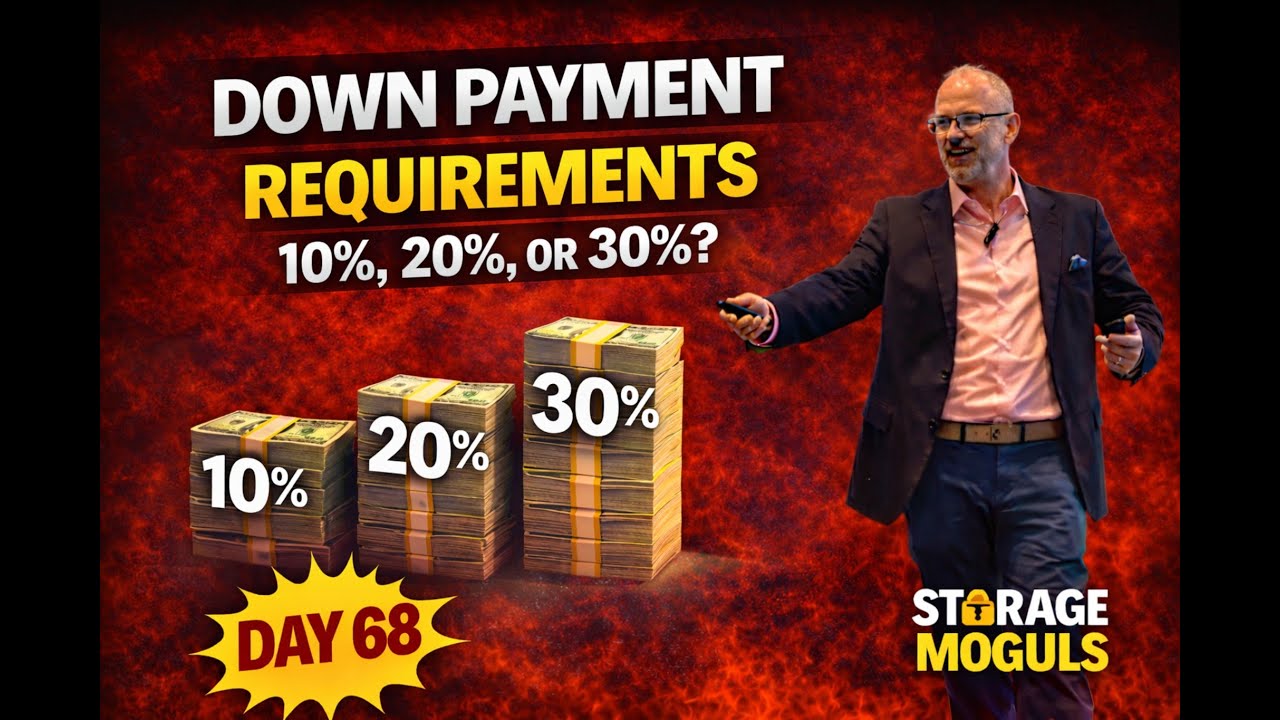
Self-storage down payments typically run 10% for SBA loans, 20-25% for conventional bank financing, and 30%+ for conservative deals. Each tier affects your leverage, cash flow, and approval speed differently. Joe Downs covers the trade-offs and how to source equity through partners, seller financing, or self-directed IRAs.
Chapters
All right. Welcome back to the Storage 100 series. This is day 68, and I am your host, Joe Downs, with the Storage Moguls Mastermind. And today we're tackling an important question in self-storage. How much cash do you actually need to close on a deal? The down payment is your first major hurdle, and it directly impacts your leverage and your risk profile. We often hear people assume a standard 20% down, but that's not always the case in commercial real estate. The amount required can swing wildly from as low as 10% to as high as 30% or more. And this range depends entirely on the type of loan you pursue and the lender's perception of the deal's risk. So understanding this spectrum is key to structuring your capital stack efficiently. In this episode, we're going to break down the 3 main tiers of down payment requirements and what each one means for your investment strategy. So let's start by looking at the full spectrum of down payments. You will encounter in the market. So the down payment spectrum shows us that there isn't a single magic number for commercial self-storage financing. We see 3 primary tiers here, each tied to a different type of financing and risk tolerance. So the 10% tier is almost exclusively reserved for government-backed SBA loans, which we've covered the other night. And these are designed to help first-time buyers. The 20 to 25% range is the conventional standard for commercial banks and non-SBA financing. And then finally, the 30% or higher tier is for riskier deals, properties with major issues, or just very conservative lenders. Your goal should be to understand which tier your deal falls into and then pursue the appropriate financing. And we'll start by diving into the most accessible option for new investors, which is the SBA loan. The SBA loan is the gold standard for minimizing your cash outlay, requiring only 10% down. And this is the lowest down payment available in commercial lending space. Allows you to keep more significant cash reserves. Government guarantee is what makes this possible. So the SBA backs a large portion of the loan, which reduces the lender's risk, the bank's risk. So this makes it the best entry point for first-time buyers who have strong personal financials, but limited capital. But remember, this low down payment comes with a trade-off. They require you to put provide a personal guarantee on the debt. Pretty much all loans do these days, but this means your personal assets are on the line if the business fails. So let's compare this to the more traditional route, conventional financing. So moving up the spectrum a little, conventional loans, which require a significantly higher cash commitment, typically to 25% down, maybe 30%. This is the standard financing you'll encounter when you move beyond the SBA government-backed structure. And the upside is that the conventional loan usually offers higher loan amounts since they aren't subject to SBA lending limits. So, um, that, by the way, not LTV in loan amounts, dollar amounts. You also benefit from much faster approval process because you bypass the government's extensive red tape, assuming you're not using a preferred lender. However, you must be prepared to commit substantially more cash upfront to secure the deal. The lender is taking on more risk without the SBA guarantee, so they demand more equity from you to mitigate it. So this brings us to the core question: why do lenders care so much about the size of your down payment? The down payment is the lender's primary tool for mitigating risk, and it's also about how much skin you have in the game. So a lower down payment directly correlates to a higher risk for the bank. When you put down more equity, You have a greater financial incentive not to walk away from the property. This equity acts as a crucial loss protection buffer for the lender. So if the property value drops or the business struggles, the lender is cushioned by your initial investment before they would see any sort of loss. The more cash you commit, the safer the deal looks to the underwriter. All right. So now let's explore the critical tradeoff between conserving cash and maximizing your leverage. One of the core decisions you make in real estate is balancing the use of cash versus the power of leverage. This trade-off determines your growth speed and your financial stability. A 10% down payment means high leverage, which lets you buy more properties faster because the strategy ties up less of your cash and therefore maximizes your potential for growth. Conversely, a 30% down payment means lower leverage, But more cash tied up. And this approach maximizes your equity, but also results in lower monthly debt payments. So you have to choose the strategy that aligns with your investment goals. Are you focused on rapid portfolio expansion or on maximizing equity and cash flow stability? All right, let's look at options for investors who don't have the full down payment ready. Because we don't want to let a lack of capital stop you. If it's a deal, the money will find it. So there are some creative ways to structure the deal. One common method is bringing in an equity partner who provides the capital while you provide the expertise. Another option is seller carry financing, where the seller carries a small second loan for part of the down payment. You can also utilize a self-directed IRA to roll retirement funds into real estate on a tax-advantaged basis. Always check with a professional on that. But remember, it's always better to build slowly and save up the capital you need. These strategies will help you acquire the asset, but we need to understand the impact of the monthly cash flow. Because the size of your down payment directly impacts your monthly cash flow, which is critical for stability. A lower down payment, say 10%, means higher debt service payments each month. This results in a significantly lower net cash flow from the property. A higher down payment, like 30%, leads to much lower monthly debt payments, and this results in a higher, more stable cash flow from the asset. You want to find the right balance between maximizing leverage and maintaining a healthy cash flow buffer. The goal is to avoid being cash flow negative, especially when unexpected expenses arise. All right. To wrap up, let's look at the typical down payment ranges you'll encounter in commercial real estate. And these percentages are not rigid rules, but they represent common market expectations. So a 10% down payment is often seen with SBA loans, which are best for your first few deals. The standard conventional loan requires 20%, 25%, maybe 30% down. And this is the most common range for stable performing assets. And then a 30% down payment is again considered on the conservative side. You might even see up to 35% required for a little more riskier of a situation. This higher equity stake protects the lender when the asset is less stable or less proven. And the right percentage depends entirely on the asset, the lender, and your personal risk tolerance. All right, folks. Well, that's a wrap on today. And if you found this information helpful, please hit the like button. Next up tomorrow. Day 69, fixed versus variable rates, making the right choice. So subscribe to stay ahead of the curve and receive our daily storage video drops. And don't forget to share this video with someone who needs to understand down payment strategies. They'll thank you later.