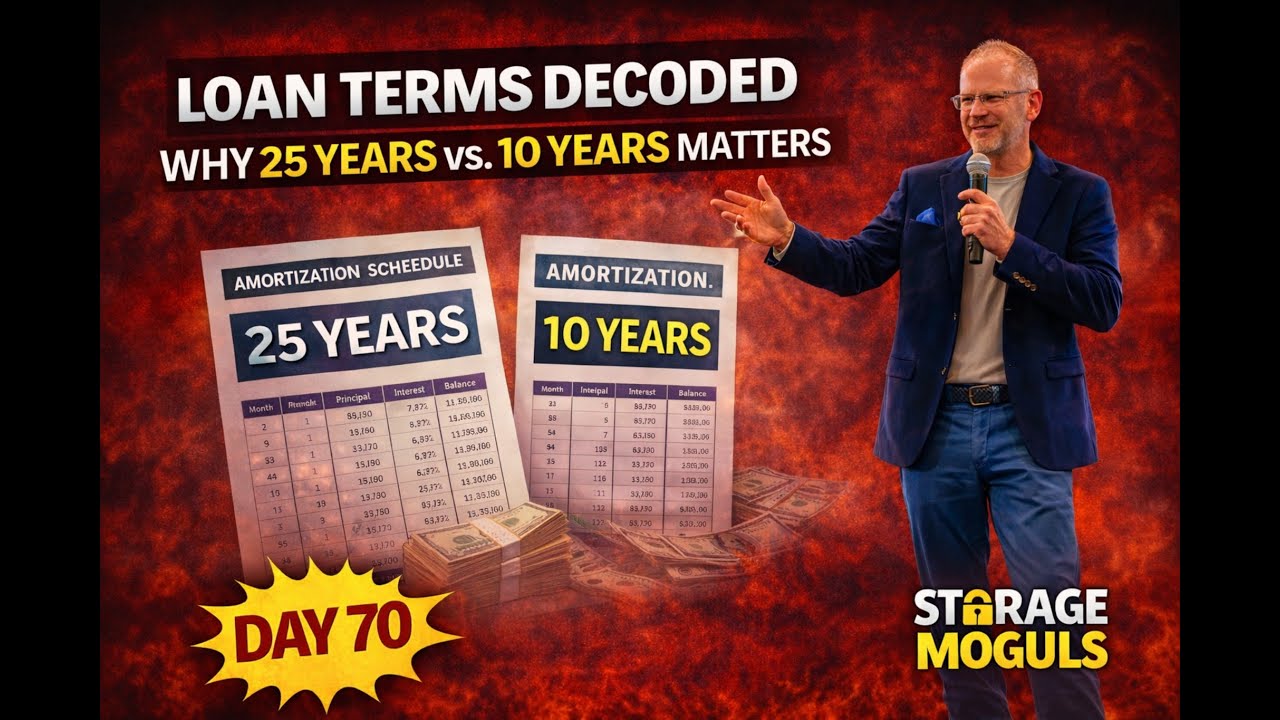
Joe Downs compares 25-year and 10-year loan terms for self-storage deals. A $1 million loan at 6% creates a $4,659 monthly payment difference. He recommends the 25-year term for cash flow flexibility, then pay extra principal when you can.
Chapters
All right. Welcome back to the Storage 100 series. It is day 70 and I am Joe Downs with the Storage Moguls Mastermind. And today we are decoding the loan terms that truly impact your self-storage investment returns. And I want to demonstrate the difference between a 25-year amortization and a 10-year amortization schedule so you can see how powerful amortization can be. Sorry, we say 25-year AM and 10-year or 20-year AM, but what we mean is amortization. Can't help it. Anyway, the length of the amortization term directly and can significantly affect your monthly cash flows, your total interest paid, and how quickly you build up equity. So we're moving beyond simple interest rates here to look at the structure of the debt itself. Understanding this distinction is key to maximizing profitability in commercial real estate. It can be the difference between optimizing for immediate cash flow versus long-term wealth accumulation, and usually even between a deal that you can do and a deal you can't do. But let's start by defining the core concept between, or we'll be discussing here, which is amortization itself. So amortization is simply the length of time it takes to fully pay off the principal and interest on the loan. So this concept dictates the structure of your repayment schedule. So a 25-year term means the loan is structured to be fully paid off in 300 monthly payments. A 10-year term means you're paying off the same principal amount in only 120 payments. The key takeaway is that a longer amortization period always results in a lower monthly payment. And that's because you're spreading the principal and repayment over a much longer timeline. But remember, a lower monthly payment doesn't mean you're paying less overall. So we need to analyze the trade-offs starting with the benefits of the 25-year option. 25-year amortization schedule is the standard for a reason, and primarily it's driven by cash flow. The significantly lower monthly payment is the biggest pro, freeing up capital for other uses. This improved cash flow is crucial for the early years of your self-storage facility. It also makes it easier to qualify for the loan as your debt service coverage ratio, or DSCR, will be higher than the same loan with a shorter term. A higher DSCR signals to the lender that you have a greater margin of safety to cover the debt. And this structure aligns well with a long-term hold strategy typically of Commercial real estate, but these benefits come with a cost, which we need to examine next. So while the 25-year term offers cash flow advantages, the main drawback is the total interest paid. You're paying interest for a quarter of a century, meaning the total cost of loan is much higher. This extended timeline also means you build equity much slower in the initial years because early year payments are heavily weighted towards interest, with very little going towards the principal. You're also committing to a long-term debt relationship with the lender. This lack of financial freedom can be a significant constraint for some investors. All right. Now let's contrast this by looking at the aggressive approach of a 10-year amortization. So a 10-year AM is the fast track to debt freedom and maximizing the long-term returns. The most compelling pro is the massive reduction in total interest paid over the life of the loan. You are debt-free in a decade, eliminating the interest expense entirely. This aggressive schedule means you build equity at a much faster rate. More of your monthly payment goes directly towards increasing your ownership stake. This option provides financial freedom and flexibility much sooner than the 25-year term. But the speed comes at a price, which we'll discuss in the next slide. The primary drawback is the much higher monthly payment you are locked into. This higher payment immediately kills your early cash flow. Which is critical for property stabilization. Less cash flow means you have less capital available for necessary property improvements or unexpected repairs. And here's a major hurdle. The higher payment makes it harder to qualify for the loan in the first place. Lenders use that DSCR, debt service coverage ratio, and a higher payment lowers that ratio. A lower DSCR means the bank sees the deal as riskier. Making approval much tougher. So while you pay off the loan faster, you might not even get the loan. So let's look at a concrete example to see how dramatic this cash flow impact is. The higher payment from a 10-year term isn't just a small difference. It creates a massive cash flow gap. So we're comparing a standard $1 million loan at a 6% interest under 2 scenarios here. With a 25-year term, your monthly payment's only $6,443. This payment allows for a healthy DSCR and keeps the property cash flow positive from day one. Now you look at the 10-year term, the monthly payment jumps to $11,102. It's a difference of $4,659 every single month. This difference is almost $5,000 you cannot use for operations, reserves, or distributions. And this higher payment creates tighter cash flow, makes the property much harder to qualify for with the lender, considering that DSCR. So this huge gap explains why most sophisticated investors choose the longer amortization period. The choice for most experienced investors is clear. They choose the 25-year ARM and it comes all— it all comes down to control. Cash flow is king in commercial real estate. You must protect it above all else. The 25-year term gives you ultimate flexibility and maximum control over your capital. You can always choose to pay extra principal and pay the loan off in 10 years if you want to, but you're not legally forced to make that higher payment every month. This creates a crucial safety margin. Lower mandatory payments protect you if vacancy rates spike or if the market softens unexpectedly. Remember this mantra: control your cash flow, don't let the loan control you. And this leads us to the best strategy for maximizing both safety and speed. So here's the closing thought and the best practice strategy we recommend for every investor. You should always take the 25-year term when you're securing your financing. This locks in safety and security for those lower mandatory payments. Then you simply pay the loan like it's a 10-year loan if you want, and you have the cash flow. Your extra cash flow will pay down the principal faster than required. This will save interest in the long run. This strategy gives you maximum safety because your required— your actual required payment is low. It also gives you maximum speed because you're aggressively paying down the principal. This is how you get the best of both worlds, safety and speed. All right. Well, if you didn't understand loan amortization before, hopefully you do now. And if you know someone considering a 10-year loan term, please share this video with them immediately. And if you missed previous announcements, we are building a community of sophisticated investors in the Storage Moguls Mastermind at thestoragemoguls.com, thestoragemoguls.com. Next up tomorrow, day 71, recourse versus non-recourse loans, protecting your assets. Please like this video if you found the cash flow comparison helpful. And subscribe to this channel so you don't miss any of our daily deep dives into subject after subject, topic after topic in self-storage. And finally, share this with a friend who needs to understand the power of the 25-year AM. They'll thank you later.