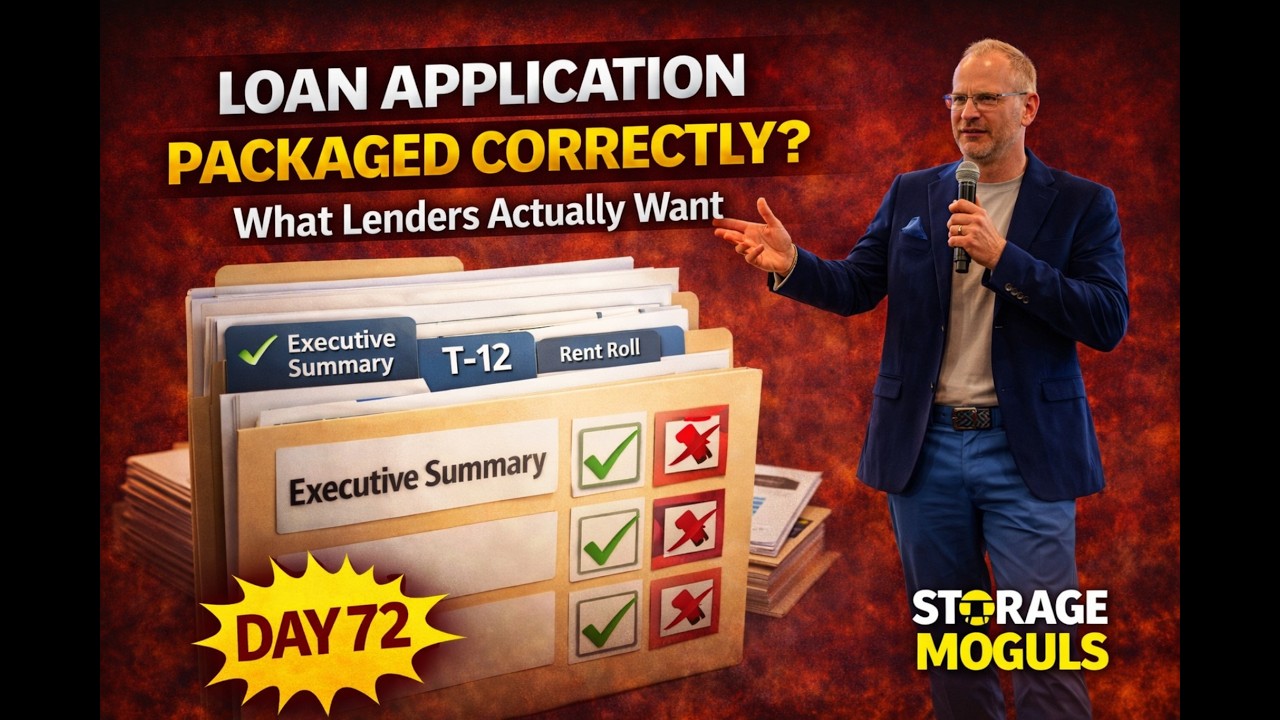
Joe Downs walks through assembling a self-storage loan package that lenders will approve. Five core sections: executive summary, property financials, property details, borrower information, and organization. Missing documents, inconsistent numbers, and weak narrative are the mistakes that kill applications.
Chapters
Howdy folks. It is day 72 of the Storage 100 series, and I am Joe Downs with the Storage Moguls Mastermind. And today we're tackling a necessary and important step, how to package your loan application so lenders actually take you seriously. This isn't about just gathering documents, folks. It's about presenting a professional, compelling case for why they should fund your deal. Think of your loan package as your first impression, and you want it to be flawless as you can. Because you can, but knowledge is here. A well-packaged application signals that you are a serious, organized borrower who understands the process, and it makes the lender's job easier, which means your loan gets approved faster. So in this episode, we're going to break down exactly what needs to go into that package. And it boils down to 5 main areas that cover you: the property and the deal itself. First, you need your personal financial statement, which shows your net worth and liquidity. Lenders want to know you can weather a storm. Second, you'll include 2 to 3 years of personal and business tax returns to verify your income and your financial history. Third, you'll provide the property's financials like the T12, trailing 12, P&L, profit and loss, and the current rent roll. This shows the property's performance. Fourth, you'll need to include property details like photos, site plans, and a facility description. And finally, the most crucial piece is the executive summary, which is your pitch. All these elements work together to give the lender a complete picture. So let's start by focusing on the most important piece, the executive summary, because the executive summary is the single most important part of the entire loan package. This is your 1 to 2 page pitch, and it's often the only thing the lender's decision maker reads initially. You need to clearly articulate the deal's value proposition and why it makes sense. This summary must quickly cover the property overview, the key financials, and most importantly, your qualifications and experience. Don't bury the lead. Put your best foot forward right here. If the executive summary doesn't hook them, they might not even look at the rest of the package. Needs to be concise, compelling, and professional. Once you have this pitch nailed down, you need to organize the rest of your documents logically. So once you have all your documents, you can't just dump them into a folder. You should organize them logically and well-labeled for the lender. You want to make it easy for the lender, and organized and complete is a great way to start. So start with the executive summary right at the front. This is Section 1, your pitch, and it sets the stage for everything else. Section 2 should contain the property financials like the T-12 and the rent roll showing the performance. Section 3 covers the property details, photos, site plans, market overview, etc. Finally, Section 4 is the borrower information, which includes your personal financial statement and tax returns. And again, label everything clearly. Use headers, And include a table of contents. This level of organization shows respect for the lender's time and makes your application easy to review. But organization isn't enough. Your numbers must also be perfectly aligned. The fastest way to raise a red flag with a lender is to have inconsistent numbers across your documents. Your profit and loss statement numbers should match the figures on your rent roll. Similarly, the financials you present must align with what's on your tax returns and your personal financial statement. Lenders are looking for discrepancies because they indicate sloppy work or worse, an attempt to mislead. If there are legitimate differences, you'll need to explain them upfront in a clear, concise note. Don't make the lender guess or hunt for explanations. This will slow down the process and create doubt with the lender about you and the deal. Consistency builds trust, and trust is the foundation for getting your loan approved. All right. Now let's dive deeper into the specific property financials you need to include. Because when you're putting together a loan application, the property financials are the first thing the lenders scrutinize. You must have a T12 and, and profit and loss statement, which means the trailing 12 months of actual performance, not some optimistic pro forma you created. Lenders want to see reality. You also need a current rent roll, a snapshot of who's renting what right now. And historical occupancy data, ideally going back 3 or more years. This proves the property stability and growth trajectory over time. Finally, don't forget the capital expenditure history and a detailed operating expense breakdown. These documents show the lender you understand the property's true costs and have accounted for necessary repairs and maintenance. Once we've covered the property, we have to prove that you, the borrower, are qualified to take on this debt. So your borrower information package is all about establishing your credibility and proving you have the financial strength and experience to execute your plan. Start with a personal financial statement that clearly outlines your net worth, liquidity, assets, and liabilities. Lenders need to know you have skin in the game and the reserves to handle unexpected issues. Should also include 2 to 3 years of personal tax returns. This is how the bank verifies your steady income and financial stability outside of this deal. Don't skip the resume. It needs to highlight your relevant real estate experience, showcasing deals, deals you've successfully completed and the skills you bring to the table. If you have none in real estate, highlight your professional experience and how it relates and/or whether or not you're in a self-storage mentorship program. Lenders feel more comfortable with first-time buyers when they know there's an experienced set of eyes also looking at the deal. A strong profile is non-negotiable. It builds the credibility that gets your application taken seriously. But even with a strong profile, there are common mistakes that can instantly derail your application. Even the best deals can get killed by sloppy execution. So let's talk about the common mistakes that sink applications. The first is missing documents. Submitting an incomplete package without tax returns or key schedules can cause immediate frustrating delays. Lenders see this as a lack of attention to detail. The second major mistake is inconsistent numbers. If the income on your P&L doesn't match what's on your tax returns, the lender will assume you don't actually know your numbers, and that's another red flag. You also need a clear narrative. If you don't include an executive summary, the lender won't understand your plan or the deal's potential, and they won't chase you for it either. Finally, avoid using outdated information like old rent rolls or stale financial statements. Which signals you're a sloppy operator. You need to submit a clean, complete, and consistent package every time. Remember this simple truth about the application process. The message here is simple and powerful. The quality of your package directly impacts the speed and success of your application. A complete package leads to a faster approval because the lender has everything they need to make a decision. Organized documents create a professional impression. Which builds trust and credibility with the underwriter. Conversely, missing pieces will lead to a dead application. The lender will simply move on to the next deal that's easier to process. You control the narrative by controlling the quality of your submission. I hope you found today's episode informative. If you got value from this, please hit the like button. It helps us reach more people who need this information. Don't forget to subscribe to the channel if you haven't already, so you don't miss any of the Storage 100 series. And remember, next up, day 73, we'll be talking about getting pre-approved, the step everyone skips. Also, you can find us on all social platforms now. The, at YouTube at The Storage Moguls. Website is thestoragemoguls.com. LinkedIn, Instagram, and Facebook, as well as Twitter, X. I still call it Twitter. All Storage Moguls. And lastly, if you know someone's applying for their first self-storage loan, share this video with them right now. They will thank you later for saving them time and frustration.