
Day 78: How to Use Your 401k to Buy a Self Storage Facility (What You Need to Know)
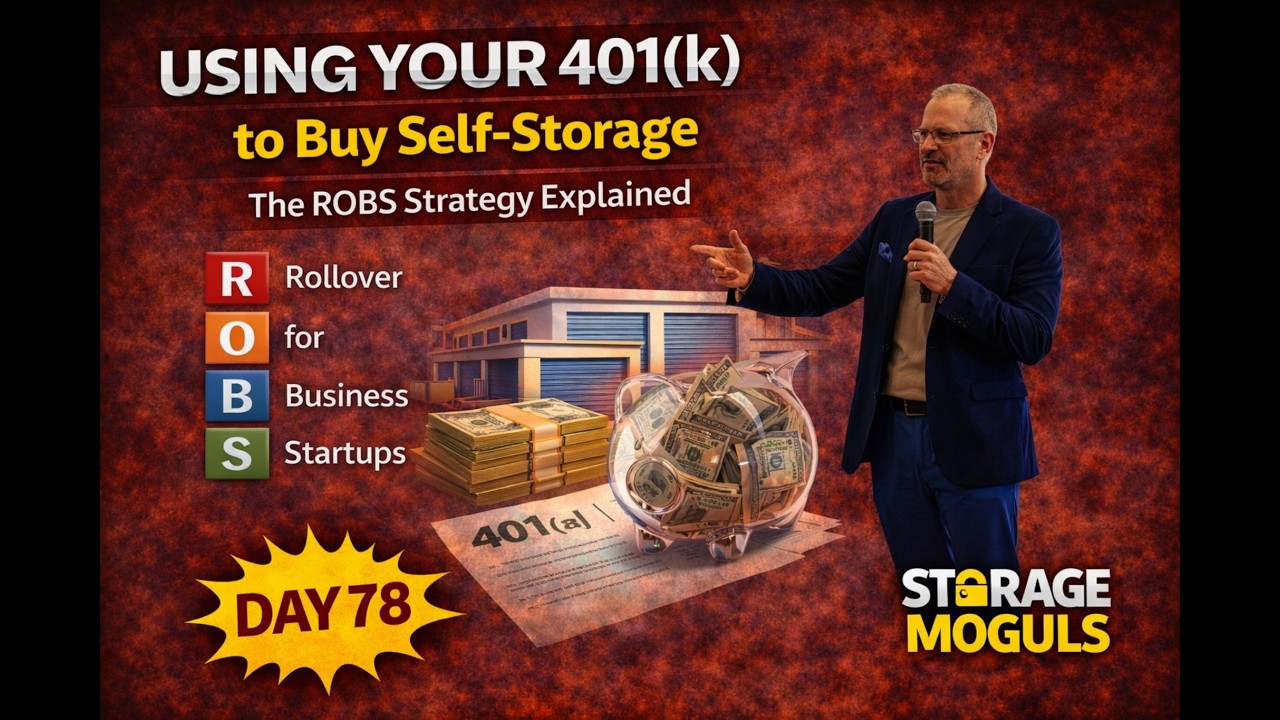
Joe Downs explains ROBS, a strategy to use your 401k to buy a self-storage facility debt-free. You need roughly $250,000 in retirement funds, form a C corporation, establish a new 401 plan, and roll over your money to buy company stock. Setup costs around $4,000 to $5,000, plus $120 to $150 monthly.
Chapters
Welcome to day 78 of the Storage 100 series. I'm Joe Downs, and today we're talking about something that blows people— most people's minds, mine included: using your retirement funds to invest in storage. Yes, it's real, it's legal, and it's more common than you think. And if you want to go even deeper on strategies like this, the Storage Moguls community at storage moguls dot ai again on storage moguls dot ai. is the place to join because it's free. And why is it .ai? Because it's an AI-powered community. We've got GPT tools, multimodal learning content across all storage verticals, and you can start for free, level up at your own pace. But back to what we're tackling today, which is one of the most powerful ways to fund your first self-storage deal is using your existing 401. Most people think their retirement money is locked up. Until they're 59 and a half. And we're going to show you how to unlock that capital and put it to work by buying cash-flowing asset right now. This strategy is called ROBS and allows you to invest your retirement funds into a business you actively run. ROBS stands for Rollover for Business Startups. Rollover for Business Startups. It's a specific legal structure that the IRS has approved for funding a new business. The core idea is that you're rolling over your existing retirement funds into a new 401 plan sponsored by your new business. It's not a loan, it's an investment by your retirement plan into the stock of your operating company. Because it's a rollover, you avoid all the taxes and penalties associated with an early withdrawal. And this is the key distinction: you're not taking the money out, you're moving it from one qualified plan to another. The new business then uses the capital from the stock purchase to acquire assets like a self-storage facility. Understanding this definition is, is important before we dive into the step-by-step mechanics. So how do we actually execute the ROBS strategy? Well, it involves 4 distinct steps. The process starts with forming a C corporation. This is non-negotiable for ROBS. You can't use an LLC or an S corp for this specific type of transaction. Once the C corp is formed, the corporation establishes a new qualified retirement plan. Typically a 401. And then next you initiate the rollover, moving funds from your old 401 or IRA into this new corporate plan. It's a tax-free transfer of capital, makes the whole thing work. Then the last step is where the funding actually happens. The new fund, the new 401 that's now newly funded, that new plan purchases stock in the C corporation. Just like the big Fortune 500 companies that allow employee stock purchase plans. This stock purchase injects the capital directly into the C corp's bank account, which you then use to buy the storage facility. The entire sequence results in your— capitalized with your own retirement money. So now that we know the mechanics, let's look at the powerful benefits this structure provides. Because the mechanics are clear, but the benefits are what make this strategy so compelling for storage investors. First major benefit is debt-free funding for your acquisition. You're investing your own capital, meaning you have no monthly loan payments to the bank. This eliminates interest costs and immediately boosts your cash flow from day one. Second benefit is that you can pay yourself a salary from the business. So unlike passive real estate investing, you're an active employee, which is a requirement of the ROBS structure. This means you can draw a salary and potentially qualify for health benefits from through the company. Finally, the growth of your investment remains tax-deferred or even tax-free if you use a Roth account. The profits generated by the storage facility compound faster because they're sheltered inside the retirement plan. So these benefits are huge because— but sorry, they're huge, but they come with a strict set of rules that you must follow to stay compliant. Because remember, the IRS is watching. So compliance is everything. The most critical rule is the entity structure. You must operate as a C corp. The C corp is the only entity type that you can issue this type of stock that the retirement plan is legally allowed to purchase. Second, you must be an active employee of the business, not a passive investor. This means you have to perform substantial services for the company and receive a reasonable salary for that work. The ROBS structure is designed to fund an operating business, not a pass-through investment vehicle. Passive investment vehicle. The 3rd rule is you have to hire eligible employees. You must offer them— sorry, if you hire eligible employees, you have to offer them the same retirement plan benefits. You don't have to hire employees, but if you do, they get the same benefits you do. An eligible employee is generally someone who would work over 1,000 hours per year. So, you know, it's a big business if that's what you're doing. Failing to follow these rules can result in the entire transaction being disqualified, leading to severe taxes and penalties. We don't want that. Okay, so that's the rules. Now let's talk about who is perfect or who's the perfect fit for this strategy, because it's a strategy tailor-made for a corporate refugee who's ready to fire their boss, right? They're leaving the W-2 world to build their own empire using their own capital. In my opinion, the minimum entry point is having at least $250,000 in retirement funds. This is the threshold where the setup fees become a worthwhile investment. You can make a case for less, but you still need to buy a storage facility and you have to be an active operator, meaning you're an employee of the business. So you need to take on a role like a CEO or a manager because this isn't passive investing. See, the ideal candidate is tired of market volatility and wants control. They want to invest in a tangible asset they can actually manage like real estate. And, and, and because we're using Rob, it's got to be a business. So that's self-storage. So what does this level of control and compliance actually cost you? Well, let's take a look at the numbers. So since we know this is who this is for, let's break down the financial commitment to make this happen. There are 2 main costs. You got a one-time setup fee and then an ongoing maintenance fee. The one-time setup fee is a flat fee, should be between $4,000 and $5,000. This should cover the C corporation, the 401 plan creation, and the IRS determination letter. Should also include the critical rollover execution to move the funds. Ongoing maintenance is likely between $120 and $150 a month, and that covers plan administration, annual IRS filings like Form 5500, compliance testing. Folks, this is not a DIY strategy. You must use a specialized ROBS provider. Compliance is everything here. Don't do this yourself. And a specialist ensures you just— you will stay on the right side of the IRS, and that's the most important thing. These costs are manageable, but let's clear up some common misunderstandings about how the money works. The first myth is that this is a loan against your 401. It is not. It's actually an equity investment since your 401 is buying stock in your C corp. Second myth is that you have to pay the money back monthly. You do not. The reality is that there are no loan payments because it's not a loan. The money stays in the business to fund your operations and growth. Third and most critical myth is that you can use your existing LLC. You cannot. The reality is that you must be a C corporation for this to work. LLCs, partnerships, they cannot issue the specific stock required for the 401 plan to invest in. With those misconceptions now cleared up, let's look at the power of the strategy, which is the ability to unlock your trapped capital. You got money sitting idly in a retirement account that you can't touch and likely aren't happy with how it's invested. This process allows you to put that money to work for you right now into hard assets, real estate. Don't let that capital sit in mutual funds earning minimal returns with outside risk while you're waiting for retirement. You're turning what we call dead money into active cash flow by using the ROBS strategy. It's the fastest way to fund your business without taking on debt. Or giving up equity to outside investors. It's time to take some action and put this knowledge to use, folks. So you've now got the knowledge to fund your business using your own retirement capital. So what's the next step? Well, next is day 79, seller financing, which is the holy grail. All right. Please like this video if you are now a fan of Rob's. Subscribe to the channel so you don't miss any of our daily Storage 100 episodes. And again, share this video with someone Who needs to hear they can use their 401 to start a business? They will thank you later. And remember, your 401 doesn't have to sit in a mutual fund earning 7%— 7.8%, I think, is the historical national average— while you build someone else's dream. We can do better than that in self-storage. Self-directed retirement accounts can be a game changer for storage investors and for your life. If you want to learn more from people who've actually done this, join the Storage Muggles community for free. Storage moguls.ai, storage moguls.ai. Your free seat with even more content than what you got here tonight is waiting for you. See you tomorrow.
More from Joe



The tenant only paid for the first month! #selfstorage #horrorstory #realestateinvesting

What happens when a storage tenant stops paying? #selfstorage #realestateinvesting #storagemoguls





