
Day 8: Class A, B, and C Facilities What Tenants Expect at Each Level
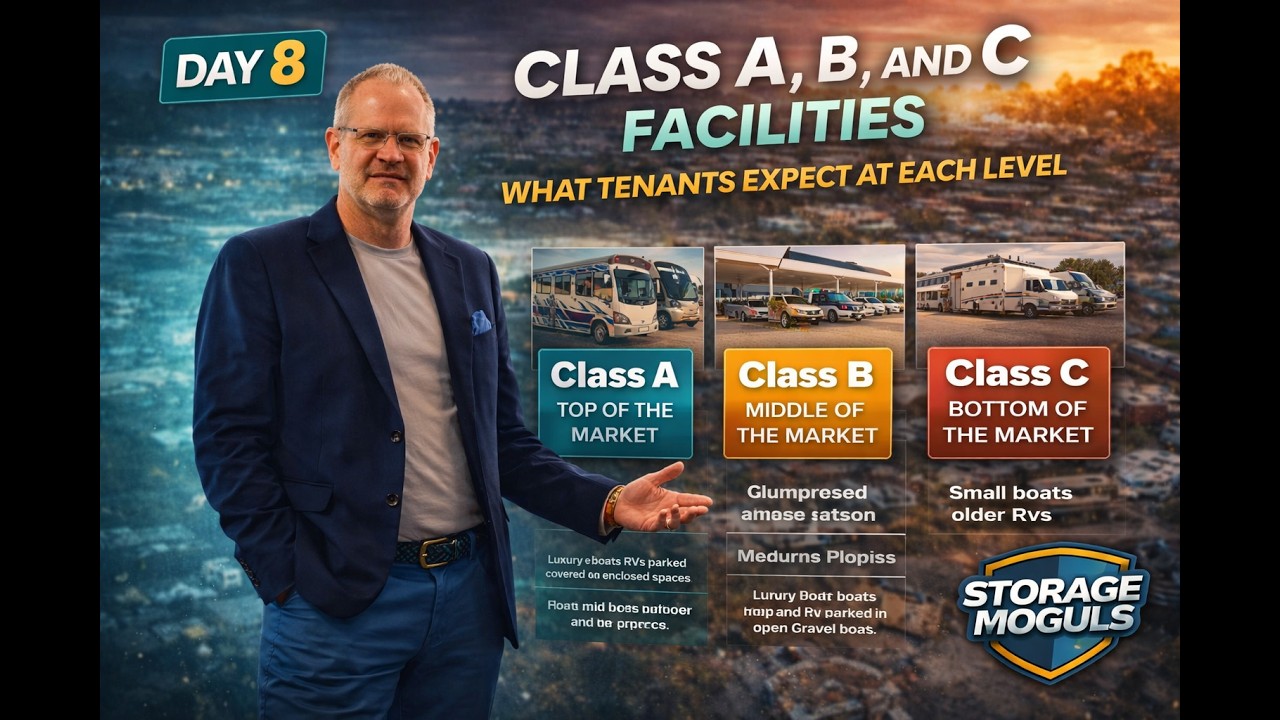
Joe Downs breaks down Class A, B, and C boat and RV storage by drive-aisle width, surface type, amenities, and rent. The single most decisive factor is drive-aisle width. Class A targets high-income coastal areas, Class B serves the larger middle market, and Class C is entry-level. Measure before you build or you risk a costly mismatch.
Chapters
And welcome to day 8 of the Boat and RV 100 series. I'm Joe Downs with Storage Moguls, and today I'm showing you the Class A, B, and C framework for boat and RV facilities, what separates them, what tenants expect at each level, and why building the wrong class for your market is one of the most expensive mistakes in this niche. This is not theory. We've operated across many of these, uh, classes, and the mismatches cost real money. And if you want the full facility evaluation framework with AI power tools, head to storagemoguls.com Our free community with GPT tools, multimodal learning, and content across every storage vertical. And that's actually why we built Storage Moguls. It's a community made up of real people who are looking for this, who want to nerd out and geek out because they're operators just like you and me. Sometimes they're husband and wife teams. Sometimes they're 2 neighbors who, I don't know, have been kicking around ideas around the fire pit for years, or Or their relatives doing the same thing. Or we've got doctors and dentists who are, you know, they don't want to leave their profession, but they're high-income earners and they want to invest in real estate and they want us to show them how. And that's what we do. That's what we build at StorageMoguls.ai. It's a network that's launching in just a few short weeks. So register now. But we're going to show people just like we did in the Storage Academy how to evaluate real deals. We're talking about how to source, evaluate, underwrite, close on them, and manage them. And we're talking about not $10 million deals, folks, not pie-in-the-sky stuff. I mean, down to $400,000 acquisitions, up to $2 million, $3 million. They're financeable. Believe me, you can finance them. They're digestible. This is not too much for you. It's the kind of deal that someone with a W-2 and a serious mindset can actually close. And we're about real results in our community. It's people becoming storage moguls, not someday in the future. They're becoming them now at their own pace, of course, but they're on that track. As soon as you join, you're on the track. And again, start for free, level up at your own pace. But back to today, because yesterday we covered the 6 facility types. Today we layered the class framework on top of that. Understanding both together is what lets you evaluate any deal in this vertical. With confidence. So before we go through each class, I want to establish the right framework for why this matters. Class is not about prestige or aspiration; it's about market fit. Every market has a ceiling for what tenants will pay and what amenities they expect. Your job is to match the class of your facility to what your market will actually support. The mismatch risk runs both directions, though. You build a Class C in a Class A market. Meaning you build a basic open-air gravel lot in a high-income coastal area with HOA-dense demographics, you just left significant rent on the table permanently. The market would've paid for covered spaces, paved aisles, and Class A amenities. You gave them gravel. Conversely, you build Class A facility in a Class C market, meaning you spent capital on enclosed spaces and premium amenities in a rural area with price-sensitive tenants. You'll never recover the capital through the rents. It'll take forever. Shouldn't say never. It'll just take forever. The tenants in that market won't pay what you need to justify the investment. The class framework slide, which is a couple slides from now, it's a market reading tool. Use it before you spend a dollar. Oop. Class A, that's the premium standard here, folks. The facility that serves the tenant storing a $200,000 boat or a $400,000 Class A motorhome. The first filter for Class A is your drive aisle. If your aisles are under 50 feet, you physically cannot serve Class A motorhomes and large fifth wheels. You're looking at need 50 feet plus to accommodate backing in both ways. For a fifth wheel and truck combination, you need 70 feet just to get from the street to the keypad, which should be in front of the gate. This is not negotiable. If the site design doesn't support it, Class A tenants will go elsewhere. And guess what? They tell everybody why. Beyond drive aisles, fully paved surfaces, covered or enclosed spaces, professional curb appeal, comprehensive amenities would include air, rinse station, vacuums, propane, Bluetooth gate access, and full camera coverage. That's what they expect. These aren't upgrades. This is the baseline expectation for a tenant with a significant asset in a Class A facility. For Class A market signals, we're looking for high HOA density, proximity to premium water, High household income, existing facilities with waiting lists. Maybe when you see all 5 of these in a market, a Class A facility is justified. The tenant is there and they'll pay for it. Class B is your middle market, and it's the largest addressable tenant pool in the vertical. Partially paved or well-compacted gravel is what you'll find here. A mix of covered and open-air spaces are your— as well as core amenities. So air, basic rents, good lighting, gated access. This is the facility that serves travel trailers, mid-range boats, fifth wheels, and the broad middle-income base of boat and RV owners. Rents range from $80 to $180 a month. You see more than that too, as well, depending on location. It's the most common in the market too, Class B. Most existing facilities are in this class, and that creates 2 things: the largest deal flow and the largest concentration of— wait for the opportunity— RVs. undermanaged assets. Class B is where operators get complacent. The facility is profitable enough that deferred maintenance doesn't feel urgent. And what happens then? Service standards drift. A competitor opens up a clean-looking Class B or maybe even Class A nearby, and you lose your best tenants. That's the Class B risk in one sentence. The Class B opportunity, though— many aging facilities in this class are undermanaged and underpriced. A competent operator who tightens operations, adds one Phase 2 covered structure, let's say, and raises rents to market can significantly improve NOI without major capital expense. That's the value-add story Class B tells most often. Class C is your entry level into the market. Gravel is what you'll find here, typically open air only, minimal amenities, maybe definitely basic gate access. The tenant is price sensitive. They're storing a smaller vessel or an older trailer, and cost is a primary decision driver. Rents are going to be at the bottom of the spectrum here, maybe even as low as $40 to $90 a month. You're going to have limited pricing power because you're not competing on customer experience here. You're now competing on location and price. Class C can be a legitimate entry point into the— into this vertical or niche though. You got a low acquisition cost, lower capital requirement, cash flowing typically from day one in a supply-constrained market. And but it has built-in vulnerabilities. The moment a Class B opens within range, the better tenants, the ones storing slightly more valuable vehicles, they're out of there. Class C facilities retain the most price-sensitive segment of the market. And price-sensitive tenants are the first to move. The Class C trap: operators who acquire Class C facilities without a plan to upgrade get comfortable with the cash flow. They tend to lose ground when the competition improves. The way to avoid the trap is to have a phase 2 plan. Covered structures, maybe paved aisles, maybe core amenities, maybe before you need it, not after the competitor forces your hand. Class C is fine. Class C without a forward plan is a trap. Here's the full side-by-side matrix I was talking about. All 3 classes across 11 factors. Screenshot this one, folks. The column that matters most when you're evaluating an existing facility is the drive aisle row. Under 40 feet, you are Class C by default, regardless of whatever else the facility has. You could be the nicest Class C around, but you're Class C. You can't upgrade past the drive aisle constraint without reconfiguring the site. Everything else can be added. Drive aisles cannot. The rent range column tells you what you can charge. The tenant profile column tells you who will pay for it. If those 2 don't match the market you're in, if the market demographics can't support Class A rents, but you've built a Class A facility, the matrix just told you something important. So use this as a calibration tool. When you're evaluating any facility, walk the site, measure the aisles, inventory the amenities, and then place it on this matrix. What class is it actually? What class does the market support? The gap between those 2 answers is either your value-add opportunity or your warning sign. The single most important physical constraint in boat and RV storage— mic drop moment here— drive aisle width. You're looking at minimum 50 feet, hopefully more, to accommodate space for them to back in both ways for Class A. For a fifth wheel and truck combination, one of the most common Class A tenant vehicles, you got you need 70 feet from the street to the gate to the keypad. You can't be they can't be blocking traffic. That's not a luxury standard. That's The minimum operational requirement for that tenant type. And if you don't have that and you don't have the drive aisle width, that's the first filter on any facility evaluation. You'll lose that tenant and they'll talk. Before you look at rents, before you count spaces, before you run a single number, measure the drive aisle. If they're under 40 feet, you're a Class C facility regardless of anything else. If they're 50 to 60 feet, you have a Class A capable facility. Everything else can be upgraded. Drive aisles usually cannot, at least not without a major site reconfiguration cost. When you visit a facility in due diligence, bring a tape measure. Or if you were a caddy like me as a kid, walk it off. If you play golf, you know what I'm talking about. You got to measure that drive aisle. That number tells you more about the facility's class ceiling than any other single factor. Here's the field protocol. 5 things you check before leaving the parking lot of any facility before you're— that you're evaluating. First, measure the drive aisles. Bring that tape measure or walk it off. Not optional, mandatory. Measure 2 or 3 drive aisles, by the way, at the narrowest point. That number places the facility on the class spectrum before you've done Anything else. Second, check the surface. Fully paved throughout means it's Class A capable if you've got the drive aisle width. Compacted gravel, clean and well maintained, currently means Class B, but it's Class A capable. Rutted gravel or dirt means Class C in its current condition. The surface condition, by the way, tells you the capital investment history of the facility and the operator's maintenance standards. Third, Inventory the amenities. Does it have an air compressor station, a rinse area? Walk the facility and count what's, what's there from an amenity standpoint, what's missing. Amenity gaps are either value-add opportunities or evidence of operational neglect. Which one it is depends on the market. Fourth, look at the gate and entry. Is it Bluetooth capable? Is there adequate staging area before the keypad? The gate design caps the tenant experience regardless of what's inside. A bad entry design is a Class B or C signal, even on an otherwise upgraded facility. Fifth, read the reviews on your phone before you even leave. What are the tenants complaining about? Gate access, security gaps, amenity failures. Those complaints tell you exactly where the class gap is between what the tenants in this market expect and what the operator is delivering. That gap is your opportunity. All right. Up next, day 9, we are going to dive into who is your tenant? Building the boat and RV customer profile. Please like and subscribe to this video if you've ever visited a boat and RV facility and you had no idea what you were looking at, whether it was Class A, B, or C, because now you have the framework and that's a good reason to share it. But also you should share with anyone who is buying a boat and RV facility or owns one and hasn't measured their drive aisles yet. They will definitely thank you later. And remember, tape measure is maybe the most important due diligence tool in this vertical. Drive aisle width determines your class ceiling, your tenant mix, and your rent profile. Get that number before you run any other number. For the full facility evaluation framework and deal analyzer, join the Storage Muggles community for free. StorageMuggles.ai. StorageMuggles.ai. And you know why it's .ai? Because we are AI-powered. Tomorrow we shift from the facility to the tenant— who they are, what they earn, how they behave. And why understanding the customer profile is the foundation for every pricing and retention decision you will make. See you tomorrow.
More from Joe



The tenant only paid for the first month! #selfstorage #horrorstory #realestateinvesting

What happens when a storage tenant stops paying? #selfstorage #realestateinvesting #storagemoguls





