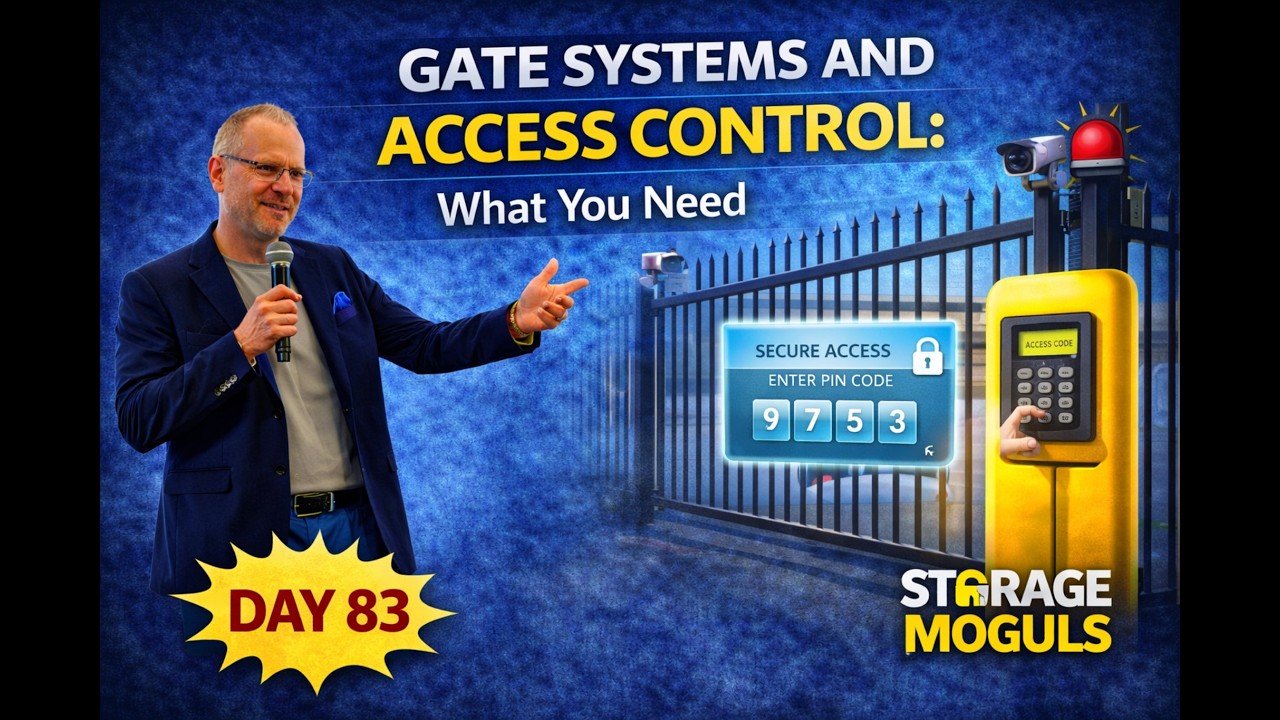
Joe Downs walks through gate systems and access control for self storage facilities. He covers major manufacturers like PTI and DoorKing, four access methods from keypads to license plate recognition, and typical costs ranging from installation fees to monthly software charges. Quality infrastructure matters because poor gates create tenant friction and security gaps.
Chapters
And welcome to day 83 of the Storage 100 series. I'm Joe Downs with Storage Moguls. Gates, keypads, access control. It all sounds so simple, right? But get this wrong and you'll have security issues and angry tenants. So let me walk you through what actually works. And for more operational deep dives like this, join the Storage Moguls community for free at storagemoguls.ai. Storage moguls.ai. Why.ai? Because I'm going to prove to you that we're an AI-powered learning community with GPT tools and content across every storage vertical. So start free, level up at your own pace. And here's a registration bonus for you. Even though the community is a few weeks away from going live, the website's live, but the community is a few weeks away. First 500 people to register, you're going to get a free Deal Analyzer GPT, but only for the first 500. It's a free Deal Analyzer GPT that we use ourselves at the Bellrose Group for quick deal analysis. But enough about that amazing free tool. Let's dive into gate systems and access control, which is one of the most critical security components you'll install. This isn't just about keeping people out, folks. It's about controlling the flow of business and protecting your assets. The gate system is the first impression of your facility's security. And it sets the tone for your tenants and deters potential criminals. You need to understand the hardware, the software, and the cost before you break ground. We'll start by looking at why this system is so much more than a fancy fence opener, because a gate system is not just a physical barrier. It's your facility's central nervous system for security and management. Provides your 4 core functions that directly impact your bottom line and liability. Controls access. Ensuring only paying tenants can enter the property. If a tenant is delinquent, the system automatically locks them out without any manual intervention from the manager. It also tracks activity, logging every single entry and exit with a timestamp. And that's important. This is invaluable for resolving disputes or providing evidence to law enforcement. Ultimately, a good gate system drastically reduces the opportunity for theft and vandalism. So now that we know why they matter, let's look at the companies that build these systems. Because when you look at the market, there's 3 manufacturers that dominate the self-storage access control space. You need to choose the right one based on your budget and operational needs. PTI Security is the industry leader and the gold standard for large operators and REITs. They offer the most reliable system with the best software integration and cloud features. DoorKing is a workhorse, offering a solid mid-tier option that balances cost and performance well. It's great value and you'll see it in many established facilities. And then there's Janus with their Noki system as your budget-friendly and tech-forward option. They have lower upfront hardware costs and are known for their smart entry solutions. The manufacturer you choose will often dictate your access control options, which we'll cover next. Once you select your manufacturer, you need to decide how your tenants will actually get through the gate. There are 4 main access control options, each with different costs and security levels. Keypad entry is the most common and simplest method where tenants use a PIN code. It's reliable, but codes can easily be shared. RFID cards or fobs offer more security because they're harder to share, but they add a small cost per card. Smartphone apps are a growing trend, offering convenience through Bluetooth entry, but they rely heavily on a strong signal. And finally, license plate recognition, or LPR, is the premium option. It's seamless and highly secure, but comes with a significant price tag. All these options have different costs associated with them, so let's break down what you can expect to pay for a complete system. Because while the cost of a gate system is a major capital expenditure, it's one you just can't skip. The price depends heavily on the manufacturer you choose and the complexity of your installation, of course, but a professional-grade PTI system fully installed typically gonna run between $10,000 and $15,000, maybe a little more. That's the top end of the market. The mid-tier DoorKing system is a little less. I think that's usually between $7,000 and $12,000 installed. Again, every situation is different. If you go with the budget-friendly Janus system, you can expect to pay between $5,000 and $8,000 for the hardware and installation. But remember, the hardware cost is only part of the equation. You also have the recurring monthly software fees, which can range from $50 to $200 a month. And this is a necessary operating expense to keep your system talking to your management software. The real power of a gate system isn't the metal and the motor though, it's the software integration. This is where you move from a manual operation to a truly automated business. Your management software, SiteLink or StoreEdge, must talk directly to your gate system like PTI or DoorKing. This seamless communication is what enforces your rules without lifting— without you lifting a finger. When a tenant rents a unit, the software auto-issues the code. When they miss a payment, the software automatically locks out that code. This zero manual work is the single biggest ROI of a modern gate system. All right, so let's talk about what happens when the integration breaks down though, because even the best systems can have issues. You need to budget for common gate problems because they will happen. Motor burnout is a big one for high-traffic facilities. You don't want to expect to replace the motor every 5 to 10 years depending on your traffic, so you got to save up for it. It's the deferred maintenance cost in your budget. Senior misalignment— uh, I'm sorry, sensor misalignment is, um, is usually a quick fix, but it's the number one reason a gate won't open or close properly. Somebody knocks it or an animal does or something. And finally, weather and vandalism are eventually keypad killers. You need to budget for maybe $1,000 to $2,000 a year for preventative maintenance and unexpected repairs for your keypad. Ignoring this will cost you more in the long run though. So don't— you don't even need a gate in the first place though, right? That's what some people ask. Yeah, you do. It's a question we get all the time. But yeah, you really do need a gate. The answer is almost always yes. If you, if you have an urban facility, it's mandatory. High traffic and high crime risk make controlled access non-negotiable for insurance and tenant peace of mind. Even if you're in a rural facility, a gate is highly recommended. Opportunistic theft is a real threat everywhere. It doesn't matter where you are. And a gate is your first line of defense. Cost of not having a gate is twofold: higher theft risk and losing the ability to enforce collections via automatic or automated lockout. You lose your best leverage over delinquent tenants if you don't have a gate. So don't try to save a few bucks here on this one. If you take one thing away from this discussion, let it be this: don't cheap out on infrastructure. Your gate system is not a luxury. It's a critical piece of your business infrastructure. A broken gate system costs you more in lost tenants and reputation than a new system costs in cash. Tenants expect security, and a constantly broken gate tells them you don't care about their belongings. Investing in quality components and a solid maintenance plan pays for itself in tenant retention and operational efficiency. All right. I'll bet when you started this series, you didn't think we'd be talking about gate systems from cost to integration to maintenance. But that's why I needed 100 days. All right. If you found this information helpful, please like, subscribe, and share to show the world you're in the self-storage business. They will thank you later for the expert advice and be much more inclined to invest in your first or second deal. That's way more important. So share away, like away, and subscribe away. Up next tomorrow, day 84, security cameras— how many and where? And remember, access control isn't just about security, it's about tenant experience and operational efficiency. The right system pays for itself. For real-world recommendations from operators running facilities right now, Come join the Storage Muggles community for free at storagemuggles.ai. storagemuggles.ai. There's a seat waiting there for you, as well as a kick-ass deal analyzer GPT for free, but only if you're in the first 500 to register. See you tomorrow.