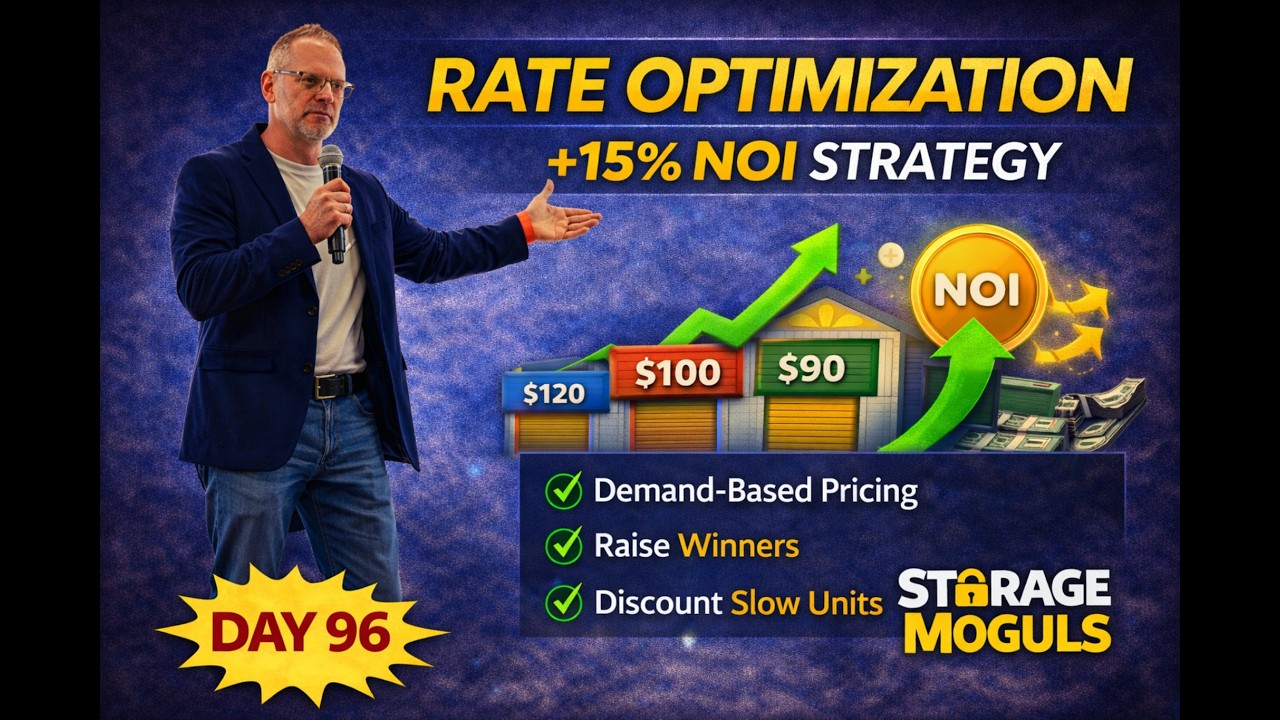
Joe Downs of Storage Muggles shows how dynamic pricing across three tiers can boost self-storage NOI by 10-15% without adding units. Premium pricing for high-demand spaces (ground floor, climate-controlled) and discounts for slow movers can add $3,600 monthly on a 200-unit facility. Automation tools like SiteLink handle the adjustments, but he recommends phasing in price increases for existing tenants over 1-2 years.
Chapters
Hello everybody and welcome to day 96 of the Storage 100 series. I'm Joe Downs with Storage Muggles, and today I'm showing you the rate optimization strategy that consistently adds 10 to 15% to NOI across our portfolio. This isn't theory, this is what we do, folks. And if you want to implement this in your own facility with AI-powered tools Head over to storagemoguls.ai. It's our free community with GPT tools, multimodal learning, and content across every storage vertical. You can start for free and advance at your own pace. And some folks have asked what multimodal is, or what do you mean by that? Well, when we launch in a few short weeks, you'll be able to learn all of these topics in different modes or ways. So via video or infographic, mind maps, podcasts, and more. That's what I mean by AI-powered and multimodal. And you can start for free and then just level up at your own pace. Steady as she goes. But back to today, because we're diving into a strategy that can boost your NOI, as I said, by 15% without spending a dime on marketing, just by pricing units differently. This isn't about filling units. It's about maximizing every dollar from the units you fill. So let's explore how this powerful strategy works. Rate optimization is all about demand pricing. Just like the airlines, we price units based on what people are willing to pay, not just for what they cost us. So high-demand units get higher rates because they're popular and fill quickly, right? Conversely, lower-demand units get lower rates to attract tenants and reduce vacancy. Like I said about airlines, think of the airlines or even a hotel. They constantly adjust their prices based on demand. Storage facilities should do the same to maximize the revenue. That sounds crazy, but it's not. We do it all the time. This dynamic approach ensures you're always getting the best possible price for every unit. Alright. Now let's look at what— why flat pricing, which is the opposite of dynamic pricing, is a missed opportunity. Flat pricing, again, huge mistake because it leaves so much money on the table. When every unit, regardless of size or demand, is priced the same, you're losing out. Popular units like a 10 by 10 could easily command a higher price, but if you price them the same as a less desirable 12 by 30, you're undercharging. At the same time, those slow-moving units sit vacant for far too long because they're overpriced. So you're essentially underpricing your winners and overpricing your losers at the same time. Flat pricing is lazy pricing and it costs you significant revenue. Instead, we need a tiered approach to pricing, and this is where 3 pricing tiers come into play. It's a simple yet powerful framework. Tier 1 is for high-demand units, those with over 90% occupancy. These units get premium pricing, like 10 to 20% above market rates. Tier 2 is for medium-demand units with a 70 to 90% occupancy. These are priced at market rate, you know, to keep them competitive. And then lastly, you got tier 3 for low-demand units under 70% occupancy. These units get the discount pricing, maybe 10 to 20% below market. You're trying to attract tenants. So you need to review your occupancy monthly and adjust units between tiers. This keeps your pricing dynamic and optimized. But how do we identify those high-demand units in the first place, you might be wondering? Well, Identifying high-demand units is crucial for the strategy to work, of course. So because remember, tenants will pay more for convenience. So like units near the entrance or in a multi-story building, the ground floor units are more highly sought after because you don't have to deal with stairs or elevators. Easier access, right? Climate-controlled units are a premium feature and command premium pricing. Then of course, popular sizes like the 10 by 10s and the 10 by 15s, they're always in high demand. These are your moneymakers, so you price them more aggressively than the others. They'll still fill, fill fast and you'll maximize your income that way. All right. Let's talk about the formula for adjusting these prices because it's the core of rate optimization and it's how you turn demand into dollars. Imagine a 200-unit facility all priced at $100 a month. A new operator comes in and implements this. They raise high-demand units to $120 and lower slow movers to $90. This isn't about being greedy. It's a strategy that increases revenue by $3,600 a month, though, which is a 15% improvement in your NOI. It's about smart pricing, not raising everything. You're adjusting based on what the market will bear. This formula helps you decide when to raise, when to hold, and when to lower prices. Now, you might be thinking, what about your existing tenants? Well, it's okay if existing tenants are on legacy rates. New tenants will pay the optimized rates. For example, new tenants might pay $120 a unit while the existing tenant is still paying $100. You'll gradually close that gap over 1 or 2 years, slowly raising legacy tenants towards the market rate. It's not about being unfair. It's standard practice across every industry. So don't apologize for maximizing your revenue. It's good business. So how do you actually implement these adjustments without doing it all manually? Let's look at the software. This is where technology becomes your best friend. Software automates this entire process. Platforms like Storeganize or StoreEdge and SiteLink all support dynamic pricing. You set your rules like raise prices 5% when occupancy is over 90%. The software then automatically adjusts rates for new tenants and phases in changes for existing ones. But remember, don't let the software run wild on you. You still need to review it monthly. Human oversight ensures the pricing makes sense and aligns with your overall strategy. All right, one final thought on rate optimization. You're pricing based on demand, not just cost. This is a critical shift in mindset, and if you can make that mindset shift, this strategy can add 10 to 15% to your net operating income. That's pretty significant. And you're adjusting every 30 to 60 days to stay competitive and maximize revenue. This is truly the easiest revenue improvement you can make, and you should start doing it today. All right, next up, day 97, we're going to dive into Google My Business, which is kind of your secret weapon. Please like this video if you've been pricing all your units the same for years and subscribe so you never leave 15% of revenue on the table again. And then finally, share Share this with someone who thinks flat pricing is fine. They'll thank you later. And remember, 15% NOI improvement on a 6-cap property means you just created massive equity out of thin air. Rate optimization is value creation in its purest form. For the full rate optimization framework and calculator, you should join the Storage Moguls community. You can do it for free. StorageMuggles.ai. StorageMuggles.ai. You already know why it's .ai. You know what it can do and what it will do. We're almost done, folks, with the Storage 100. And after this series wraps, we are taking everything you've learned and applying it to boat and RV storage where the margins are even better. Stay tuned.