Olympic Medalist To "The Time Guy" - John Coyle Explains Chronoception & How Humans Process Time

Olympic short-track speed skater John Coyle won silver by doubling down on his strengths instead of fixing weaknesses. He now studies chronoception, the neuroscience of how we experience time, and argues that high-intensity moments slow time because the amygdala and hippocampus encode more memory. His upcoming book explores how mindset can make life feel longer.
Chapters
Welcome to Ninon Speaks. I'm Ninon de Verderosa, as you know. I have the most incredible guest with me, um, gentleman I believe is from America because— I don't really know because I don't pre-interview, as you all very well know. We've had a little bit of conversation of what's going on in his life. John Coyle. Is, um, he's kind of an international figure, an Olympian. So here we go. John, welcome to my show.
Thank you, Ninon. It's great to be here.
How are you?
I'm really well.
Well, I think he's really well because he's got his girlfriend and him that he says he's going to marry and everything. It's all very, very exciting, but they're all getting together and everything sounds very exciting in that degree.
Yes, for sure.
For sure. You're very happy about the whole thing.
I am very happy. It's been a long time coming.
Yeah, a long time coming. Now, he mentioned that he also had an older daughter, and that kind of surprised me because you said she was 22. He doesn't look 22 himself. So you're obviously older than 22.
I am.
We won't— we don't have to discuss ages, but absolutely.
I identify as 34.
34. Okay, well, he's a little younger than I am because I identify as 39 and holding.
There we go.
I've just been holding a long time, but who cares? Age is just a number and everybody says that. But anyway, John has had a fascinating career as an Olympian. And I'm going to start off with that because that to me was, you know, anybody who's been in the Olympics, who's actually practiced and got there because it takes practice, it takes time, it takes practice, it takes a lot of energy out of you and perseverance.
Yes, for sure.
So, and you are what? You do— discuss what you do.
Short track speed skating.
Short track speed skating, which is all of today, that's kind of, you know—
It's pretty popular.
Yeah, it's very popular now. Now, how did you get into that? I mean, you started it probably as a kid.
I did. My father, by age 2 and a half, would freeze our backyard, and so I started skating when I was 2 and a half. And then speed skating and cycling, or cycling and skating, they go hand in hand. So by the time I was 4, I was bicycling a lot. By the time I was 8, my father got me a nice bicycle, and I went on— when I— the summer when I was 8 years old, I did 13 100-mile rides. How many 8-year-olds on the planet did that?
That's amazing.
Probably one.
So you had a tremendous amount of tenacity in whatever you went into then.
I just loved it, you know, like, from— they— my parents didn't have to push me. I, I wanted to do this.
You wanted to do that. Now, did you practice every day?
Every day for 3 or 4 hours. Some years.
For 20 years, every day.
Every day, 3 times a day during the Olympic years.
So you put your heart into it.
Yeah.
So did you ever do any of the big bicycles?
Yes, so I competed in the World Championships of Cycling. Okay, well, I came 11th.
Um, oh wow.
And then in speed skating, you know, quick side story if I may.
Yes, absolutely, that's what I want.
So I'm, I'm, I was studying at Stanford, uh, when I was 21 years old, and I managed to get, despite being in California with No coach and no training program, I still got 12th place in the world in the sport of speed skating. So I thought that by graduating and joining the Olympic team full-time, I could go from 12th to 6th to 1st in the 2 years I had to prepare.
Yes, you had 2 years to prepare.
Correct.
That's not very long.
No, but I had— now I had the best coaches in the world and all that.
Of course.
But they put me in a program that was very much designed to fix my weaknesses, which it turns out are many and varied.
Don't we all have more than— I don't want to know mine, but you know yours, right? I do now, yeah.
So unfortunately, that didn't work for me. I went from 12th to 34th to not even making the US team 2 years later.
Oh, wow.
So this is where it gets sort of interesting. I had learned this method of problem-solving at Stanford, and I was like, maybe I shouldn't be fixing my weaknesses. Maybe I should double down on my strengths instead. So I quit the team, not the sport, trained all by myself for an entire year, and the very next race I entered, which was the World Team Trials, the most important meet of the year in a non-Olympic year in the sport where hundreds of seconds determined first from second. My very first race back, I broke the US record by 5.5 seconds, the world record by over a second.
That's a lot. Yeah, 5.5. I mean, I know we don't think 5.5 seconds is that much, but that's a lot.
It's a giant break.
You know, they say they, they do them by 1 second, 2 seconds. That's amazing. So what did that do to you then?
Then I had— I, I'm going to quote a German cyclist, but I— after that, I had Self-belief beyond all reason.
So now you believed in yourself, and you were a little bit dodgy on believing.
Before that, I trusted in the coaches and other people.
Yes. Now I was like, because you had done that year training yourself with no teachers, and thyself be true because you know who you are, right?
So you're making good decisions going forward. I think I've done a reasonably good job of that.
I think you've done so. How did you get into the Olympics? Because you won this. This is the This is—
yeah, so then, you know, I was able to go to the Olympics after that and win a silver medal, which is right there.
This is this one right here. I'm not going to touch it because it's a little delicate, but this is the medal he won. If you can take a close-up of that, Steve, or whatever, he'll find a way. And it's absolutely amazing. And you've got— he's got so many things going on here. So when you stood up there, you know, there's— you're standing here and then you've got either side of you. How did you feel? Well, that must have been— I mean, did you want to cry? I want to cry right now.
So the, the quick side story, but yeah, back then, you know, more than 20 years ago now, you— we finished the race, we're back up on the medal stand right away. We're still breathing hard.
You're still breathing hard, but you're getting your medal right away. Right.
And so no time to process. You just— I got there and I'm like, literally, I'm thinking, um, I hope I don't get drug tested because I don't have to pee. What time's the party going to start and end tonight? I hope I can find my parents in the crowd. You know, like, it's all mundane things, right?
Yes, because you just won.
But they fixed it now. So they fixed the glitch. It's so smart what they've done now. So in the Olympics today, starting actually probably about 15 years ago, 16 years ago, you do not get your medal the same day you win it. You get flowers.
Yes.
And then the next day you've got 24 hours to absorb what just happened.
Oh.
You get all the emails and letters and thoughts and notes, and then you go and you actually bend your neck to get the medal.
And you're so excited with all the emails and all the congratulations and dinners and what have you.
And just a little even more cool, super cool thing that they've invented. So you go, you stand, and now it's everybody. There's 5,000 people, it's all the athletes, everybody gets their medals same time. And then you have 90 minutes to get to the USA house or Canada house or Russia, wherever your country is.
Yeah, yeah.
And there you must give a medal to the person that helped you the most.
Oh, so you gave yourself a medal?
Well, I didn't get to do that, but no, you're right. Well, that's interesting. I would have given it to my dad. But, um, so you go from the height of pride, like, I accomplished this big thing, and now you're going to give back. Oh shoot, I didn't achieve this by myself.
Well, no, nothing happens without—
right—
anybody else.
So they go from the height of pride to the depths of humility. All in an hour.
It's amazing. Oh, how— that is amazing.
Nobody doesn't cry.
Nobody knows about that though.
No, it's a secret. It's not allowed. There's no cameras allowed. There's no film allowed. There's no reporters allowed. It's only family.
And that's probably the reason they do that is probably the tension of you and the tension of the person you're giving it to.
Exactly.
Who did you give it to?
I didn't have the chance. They didn't have it yet. I would have given it to my father.
Oh, you would have given it to your dad?
Right.
Oh, that's right. You didn't do it. That came up later.
Yeah, they figured it out. They fixed the glitch.
So you would have given it to your dad?
Yes, absolutely.
And the reason you would have given it to your dad is what?
My father was unwavering in his support. He never didn't believe in me. Not once. Never once. He showed up to every practice, every race, every competition for the entirety of my 17 years on the national team.
Now, do you think, getting a little bit off that, do you think that's needed more now? Because it seems like fathers are not there. I don't know, fathers, it's very important for you to be there. I had a father. My father was home 24 hours a day, so, and I didn't go to school, so I was home 24 hours a day. So I was very used to dad being around and mum and all the others, siblings and everything else. But I think it's, it's so lackadaisical now about a father not being there. I, I, I don't know if it's the, the wife or the woman should encourage the father more, or just because he's an idiot and doesn't know anything. I'm putting it bluntly, aren't I?
But, you know, I think I was just lucky to have a father that, A, was committed to me, but B, could work with his work schedule.
He made it work.
He made it work. He would go in at 5 AM and be done by 2.
So he was there after school, right, to help you and be there. Now, you're not the only child.
No, I had a sister as well.
You have a sister as well. So did he give as much to the sister, your sister, or Well, let's just be honest, no.
And she would very easily agree to that's true. But she, you know, she had different pursuits.
But you were the boy. Right.
And I was the sportsman and she was more into other things.
Yeah. So it was. So now also, you know, you've done all that. You've also written, I believe, 3 books. We've got one right here and it says Design for Strength. This is your second or first one?
Second.
Yes, your second book. What was your first book?
It's actually a poem about the human relationship with time.
Poems?
Yes.
It's a book of poems?
Yes.
I write poems as well. Yeah, I've got about 75 of them. I'm trying to put them into a book as well. But anyway, so that was a poem of thoughts?
Yes.
And was that thoughts of kind of each day or something that meant a moment to you and you wanted to put it down in writing? Because that's kind of something different.
So it really was around my obsession with the nonlinear nature of the way we experience time. And so, you know, time can slow down or speed up. You can experience, you know, an entire, like, lifetime in a moment, and you can have a year that disappears into nothing. Like, the way that we experience time is so variable.
Yeah.
And so I really wanted to figure out how does that work, you know, and And I talked to some of the most famous neuroscientists in the world, and a lot of them are basically like, we don't really know.
Well, this is like moments of time.
Right.
Moments of time are something that comes in and goes out.
Yes.
And so you decided it came in, let's write it down before it goes out and I miss it.
Yes.
So there must have been very important times for you to realize which ones you wanted to write. And it must have been probably over the years that you—
Of course.
these little moments tagged onto you.
Right. And you've really sort of nailed it, like this notion that sometimes in a moment you can live a week or a month or even a year because of the memory you've accumulated and created and stored and recalled. Like those moments are vastly more important than the filler in between.
Yeah, they are. They are far more important. And I think that's how I write my sort Actually, they're sonnets I write, so they're 3 paragraphs like Shakespeare used to write.
Like when your husband returned and that, you know, the date, that had to be one of the most important days of your life.
That's me, no makeup, and I'm as sick as a dog and he's seeing me like this. But then I'm thinking to myself, well, if I'm going to marry this guy, which I knew I was going to, then it didn't matter. And it didn't matter to him at all.
He's going to have to see you that way anyway.
There you go. No makeup is a nightmare. So anyway, so that's your first book with all the poems. In that book, what was your favorite poem? You've got to have a favorite.
I mean, I could just break one out if you'd like.
Yes, go ahead. I love that. They would love that.
Let's do the first one. How long did summers last when we were kids? Splashing into the lake, riding bikes across busy streets, Crushes, broken hearts, bruises, and dirty knees. We all know summers lasted forever when we were kids. Everything was new. We really lived everything we did. And now, how long do they last in this world so mundane? I don't know about you, but I ache for endless summers again.
Isn't that beautiful? That was obviously written as of your childhood, going out there and on the bicycle and falling off and the whole bit. So you related all that together and you put it together. How beautiful.
Thank you.
Second book, what was that about? That's this one.
So that's this one. So this is, um, Designed for Strength.
So we know what that is.
Uh, it's more of a business book. It's, uh, it's a, it's a concept that's become very popular. I think that while we're programmed as kids to fix our weaknesses, yeah, at some point— I love this quote— at some point, if you're still trying to fix weaknesses after age 25, that ship has sailed.
Yes, definitely.
Your prefrontal cortex is mostly hardwired at that point, not completely, but, um, So trying to become somebody that you're not is a waste of your time and energy. And so, you know—
Oh, that's so true.
The story I told you of trying to fix my weaknesses with the Olympic team didn't work.
Well, they're your weaknesses. Why would you try to fix them?
Right.
You never use them anyway. So that's why they were called weaknesses. Right.
Because they were— The moment you double down on what you do well, yeah, then that's when doors open. And the, the thing about strengths and weaknesses is that they kind of tend to be facets of the same thing. So If you're calm, you're probably unemotional. If you're practical, you're probably critical. If you're creative, you're probably disorganized. If you're a big picture strategist, you're probably bad with details. If you're detail-oriented, you're probably a perfectionist. I could go on all day. The point is—
Sounds like it.
The point is that if you have a really amazing superpower, it probably has a dark shadow sitting beneath it. But as long as the environment you're in doesn't care about that—
Oh, I don't know about it until you bring it up.
Right, but I mean, let's say you're direct, honest, and probably blunt and rude.
I am. How did you know? How did you know?
I don't know yet, but in the right environment, that's perfect.
Yeah.
Right?
Choosing your environment is the right thing to say at that.
Versus I had a lady raise her hand, she's like, this is never gonna work for me. I'm like, what do you mean? She's like, I'm a parochial school teacher in Minneapolis for elementary school kids, and I'm a direct, honest, blunt, rude person. I'm like, no, that's never gonna work. It's the nicest state in the union and you're also in a religious environment. Like, that's never going to work. Move to upstate New York and teach boarding school and you'll be fine.
Yeah.
Those kids would love it.
They want to know what's going on outside.
They want to be told directly.
They want to be. Yeah, that's absolutely true. So you created this book because this is completely, totally, as I can see it, totally different to poems. I mean, a poem is more of a— if I can say this, I think it's true— is more of a happy, happy sort of ending and more of a true thing going on, but more of an upbeat thing.
Yes.
Of a poem. Because when you read poems, you're reading something that somebody else has thought of.
Yes.
And you're reading it purposely to find out what did they think about that.
Correct. But, you know, I think the power of writing poetry, which you do, is you get really concise with your language.
Very.
And then when you can bring poetic tight language into a business book, the book doesn't have to be that long.
No. So that's what you did with this book. So you kind of, with your thoughts and your business— also when you started and you sort of got involved in all this, you were very young, in your 20s.
Yes.
And then you realize that there has to be a business side of this as well. It can't just be all this money coming in and all these talks going on and everything happening. You also have to suddenly realize, wait a second, I've got to start thinking, you know, of, of being a business person. Were you married at that time?
I was, yes.
You were. So then you had the responsibility of a house, cars, food, education, all the things that men should realize what they have to support. I'm saying that purposely because it doesn't seem to be that so now, right? Seems to be 2 people now, the husband and the wife. Before it used to be just the husband.
Correct.
Yeah. So when you Did you start getting into business like, where do I go and what do I do? And now I've got to get organized, you know. And you had a daughter.
Well, I didn't at the time. When I retired from athletics, I was 30, so I'd never had a job. I had no work experience. I didn't—
Nothing.
I had no idea how to do a resume. I didn't know how to interview. I didn't know anything.
Um, well, you occupied your time with getting awards.
Yes. You know, I retired when I was 30, but yeah, the work ethic that you learn in High-level competitive sports sort of translates over, and so what I did immediately is I buried myself and figured out how do I do a resume? How do I do interviewing? I had friends that helped me, and I within a few months I was able to go into management consulting, which is relatively high-paying consulting, high-paying field, and they're the only people that will hire a low-experience, high-energy person.
Yeah, because you've got everything going for you except the knowledge.
Because they're going to make you work 80 hours a week.
So yeah, but the knowledge you didn't have because you've been doing your other stuff, so you didn't have all. You didn't have all that knowledge, but you did have the experience.
The kind of experience they were looking for, which is how to get things done, how to be resourceful, how to look for solutions.
And you did that. And you could give them the whole history of that because you did it.
Right. And I was fortunate to have 2 degrees from great universities. Because a lot of the athletes today don't have that option anymore.
No? Why?
Because they're too busy. It's vastly more professional now. I would say no elite Olympic caliber athlete in the country right now is probably attending Stanford, I'd say.
Really?
Not for a non-school sport. Sure, swimming, football, like, yeah, they get all the sport, but, you know, speed skating, no. Figure skating, no.
Really?
Yeah.
So that's something to know out there. So anyway, so you were now 30 years old, you've got— now you've got a great job.
Yes, I did. Yes.
And what did you Did you decide at that time that you were getting too old to do what you were doing, or did you just feel that you needed to get sort of a little bit stable? Because you were earning enough money. You didn't have— it was— the money wasn't a problem.
Well, I had no money, actually.
You had no money?
I was earning no money.
You were earning no money. But what about all these— all these things you went into? You didn't get much out of that either.
I got paid zero.
So he had zero, so he had to do something.
Yeah, I mean, really, the decision point was partially, you know, Not too many athletes over 30 in the Olympics.
And yeah, that's what I was saying. Yeah.
And B, I would like to have some money. I would like to be able to go on dates and have myself pay for them.
Yeah, yeah. Well, in those days, that's kind of what it was.
Yeah, but I mean, it was almost impossible for us as athletes to even—
To have any of that. I don't think people realize that. I think people think that they get money for— because they have all these sponsors and everybody.
No sponsors. It was illegal at the time to have sponsors. They've changed those rules now.
See how things do change and people don't even notice them because they kind of roll on in.
When I finished skating, I had $67,000 of credit card debt. That's how I funded myself.
And that's how you started?
Yeah.
Started in a car wash. Lovely way to start. Marriage and children and all this stuff.
Creates a very marriageable profile, right? I've never had a job. I have $67,000 of credit card debt. Would you like to go out with me?
Because you never presented that. No, probably not. No. So how— so, but you still had that in the back of your mind, so that's why you went into management. Did you go into this because you felt that this is where— this was your knowledge, number one? Number two, this is where you could actually do it quickly for yourself?
I mean, the beauty of management consulting is because you work 80 hours a week is you're really working 2 years for every year. So I was able in 5 years to get 10 years of experience. At least.
At least.
So by the time I was 5 years into management consulting, I was— I had a pretty good pedigree. I mean, I worked— this is both good and bad, but I worked directly for Jeff Skilling and Ken Lay at Enron back in the day.
And, you know, they're quite a big name out there.
And then before that, I was also on the same team as Lance Armstrong. So arguably the 2 greatest frauds perpetuated in modern mankind.
I love it. I love it. I love how honest you are with everything. I think it's beautiful. So how long did you do that?
Consulting I did for 5 or 6 years. Then I went into corporate.
Yes.
I did that for 7 or 8 years. Went back to consulting for a couple of years, led a consulting firm. And then somebody invited me to do a TEDx talk about 9 years ago. And I was like, well, I can't do that. I don't know how to do that. I'm not going to do that. And then they like—
Why?
I don't know. I just never—
You never thought you were in that league or you were in that position?
No, I never thought I could do that. Never even crossed my mind.
Yeah, it was like a no. It wasn't even a yes. It wasn't even a thought.
Right. But they pushed me into it, so I eventually—
Okay, let's try it.
I did it and it went really stellar. And within a couple of weeks, I started getting hired to speak. And now that's all I do all around the world.
That's all you do around the world. You just mentioned the 3 places you're going to.
Oman and then Bahrain and then Dubai. All in the next 6 weeks.
All in the next 6 weeks. So you'll be traveling in the next 6 weeks. And you'll be traveling with your girlfriend.
She can't come yet.
Oh, she can't come yet. So that's going to be a big miss for you because he's very attached to this young lady, which is really cool. I love that. So now we're going into— we're now going to go into his 3rd book. He has 3 books, but the 3rd one isn't out yet. Now, what's the name of the 3rd one?
The book is called Counterclockwise.
That's going backwards. That's going the other way.
Well, that's the way we turn in speed skating.
Yeah. Oh. I'm glad you explained that one because I'm thinking of a good question.
But the other thing is, it's called Counterclockwise: How to Design Endless Summers. And so it's about how do we slow, stop, and reverse the perceived acceleration of time that most adults feel and experience the endless summers of our youth again.
This is interesting. So what made you write this book? Well, also because you were counterclockwise.
Well, so a couple of things. So in sports, yes, the margins that determine A life-changing positive outcome or nothing are tiny.
Yeah, okay.
And as it turns out, after I retired from skating, I figured out that's actually true in real life as well. You said yes to your husband or you didn't. You got off that exit or you didn't. Your, your parents met on the boat or they didn't. They acknowledged this magazine or they didn't.
Oh, is this also true?
But I mean, tell me again. All these things happen in moments. They don't happen in minutes. They don't happen in months.
So— These are all moments of time?
Yes. And the Greeks had a word for this. They were so smart.
What was the word?
So we have time as our only word for time. It's the most common word.
But it's time. I mean, it's all we live is time.
But we should have multiple words. The Inuits have 17 words for snow. Why do we have only one word for time? It's really quite stupid. The Greeks had 2 words at least. They had chronos, which is clock time, which is the way we tend to use it.
Yes.
They only use that 33% of the time. 67% of the time they use the word kairos, which is human time, or the way We experience time, and very specifically to what you had said, the etymology or the meaning, deep meaning, is when everything happens at once and the trajectory is reset.
Yes.
And it comes from the archer releasing the arrow.
Oh, the archery. When you see that, now I know what that archery is.
Yes.
I never knew what that was.
So it's a kairos moment. So you had a kairos moment when you made your declaration to your future husband, and then he showed back up.
Yes.
And you accepted him in your state, right? That's a kairos moment.
And it's like, I didn't know this was going to happen. I had no idea what was going to happen, but I knew he was the one. Right.
And so in speed skating, hundreds of seconds determine— well, as Seinfeld put it, I'll try to do it on camera correctly— gold, silver, bronze, never heard of you. That's just facts.
You got it right.
It's just true. 4th, nobody ever has ever heard of you. It's sad, but it's true. But in real life, the decisions we make in moments ultimately determine the trajectory of our future. And these happen sort of haphazardly. Yes, they do. But if you can design more of them, then your future gets more clear, you have more opportunities, life feels longer, life feels more extended. And if you can create more of these, you live almost forever.
Yeah. So do you have to recognize those moments?
Yes.
Because I, I, what I kind of do, which I didn't know I'm doing until you've just told me, I recognize a moment of something happening And I immediately thank God because normally it's a positive thing that's going on.
Right.
Or it's a left or right, as we were talking about, or a straightforward. I mean, you don't, you have the, you have choices in your life. Every second of your day you have choices to make. And I don't think everybody realises that. But I always try, I always sort of return to God and say, thank God, thank you, thank you so much for me recognising that choice. Is that a good thing? I mean, obviously it's a good thing, but—
Oh, of course it's a good thing. It means you're present.
Okay.
And you're acknowledging that a kairos moment just happened.
Yes.
And you're also storing it, because I think sometimes people slide through life and something amazing might happen and they don't even acknowledge it because they're so future-focused. They don't—
That happened to me yesterday. I was judging a karaoke thing. And we were given this little box and there was a little tiny, a little smaller than that actually, little tiny emblem of thanking us for being there. The girl next to me didn't think anything of it. And I said to her, I said, no, don't think like that. I said, the thought that went into that and just presenting us, I said, maybe they couldn't afford a great big thing, whatever. And I've had big things, I got lots of them. But that's the— the big ones are just important as the small ones. Or should I turn that around and say the small ones are just as important as the big ones? And she looked at me and she said, I'm going to look at this a different life, in a different way through my life. I said, always remember, sometimes those little tiny ones are more important than big ones.
Can I tell you a story regarding that?
Yes, I want you to.
It's the most important It may be the most important moment of my life, actually. And it happened in about 15 seconds. So I won the silver medal. I was training for 4 more years for the next Olympics. I wanted a gold medal. And that's all I was focused on. One thing, gold medal. That's it. To the exclusion of all else.
Yes.
And for 3 years, I trained on my own, and that was fine. And then a 4th year, I got lured back into training with the Olympic team again, which had never worked before. But I was like, I'm ready now, I thought. Stupid idea. Um, they put me on a program of fixing my weaknesses again.
Oh, that's not good for you.
Uh, I won the first World Cup of the year. Apolo Ohno at 16 was second, but then I overtrained, and by the time the Olympic trials came, I failed to make the team. And I was so humiliated— and I'll use that word specifically— that I got off the ice, didn't put my skate guards on. I walked across the concrete, grabbed my skate bag, got to the car, put my skates off in the car. Didn't want to see anybody, didn't talk to anybody. Hard divorce for 8 years.
So disappointed.
I was a one-timer first loser, meaning one Olympics only, second place. That's the way I identified for almost a decade. One-timer first loser.
One time. And you were?
But then I got invited to be the analyst for NBC, and we'll talk about that in a second. And so I couldn't say no to that. So I'm back at the Olympics, but now as the analyst. So my job is to interview the parents, coaches, and skaters and get the backstories to feed them to the commentators.
Yeah.
Well, I'm there the 16th of 17 days at the Winter Olympics. It's the night before the gold medal round for my event, and one of the parents I'm having dinner with— I'm having dinner with the parents and skaters— one of the parents says, I need to tell you something that's really important. I said, okay. He looked nervous.
Yeah.
So now I'm nervous. So we walk away from the table. He's like, I just want you to hear this. I just want you to know that we wouldn't be here right now if it wasn't for you.
So what did that put on you?
Well, I didn't know what he meant at first. I said, I don't know what you mean. He's like, you won't remember, but 12 years ago After you won your silver medal, you brought it to a little reception in Bay City, Michigan. You put your medal around my son Alex's neck. He was 11 years old at the time. He'd never skated before. The next day he joined the Bay City speed skating team. Tomorrow he is in the gold medal final.
Oh my goodness. So all the— you know, we don't understand the history that goes behind something and the reasoning. And I had a similar story. I had a program called Voices of Tomorrow. I interviewed children from the ages of 12 to 18. And I'm— I've got this big fundraiser going on and I'm telling them, parents, just listen to your children. Don't tell your story, listen to them because their attention span is very short. I see him later, a couple of years later, and he said, thank you, Ninon. And I said, thank you for what? The same thing. I'm like, what did I do?
Right, right.
You know, what is this? And he said, I just listened to my son. He said, I learned more about my son by listening to him rather than him coming and telling me part of a story and I interrupt him with my story. And I said, yeah, that's the whole idea with younger generation. Their attention span is low, but you paid attention. So it's a similar story. I understand that story so well. So what did— when he said all that to you, what did you feel?
It's like the top of my cranium popped off. Like everything that I had been disappointed with and humiliated by went away. It went away.
Went away completely because you made such a difference to one person.
Right. One person is all that matters. And suddenly this one-timer first loser thing became, well, damn it, I got a silver medal.
There you go. You know, see, it's the positive side of life, you see. But do people realize, and this will definitely attach to you, that this is all we have, right? We have nothing else to deal with. We only have this particular body. And we might have 6 cars or 10 cars or millions of dollars, or we might live in a trailer home. I don't know. But it's— you're still that one person. And is that all your kind of responsible for, and whatever comes out of you is what you are responsible for.
Completely agree. Well said.
Isn't that true? I mean, so whatever you put out there, how would you explain that to people?
Well, you know, I do think that when you build your life around your natural strengths, when you become the you that you were supposed to be, yes, people watch, they listen, and it matters. When you're fighting to try to become somebody you're not, oh, then you get into this turmoil and darkness. Well, you're never who you are, pulling other people into this darkness and turmoil and blackness. But people that live their lives, which I'm sure you do, I can tell, and, and I think I do as well, where we're just doing mostly, almost entirely what we're, we're good at.
Yeah, I'm doing what I'm supposed to do.
Then that draws people in and it lifts them up. It doesn't— this tears nobody down.
That's funny because you walk around totally confident. As to who you are. And people, I don't even think about it, but people tell me, you know, when you walk, when you talk, you're so confident in what you're doing. And I look at them and I think, how do we do that? And now you've just said it. You've just told me what it is, because we're doing what we have within.
Right, we were born to do. Yeah.
But we're not fighting it and we're trying to do it better or organize it better. Like you're now giving speeches all over the world. Which means you're actually helping other people. You're helping other people of being who they are. Do you think most people are afraid of admitting who they are because they don't like who they are? So how do they change that? Well, they don't know who they are, so they can't dislike it.
Maybe they don't know who they are. This is my cocktail hour question, which is I always ask people, what are you best at? And people will be like, I don't know. And then they'll make up some words, like some words communicating, and like, well, to whom about what? Like, strengths are very specific, right? And so if you don't know your superpower, you don't get to put on the cape. No. Um, but also that people don't want to acknowledge they also have weaknesses. But everybody does.
But everybody— I have loads of weaknesses. I don't want to talk about them. We all have them.
I'm not an organized person. I am not.
But don't emphasize on what you're bad at. Emphasize on what you're good at. Work on what you're good at. It's like sometimes you can go to the car, start the car up, and And all of a sudden I'm told to go back inside because I've got to get this. But I'm told to go back inside not for what I went back inside for, but for something else that I forgot.
Right, right.
And I think I recognize those things. This is what I say, oh, thank you, God, because he's like, made me go. In other words, obey what you're thinking and what you have to do. Don't say, I'll do it later. Go do it then because that'll take you to the next level of what you really need to do.
Our intuition is very smart most of the time.
Most of the time.
Not all the time.
No, no. That's when we go to bed at night and put our head on the pillow. Think good thoughts when you put your head on that pillow.
Yes.
Because that's what you'll sleep with. Now, putting your head on your pillow, we have another award here that's been going around. This lady holding this. So tell me about this.
So it's kind of funny because if you knew me better, you would know that I never talk about this. It's 17 years in the making, is a huge part of my life, and I don't talk about it.
I understand that.
Because I don't want to lead with that. I would like people to get to know me.
As you are now. Yes. Yeah.
Um, but because this was not as much work, I tend to talk about it a lot because it's just funny to me. So, so it's kind of an accident. I, I won it, uh, almost 18 months ago. And I didn't know I won it. I was working for NBC for the Beijing Olympics, and every 4 years I work for— this is my 5th time or 6th time working for— as the analyst. And, and when I'm there, because I like to write, I'll write features. Features are short vignettes between the production stuff. So, yes, backstory about a skater or, you know, the equipment.
You'll have something.
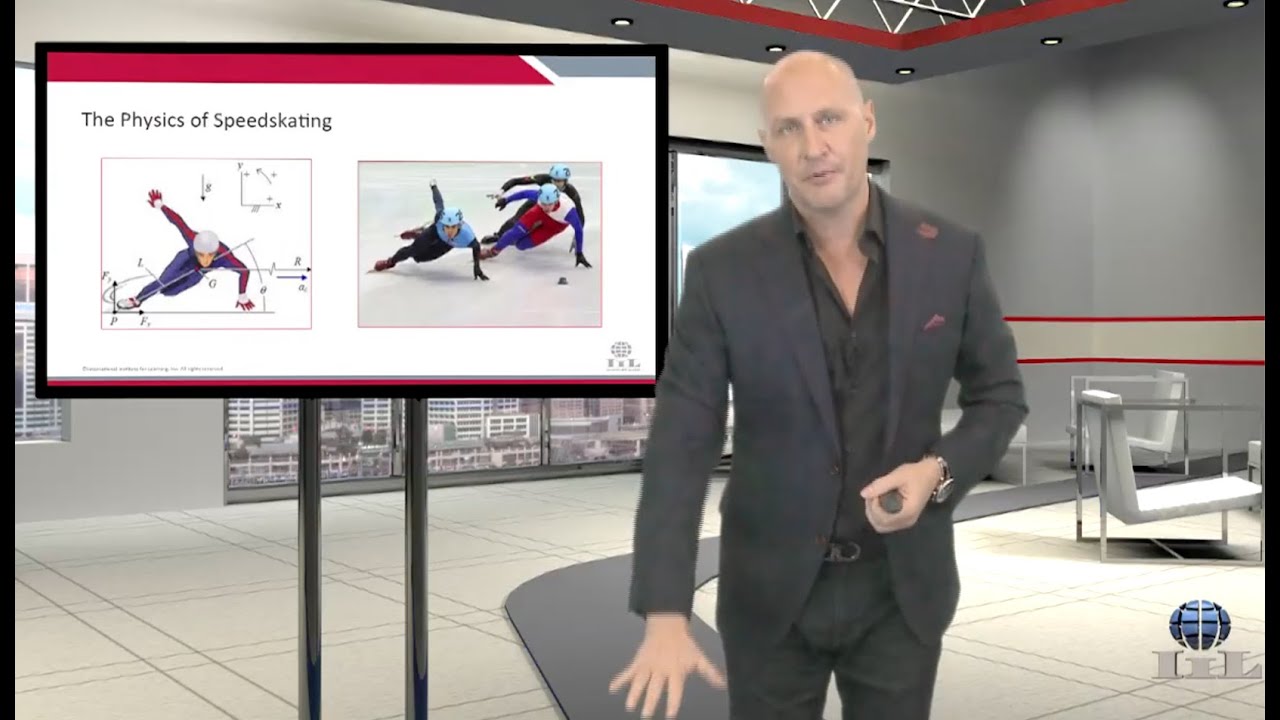
Or in this particular case, well, 4 years before Beijing, I did one about the physics of speed skating, and then this one I did one— I wrote a feature comparing short track speed skating to NASCAR.
Okay.
Because it turns out, despite the speeds being different, the G-forces are the same. So it's approximately 3 Gs in the corners for NASCAR and speed skating. So I wrote this, this feature.
It's gone way above me. I'm just nodding my head pretending I'm—
So 3 Gs is triple your body weight. So triple your body weight.
I can't explain.
Because you enter a corner going 33 miles an hour this way on skates.
Okay.
And you exit 2 seconds later going 33 miles an hour this way. So it's 0 to 66 in 2 seconds, which no car on the planet can do.
And I understand that because off-ramps, you have to go from, say, 65 to drop to 45. And I've often thought, how on earth do you do that without braking? You're supposed to automatically do that. And now you've explained that. So you'd have to really put the brakes on.
So it's just a really intense— because we're never on 2 legs at once. So No. It is equivalent for a short track speed skater of a 500-pound one-legged squat from deeper than 90 degrees while leaned over at 70 degrees while traveling 33 miles an hour on an 18-inch long blade on ice headed directly at a wall. It's hard.
And you would know all about this because you did it many times.
So I wrote this feature and the producer said, oh, we're totally going to do this, but we're not using you. And I had previously been the on-camera person. I was like, well, that's rude.
Yeah, that's not very nice.
She's like, we got Dale Earnhardt Jr. to do it. the most famous NASCAR driver of all time. And I was like, oh, I get that. That makes sense.
Okay.
So I, you know, I worked with the producer.
We, we— You worked together.
We worked with— so I became the associate producer. And, uh, so Dale Earnhardt did it. It's a really nice little short piece, a minute and 9 seconds, came out perfect, well received. Forgot all about it. So then I'm getting emails saying, collect your Emmy. And I'm like, well, that's—
what Emmy? What are we talking about?
So I'm just throwing them away, right? I deleted them for a year and a half. And then I, I got one that said, if you don't acknowledge the receipt of this, we're going to rescind it or something like that. And I was like, all right, well, I'll at least follow the link.
Yeah.
And I follow it and it's like, oh, you know, best short program for U.S. Olympics. And I was like, what? This is a real thing? So then I messaged my producer. I'm like, is this legit?
What is this? What's going on here?
She's like, I forgot to tell you.
Oh, thanks a lot.
So then I filled out the paperwork and she came a couple weeks later.
Oh, how amazing. So you were quite thrilled about— because you've got 2 very big awards. I have awards, but they're not as big. But this is still big. I mean, this is amazing. It's absolutely wonderful. Now, what about your books? When's your 3rd book coming out? Because your 3rd book sounds like it's a little bit about astrology, your body, your mind.
It's not. It's all math and science, neuroscience.
Oh, okay.
Um, I mean, there are obviously people can interpret it Yeah, of course. You know, it's funny because in this book, I never say the words purpose, spirituality, any of those, any of the, what the business world would call woo-woo words. I don't use them.
They want people to—
But they get there by themselves.
Yes, they do.
So I bring them in a way, I sort of Trojan horse in and let them figure out their purpose and spirituality and all these other words that I don't use because some people will shut down if you use those words.
That's right. They do. They're like, I don't want to read it anymore.
And the time book will be the same. I'm coming at it from a purely behavioral psychology and neuroscience perspective, but it's going to lead the horse to water of what is my purpose and what is my—
What is your purpose of life? What is the purpose of life? What is it?
So yeah, that book will be hopefully done, completed, written by the end of the year and then published sometime next year.
Sometime next year. So with all this, with everything you've done, which is quite— this is quite ironic actually. Did you ever think you'd be a writer?
No, of course not. Nor a speaker.
Because this is something that's kind of come out of the blue.
Yeah, yeah.
You've been out there, out there, out there practicing, practicing, not sitting down, right, you know, with anything, concentrating on, on the computer. I presume it's done on the computer.
Yeah, of course.
And putting it all out there and then putting it all together as it is. Because I'm— did you write it in different times and then put it together?
So this book I wrote in 3 weeks, but it was, you know, 5 years in the making or whatever. Like, it was always in my head.
It was in your head, so it was always there.
Yeah, and I was always practicing it with people.
Yes.
So, but when it was ready to come out, it was ready to come out. The time poem I wrote in less than an hour, but again, it had been years in the making.
Yes. And so how many poems?
So it's just one poem, but it's 13 stanzas. Okay, so it's a long poem.
It's a long poem.
Yeah. No, the time book is going to be a longer book, and it's what's it called? Counterclockwise. How to design.
We're going to the opposite side of life, which we don't think.
How to slow down time.
Yeah. Yeah. We're going the opposite side.
You know. So yeah. I'll get that one right itself as well.
Well, it's rather than getting older, we're now going to go back and get younger.
Exactly.
I'm going to definitely read the book.
That's the point.
That's what I want.
But it's something you said, and I said so. This is a really great study. This is obliquely adjacent, but they took a bunch of— I think they were 76-year-old men. I think they knew each other, and they put them back into a day camp they went to when they were like 16.
Oh.
Or an overnight camp. So they went there for like 2 weeks.
Counterclockwise.
And they told them to do all the stuff they did then. Bonfires, s'mores, canoeing, swimming, all that stuff. Singing, whatever.
What most 16-year-olds do. Right.
And then they took their biomarkers before and after, and they literally unaged like 2 decades in 2 weeks.
Wow.
Because their mindset was, oh, I'm a kid again, and then their body listened to it. So even though I sort of joke that I identify as 34, I'm not completely joking because every day I just sort of lie to myself and I say I'm 34, I can do the things 34-year-olds can do, and I hang out with a bunch of 34-year-olds. 4-year-olds and this kind of works out.
I'm not going to tell him how old I am because I know he won't believe it. But I have to agree with what you're talking about is 100% true. If you think you're old, you're going to be old. If you think you're going to be sick, you're going to be sick. If you talk about depressive things, then you're going to be depressed. And if you're negative, you're going to be negative. And it truly, and I truly believe what you're saying is absolutely right. And I always say that, maybe you can answer this, that people They think about things and they're, oh, this is terrible, this is that, and it's going to be this and it's going to be that. It never materializes.
Right.
How do you get out of that? How do you, how do you not do that?
There's a great lyric from Tom Petty I'll start with, which is, most things I worry about never happen.
Never happen. They don't. And I, I know they don't.
Right.
I don't worry about those things because I know there's nothing I can do about it anyway.
Well, we share a catchphrase, I believe, which used to make my now ex-girlfriend crazy, which is It's all going to work out.
It's all going to work out. That's one of my favorites. It's all going to work out. Don't worry about it. No matter what, whatever I do and however I— so that's the answer. Don't worry about it.
It's all going to work out.
It's all going to work out.
There's some solution somewhere. And there always is. Like, think about it. Like, we're still alive.
Well, yes.
Right? So absent that, already the worry about dying in a thousand different ways hasn't happened.
No.
Right? We've never frozen to death. We've never starved to death. We know Got stranded in the middle of nowhere and died.
And that's so funny because, you know, I think very much I like about this, about don't worry about it, everything's going to be okay. And even if you feel you're not going in the right, right direction, you are going in the right direction to get to the direction you want to get to. So sometimes you have to do a whole bunch of stuff and things and thoughts or whatever you want to call them, I don't know. You're going to end up exactly where you want to be and how you want it to be.
I'll lend you a phrase I really like.
Please.
In the infinite possibilities of the universe, there is always a way.
I love it. I love it.
Always.
So you've— have you finished this book yet? You said you're going to finish in January. You're still writing it. You're still putting it— has this been your hardest book to write?
For sure. Here's the reason why. It's sort of like a receding finish line. Every time I speak to my neuroscientist friends, be it David Eagleman, who's probably one of the most famous, he's on PBS, The Brain, Moran Cerf, who's the whisperer to the spirit world.
Oh, he's on the PBS thing of The Brain. I listen to him all the time. Little skinny guy.
Yeah, David. Yeah, he's a good friend.
Oh, I think he's amazing. I love to— I never build—
Every time I speak to him, he'll say this, that he or Moran or any of the others, they'll say the same thing. Everything I'm about to tell you is wrong. It's just less wrong than last time we spoke. And then they'll say, we've learned more about the workings of the brain in the last 18 months than the entire history of humanity. So when I first started working on this book, which was 8 years ago, there were 8 white papers about the neuroscience of time perception.
Perception.
That's all? Only 8. Last year, guess how many?
Oh, I'm not going to guess. 871.
So it's just exploding.
So it's tripled, more than tripled.
Yeah. So it's exploding. And so every time I feel like I'm almost done, I learn something new that changes—
That changes your whole way.
Changes the whole narrative.
So then you have to change it in the book and the whole way because now you've understood what it is today as well as what it was before, but it changes. I happen to love the brain. I don't think we use it enough. I know there's a I hope I get this right. There's a left side and a right side. Did I get that right? Because usually I'm the opposite. And there is, there's a big difference, right?
Yes.
So how do you tell? I know most people want to know this. How do you tell your left side to your right side?
Well, and they go invert to your actual physical. So like your left brain controls your right side and your right brain controls your left side.
But okay.
Oh, but you know, left—
I didn't know that.
Yeah, yeah. So, and left-brained people tend to be more analytical and right-brained Dominant people tend to be more creative. Women have a stronger connection between left and right so they can communicate with the muscles better.
They communicate faster and more precise because they are the child bearer and they know when a child has a problem without even a movement.
So they're just faster that way.
They're just faster understanding it. Whereas men, I'm not saying they're calculating, but men calculate it in a different way to get it right.
Correct. Men have to be more analytical than women. Women are more instinctively creative.
More instinctive.
Correct.
Yeah. Yeah.
So, but you know what's really, I think, for me is interesting is the memory writer of the brain is a thing called the hippocampus. So it's sweeping memories, your memories and memories, to think of it as a stack of photographs that also have sound and emotion.
Yeah. Okay.
But it's doing about every 2 to 3 seconds. Okay.
Normally. Okay.
You can hold up to 7 seconds, but that's the most. That's not much. So the most you can possibly store in short-term memory is 7 seconds, and that's when you're like trying to remember a long number or something.
Yeah.
Um, but the amygdala, which sits next to the hippocampus, is the most important intuitive part of the brain.
Okay, I'm listening, I'm paying attention.
It's a sentinel. It's doing this. It likes to be quiescent. It likes to be quiet.
Okay.
And but when it wakes up, it wakes up for only 2 reasons. When it comes to memory writing, never do that again, or always do that again. Stay alive and procreate. That's what it exists for.
I love it.
So now when it wakes up, it tells the hippocampus to write memories not every 2 to 3 seconds, but 20 to 30 times per second. So your frame rate goes up 50 times. So this is why when things are really intense, in any kind of intense moment, car crash or your husband returning with—
Yes.
Time seems to slow down because your frame rate goes up. So you're storing so much more information. And amygdala-driven memories tend to be much more highly recallable.
Okay.
So 7- and 8-year-olds, their amygdalas are pretty much awake all the time. This is why summer lasts forever, because everything's exciting, everything's scary, they cry a lot.
They're becoming logical. They're becoming to understand the world.
But as people get older, they get— everything gets safer and they have more control over their environments.
Yes.
And the brain's lazy. It's 3% of your mass and 28% of your calorie burn.
So it becomes lazy.
So it's like, I didn't write it down, nothing new here, I'm not gonna write it down. So that's why time speeds up as you get older.
So this is fascinating to find out about the brain. What's your next project? Because you're obviously, you're writing, you've finished the book in January. What do you have in mind after that? Another book or—
So I have another book.
And you have all this speaking thing to 2/3 done. Oh, it's 2/3 already done.
And it's just— it's a memoir, but it's called Why Am I Still Alive? The 56 Times I Almost Died.
Well, I'm sure you had many of them because of all the practicing and all the things you went through.
I've lived a fairly high-risk life and I've managed to survive this long, so that's good. But, you know, the 56th story just happened a couple weeks ago. Stephen already knows this, but I came home. I was speaking in Georgia, the country, not the state. So overseas. Yes, overseas in Central Eurasia. And I came back on a long trip, 30 hours.
Near to Russia.
Near to Russia. Yes.
I know a little bit about my world.
Caucasus. Yeah. And I arrived home at like 2 in the morning, and I don't think I drank much water on the trip because I was trying to sleep. And then it was 2 AM and I couldn't sleep because of the time zone difference. And at 5 AM, I'm like, I'm going to go out. And just catch sunrise on my electric e-bike. You still have to pedal, but it's very easy.
But it's easier.
Versus my regular bike, where on my regular bike I would put on—
You'd be public.
Cycling shoes, and I'd have a jersey with water bottles, and I'd have my helmet, and I'd have my glasses.
You'd be prepared.
Right. But I was just like, I'm just wearing shorts and flip-flops. I'm just going to go up, catch sunrise, come back. Well, I couldn't find a good ridge, and so I'm wandering about a bit on the e-bike, and it goes quite fast. It goes 30 miles an hour, right?
Whoa, whoa, that is fast.
So I'm out, you know, maybe 40 minutes, maybe 15 miles, and the bike breaks down. I look at my phone, my phone's dead, and I'm in a place where I don't know where I am. So I'm lost. The sun comes up.
You're not even— you're not even in America.
I'm 105 degrees out there, and for 6 hours I wandered about trying to find my way home. And thank God a Jeep found me. I was literally walking in a small circle muttering to myself. I was Totally lost. Totally lost and not very cognizant.
But you thought you were lost.
I would have died out there.
But you weren't really lost.
I would have died out there. I would have if they hadn't come.
If this Jeep hadn't come. How did the Jeep know you were there? What was the Jeep doing?
They were out there surveying. They had no business being there normally. So it was bad. I had a heat stroke.
So you have to think of things like this that happen that come and save you. And I believe in that 100%. And the reason I believe in that is because it's happened so many times.
Yeah, 56 and 9.
You see, he's got the answer to it. So when you— it's not an accident being saved, or it's not an accident when things happen, to the good or the bad.
Right.
They're both— I don't know that they're equal. I would say good is stronger than bad.
We would observe, yeah.
Possibly. We really don't know. But you got saved in a predicament you were in that you had absolutely no idea.
No, I didn't.
You didn't have a compass, which, you know, normally when you're on a thing, you have a compass on there.
Normally I just have my phone, which tells me, you know, the way home.
But you were agitated, and when you got on this bike, you weren't like 100% together.
I was not 100% to start. No.
To start with, you weren't. So maybe you were meant to do this to make sure you're collected next time you do do it. Make sure you've got all the equipment.
Yes, yes. No, I'm definitely going to be very much more cognizant.
Aware of when I enter do something. I better have stuff with me to make sure I can get back home again. This is a very long interview, but I, I can't help it. And my producer is saying, yes, Ninon, you are going on and on and on. But I'm not, because this is so beautiful of what you have to say, John, and what you're giving. What would you like to give— obviously, we're both connected to the younger generation— what would you like to say to the younger generation of, of their goals and where they want to go, and how pursuant should they be?
I would say this. I think that we all sort of know that time and money are fungible.
Yes.
You trade your time for money.
Yes. Oh, good way of putting it.
But you can also trade your money for time. And, and when you're younger, it makes a lot of sense to invest heavily in trading your time for money, for sure, right?
Wow.
You're going to get that job, you're going to get that career, you're going to build your career, you're going to invest your time to get farther ahead and get financially stable, right?
Yes, correct. Which is what you didn't do.
Right. I eventually did, but it took a little while.
Today was 30.
Yeah. But then there comes the time where you have the financial resources.
Yes.
And I know so many people in corporate America that are still slaving away for the man and working 60, 70 hours a week when they have children and they should be home and they can afford to trade their money for time and they're not doing it.
And they're not doing it.
And for what reason? I remember I worked at Goldman Sachs for a while and these people had 3 houses and they would Sort of laughingly lament that they'd only been to each one one week per year. And it's like, well, what's the point? Yeah, you know, why are you here till midnight every night? Yes, when you have the financial resources to trade that away and get back time with your family and your loved ones and your, you know, your pets.
Sometimes your time is, is, is, is reflexed or detoured to somewhere else which is not important as much. And I do agree with you that I think if you have children I think spend that time with your children. You have a daughter, 22 years old. Do you feel that you spend enough time with her?
I would say probably not because I was in corporate America during her early years.
No.
And I regret that. I do. I was working a lot of hours. I think I did, and this is a bit of a misnomer, but I did— we did things together. And this is something I learned from my dad. We never had the long conversations like some parents have about, I don't know, your future and stuff like that. Whatever. Yeah.
You just did the modern speech.
Right. My dad and I never talked about anything.
Actions sometimes are louder than words. That's a great saying. Actions are louder than words.
So, you know, I feel proud of the fact that we were always doing things together.
So you were together enough, you felt. Yes.
But, you know, I wish I'd had more of those thoughtful conversations.
I think we all wish that. You know, we all wish, oh, we wish, but anyway, this has been going on a long time. John has been an incredible guest of mine because we've learned so much. And also helping the younger generation, your guidance. And don't be afraid to talk to your mum and dad. A little girl to her mother maybe, and a boy to her father. But both are very important because they've both got different ways of doing things, which I think we have. And so what's the last message you'd like to give out there, being an Olympian? Got it.
I would say that figuring out what you're best at is no easy task.
No. It takes trial and error.
It takes a lot of trial and error to— I mean, I was—
Figure it out.
I was 46 before I gave my first paid talk, like, and now this is all I do. So my— literally my career now I didn't discover until I was 46 years old. And so—
But that's okay, you're still young.
Totally fine, right? It's totally fine.
Age doesn't matter.
But being aware that you might not yet have discovered the person you're supposed to be— now I'm certain.
You know who you are and what you are.
Now I'm for sure, like, I won't ever be doing anything different. But when I was running marketing for a, you know, Fortune 500 company, I thought that was it. I didn't love it.
That's why you— that's why you didn't continue with it, right?
I love what I do now.
Now you love what you do.
So if you can find that sweet spot of getting paid to do what you love to do.
That's the greatest. He's just given the greatest message. Do what you love to do because then it's not work.
That's right.
Always remember that if you're doing something that is becoming, I've got to go to work, or it's work, it's work, it's work, then you're doing something against what you really should be doing. So find out your inner side and find out, you know, this is all coming from John actually. I'm just saying it. It's do exactly what you would like to do. And it might take a little half of working that you don't like and half of what you are doing that you do like, because eventually it'll flip over to 100% of what you'd like to do. Yeah. Is that— is that— would that be correct?
Absolutely correct. And I'll echo that with one last thing, which is—
Okay, great.
Uh, here's how you know you've sort of got there, because when I don't have a speaking gig the next week, I'm disappointed. I would rather be doing what I do.
Than not be doing what you're doing. So it's actually when he walks out on the stage, he is not afraid. He's very— he feels very secure with himself, and he wants to give a message of what he's been through and give it to the audience so that maybe they'll catch something out of it and follow through a little bit of what they want to do. I have to thank you, John.
It's been such a pleasure.
It's been wonderful. Amazing man. Great handshake, by the way. And thank you for watching Ninon Speaks. It's absolutely incredible of the the people we managed to get, of getting a story out there that will enhance who you are. Don't forget to tune in to NDD Network, that is YouTube, and of course we're on Facebook and all those different places wherever they put me, I don't know. Thank you for tuning in, take care. Thank you.
More from John


Applying 'Design Thinking' to Your Strengths | Prof John K. Coyle | MILE Webinar

How to design moments that help you live (almost) forever | John Coyle | TEDxNaperville