Dating and Relationship Conference 2019
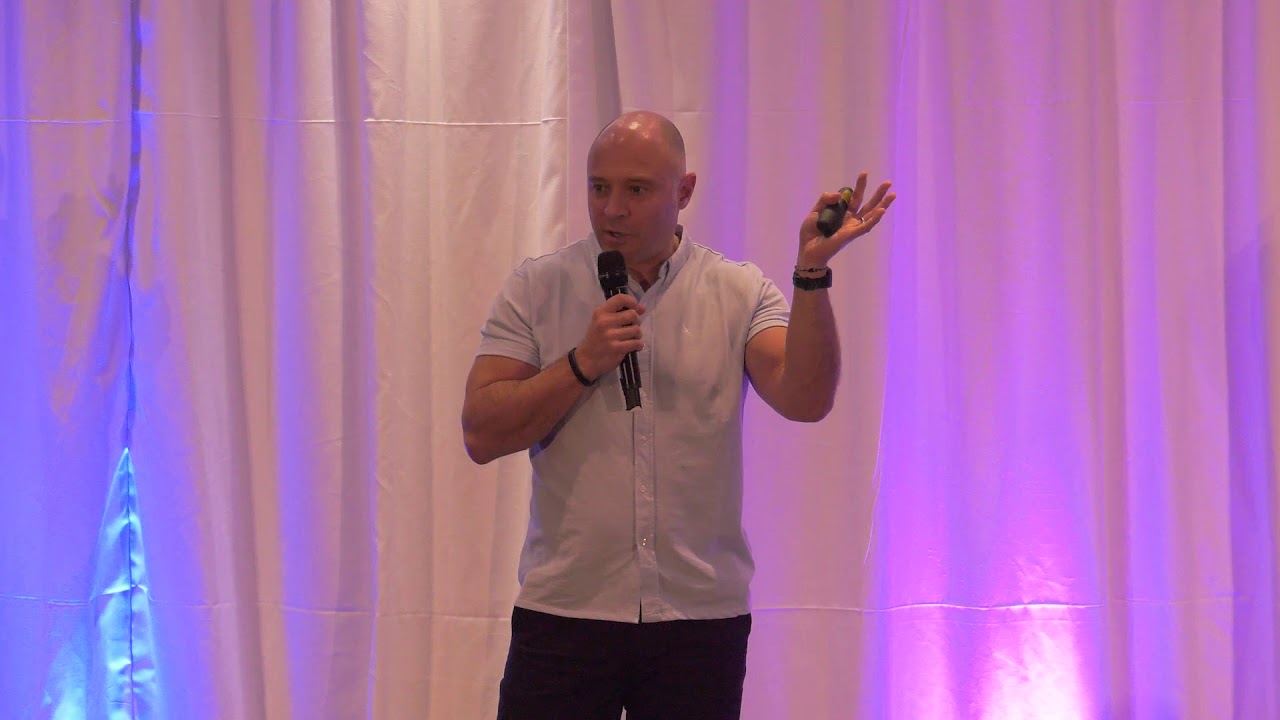
John Kenny presents his relationship coaching framework, arguing that how you relate to yourself shapes all your other relationships. He uses the "Bicycle Effect" model to show how childhood experiences create thought patterns that drive reactions and consequences, and demonstrates how unprocessed pain and negative beliefs keep people stuck in self-sabotage.
Chapters
This was supposed to play when I came on, so it's a little bit out of sync. You can stop it now. Thank you very much. Hello everybody. Thank you, Des, for the introduction. I hope I get that round of applause by the time I've finished as well. That music, how many of you recognize it? Yeah, and how many of you never heard it before? And how many of you weren't paying attention, didn't hear it at all? If you don't know it, that's the theme from the Rocky tunes, Rocky movies, and it's from the first couple of films when Rocky's doing his training, getting all motivated. And that means something to me because when I watched the films, I used to get quite excited at the bit where he was running down the street and all the kids were chasing him. And now I use that sometimes to motivate myself. Some of you might think, oh God, not that piece of music again, I've heard it so many times. And some of you don't even remember that it was being played. And that's all because of the meaning that you give to certain things. So I give that a positive meaning. Some of you might think of it as a negative thing, and some of you don't care. Because you don't give it any meaning at all. And the reason that you don't give it any meaning is because you don't think about it in a certain way. So I think about it in a positive way because of my memories of the film. And the way that I think about it determines how I feel because we are all Feeling beings that think. We don't get an emotion unless we have a thought first. And if that thought gives meaning to something, then we will have an emotion based on it. Now I'd like you to, if you can, Just picture a 4 or 5-year-old child. There is music playing from the radio in the background in the living room where he's sitting at the table and he's doing a little drawing. And there's a smell coming from the kitchen, someone's cooking lunch. Mummy, mummy, I've done this drawing for you. The one that you asked me to do, the one of me and you. John, I'm cooking dinner, just go over there, will you? Just put it down and I'll look later. But Mummy, you asked me to do it. Look, I'm really, really busy, put it down and I'll look later. But you wanted me to do it. Look, go away, go and play with your brother or something. But I don't want to play with him because he hits me because he needs to win all the time. Well, just let him win then. You know what he's like. Go and play with him, go on. Your dad's going to be home soon and you know what he's like and I need to get this finished. And then the mood changes as my dad walks in and I think to myself, I think I'll just go to my room and play. That's where it's safe. Move on 5 or 6 years, my mum's left home and I'm on holiday with my dad and my stepmother and my dad's got his video camera out and he's looking Across the vista, recording on his video camera. And up comes this little boy trying to get in the shot, messing about, smiling and dancing. John, get out of the way, stop sodding about. I'm trying to take some video here. But Dad, I want to be on the video. John, get out of the bloody way. I'm not telling you again. You're so bloody stupid. Go on, move. How many of you here are in a relationship? Please raise your hands. Okay, and like everybody that hasn't got their hand in the air to put their hands in the air. Everybody, hands up. Because we are all in a relationship 24/7, 365, and that's relationship that you have with yourself. And just imagine what my relationship became like with myself based on the experiences briefly that I've just explained there. The relationship you have with yourself is the most important relationship you're ever gonna have because it dictates everything that you do. Everything that you think creates all of your emotions and your emotions, as I said earlier on, will then decide the meaning that you have given to something and then what you do with it. And interpersonal relationship coaching is all about being able to understand that relationship. I have a background as a counselor. I was a counselor for 12 years and about 6 years ago I trained as a coach. And over the last few years working with thousands of people and also working on myself, I realized that if I could improve the relationship that I had with myself, And these people could improve the relationships they had with themselves, then you could overcome your blocks to success and live the life that you wanted to live. Now, the basic concept behind interpersonal relationship coaching also includes 3 Ps, which you might have just seen from the last presentation, and one of the words is the same. But I'm going to start with the front wheel of the bicycle. The bicycle effect I came up with because I tried to put together something to explain what interpersonal relationship coaching was all about and it ended up looking like a bicycle. So the front wheel is the TERCC cycle. T stands for thoughts, E is your emotions, R is your reactions, and C are the consequences. And as I said, everything starts with a thought. And it's called cycle because it goes round and round and round. So you have a thought that creates your emotion, your emotion will then create a reaction, and then your reaction creates your consequences. Please feel free to take any pictures and write some stuff down. There's also a video on my YouTube channel and a free ebook on my website which explains the bicycle effect in a bit more detail. So I'm gonna give you a brief example of how the Turk Cycle works. Now, we probably all, maybe if we haven't had it ourselves, we've all heard of road rage. Now, I used to be a massive road rager because when someone would cut me up or if I let them out and they never said thank you, the message I would send to myself was— You're a dick. They're disrespecting me. And that came from my childhood where I felt very disrespected. So if someone would not say thank you or they would cut me up and they didn't apologize, I would then give them a bit of a flash-up or call them some expletive names. And depending on then what they did, if they then said, oh, sorry, mate, it's all okay, then I'd be okay because then I thought, okay, well then you're telling me that it's all okay. But then if they were to throw expletives in my direction or sometimes slam their brakes on or whatever it might be, I would then get very angry. So my thought was, I'm being disrespected. Then I would feel disrespected and then my reaction would be irritated and then angry. And as was said earlier on, anger is never the first emotion that you feel. It always comes from somewhere else. It's a secondary emotion that covers up how you really feel. So my reaction then was angry. My consequences would be that I'd start chasing this person down the road maybe. Sometimes they would want to fight you and then I'd start to crap myself and— oh, I need to drive off. But sometimes, in this one incident that made me change how I was, I had a partner in the car at the time. And this guy cut me up and I thought, I'm not having this. This guy's very disrespectful, didn't say sorry. So I decided to shoot up the inside because I had this sports car at the time and nearly drove into the back of a tipper lorry. And if I hadn't been able to swerve out the way, I'd have killed my passenger. And that's the time I decided I needed to change. So now what do I do if I get cut up? Ooh! It's probably my first response. reaction because I have that feeling of being disrespected, that thought of being disrespected is still in my head, and then I just have to tell myself I need to calm down because I'm misinterpreting my messages. I don't feel disrespected. That person's doing what that person is doing and I just need to be able to let it go. Now the back wheel of the cycle is the 3 Ps, which is the past, your pain, and your perception. So we all have a past, and as has already been mentioned by some other speakers, the past dictates how you see yourself. It dictates how you learn to see things because of the way that you're treated. And the way that you then deal with the pain that you get from those experiences determines your perception. And then how you perceive things will then lead you to have your thoughts. Thoughts. Such as being disrespected, your emotions will then kick off from there and then the consequences will go round and around and around. And our saddle is our wounds. So like a physical wound, we all have emotional wounds. And this is where we sit on our bicycle. And as was so put over Philip— Daniel, sorry— said earlier on about the That we don't process our emotions. We sit on our emotions because the ones that are really painful we don't wanna look at. So we sit on them. But because we sit on them, they don't go anywhere. And they don't get resolved. So therefore they can come up whenever they feel like it. And sometimes you'll know because you're feeling something at a time and you think, well, this isn't relevant to where I am. But you don't know where it comes from. And it's because you haven't looked at where your pain is. And then probably the most important thing that comes out of this are our beliefs. Now, our beliefs are probably the most powerful thing that we're ever going to carry because our beliefs are the only thing that can override our need to survive. Now, I've worked as a therapist for many years, and the people that I've spoken to that have had suicidal ideation Always believe there's no other choice. They believe they need to kill themselves because it's the only way out. And I help them to see there's another choice. But at the time, their belief overrides their need to survive and your brain is made to help you to survive. So if it can overcome that, it can overcome anything. And if we're carrying negative beliefs throughout our life, then they're gonna plague us all the time. And another thing about beliefs is we think they're true. So your brain tells you that if this is true, I need to look for evidence that this is true. So then we create circumstances in order to believe what we don't really wanna believe, but it needs to be made true. So my belief was as I grew up that I was never gonna amount to anything. So every time I got a little bit of success in my life, so I was an international athlete, but I never was able to go I didn't go as far as I possibly could because I didn't allow myself. Every time I got to a certain stage, I would self-sabotage. And that's how your beliefs work. Your beliefs can keep you in this self-sabotaging place because if your negative belief is telling you it needs to be made true, you will experience this because you're creating circumstances to show you that it's true. Or you'll end up in relationships with people that will also tell you that it's true. Yeah. So then we can choose relationships just to prove that these beliefs are real. And then this will direct your life in the way that you don't want it to because you're just gonna keep following these negative patterns all the time. Now I'm gonna do a little exercise with you now. It's only gonna be for a couple of minutes. There are a list of limiting beliefs on the board. If you're anything like I was when I first did this exercise, you'll look at them and go, oh, this is all about me. They're all mine. Some of you are thinking, no, none of them are for me. But what I'd like you to do, if you've got a piece of paper and a pen, is just to pick 3 from that list and I'd like you to write them down. So 3 that resonate with you the most. If you think, well, this is definitely me. I feel this one. I'd like you to write it down. And then once you've got your list of three in your head, I'd like you to repeat that belief to yourself five times. So write your list of three beliefs down and then repeat them to yourself five times. And then next to that belief, I'd like you to write a score out of 10. So 10 being, this is definitely my belief, I definitely feel this, and 1 being, this means nothing to me at all. So I'm gonna give you a couple of minutes to do this. Is everybody clear? Anybody don't know what I'd like them to do? Put your hand in the air. So pick 3 beliefs off the list. Whichever ones you feel resonate with you the most. Yeah? And then I want you to say them in your head 5 times each over in your head and then write down a score of 1 to 10. 1 being this doesn't feel anything and 10 this really feels powerful. Okay? So I'm gonna just give you a couple of minutes to do that now and we're gonna play a piece of music while we do that. Okay. You've had a couple of minutes there and we're gonna be running out of time. So, would anybody like to tell me their score? If you put your hand in the air just so you can share with everybody else. Would anybody like to tell me what their scores were? That man over there, would you stand up for me please? I don't want to know what your beliefs are. All I want to know is the one that you gave the highest score to. Just the one? Yeah, just the one. And what score you gave it? People can't be trusted, 10. You gave that a 10? So he said there, if anyone could hear, people can't be trusted, tense. Thanks for sharing that, man. Give him a nice round of applause for helping out. So some of you would have felt something, some of you would have felt something less than others, but just imagine if you've been saying that to yourself for all of your life. You just said that just now 5 times in your head. Now if you've been repeating that to yourself for the last 30 years, 40 years or so, Imagine how powerful that is. If he felt a 10 now, just saying it 5 times, that's how powerful a belief can be. Now he believes that's true because he gave it a 10, but it's not true, it's a belief. So what we're gonna do now is undo everything I've just done. So what I want you to do is repeat after me. If this moves— If this moves— Okay, it's not gonna move, but anyway. These beliefs are not true, and I no longer believe them. So, after me. These beliefs are not true. These beliefs are not true. And I no longer believe them. And I no longer believe them. These beliefs are not true. These beliefs are not true. And I no longer believe them. And I no longer believe them. These beliefs are not true. And I no longer believe them. And I no longer believe them. And this is all part of the positive psychology. Because these beliefs are not true, they're just beliefs. They're not truths. They're just something that you believe. Now some of you will be sitting there going, I still believe it. And that's because you've been saying it for so long. And beliefs are a concrete part of your brain because you've been saying it for such a long time, you've got neurons that fire off every time you believe it. So even though you just said, I don't, you don't believe that either. But positive psychology will help you to change your beliefs. And we can replace those negative beliefs with positive ones because we need to start saying those instead. But we need to understand what our beliefs are so then we can start saying they're not true anymore. And until we figure out what those beliefs are, we're not gonna know what to do. Now, as some of you may have seen, if I can get this to move. It's not moving down here. I've got a new book out called The People Program, and it's one of the coaching programs that I offer. And the book is— first half is about my life. And a couple of little stories that I told earlier on, some of those are in the book and there's a lot more stories as well. And what that tells you through reading the book is how I developed my sense of self, how I developed a sense of relationship, how I learned to relate to myself which then impacted on all the other relationships I've ever had. And the second half of the book is how you can figure that out for yourself. So it asks you the questions that you need to ask yourself in order to find the answers that you might need to understand who you are, where you come from, what your beliefs are, and how you can change them. The book is available from next Sunday, although I do have some copies with me today. And we're also running a special preorder on Kindle versions For £3.99. All profits from the book are going to a social enterprise company near where I live in Hertford, and they offer low-cost therapy for people that can't afford it. So not only will you be helping yourself by purchasing the book, but you'll be helping everybody else that needs therapy and can't afford it. I'm gonna just tell you briefly about one of the letters in the PEOPLE program, and that is the second P. And this is really important because it will help you to understand when you're going around in circles. It'll help you to understand the way that you've developed of being that you keep repeating. And this is really important because if you can change this, you can change your life. And that's your pattern. So we all do things because we've learned how to do them. And what we're doing with our beliefs and these emotions is we're chasing these all the time to make them be fulfilled. And we create patterns in our life in order to get those feelings fulfilled. So if you can recognize what your pattern is by recognizing how you feel at certain times and then being able to sit with your emotions Which we've already talked a little bit about today because they need to be processed. Because if you don't process your emotions, they sit on your bike on your wounds and then they just come bite you on the bum whenever you don't want them to. And again, you'll recognize this because you'll feel like everything that you're thinking or feeling at certain stages is completely out of context. So if you can understand where these come from, you can accept where they come from and it gives you the ability to move on. I'd like you to just imagine there that the pattern is like an old pair of shoes. That you are putting on these old pair of shoes even though you know they're gonna give you blisters, you know they're gonna cut your feet, you know they're gonna give you painful feet, but you still keep putting them on and you know they're gonna hurt. Well, over here, Here's a nice new pair of shoes. These shoes are really comfortable. These shoes are never gonna hurt your feet and you can wear them as long as you want. And you know you're gonna feel good wearing them. So throw away your old painful shoes. Get yourself a new pair. Get rid of your patterns. Create new patterns. New patterns that are gonna make you feel more positive so you can understand where they come from. Thank you. So the next steps in your new shoes. As I said, the book is out next Sunday, and I am running a launch event on the 2nd of March at the Grange Holborn Hotel in London, where if you've taken anything from today and you've liked what I've said, I'm gonna be talking for 4 or 5 hours. And I'm gonna be going through the book and also lots of other different coaching strategies and tips and things for you to be able to take away on how to overcome the blocks to success in your own life, experience the relationships that you've never had. So that's on the 2nd of March. The tickets are £19, and again, all the profits for this are going to the non-for-profit organization that offers low-cost therapy. If you book a ticket before the 17th of February, you'll also get entered into a draw to get the VIP ticket. Now, the VIP ticket will include a copy of the book and also a 2-course buffet lunch in the hotel restaurant where we can sit and have a chat over lunch and answer any questions you might have about the coaching and the things you might have heard in the morning. Also, along with the People Program, I'm offering a do-it-yourself webinar program. So sometimes people get more from listening to things, so I'm going to be making— it's also coming out in line with the book now. Next week where you can access a webinar, a do-it-yourself webinar where I'm going to talk through the People Program and you can pause it, stop it wherever you want and you can then work through it yourself. There's a do-it-with-me webinar. So that will be a live webinar for you to join me where you can ask questions and I'll talk through that. It's all in 6 parts. So for 6 weeks you just come online, we'll talk together, you can ask me some questions about the People Program. And then I also have my group coaching. So that's up to 5 people and that's all online. And there's 6 sessions for you to talk with other people but also go through the People Program with me. And it's really good to work in groups, I find, because there are people in the same situations as you. They'll ask the questions that you don't ask and it's also really good for a multitude of ideas and people even talk about things that I haven't thought of. So that's a really good thing to take part in. And then there's the one-to-one coaching. So basically that's just working with me on a one-to-one basis. We can work through the PEOPOL program together for 6 sessions, and that also includes the 2 of the coaching, the group coaching and the one-to-one coaching includes a 30-minute consultation where I can find out a bit more about you, which will then help me with the coaching process. The one-to-one coaching is not just based around the PEOPOL program as well. So if you wanted one-to-one coaching but you didn't want to work through the People Program, then we can also work together just on a one-to-one basis to work out what you're going through, and we can tailor that to your personal needs. Thank you very much for listening today. That's me. If you'd like to come and book up for the workshop and think— or if you'd like a copy of the book, it's at the back there where I've been sitting all day. So please do come and say hello, ask me any questions about anything that I've spoken about. Thank you. I'll be more than happy to answer those and to give you some more information about everything that we do. And thank you for listening and enjoy the rest of your afternoon. Let's give a round of applause to John Kenny. It was his first time speaking.
More from John






Signs Someone May NOT Like You - 2 #dating #coach #datingexpert #coaching #relationships



Signs That Someone May NOT Like You - Part One #love #relationships #datingadvice #Top10 #coaching
