A Q&A with 7 regenerative agriculture thought leaders, Part 1 | Regen Rev 2022
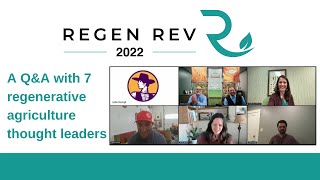
Seven regenerative agriculture leaders answer farmer questions at Regen Rev 2022. They discuss soil microbial capacity, nutrient density, and why observation skills matter most. Sarah Day Levesque, Nicole Masters, Dan Kittredge, and others share what they wish all farmers knew.
Chapters
I just wanted to welcome everybody here. And back to what we're going to wrap up part of our program, or at least the presentation part with a Q and A that's going to be moderated by John Kemp. And John Kempf is the man that needs no introduction, but I'm going to do it anyways. So I'll give you a quick introduction of John Kemp and then I will pass things over to him. So John Kemp is a leading crop health consultant and designer of innovative soil and plant management systems. He is founder of Advancing Eco Agriculture, as well as the founder of Pine Harvest, the agriculture social network. John is the host of the Regenerative Agriculture podcast where he interviews top scientists and growers about the science and principles of implementing regenerative agriculture on a large scale. And he is also the author of the book Quality Agriculture. Needless to say, John keeps very, very busy. Please welcome John and the rest of today's speakers for a Q and A.
Thank you, Sarah. Thanks, everyone. Yeah, I think, I think you that's the first time anyone has ever introduced me as keeping busy. But you know, I have so much fun at what I do that it doesn't really seem that way most days, but then some days, yeah, it does. All right, well, I want to say thank you to all of you. The, the presentation so far over the course of the day have been an absolute delight. The energy has been very fast paced and intensive. We've had lots of really great questions from our audience. So thank you to our audience for everything that you've brought. And there is there are still lots of really great questions left over from the presentations that will go through and get some of those as well if we're able to. And I'm sure more questions will be coming through here. So for our audience, you're welcome to ask any questions that we definitely you didn't get to in the Q and A or in the chat and we'll get to as many of them as we can. To kick things off, I want to ask a question. I'm going to ask this question of the group. Each of you can, I'd love to take for each of you to take just a couple of minutes to answer this question. What is it that you wish all farmers knew? As farmers begin making this transition or begin considering regenerative agriculture practices and they come from a background where they have not had this level of experience or exposure to regenerative agriculture, what is it that you wish all farmers knew to help them on their journey? And so Dennis and Steve I'm going to go to you first.
Oh, that's a great question, John. And I guess my answer as we head down this path is I will say it's okay to be judged by your neighbors. And the way I'll answer that is a lot of times in agriculture we do things that may not be good regenerative principles, because how we are judged by weeds, how we're judged by tillage, how we're all those things that disrupt the regenerative process. You know, there's a. You know, the good old boy group of farmers are all get together and they talk about you.
The coffee club.
Yeah. You know, so I would. I guess I would say that. And the highest yield at the coffee shop is not always the most profitable farmer. So I guess those would be the.
Things that I would say it's okay to be judged. All right, thank you, Dennis. I didn't see Steve participate in that response. So specifically excluding him this time.
Do you buy duck oil so it'll just roll off your back?
Yeah.
It's hard to find that at the store, though. If everyone could come in with observation and evaluation skills, I think that it would be a significantly difference matter. I think that the approach would be different, and I think that people would have probably an easier time. There's so many times where we'll go to a farm, we'll go to a fields and people that are used to conventional, especially with Dennis, I mean, people look at Dennis like he's weird to begin with, but when the first thing he does is goes out, pulls out his Leatherman, chops up some soil and starts sniffing stuff. If people aren't used to that, it's weird. But the reality is our senses are unbelievably incredible. I mean, our nose can differentiate millions of different smells. We have this ability to pick up on these, and as you train yourself, you can start incorporating those. So starting off with the observation, like Stephen said, taking that data, if you take too much and you can't digest it, it basically becomes useless. So observe. Know what you're observing. I mean, see, what you see, I guess, is stealing somebody else who's much smarter than me's quote, and then taking that data in and being able to evaluate it so you can actually do something with it.
As Shorty Fenske says in the comments, the nose knows. Stephen, you're next on my screen, so I'm going to go to you next. What do you think all farmers who are on this pathway should know? What do you wish they would all know?
I Guess I more wish it would be a change in the practice and to stop waiting for other people to tell you what to do. I think people need to, I guess, take the bull by the horns, learn these things yourself. They are difficult to learn. It's difficult to learn new things. But, you know, they say knowledge is power. So the more, the more that you learn, the better you can do so. Again, digestible information. But if someone else is smarter than you, especially the people that I see on this screen around me, you guys are all smarter than me in very specific ways. And I know that if I have a question about one of those things, I know who I'm asking, because I don't know and I want to know. And if that's something that's going to bring value to me, then I need to know. So I wish farmers would, at least, I guess, in that sense, I wish they would know that they need to be asking these questions themselves a lot of times and then finding out the answers and not relying on someone else to tell them when or how to do something.
Steven, you make a great point. You had a slide on your slide deck that you didn't get the chance to really expand on, which was write your own book.
Yes, I could have spent a lot.
Of time on that.
Could you elaborate on that just a bit? Steven, I know you and I have had this conversation.
Yeah, for sure. Everybody has different ways they like to do things, and there's no one perfect way. And if you're always trying to copy somebody else, you're always going to end up failing at something. So finding what works best for you is going to be dependent on, you know, the things that you grow, your management style, the people you have around you, the products you have available to you. What style of farming, conventional or organic. So basically, you need to figure out for yourself what the goals are and then find. Find the ends, find the means to that end. And you can do that. It's difficult and it takes a long time, but by taking those things yourself and saying, I'm going to try this, I'm going to go this direction. When you start seeing results like I've talked about before, it's going to give you confidence. And confidence comes from expected results happening. So trying some things on a small scale is going to give you more confidence to try more things, and that's just going to build on itself.
And eventually you start doing things that are so radically different from what is perceived to be normal that you don't even fit into normal anymore. And then you start producing 160 bins and apple of apples per acre instead of 50. Thank you, Stephen.
Good place to be.
Now we have to redefine the goalposts because we don't know where they fit anymore.
That's right.
Nicole, I'm going to go over to you. What is something you wish all farmers knew?
Thank you, John. And these questions are always hard because you've got to say one thing. And I think Stephen and Dennis and Steve, I totally agree with what you're where you're coming from. And I think one of my take homes is just how you're not alone. And it feeds in a little bit to what you were saying too, John, is we find circles of friends might change, but that sense of like being totally isolated is there's a huge community out here. So getting in communication with whatever that looks like, if that is events like this or WhatsApp groups or phone groups or there is always people that are wanting to share information on the ground and often willing to come and see your place or go and see others. But stepping out of that sense of isolation I think is huge. And then that even deepens down to the fact that you're not isolated in terms of your microbial life. And you know, you walk out the fields and they all know that you're out there, that there's so much life and diversity around us. And probably my first action is to always dig a hole and then really looking at, you know, digging a hole in your field and then dig a hole under a fence line or an area that's not disturbed and just kind of really get the impact of this as a consequence of decades of management has now created this. What would it be like if we actually had a soil that was really functional? So getting the shovel and yeah, getting in communication.
You know, Nicole, I think speaking to an audience of farmers is probably the only audience where you could say that the first thing you need to do is dig a hole. Otherwise that sounds really bad. Thanks, Nicole. Dan Kittredge, I'm going to come over to you. What is something that you wish all farmers knew?
That life is the central piece of the puzzle, that it's only when life flourishes that anything else happens. And so it's about creating the environment for that. It's not about fertilizer or tillager, any.
Of the other things.
It's just about what does it take to create a reality that life can flourish. I think if we can, it's not that far from most farmers. It's a natural story. But to tell that story properly, to help them understand the implications of the steps. It's a really short connection to profound.
Change.
I think, Dan, to build on what you just described. Yes, there is a short connection, but there is also an internal conflict. There's an internal dissonance where often we believe in being good stewards and we believe in supporting life on one hand and yet we find feel that we are required to use pesticides on the other. And so the shift is not that significant, but it's across on it, it's across a cliff. And so there's some interesting internal work that has to occur there sometimes, but.
In proper scale it still facilitate that life. You don't have to be culture in anything. Right?
Yeah. Sarah, I really enjoyed your presentation about the changing landscape in agriculture and investment opportunities. And so I'd love to ask you a similar question, but with a slightly different twist is given. Given your high level overview of the landscape, the business landscape in region of agriculture, where do you see untapped opportunities for farmers? What is it that many people are missing.
From the farming perspective? So there's a couple things. First, I would like to answer your last question echoing just what they said because working at acres, this is what I hear from farmers all the time. If I invite them to speak or I ask for their. But I'm just a farmer, nobody wants to hear from me. And I just want to correct that because it's not true. And we've all talked about communication in your answers and I think the farmer story really needs to be told. And so I think continuing to have confidence that your story is valuable no matter where you are in your journey is really important. So that's the acre side of me speaking right there. The RFSI story. The RFSI side of what? What was the question again? It was untapped opportunities.
Where are the untapped opportunities that many folks are not seeing or missing or unaware of?
Okay, so where are the farmers? So I guess there's two things I think of and one relates to what I just said, which is operationally, I think farmers, I hear they're not the people, they're not marketers, they can't talk about themselves. And so therefore they're missing out on connections they might be making within this sector. So I look at it from a much bigger scale, not just connecting with farmers, but connecting with the supply chain and connecting with consumers and investors. And so I think there's a missed opportunity when you, I don't want to say, shy away because farmers are so busy but when we step away from making connections. But I would say on the other side of things with the investors, there's also an untapped opportunity for them to learn from farmers. So I think those are the two things. One, make sure that you're communicating with folks. Two, make sure we got to get the investment community communicating back with farmers. And then the last thing I would say is as we think about how, as farmers think about how we, we reevaluate our practices on the farm, it might also be time to reevaluate where you look for, for your capital resources. So there's untapped opportunities in the sources that you go to for financial support or financial investment. I will say that our community needs to do a better job of communicating that to farmers as well in terms of making sure they know where to go for that.
Thank you, Sarah. And you know, I'd like to build on the, your first answer to the first question of farmers communicating that. Oh, nobody wants to hear from me. And yet when I think about it, when we ask farmers the question, who is it that they want to learn from? They actually want to learn from other farmers. So we want to hear other people's stories. We want to connect with our peers. Stephen, there's a question that has come through that is directed towards you, I think is a very important question in the popular regenerative agriculture narrative of the day. One of the main stories that is being told, that was told here today as well is a story of input reduction, the capacity to reduce fertilizers and pesticides. And yet you didn't follow the narrative. So you specifically said that you don't want to, that input reduction is not an objective for you. And so the question is the question that was asked, and I'm paraphrasing it a bit here because I'm just going from memory, but the question that was asked is would that approach still be viable in a lower value crop?
That's a good question. It depends. It depends on a few things. If you're paying for products, is that me?
No, it's not. Okay.
If you're paying for products, then in my head I would say you may as well make sure that they're applied in the best way possible. And so like I went over ensuring good coverage and using the right amounts, I still think the, the priority is going to be taking care of the crop. Obviously there's a balance to it. You know, you can't be putting $1,500 an acre into a wheat crop. That's not going to make you any money. So, so there's limits to everything. But as, as often as you can it, you know, I think of it more in terms of if I can spend $100 to make 101, I'm going to do it. And the same thing is true for $1,000 or a thousand and one that I would make off of it. So the amounts might be less, especially to begin with if you're moving towards regenerative things. But those, those numbers will increase after the first time you spend a thousand to make a thousand and one. The next time it might be a thousand and ten and then it might be eleven hundred and it will slowly increase from there and you'll get a better feel of where you need to be focusing on and what things will maximize those net dollars better. So I know that's kind of a difficult thing because you could say, well, are you going to spend a million to make a million in one? Well, no, there's a whole lot of effort involved in that. So you have to make your time worth something too. So everything is relative. So that's a little bit difficult. But I still think that for my operation and for orchard in general, I do think that cost savings should be a secondary priority to fruit quality being number one.
Thank you, Stephen. Yeah, I'm not going to expand on that response. Given our timing sensitivity. There's a question here for Dennis and Steve as well. And the question is really folks, really enjoyed your very dynamic presentation on the value, the function, the role of biology. We understand that it is primal and foundational in this regenerative agriculture approach. But we cannot expect to achieve the outcomes that biology is really capable of purely by adding inoculants. We all know that we have to change the system. What have you observed being the most significant, what's the word that I'm looking for? Drag factors, Factors that are holding back the development of microbial populations. Or I think the question that is trying to be asked is what are the practices that would produce the biggest responses that you're having the most difficult time getting growers to actually execute and implement.
So if you go into like the picture of the soil, a chem fallow crusted over, where do you go?
What do you do first?
I'm asking you, I refer to it and I've done a presentation on this, I call it building habitat. We need to have carrying capacity of life within that soil environment and there's a lot of different ways and it's not going to be exactly the same for every Grower of where do we need to start in order to start building a structure within that soil environment that can support life? And I find that to me, being in agriculture, the biggest drag when it comes to a robust microbial community within that soil environment. You know, I sometimes refer to it, I'm a fly fisherman. And so I give the example of a river in water in Colorado that basically had no fish in it. They throw fish in it inoculums, and then those fish would die. They throw more fish in and those fish would die because that river did not have the ability to support fish. I mean, we built structures, they took out the chemical contaminations, they started getting food sources in there. Suddenly it's a gold medal water. You can go there, fly fish. It's absolutely beautiful. The whole. This holds true to our soil environment also. So what things as a grower can we implement to start building that carrying capacity or that habit to support life? And you know, I mean, we talk about no till, we talk about tillage, we talk about fungicides and herbicides and the use of these, we talk about nutrition. And you know, we gave the example of getting plants out there photosynthesizing to feed that biological community within that soil environment is going to be the best success for building a robust population within that soil environment and then understanding what we can or can't do in order to destroy what we've just built. It's pretty easy to take two steps forward and five steps back in one thing that we can do sometimes in agriculture if we don't pay attention.
Thank you, Dennis. Yeah, that's good enough for now. I'm conscious that we're running up against the clock very quickly and I have questions for a few more folks here. Dan, you've been really good at giving concise answers tonight. Perhaps a little bit too good even. So I'm going to ask you a big question. And the question is, if your dream, when your dream is realized and you have a sensor and a meter that can do the things that you aspire to, the things that you describe in measuring nutrient density, what does the future look like? What does that future reality, when folks have the capacity to measure nutrient density on a common basis look like, how do you imagine that different from what it is today?
Well done, John.
Good question.
At the moment, when it's in a smartphone, in your every iPhone, in every Samsung, in every pixel, or three years from now, I think systemically what we're driving towards is occupation of the land. We understand that the deeper the connection to the community to the landscape, the better the quality. There's a lot that current supply chains can do to dramatically improve, but deeply I think it's about reconnecting. How's that for a short answer? I can keep going, of course.
Yeah, I think. Can you expand on that for us for just a little bit? Specifically in the, in food and agriculture general supply chains, when you talk, you mentioned repopulating the landscape and that's from my perspective, a very futuristic perspective. But what are the interim steps until. How do we. What's the pathway to having nutrient dense food be the majority of the food supply chain?
Well, the growers that are producing higher quality are affirmed for it and offered premiums. It's, you know, it's imminent. Basically. We've identified variation across dozens of crops. We've connected that to management. We're defining the true density across the board. In short order, people have been able to say, this wheat is in the 80th percentile of the 20 percentile. This beef is in the 70th percentile of the 30th percentile. It's imminent that those who are producing more well will be provided some capacity for a premium. Not that they should need to accept it because their cost of production is lower because their gross net profit per acre is going to be fine. But either way, let it be that until it spreads more broadly. But I think the way we drive the regenerative proposition is through the quality of the food. I think the more powerful economic vector than tons of carbon per acre, 30 bucks per acre for carbon, whatever it is, for ecosystem services, 200 net per acre on nutrient density, on premium, that's going to drive this thing much more powerful than anything else.
So. All right, Nicole, I'm going to move over to you. The question that I have for you, you have, of all of us here on this panel, you have traveled most widely, all around the globe. You've had the opportunity to interact with lots of acres of region of agriculture. What has been the experience that really stands out in your memory as a, wow, extraordinary moment of realizing the potential that regenerative agriculture really has?
Oh, gosh, there's so many. But I think it is the value of traveling for all of us, which is harder these days, is everywhere you go, people think that they have the most challenging environment. I promise you, everyone thinks their challenges are unique and super challenging. So to go to Western Australia is always very eye opening. They're a tough bunch out there. But for me, I think it's driving into Martin Roy's Place Jillamutong in New South Wales and he has a river running out of the bottom of his property. In the middle of that 10 year drought, the local district was buying water often because the town had run out of water. We drove around, there were 12 different mushrooms that we identified and the life and the grass and to see skipping cows after. I've been driving down a road where there were dead kangaroos everywhere because there's no food and they were trying to cross roads and I mean it was just wholesale devastation. It was before the fires I think. Unfortunately all the kangaroos ended up moving to Martin Royd's place. But the sense of life, of grass, of moisture and he did this thing where he said, feel my grass. We were like, oh, your grass is so soft. And then we jumped the fence to feel the neighbor's grass. And because we were used to kind of hitting the ground, we put our hands down hard on the neighbor across, just across a fence and the neighbor's ground was covered in this. And it was literally like the land was saying get off, just get off. I feel like a lot of what we're hearing at the moment is lands actually saying to people, get off or change, you know, shift what you're doing or go away. And yeah, so Martin Roy to me was an absolute like, if we can do this in the middle of a 10 year drought and bring water back and have rivers that start on our properties, what's possible for the planet? And what was really amazing is government. The Minister for agriculture ended up visiting him and They've now invested $400 million into a catchment program with Mulloon Creek to restore an entire catchment after seeing the inspiration that he provided. So it comes back to, you might feel like you're one single person, but the impact that you can have is just huge. So yeah, thank you to Martin.
Thanks Nicole. And just so you know, I'm going to steal that phrase from you. Sometime in the future there's going to be a blog post that is will be titled Watershed or Water Cat. Because I heard what you said today clearly.
Yeah, bring it on.
Yeah. Thank you, Sarah. I recognize that we're up against the clock. You have done such a wonderful job today of keeping everyone on track and right on the minute. I want to say thank you for all that you have done. Do you have any closing thoughts for us to wrap up?
I have some instructions for everybody to head somewhere if that's what we're getting at here. I think my first closing thought be echoing what our entire team at the Regenerative group would say, which is thank you again to all of today's speakers, to John for moderating this session, and to our audience who has stuck with us for an awesome day of content. We certainly hope you've learned some great things today. Hold on one sec, I actually have a slide to go with this. We hope you learned some tips for your journey today and are excited to continue to on this journey with you tomorrow. But if you have more questions, please contact the organizers or join them in the Expo booths in just a moment. They are here to help just a little bit about what they're doing. AEA Consultants can help you create your Regen nutrition programs for large farms or give you a sample crop program for small operations combining biological and mineral nutrition products from AEA and Taniel with regenerative practices. You can contact Tanio Biologicals for more information about getting started with biological inputs, which we've heard a lot of good things about today. And then you can sign up for the Kind Harvest newsletter, the all in one resource and community for Regenerative agriculture. Connect with your peers and take courses and read exclusive content. And finally, you can sign up with all the newsletters of the folks and get notified of the recordings and when they are available. You can follow Regen Rev on YouTube, Facebook, LinkedIn and Twitter. How is that for a whole bunch of calls to action for you guys? We're going to keep you busy.
More from John

Episode 186: The Power of Precision Management and Multi-Species Covers with Mike Thompson





Podcast Extra: John Kempf on Soil Biophysics, Plant Immunity & Foliars on the Permaculture...


