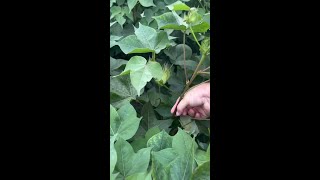
John Kempf and AEA agronomist Jeff Kluipas visit coastal Texas cotton treated with Accelerate at 1 gallon per acre. The early-planted crop shows good row closure and fruit load despite minor nutrient deficiencies, with coastal moisture and chloride profiles creating different growing conditions than West Texas.
Chapters
Hey folks, Jeff Kluipas here with AEA here in the Coastal Bend region of Texas, south of Houston. On a beautiful day with a little bit of rain threatening. Looking at some cotton that has been treated with Accelerate just past Pinhead Square in this situation. Other fields I'm looking at were applied at Pinhead Square. So going to be interesting. See any of our differences.
Here's that cotton that's treated with accelerate 1 gallon rate and really getting some.
Nice row closure at this growth stage. This is earlier planted than some of the other cotton that I looked at.
But really starting to get. There's a little bit of nutrient deficiency in here that we would probably like.
To address, but this particular grower isn't in our full program.
So we're just looking at what that.
One particular application of accelerate is doing.
But you know, this cotton still, still loading up nicely. I mean you can see this top crop definitely putting on some nice load and also not, not a terrible internode length here.
So knowing when you look at West.
Texas cotton, might like to see a little more compact. But you know, this coastal cotton with more moisture and, and just different nutrient profile with the chlorides and whatnot, it makes it a little bit of a different challenge. But we are seeing some really nice.
Fruit load in here.
Growers excited to see how this turns.
Out, what the difference is going to.
Be versus the untreated. And hopefully we get to harvest it and don't have a hurricane come in. But as you can see, clouds are definitely on the horizon and we're going to keep on moving so we don't get rained out.