Effect of Post Harvest Applications Of Foliar Nutrients on Tree Fruit
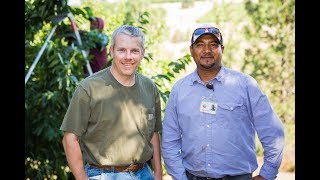
Conversation (interview) between John Kempf and cherry grower Mike Omeg about the importance and practice of post-harvest foliar and fertigated nutrient applications. They argue that plants actively sense and respond to environment and that the critical window to influence next season’s crop is the post-harvest period (harvest until leaf drop), roughly three months. Mike describes farm experience: switching from limited urea-only post-harvest sprays to an intensive AEA-guided program (SAP leaf analysis guiding biweekly/weekly sampling), reporting larger spur leaves, increased fruit size and yields on some varieties, reduced powdery mildew and bacterial canker incidents (anecdotal), improved shoot growth through harvest, greater root exudation and soil biology benefits, and resilience to a severe freeze (Nov 2014) on AEA-treated blocks. They discuss timings (post-harvest sampling Aug–Oct; foliar every 2–3 weeks; fertigation every ~2 weeks) and that many nutrients are drawn into buds post-harvest (requiring replenishment).
Questions this video answers
August 4, 2017.
John Kempf and Mike Omeg.
Chapters
Mike, thank you for joining us for this conversation on post harvest applications. It's a pleasure to work with you and especially great to sometimes just get to sit and talk about the things that we do and how they work. I'd like to talk about the post harvest application starting maybe with just looking at how we actually look at plants in general. And the industry as a whole often has come to a place where we often see plants as more of machines than as beings with sense like animals or maybe even humans. You know, they're supposed to just do their thing and we give them prompts and they do that. But really plants are continually communicating with the environment about them. They're getting, you know, they get signals on how much moisture there is, on how much fruit load they have on the heat. Many different things that are continuously being communicated and the plant is making choices based upon the environmental conditions. Some examples of that might be biennial bearing, June drop abortion. Like blueberries will send a lot of fruit and then they'll abort apples. You have biennial bearing. There's just a lot of different things that indicate that plants are actually kind of have, have common sense, if you will. So when we, when we look at it from a holistic regenerative agriculture perspective, we realize that we have as much or more influence these plants after the crop has been harvested. Yet a lot of focus is put on the crop during the fruit production period. So we start in spring with blossoming and then fruit sizing and harvest and then what's after that. It's just kind of we forget about the plant until next spring when it's time for blossoming again and then we pour on the nutrients. We want to get the best flowers we can, but what's really happening during the period between harvest and next season and that's where I think we really need to focus because the crop year from what we've experienced and Mike, I'd like to hear your comments on this starts as soon as the cherries are harvested and even in some cases a bit before that. Mike, do you want to comment on what you have seen on your farm as to that starting and when you start looking at your next year's crop?
We have been, we've always used some post harvest applications on our farm. Prior to us working with aea, we had always used a limited post harvest program. A couple of fall urea applications would increase the winter hardiness of buds and increase fruit size the next year. And so we have always followed a very simple post harvest program prior to working with aea. But after starting to work with aea, what I learned as a grower is that we have a substantial period of the year after harvest until leaf drop to pump up the buds the that are going to be growing next year's cherries. As I started to learn about this process myself, what I liken post harvest nutrient program that we follow now, which is quite extensive, I liken it to making sure that the buds that we're sending off into winter have their bags packed with everything that they're going to need the coming spring to grow big leaves and healthy blossoms. We don't have any opportunity to treat those buds in the springtime, often before bloom because of weather conditions and being able to get on our ground because of soil moisture and things. And after harvest, until leaf drop, we have about three months of time to pack those buds bags that they can take into next year's crop. So I view this as a very important time of the season to have a substantial influence upon next season's crop. When we started this process of post harvest applications on our farm with just urea, we did see an effect. We could see greener leaves when we did that in the spring. And in fact you could drive across a hillside and look across and you could actually see the blocks that we treated with urea had greener leaves and more of them just after blossom stage. And so we were very open to the idea of increasing our post harvest nutrient program. Once we began working with AEA to be more complex and more comprehensive than just urea, we really have substantially increased the size of our spur leaves in the spring, in my opinion. It's difficult to do a statistical analysis of yield of course, but in my opinion our fruit are much larger and we have more of them. And I think that the post harvest program is integral to that. If you think about that three months after harvest, many of us before or including me before I began to really understand that window of opportunity to impact the crop. If you think about that three months, we have three months after harvest roughly until leaf drop to apply post harvest nutrients. But in the spring, we really only have about the same amount of time to get nutrients onto our crop before those cherries are ready to pick. If we don't follow a post harvest nutrient program, we're cutting our window of opportunity to build that next season's crop in half. Cherries come fast and furious and it's not much time between bud swell to bloom and then bloom to harvest in many cases. When you think about it, wouldn't it be nice to have more opportunity to do more things. And that means thinking about this post harvest period that we're talking about today.
I like the way you talked about packing the bags. You know, it's kind of like a bear going into hibernation. A scrawny bear is probably not going to make it out very well the next year. But when you also consider that blooming and fruit set is a huge hormonal shift for the tree, like that tree is becoming pregnant. So there's a lot of hormonal shifts going on that require a lot of micronutrients. And there's no way that you're going to be able to apply adequate levels of micronutrients in that from bud swell to fruit set. You have what, three weeks in cherries. There's just no way that with the leaf surface you have and that period of time. And as you mentioned, then you have all the weather challenges to deal with. You have all the opportunity after the fruit is off, you've got those trees growing, you've got a lot of time to just fill those buds with not only nitrogen, but with all the micronutrients and everything that's critical for that plant to set fruit the next year. And we have seen some evidence, and we believe strongly based on common sense and science, that a lot of the diseases in these perennial crops that blossom in spring and then they set all their fruit start during that time when the fruit is setting during flowering and pollination because of the plant going through such a huge hormonal shift without the nutrients to support that hormonal shift. And so the tree is weakened during that time. And that's when a lot of these diseases, talking apples like apple, scab and a lot of those things, fire blights another one that starts at that time and may not manifest itself until later. But that's when the inoculation actually happens. And the tree is not able to fend it off because lack of micronutrients at that time. Have you seen anything of that on your farm?
Well, I think what you mentioned about the tight time frame in the spring is really important. The way I think about that here on our farm is if you look at the dramatic change over a three or four day period or five day period in the cherries that we have in the spring, they go from having very small leaves to in just four or five days, having a fully expanded spur leaf. That nutrition is not coming from. It's not coming from always the roots. That nutrition that generates that leaf is actually all stored in the buds. Primarily in the buds. Research that was done in Canada showed that there's actually very little SAP flow from the roots of the trees into the upper part of the canopy until after bloom. All those initial flowers and those initial leaves that are occurring are building just off of reserves that are in the tree already. That's exemplified by the fact that you can go and you can cut a cherry branch at bud, swell and bring it inside, put it in water and that branch will actually fully bloom. It will go into full bloom. It doesn't last much longer after that. But that just shows you the amount of nutrition that's stored in those buds themselves. That nutrition is put in those buds post harvest in the previous season. It doesn't just miraculously appear in the spring because there's very little connection between the roots and the buds in the spring to do that, to put those nutrients there. They're all stored away in the wood and of the spurs and in the buds themselves. And so if something is happening so fast, the way I look at it is I'm not able to put on enough nutrients fast enough and cover our acreage. Foliar sprays. There's just the laws of physics, the laws of us having not enough time to cover our ground in the spring to keep up with the intense demands that the trees have. The trees go within a period of weeks from having no leaves to having a fully leafed out canopy as far as spur leaves are concerned. And then shoots start to develop later and the canopy fills even further. But there's just an impossibility that we can cover our ground and we can put on enough nutrients often enough to satisfy the trees nutritional needs. The other thing that's really important is the amount of surface area that we have to cover on those leaves and green tissues is very limited in the spring, if we try to jam too much onto there, we could run the risk of injuring those tissues. If we say, well, we can't cover our ground fast enough, so with what we put on, we're going to really jam it on, that could stress the tree too. We could stress it by having too much that we're trying to do with it. To go back to my packing the bags analogy, if you try to pack your bags a half hour before you need to be at the airport, you're going to be just throwing things on there and you're likely going to arrive at your destination without your socks because you haven't had time, you're in a hurry. So I really think that the post harvest time is really critical for us to utilize to properly build the crop that we're going to have the next year. The other thing that is very important to think about is in the spring it's not practical and I would say not possible in our experience to actually do tissue or SAP analysis of the plant tissues to guide what we're going to be applying foliar or fertigated nutrition in the spring. There's not enough leaf surface for us to submit those samples for analysis. And there won't be leaves until later into several weeks into this growing cycle. And so we miss a very important window when we're talking about just a few months of time to influence the crop in the springtime to harvest that couple of weeks is really substantial. Whereas post harvest we have a considerable amount of time to continue to do our SAP analysis of our plant tissues and give those trees exactly what they need to pack into those buds for the next year. By monitoring spur leaves and monitoring shoot leaves through SAP analysis, we're able to ensure that the tree has at the ready all the nutrients that it needs to build that next year's crop storage, so that when we come into spring, we can be certain that the trees went into the dormant season and are coming out of spring with the exact nutrients that they need to optimize blossom development, to optimize leaf development. We don't have that ability in the spring to do those tests. It's not possible because of the phenology of the tree and the timing. So you'd asked about the resistance to disease that we've seen. We have not done a thorough statistical analysis on our farm of disease resistance. We're actually cooperating with Oregon State University and Washington State University with a grant from the Natural Resource Conservation Service. This is the first year of a three year study that we have evaluating the AEA nutrition program with powdery mildew resistance in cherries. And that's a replicated will be a peer reviewed published study. I can give you anecdotal data in that or anecdotal observations I should say, in that we have been able to, through intensive nutrition, reduce our population of mildew that we have in our orchards and drastically reduce. In fact, it's hard to find bacterial canker in our orchards now. And the only thing that we've changed in our management is our nutrition program in our nutrition approach. Whether that's occurring thanks to the post harvest applications or not, I can't comment. But I would comment that post harvest applications are an integral part of our nutrition program here on the farm. And I believe very, very strongly that our nutrition program that we're following is the factor that is reducing drastically our powdery mildew incidents and has virtually eliminated bacterial canker here on our farm.
So we've talked a lot about the benefits of the post harvest application in terms of, in your case, fir leaves and the fruiting spurs and how that will affect the quality of the fruit. As you were talking about that, my thought went to the roots and the soil as carbon. That's huge component of these preannual crops that are also affected by having a healthy growing tree throughout the whole season. That we really think about very little, but I think is very important. Do you have any thoughts or comments on that?
I do have some thoughts related to root development and canopy health post harvest. When I think about on our farm, our approach of applying fall ureas. Our only post harvest nutrition program, we're asking a lot of our trees to only put on foliar fertilizers in the spring and early summer before harvest, not putting on a lot during harvest, and then doing very little or nothing after harvest. If you think about it, that the stress of growing a crop and then having that crop picked really is stressful on the trees. And we can see that in the soil moisture monitoring that we do here. We take neutron probe monitoring weekly for soil moisture levels. You can actually see that harvest is really stressful after harvest. Believe it or not, the trees are so stressed they shut down a bit and they don't use water for a period of time until they begin to recover from that stress of harvest. The other thing is we pick 8 tons of cherries off of an acre of one of our orchards. Cherries are mostly water, we all know that. But the stem has a lot of dry matter and the cherries themselves have about 3% dry matter in them roughly. So if we're taking that amount of dry matter off, we have to think that we're exporting a lot of nutrients off of each acre. The other thing that's really important is the most nutrient dense part of the cherry tree is actually the pit and the seed inside there that has been developed. And so the cherries allocate everything that they've, that they've garnered from the soil and from foliar nutrition sprays. They concentrate the best material that they nutrients that they have available into the pits. And the trees will actually sacrifice their canopy growth, sacrifice root growth in order to take those nutrients that they need for the canopy and root growth and put it and concentrate them into Those pits, and if you think about how many pits are in 8 tons of cherries, it's a substantial pile of pits that we're taking off. If we don't do anything to replace those nutrients back to the tree and to the soil biology that's generating those nutrients for the tree. If we do nothing to help put a bit back into the system until the next spring, then that means that our trees are just having to keep sort of bump along for a good portion, a third of our growing season or maybe more without having those nutrients available to them. So as I think about what are we trying to accomplish with our post harvest nutrient programs, I do think very carefully about the root system, of course, and of the canopy as well. We need to put on our foliar sprays and our fertigation that, that the plant SAP analysis is indicating, because those trees, if they have those nutrients, are going to produce the root exudates in a bountiful amount that will strengthen our soil biology. And if we want to increase our soil biology the best, as John Kemp says, we want to have healthy plants because there's no way that we as humans can put on enough nutrients and enough carbon onto our crop to keep the soil biology healthy versus if we have healthy plants that are going to pump those root exudates out and increase our soil health.
According to Horst Marschner, when a plant is healthy, up to 70% of the root exudates or of the carbohydrates will be exudated out through the roots. If you do the math on that, Mike, I mean, that's 80 ton of cherries, plus all of the biomass of your new shoots and leaves. There's, you know, there's a tremendous amount. If that's only representing even at, you know, a modest number, 50% of the carbohydrates that were produced through photosynthesis, that's a huge amount of carbohydrates being pushed out through the roots.
It certainly is. The other thing that I think about as I consider our post harvest program is I used to be satisfied before I began expanding my knowledge about the importance of a post harvest program on our farm. I used to be satisfied with having my canopy actually stop growing. And we would set our terminal buds on production on productive acres of bearing acres, and that would be okay. And so my goal was to have 24 inches of shoot extension and then stop and just have the trees just stay alive until the next spring. And what I have really learned is that we need to maximize our shoot extension and through the harvest period and after harvest, of course, we don't want very vigorously growing shoots going into winter, but we do want our shoots to continue to grow all the way through harvest and then after harvest. And in our observations here on the farm, it if we're actively growing our shoots after harvest, those blocks that are doing that have much better crops of larger, higher quality fruit the next year. And the cherries, if we put on just spring and early summer pre harvest nutrients onto these trees, they just seem to run out of steam. We can't seem to keep them going enough. But if we have an intensive post harvest program the previous season, we see that the blocks, now we do it on all acres. But before we started doing this on all acres, we saw that blocks where we followed an intensive post harvest SAP analysis monitoring program and then applying the corresponding necessary nutrients to those blocks, we saw that those blocks had no trouble, no difficulty growing shoots actively through harvest and beyond harvest. And we really like that result. It produces a lot more higher quality cherries when you have your canopy growing like that. And the other thing is, especially on dwarfing rootstock trees, where we have a dwarfing rootstock, you oftentimes have trouble with maintaining vigor in canopy vigor. And so those trees, over time, as they age, the amount of fruiting wood in them decreases. And in cherries, if we want to grow an optimal crop, we need to be producing that crop on young wood. And so we need to have a lot of young wood being produced, a lot of new wood being produced each year, so that when our pruning crews go through and prune, they can have the choice of cutting out old wood because there's new wood present in the tree without reducing our yield. If you don't have vigorously growing canopies, then you don't have enough young wood being generated, especially in those dwarfing rootstocks. So we think that the post harvest program has been integral to that. A big benefit to the post harvest program has been that we've been able to generate a lot more canopy, which is important for us to have that constant cycling of new wood in our trees.
You mentioned shoot growth after harvest, and I sense that that used to be a major concern. Maybe you don't want a lot of shoot growth going into winter. So you were very cautious to not have those shoots actively growing. Am I thought on that is there's a big difference in how that shoots growing, whether that's growing on NPK alone or whether that's growing on a, on a balanced nutrient or nutrition package. So you Know as you've done the post harvest application for a number of years now and you've seen that continued shoot growth, have you seen like freeze back or tissue damage, like winter damage? I remember one of our earlier, early conversations on post harvest applications, you were quite earnest about we can't, you know, we can't be growing shoot too long or we'll have, you know, we'll have a lot of winter damage and die back. What have you observed with that?
Well, that was a concern that I had and that's based upon many, many years of stored knowledge in the cherry industry that you don't want to have actively growing shoots going into fall because of the potential for some substantial freeze dieback. And that that knowledge was well founded because nitrogen was our only means of growing shoots traditionally in cherries. And so if you wanted to grow canopy in a traditional sense, you would just put on a lot of nitrogen and you could grow limbs 12ft long and then the last 6, 8 inches would freeze back. And if that last inches is actually what dies, just think of all the other shoot that doesn't die, but it's just weakened. So I was really concerned about invigorating my trees too much to where they were susceptible to winter damage when we started this process. That's something that I've learned over time working with these post harvest treatments is that our shoots are very resilient and we have not seen any winter die back. And we've had some substantial freezes, early fall freezes happen in our area and our trees have done fine. In fact, In November of 2014, we had a historic freeze, once every 50 years sort of freeze happen here in our area where we went from low temperatures in the mid to low 40s to just a few days later here at my house, we were -4 Fahrenheit. So we went from 43 degrees Fahrenheit as our low. We had no frost at all, no freezing temperatures at all for those trees to acclimate till we were at minus four. And there was a substantial impact of that freeze in the orchard area here. Locally in the Dalles, there were many, many dozens of acres of trees that were killed. And that 2015 crop, that next year's crop was really low in many of the area orchards. However, interestingly enough, on our farm we actually picked 110%. So we picked 10% more cherries in 2015 than we did in 2014. So the average orchard in our area had, I'm just going to say, roughly half to three quarters of A crop on our farm, we actually picked more cherries. And what I like in that too, is that our trees going into that freeze had complete nutrition as best as we could accomplish that in those buds that were going into that freeze. And they survived much better, in my opinion, than buds that were being managed under a conventional traditional nutrition program. And I have evidence of that here on our farm, because in 2014, we were actually still doing evaluations of the AEA approach and of post harvest nutrition. And so I had orchards that were side by side where the AEA managed orchard had no freeze damage at all. But the orchard right next to it that I was managing under the traditional program that we followed here on our farm, that orchard completely was wiped out and had to be removed. And the only difference between them, they were the same variety on the same rootstock, planted the same year, same elevations, all those, again, they were side, they were right by each other was the difference in the nutrition program. And so after that 2014 freeze, I don't like having life lessons that are so hard. The orchard industry in our area suffered because of it. But what it taught me is that the resilience of these trees when they have complete nutrition is really, really substantial, far more than what anybody would have imagined, including myself.
We've talked about a lot of the why and the benefits that you've seen. I think it's pretty clear that post harvest applications well worth their money. But what are you actually doing? I mean, you were doing urea, but what has AEA brought to that? I mean, what's been added? And also what are the timings? You know, is there a specific timing that you look at? Is there specific intervals? Is all that. How critical are those things?
For our pre harvest program, we apply a foliar or fertigated nutrient, or oftentimes both about a two week schedule. And so we're passing by the block every two weeks with a foliar spray and we're fertigating about every two weeks or sometimes every week. We base all of these applications upon SAP analysis that we conduct in the growing season. So our spring applications are based upon SAP analysis and they're based upon just normal schedule, normal spray schedule for pest and disease management. Our post harvest applications, we continue to sample leaves that we submit for SAP analysis post harvest. And we do that up until usually in our time period, our harvest is done in the month of July. And then we continue to SAP sample until usually the beginning of October. In the beginning of October, the trees are actually starting, even though the leaves are on those trees and they, they look normal. We actually, the SAP actually starts to begin to be difficult to extract because the trees are actually starting to pull that SAP back into the roots and into the woody tissue of the trees. And they're getting ready for winter. And so we sample post harvest from August until the end of September, the beginning of October, somewhere in that range. And we do a bi weekly sampling on bearing trees and we do a weekly sampling on trees that are in renewal. So baby trees that we're trying to grow or that we're growing for future productive acres, those non bearing acres that are young trees, they get sampled weekly. The productive acres get sampled bi weekly. When I first started to do a post harvest program with the AEA approach, I was doing monthly post harvest treatments. And so I would look at what the 2 SAP analysis for that month indicated, what are our trends on our various nutrients, and I would apply a full year program based upon that. I was not doing fertigation at that time, but starting at the end of last harvest in 2016, I said to myself, I'm seeing some real benefits from this post harvest program, a real return on my investment. I should be doing it more intensively so we can see a further return on our investment. And so what I began doing is we continue to do our bi weekly sampling of our bearing orchards and our weekly sampling and non bearing, but I've shortened that interval up to two or three weeks for foliar applications and every two weeks for a fertigation. So we began doing both foliar and injection starting at the end of harvest last year. And my plan is to continue that this year. I don't have a base to program. We follow what the SAP analysis indicates. But I will say that I saw a couple of surprises that I thought were very interesting when those cherries come off the trees. The trees generally have had a very high need of nitrogen applications at that time. I don't know why, but we see across much of our bearing acreage that we have a nitrogen deficit in our leaves. And I think that's because the trees are packing away in those fruiting and vegetative buds that are dormant. They're packing away those nutrients into those buds. And it's amazing how much micronutrients and nitrogen those trees are packing into those buds. And so the trees are drawing mobile nutrients, which nitrogen is highly mobile. They're drawing them out of the shoot and the shoot leaves and they're packing them into those buds. And so there's a real drawdown in these nutrients. We wouldn't know that if we weren't doing SAP analysis post harvest and we wouldn't be able to satisfy that tree's need if we weren't doing our post harvest applications. Again, we do that bi weekly sampling for SAP analysis and then we do about every two or three weeks of foliar and we do about every two weeks an injection.
So you mentioned that the tree drawing a lot of, you know, it appears like it's packing a lot of nutrients into the bud, which you know, is our assumption, but you have evidence based on the SAP analysis. So has that translated to more flowers, better pollination, any of that, you know, type of thing?
We have seen over the past several harvests. Actually, the past three harvests we've seen a pretty substantial increase in one of our varieties that is difficult to set a crop on and that, that's the Regina cherry variety. We've seen our production go up from an average of less than in some blocks, less than 2 tons per acre to over the last three seasons we've had 8 ton plus an acre in these blocks. Now I don't know if that's all due to post harvest nutrition, but I think that there's something there for us to further explore. We just haven't had an opportunity to do scientific analysis of that. But at the same time, there's another variety, Benton, on our blocks or on our farm that we have not had that same result. But interestingly enough, if we look at the SAP analysis needs of Benton and needs of Regina, they're very different. And when we started with AEA five years ago now, I was really focused on fruiting those Regina because we had a lot of acres in production and we were getting very low yields. And the Regina cherry is a premium cherry. It's very sought after in our export markets, which generally pay more per pound to us as a grower. But the other thing is it's very rain crack resistant and those are two things. If it has a high price and it's rain crack resistant, it's very appealing. The challenge is it always had very low yields and so we made a concerted effort to focus upon that cherry with doing intensive management of paying attention to what's going on. And we've seen results of that here on our farm, Benton. Really we only started monitoring that intensively two years ago and it's frankly been a bit ignored. And I'm wondering if we aren't suffering because of that. Where we haven't had the same result as we have had with, with Regina, doesn't.
It doesn't like being treated like Regina is what you're saying?
No, it does not like being treated with Regina. If we, if we look at the SAP analyses between Regina and Benton, they're very, very different. As we've learned that most all the varieties of our cherries here on our farm have different nutritional needs, which just makes sense because the trees are very different trees. Not every cherry tree has the same need. The other thing that's been very noteworthy through SAP analysis is that the post harvest program that's needed by dwarfing rootstocks like the Kremsk and Gisela rootstocks, we have to oftentimes be far more intense with our post harvest nutrition on those blocks than our non dwarfing mazard seedling rootstock trees. I think that is because those dwarfing rootstock trees, they produce a lot more flowers per bud. That's why we plant them, because they're much more precocious. And I think that that means that those trees are having to allocate a lot more resources to growing that next season's crop, or at least potential crop than the mazard trees.
More from John

Episode 186: The Power of Precision Management and Multi-Species Covers with Mike Thompson





Podcast Extra: John Kempf on Soil Biophysics, Plant Immunity & Foliars on the Permaculture...


